
If you share your home with an axolotl, you already know these gentle amphibians are sensitive to water movement in ways most fish are not. A filter that works beautifully for goldfish or bettas can stress your axolotl within hours — not because it’s dirty, but because the current is simply too strong. Getting the right filtration without turning your pet’s habitat into a washing machine is the single most important equipment decision you will make.
I’m Mo Mahin — the founder and writer behind Furric. I spend my days analyzing pet product safety standards, reviewing veterinary guidelines on aquatic animal care, and studying thousands of real owner experiences to recommend gear that truly protects your pets.
After researching water quality standards and owner feedback, I’m confident this guide will find you the best axolotl filter for your pet’s health.
How To Choose The Best Axolotl Filter
Axolotls are not like other aquarium pets. Their delicate external gills and low-energy lifestyle mean they cannot tolerate strong water currents, sharp intake valves, or turbulent surfaces. Choosing a filter for them requires thinking about three things that matter more than raw power or price.
Flow rate and current control
Axolotls come from still, slow-moving waterways in nature. A filter that pushes more than 150 gallons per hour through a 20-gallon tank will create a current that forces your pet to constantly swim against it, causing stress and physical exhaustion. Look for filters with adjustable flow valves, sponge baffles, or spray bar attachments that let you dial the movement down to a gentle circulation. Sponge filters are naturally ideal because they produce barely any directional current at all.
Filtration type and biological safety
Mechanical filtration removes visible waste, but biological filtration is what keeps ammonia and nitrites at zero — and that is what keeps your axolotl healthy. Sponge filters excel here because their porous surface hosts colonies of beneficial bacteria without exposing your pet to high-velocity water or uncovered impellers. Canister and internal power filters can work, but you must protect the intake with a pre-filter sponge so your axolotl’s gills or limbs never get pulled against the slots.
Physical safety and materials
Axolotls are curious and will explore every surface in their tank. Any filter with sharp edges, hard plastic corners, or exposed suction openings is a risk. Submersible units should sit fully underwater and have no metal components that could leach into the water. ABS plastic and food-grade silicone are the safest materials. Always confirm that the filter is rated for freshwater use and contains no copper or other compounds toxic to amphibians.
Quick Comparison
On smaller screens, swipe sideways to see the full table.
| Model | Type | Best For | Key Feature | Amazon |
|---|---|---|---|---|
| TARARIUM IX-120 | Waterfall Internal | Heavy-duty bio-filtration | 3-stage media with ceramic bio-balls | Amazon |
| DEGGOX YU-228C | Electric Sponge | Small tanks 10-20 gallons | Venturi nozzle with rain mode | Amazon |
| hygger Sponge Filter | Air Sponge | Gentle low-flow setups | Dual sponge plus bio-ceramic balls | Amazon |
| Yaubay RFT0601 | Internal Submersible | Mid-size tanks 10-50 gallons | 360° suction and built-in aeration | Amazon |
| NO.17 HY-1200F | Internal Submersible | Large tanks 50-150 gallons | Adjustable 320 GPH with 4 nozzles | Amazon |
In-Depth Reviews
1. TARARIUM IX-120 Internal Filter

This TARARIUM unit is built for owners who want serious biological filtration without the turbulence most power filters create. It pulls water through a dense double-sided mesh sponge to catch debris, then passes it through ceramic bio-balls that host the beneficial bacteria responsible for breaking down ammonia and nitrites. The waterfall return design naturally aerates the water while keeping surface agitation low — a major advantage for axolotls that prefer still conditions. Rated for tanks from 20 up to 75 gallons, it gives you room to grow without needing a second unit.
The adjustable flow control is what really sets this model apart for axolotl owners. You can turn the pump down to a gentle trickle that barely moves the surface, which keeps your axolotl calm while still processing waste effectively. The lowest operational water level is only 2.6 inches, so it works in shallow setups and breeder tanks without sucking air. The top-lid canister design makes cleaning the media quick — you do not have to unplug or disassemble the whole unit.
For axolotl parents who want the reliability of a three-stage system in a package that respects their pet’s need for quiet water, this is the strongest all-around choice. The build quality feels solid, the media chamber is generously sized, and the warranty offers peace of mind that cheaper filters simply cannot match. If you run a single larger tank or a robust 40-gallon breeder, this filter handles the workload without stressing your animals.
Why we love it
- Three distinct filtration stages catch everything from sludge to microscopic waste
- Flow adjustment lets you create a nearly still environment for sensitive axolotls
- Ceramic bio-balls provide exceptional surface area for biological colonization
- Low water level operation works in shallow breeder and hospital tanks
Good to know
- Larger footprint may dominate the back wall of smaller tanks
- Waterfall return, even on low, needs a baffle for extremely current-sensitive axolotls
2. DEGGOX Electric Sponge Filter
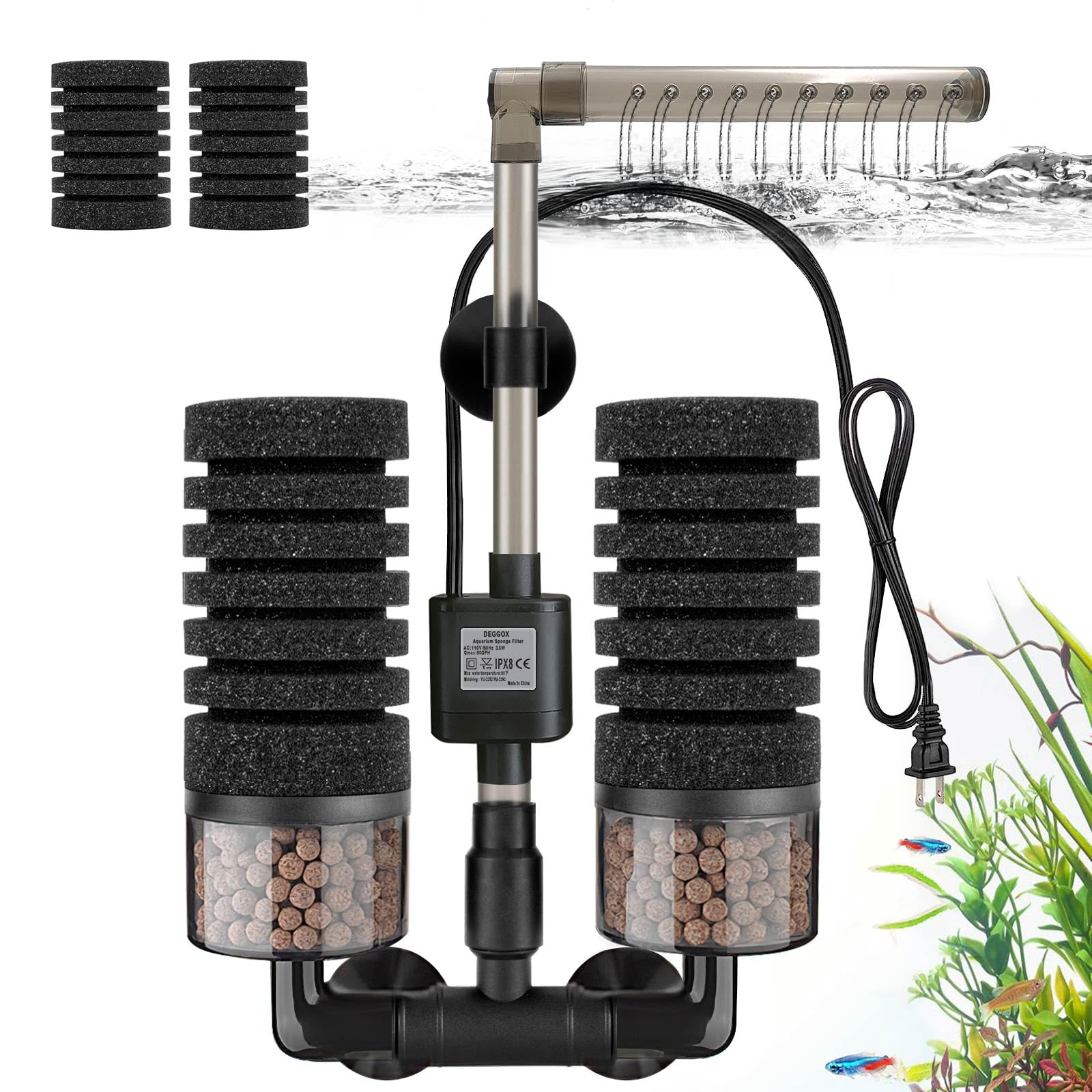
This DEGGOX filter solves a common headache for axolotl owners: you get the safety of a sponge filter without needing a separate air pump cluttering your setup. The internal submersible pump draws water through the fine sponge, trapping particles while the included ceramic bio-media balls handle the biological load. The venturi nozzle attachment creates a softer outflow that is much gentler than traditional power filter returns, and the rain mode distributes water across the surface instead of blasting it in one direction.
Designed specifically for tanks in the 10 to 20 gallon range, this unit is an excellent match for juvenile axolotls or single-adult setups where space is tight. The sponge is detachable for easy rinsing, and the package includes four spare sponges plus a bag of ceramic media, so you are stocked for several months of maintenance cycles. Assembling the filter takes under two minutes, and because it does not rely on an air line, there is zero risk of back-siphoning or noise from a vibrating pump outside the tank.
Owners who prioritize ultra-quiet operation and minimal current will find this filter hard to beat for smaller enclosures. The electric pump is whisper-quiet, and the venturi diffuses flow so thoroughly that your axolotl can rest directly next to the outflow without being pushed. Just be aware that the 10-20 gallon sizing means this is not the filter to stretch into a larger tank — keep it in its recommended range and it performs beautifully.
Why we love it
- All-in-one design eliminates the need for a bulky external air pump
- Venturi and rain mode produce the gentlest water movement in this lineup
- Four replacement sponges included means no immediate repurchase needed
- Dead-silent operation does not disturb sensitive amphibians or sleeping owners
Good to know
- Limited to tanks under 20 gallons despite its premium price tier
- Replacement media bags are proprietary and must match the chamber size
3. hygger Aquarium Sponge Filter

hygger brings the classic air-driven sponge filter formula and refines it with a detachable base chamber packed with bio-ceramic balls. The circular bio-cotton sponge provides mechanical filtration, catching waste and uneaten food before it can decay, while the ceramic media underneath hosts the bacterial colony that processes toxins. Because this is an air-powered design, the current created is limited to the gentle lift of rising bubbles — arguably the safest possible flow pattern for an axolotl’s delicate gills.
This filter comes in three sizes, so you can match it precisely to your tank volume rather than over-powering a small space. The large version handles 55 to 125 gallons, which makes it one of the few gentle-flow options for big axolotl habitats. Each purchase includes a spare sponge, letting you rotate clean media without interrupting your biological cycle. Maintenance is straightforward: squeeze the sponge in tank water every two to four weeks and rinse the ceramic balls if they become clogged.
For owners on a practical budget who still demand excellent biological performance, this hygger delivers everything that matters and nothing that does not. The lack of moving parts means there is almost nothing to break, and the air pump you pair it with can be placed outside the tank for a clean interior look. The only trade-off is that air-driven filters produce less mechanical pull than electric models, so very messy tanks may need a supplemental pre-filter or more frequent water changes.
Why we love it
- Air-powered operation creates the gentlest possible water movement for axolotls
- Three size options let you buy exactly the capacity your tank needs
- Spare sponge included for seamless media rotation during cleaning
- Bio-ceramic chamber adds robust biological filtration beyond basic sponge-only designs
Good to know
- Requires a separate air pump, increasing total system cost
- Mechanical filtration power is lower than electric impeller-driven units
4. Yaubay RFT0601 Internal Filter
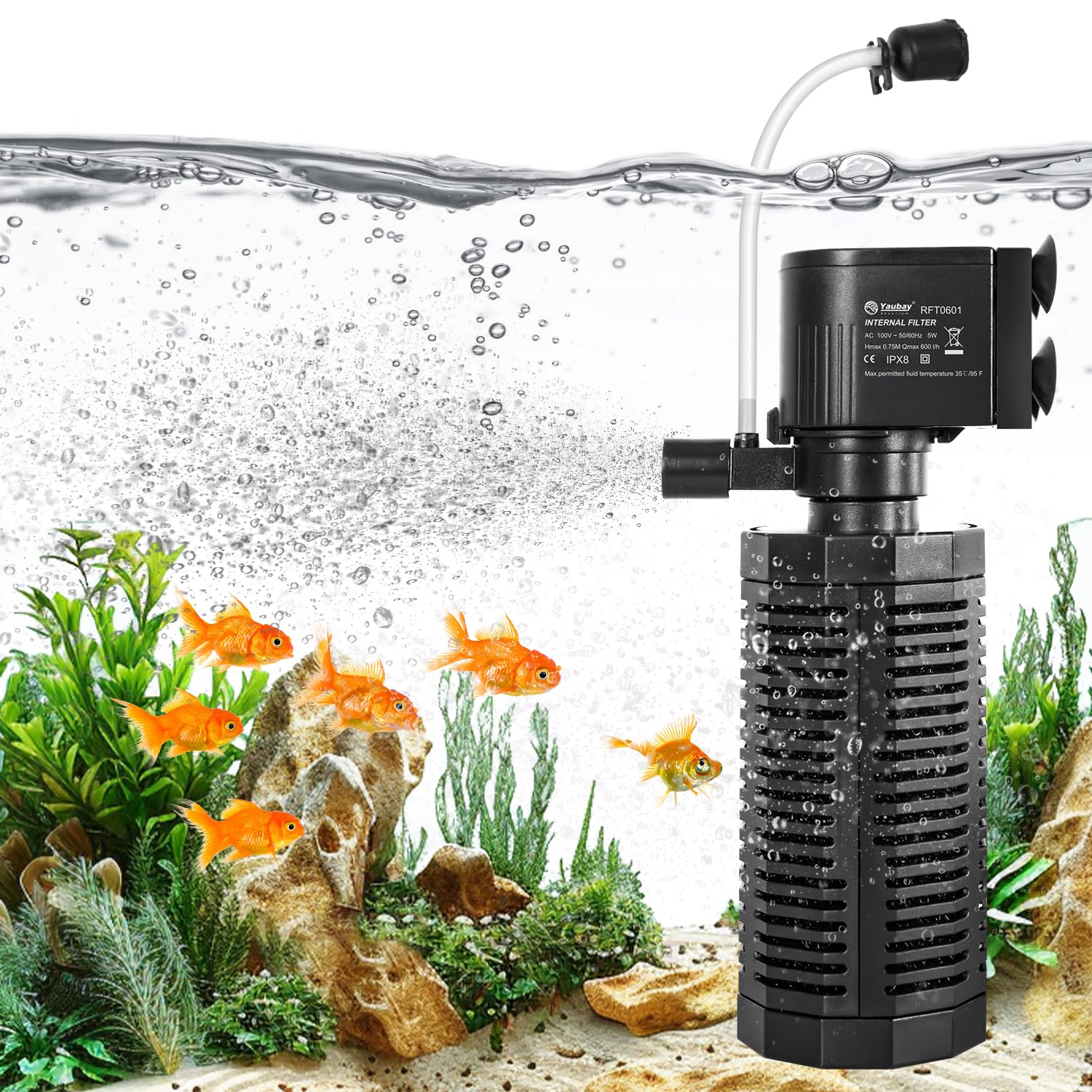
The Yaubay internal filter occupies a useful middle ground for axolotl tanks that need active water turnover but cannot tolerate the turbulence of a full-size canister. Rated for 10 to 50 gallons with a 212 GPH pump, it pulls water through a biochemical sponge while simultaneously drawing in air through an oxygen tube to boost dissolved oxygen levels — a handy feature for axolotls that appreciate well-oxygenated water. The 360-degree intake design means it pulls debris from all around the unit rather than sucking from a single point.
At under 40 decibels, this is one of the quieter submersible filters in its class, so it will not add distracting hum noise to your living space. Installation is simple: two suction cups hold it firmly against the glass in either a horizontal or vertical position, giving you flexibility to fit it around decor or hide it behind plants. The detachable filter box makes cleaning intuitive — just pop it open, rinse the sponge, and snap it back in place without tools.
This Yaubay works best for axolotl owners who want a bit more water circulation than a sponge filter provides but need the ability to tone it down. The flow is not adjustable on this model, so you should pair it with a spray bar or a pre-filter sponge to diffuse the outflow if your axolotl seems bothered by the current. Used thoughtfully, it delivers consistent mechanical and biological filtration at a very accessible entry point.
Why we love it
- Built-in oxygen tube increases dissolved oxygen without an extra airstone
- 360-degree intake prevents waste buildup in corners of the tank
- Near-silent motor at 40 dB keeps the habitat calm and quiet
- Dual mounting orientation offers flexible placement in decorated tanks
Good to know
- No built-in flow adjustment requires external modifications for current-sensitive pets
- Suction cups may lose grip over time and need periodic replacement
5. NO.17 HY-1200F Submersible Filter

The NO.17 HY-1200F is built for the big leagues — it moves 320 gallons per hour and is rated for tanks from 50 up to 150 gallons. That kind of power is overkill for a standard axolotl setup, but for owners with massive custom habitats or multi-pet enclosures, it provides the water turnover needed to keep nitrate levels under control. The pump comes with four different nozzle attachments that let you direct and diffuse the outflow, which is critical for turning this high-flow unit into something an axolotl can live with.
The submersible design means the entire pump sits inside the tank, and you can mount it horizontally or vertically depending on your layout. The multiple filter media chambers accommodate sponges, bio-balls, and carbon pads, so you can customize the filtration to prioritize biological or mechanical needs. For axolotl use, you will want to run the pump at the lowest setting and aim the nozzles toward a wall or decor to break up the current before it reaches your pet’s resting area.
This filter is best reserved for experienced keepers who understand flow management and have the space to baffle the output appropriately. It is not a plug-and-play solution for a standard 20-gallon tank — the current will be too strong. But if you have a 75-gallon or larger axolotl habitat and need serious filtration volume, the NO.17 gives you the raw power and nozzle flexibility to make it work with the right accessories.
Why we love it
- Extremely high flow capacity supports extra-large and heavily stocked tanks
- Four included nozzle configurations allow customized flow direction
- Horizontal or vertical mounting fits unusual tank shapes and sump setups
- Multiple media chambers let you tailor filtration to your specific water chemistry
Good to know
- Out of the box flow is far too strong for axolotls without baffling modifications
- Large footprint takes up significant interior space in the tank
Safety & Care Tips
Monitor water flow around your axolotl
Even a filter rated as gentle can create dead spots or unexpected currents in certain tank layouts. Watch your axolotl’s behavior after installing a new filter — if it clings to the glass, hides constantly, or avoids one side of the tank, the flow may be too strong. Add a pre-filter sponge, a spray bar, or a piece of decor to break the current. Axolotls should be able to rest on the bottom without being pushed or swayed by water movement.
Stick to a regular cleaning schedule
Sponge and media filters need rinsing every two to four weeks, but always use dechlorinated or tank water — never tap water, which kills the beneficial bacteria your filter has worked to establish. Squeeze the sponge gently until the water runs clear, then reassemble. Replace ceramic bio-balls only when they start to crumble, typically every six to twelve months. Keeping a spare sponge on hand lets you rotate media without crashing your biological cycle.
FAQ
What type of filter is safest for axolotls?
How often should I clean my axolotl filter?
Do axolotls need a strong water current?
Final Thoughts: The Verdict
For most axolotl owners, the best axolotl filter winner is the TARARIUM IX-120 because it combines three-stage biological filtration with fully adjustable flow that can be dialed down to a near-still current, all in a package sized for the tanks axolotls typically need. If you want a no-current sponge design that is dead quiet and needs no separate air pump, grab the DEGGOX Electric Sponge Filter. And for the best value on a proven air-driven solution that grows with your tank, nothing beats the hygger Sponge Filter.