
Watching your cat struggle with kidney disease is heartbreaking — the weight loss, the refusal to eat, the constant worry. You want food that supports their health without turning mealtime into a negotiation. The right diet can slow disease progression, improve energy, and give you more precious time together.
I’m Mo Mahin — the founder and writer behind Furric. I’ve spent years analyzing veterinary nutritional standards, poring over clinical research on renal diets, and listening to the real-world struggles of cat parents managing chronic kidney disease at home.
After thorough research and veterinary consultation, we’ve identified the most effective dietary choices for supporting your cat’s renal health with the best kidney food for cats.
How To Choose The Best Kidney Food For Cats
Selecting the right renal diet goes beyond grabbing a bag labeled “kidney support.” Cats with chronic kidney disease (CKD) have specific nutritional needs that directly affect how their kidneys function day to day. Understanding a few core principles will help you make an informed choice alongside your veterinarian.
Understanding Phosphorus Restriction
Phosphorus is the single most critical mineral to manage in a CKD diet. Elevated phosphorus levels accelerate kidney damage by worsening the workload on compromised nephrons. Therapeutic renal foods restrict phosphorus to slow disease progression. Look for foods that explicitly state reduced or restricted phosphorus — ideally below 1.0% on a dry matter basis for early to moderate stages. Some non-prescription options like Weruva Wx Phos Focused can achieve this through careful ingredient sourcing without requiring a veterinary prescription.
Prescription vs. Over-the-Counter Options
Prescription renal diets from Hill’s, Purina Pro Plan, and Blue Buffalo go through clinical feeding trials and have precisely controlled phosphorus, sodium, and protein levels. They also include added omega-3 fatty acids, potassium, and B vitamins tailored for CKD cats. Over-the-counter low-phosphorus foods can be helpful for cats with early-stage disease or those who refuse prescription diets, but they may not offer the same level of nutritional precision. Always involve your vet when choosing between the two, especially if your cat is in stage 2 or higher.
Wet vs. Dry Food and Hydration
Chronic kidney disease puts cats at high risk for dehydration, which further stresses the kidneys. Wet or canned food provides critical moisture that dry kibble cannot match. A primarily wet diet helps maintain hydration, supports urine dilution, and reduces the concentration of toxins in the bloodstream. If your cat prefers dry food, look for options with higher moisture content or consider adding warm water or low-sodium broth to kibble. Many cat parents successfully combine a prescription dry kibble with a low-phosphorus wet food for the best of both worlds.
Key Ingredients That Support Kidney Health
Beyond phosphorus, certain ingredients actively support renal function. Omega-3 fatty acids from fish oil help reduce inflammation and lower blood pressure within the kidneys. Added B vitamins compensate for losses due to increased urination. Potassium citrate helps maintain electrolyte balance and may reduce the risk of kidney stones. Antioxidants like vitamins C and E combat oxidative stress. Some advanced formulas now include prebiotic blends like Hill’s ActivBiome+ to support the gut-kidney axis, which emerging research shows plays a role in kidney health.
Quick Comparison
On smaller screens, swipe sideways to see the full table.
| Model | Type | Best For | Key Feature | Amazon |
|---|---|---|---|---|
| Hill’s k/d Early Support Chicken | Dry Food | Early-stage CKD appetite support | ActivBiome+ prebiotics + E.A.T. appetite trigger | Amazon |
| Blue Buffalo K+M Kidney + Mobility | Dry Food | CKD plus joint health needs | Dual kidney + mobility support with glucosamine | Amazon |
| Hill’s k/d Ocean Fish | Dry Food | Picky cats who love fish flavors | Clinically proven kidney protection, fish taste | Amazon |
| Pro Plan NF Kidney Function | Dry Food | Budget-friendly prescription option | Restricted phosphorus + omega-3 EPA/DHA | Amazon |
| Weruva Wx Phos Focused Variety | Wet Food | Non-prescription low-phosphorus wet diet | Up to 50% less phosphorus than AAFCO minimum | Amazon |
| Standard Process Feline Renal Support | Supplement | Whole-food renal supplement | Whole-food based kidney and urinary support | Amazon |
| Nutramax NARAQUIN | Supplement | Phosphate binder + renal support | Triple phosphate binder with omega-3s | Amazon |
In-Depth Reviews
1. Hill’s Prescription Diet k/d Early Support Kidney Care Dry Cat Food, Chicken

Hill’s Prescription Diet k/d Early Support is the food veterinarians reach for first, and for good reason. It is the number one US vet-recommended therapeutic kidney diet, backed by decades of clinical research. This formula uses ActivBiome+ Kidney Defense — a proprietary prebiotic blend that supports the gut microbiome and, in turn, helps protect kidney function. The Enhanced Appetite Trigger (E.A.T.) is a lifesaver for CKD cats who tend to lose interest in food, as it encourages consistent eating and helps maintain body weight.
The dry kibble delivers controlled phosphorus and reduced sodium to lighten the kidney workload while providing high levels of amino acids and L-carnitine to preserve lean muscle mass. Antioxidants bolster the immune system, which is often compromised in kidney patients. Many cat parents report that their cats actually enjoy eating this food, which is no small feat when dealing with the nausea and appetite loss common in renal disease. The 4-pound bag is a manageable size for trial runs or smaller households.
If your cat has been diagnosed with early to moderate stage kidney disease and still has a decent appetite, this should be your starting point. It is a prescription diet, so you will need a veterinarian’s authorization, but that also means the nutritional profile has been clinically validated. Pair it with a low-phosphorus wet food for added moisture, and you have a powerful one-two punch for managing CKD at home.
Why we love it
- Clinically proven to support kidney function and extend quality of life
- Enhanced Appetite Trigger helps picky CKD cats eat consistently
- ActivBiome+ prebiotics support the gut-kidney axis
- High amino acid content preserves lean muscle mass
Good to know
- Requires a veterinary prescription to purchase
- Some cats may need a slow transition period of up to a week
- Smaller bag size may not be ideal for multi-cat households
2. Blue Buffalo Natural Veterinary Diet K+M Kidney + Mobility Support Dry Cat Food
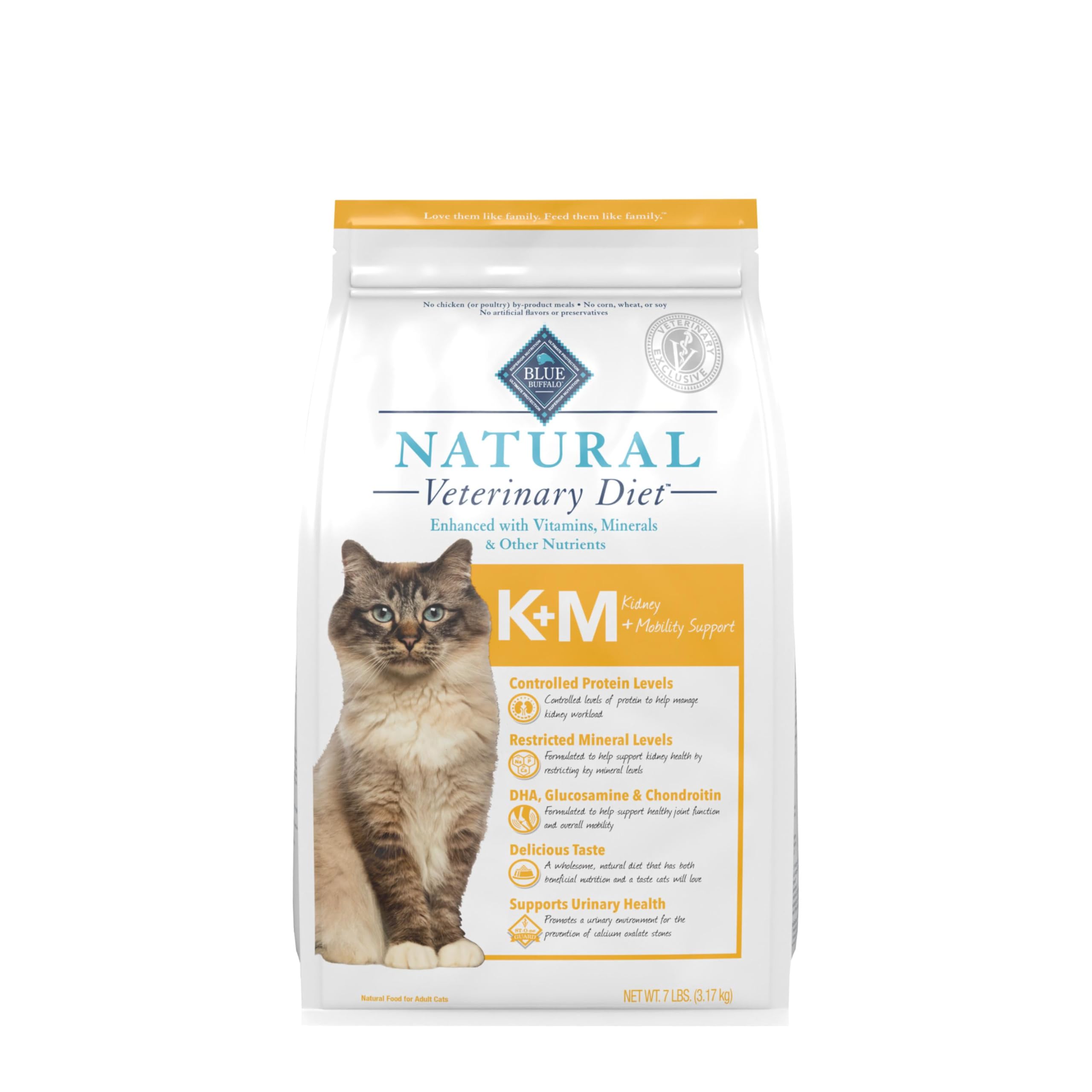
Blue Buffalo’s K+M formula earns its spot by addressing a reality many senior cat parents face: kidney disease rarely travels alone. Arthritis and mobility issues frequently accompany CKD in aging felines, and this diet tackles both with controlled protein and phosphorus for the kidneys plus glucosamine and chondroitin for joint health. The first ingredient is real deboned chicken, which helps maintain muscle mass without overwhelming the kidneys.
What makes this food stand out in real-world use is the kibble size. It is noticeably smaller than many other prescription renal diets, which makes a real difference for cats with dental sensitivity or sore gums — a common issue in older cats. Pet parents of picky eaters have shared stories of cats who turned away from every other kidney diet but finally accepted this one. The 7-pound bag also offers better value compared to smaller bags of similar prescription foods, especially if you have a cat who eats well on it.
For cat parents managing both kidney disease and joint stiffness, this two-in-one approach simplifies feeding and eliminates the need for separate joint supplements. It is a prescription diet, so vet authorization is required, but the dual-purpose formulation can reduce pill burden and make daily care more manageable. Just keep an eye on your cat’s phosphorus levels over time, as the protein content is slightly higher than some strictly renal diets.
Why we love it
- Combines kidney and joint support in one food
- Extra-small kibble size is gentle on sensitive teeth and gums
- Real chicken as the first ingredient for high-quality protein
- Larger 7-pound bag offers better overall value
Good to know
- Requires a veterinary prescription
- Protein levels are slightly higher than some strict renal diets
- Not ideal for cats with advanced-stage kidney disease
3. Hill’s Prescription Diet k/d Kidney Care Dry Cat Food, Ocean Fish

Hill’s k/d in Ocean Fish is the same clinically proven renal platform as the chicken version but with a flavor profile that can be a game-changer for finicky cats. Fish flavors are inherently more aromatic and palatable to many felines, making this an excellent option for cats who have gone off their food due to CKD-related nausea. The formula includes ActivBiome+ Kidney Defense prebiotics and the Enhanced Appetite Trigger (E.A.T.) to further encourage consistent eating.
Beyond palatability, this diet delivers reduced phosphorus and sodium to protect kidney function, plus elevated levels of essential amino acids to help maintain lean muscle mass. The fish-based omega-3 fatty acids provide additional anti-inflammatory benefits for both kidneys and joints. Many cat parents report that their cats who refused other kidney foods eagerly ate this variety, and some use it in rotation with the chicken formula to prevent flavor fatigue. The small, easy-to-chew kibble size is another practical plus for older cats with dental concerns.
If your CKD cat has become a picky eater or simply prefers fish flavors, this is the prescription renal diet to try. It offers the same clinical rigor as the chicken formula but with a taste that can make all the difference in maintaining adequate calorie intake. Some cats do develop a preference for fish flavors that can make switching back challenging, and fish-sensitive cats should be monitored for any digestive upset.
Why we love it
- Highly palatable fish flavor appeals to picky CKD cats
- Same clinically proven kidney protection as Hill’s chicken formula
- Omega-3s from fish oil support kidney and joint health
- Enhanced Appetite Trigger helps maintain food intake
Good to know
- Some cats may develop a strong preference for fish flavors
- Fish-sensitive cats may experience digestive sensitivity
- Requires veterinary prescription
4. Pro Plan Veterinary Diets NF Kidney Function Advanced Care Feline Formula

Purina Pro Plan Veterinary Diets NF Kidney Function is a solid, well-researched prescription option that often comes in at a lower price point than competing brands without cutting corners on key renal metrics. The formula features restricted phosphorus to reduce kidney strain, reduced high-quality protein to manage nitrogenous waste, and added omega-3 fatty acids from fish oil to support kidney health at a cellular level. Antioxidants round out the profile to support immune function, which is frequently compromised in CKD cats.
What makes this food particularly noteworthy is its acceptance rate among picky cats. Multiple cat parents have shared stories of cats who flatly refused Royal Canin or Hill’s renal diets but started eating Purina NF without any transition fuss. The kibble texture and flavor seem to hit a sweet spot for feline palates. The 3.15-pound bag is on the smaller side, which works well for trial periods or single-cat homes, though multi-cat households may find themselves ordering frequently.
For budget-conscious cat parents who still want a clinically validated prescription renal diet, Purina NF delivers excellent value. It covers all the essential bases — low phosphorus, controlled protein, omega-3s, and antioxidants — at a more accessible price. Just be aware that it is a veterinary diet requiring a prescription, and the smaller bag size means you will need to reorder more often than with larger bags from other brands.
Why we love it
- Clinically proven restricted phosphorus and protein levels
- Often more affordable than comparable prescription brands
- High acceptance rate among picky eaters
- Omega-3 EPA and DHA support kidney function
Good to know
- Requires veterinary prescription
- Small 3.15-pound bag may require frequent reordering
- Some cats may need a gradual transition period
5. Weruva Wx Phos Focused, Chicken Formulas Variety Pack
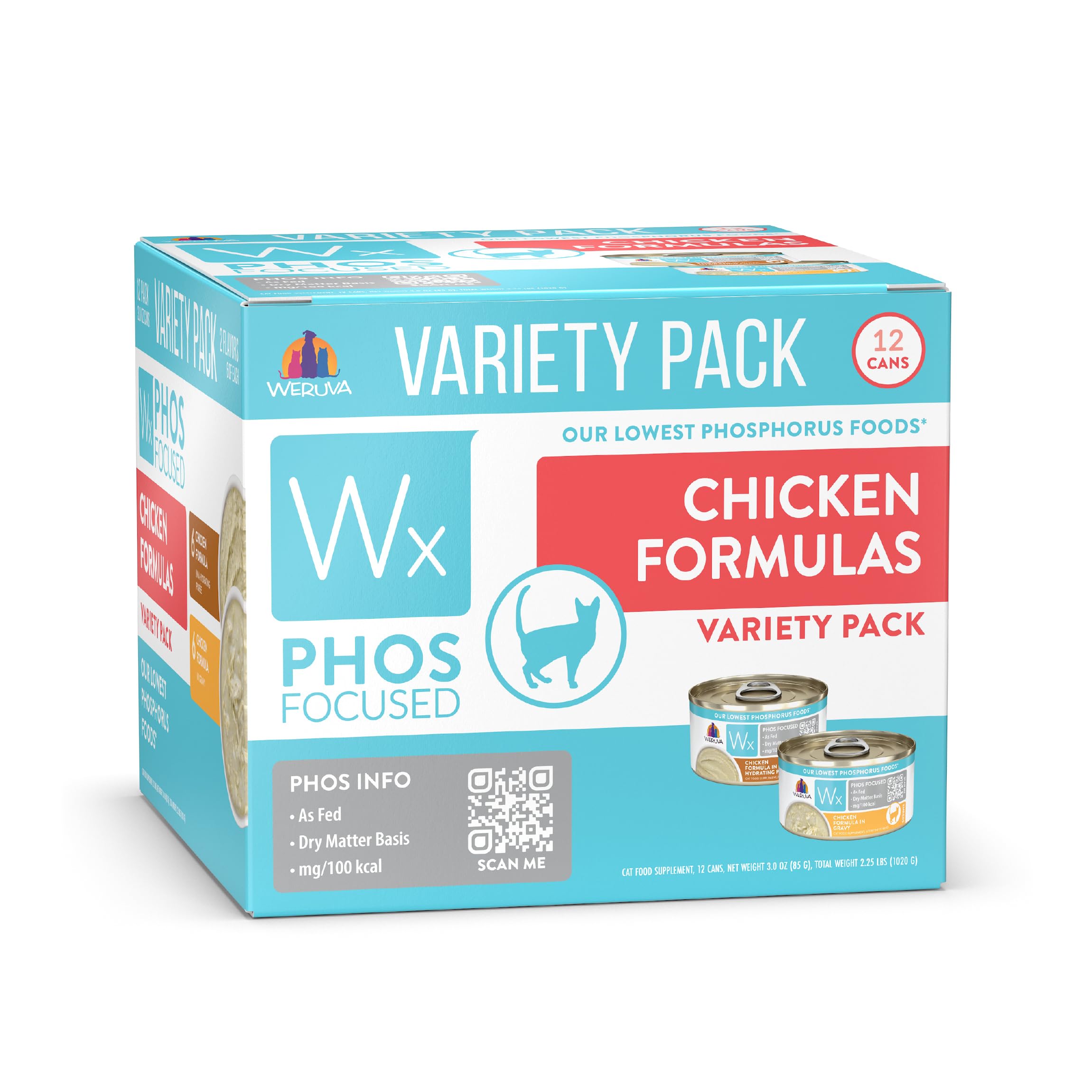
Weruva Wx Phos Focused is the standout non-prescription option for cat parents who want a low-phosphorus diet without the veterinary prescription requirement. The formula delivers up to 50% less phosphorus than the AAFCO minimum, making it genuinely therapeutic for early-stage CKD or as a supplement to a prescription dry food. It uses all-natural, bone-free proteins that are highly bioavailable, meaning your cat’s body can absorb and utilize the protein efficiently without creating excess waste for the kidneys to process.
The variety pack format is a practical advantage — each 3-ounce can offers a different chicken recipe, which helps prevent mealtime boredom for cats who need to eat this food long-term. The chunks-in-gravy texture provides excellent hydration, which is essential for cats with kidney disease who are prone to dehydration. Many cat parents pair this wet food with a prescription dry kibble to create a moisture-rich, low-phosphorus diet that their cats actually enjoy eating. The small can size also means less waste if your cat eats small portions throughout the day.
If your cat has early-stage kidney disease or refuses prescription diets, Weruva Wx Phos Focused is a worthy alternative to discuss with your vet. It is not a complete therapeutic diet for advanced CKD, so monitor your cat’s bloodwork regularly to ensure phosphorus levels stay controlled. The taste and smell are mild compared to some prescription foods, which can be a plus or minus depending on your cat’s preferences, but the clean ingredient list is hard to beat.
Why we love it
- Up to 50% less phosphorus than AAFCO minimum
- No prescription required — accessible and convenient
- All-natural ingredients with no fillers or artificial additives
- Variety pack prevents mealtime boredom
Good to know
- Not a complete therapeutic diet for advanced CKD
- Some cats may not love the mild taste and smell
- Regular vet monitoring of phosphorus levels is still essential
6. Standard Process Inc. Feline Renal Support Supplement

Standard Process Feline Renal Support takes a whole-food approach to kidney health that complements rather than replaces a renal diet. This supplement uses carefully selected whole-food ingredients to support kidney function, urinary health, and the autonomic nervous system. It is designed to be given alongside your cat’s regular food — either as a whole tablet or crushed and mixed into meals, which makes administration flexible even for cats who are picky about taking pills.
The 90-tablet bottle provides a two-month supply at the standard dosing of one tablet twice daily. Cat parents have reported noticeable improvements in their cats’ quality of life, including reduced vomiting and normalized stool consistency when using this supplement alongside a low-phosphorus diet. The whole-food based formula sets it apart from synthetic supplements, as it provides nutrients in a form the body recognizes and utilizes more efficiently. Standard Process has been a trusted name in whole-food nutrition for over 95 years, bringing considerable expertise to the feline renal support space.
This supplement is best suited for cats with early to moderate CKD who are already on a kidney-supportive diet but need an extra nutritional boost. It is not a standalone treatment for advanced kidney disease, and it works best when combined with veterinary guidance and regular bloodwork monitoring. The tablets are relatively large, so crushing and mixing with wet food is the preferred method for most cats.
Why we love it
- Whole-food based ingredients support kidney and urinary health
- Flexible administration — whole tablet or crushed into food
- Two-month supply per bottle offers good value
- Trusted brand with over 95 years of experience
Good to know
- Not a replacement for a therapeutic renal diet
- Tablets are large and may need to be crushed for easy dosing
- Results vary and work best alongside veterinary monitoring
7. Nutramax Laboratories NARAQUIN Dietary Phosphate Binder

Nutramax NARAQUIN is a targeted phosphate binder that goes beyond typical binders by also delivering renal support through omega-3 fatty acids and beta-glucan. The proprietary blend combines three phosphate-binding agents — ferric citrate, calcium acetate, and chitosan — to bind intestinal phosphorus and protein byproducts before they enter the bloodstream. This mechanism is especially valuable for cats whose phosphorus levels remain elevated despite dietary restriction, which is common in moderate to advanced CKD.
The sprinkle capsule format is a practical win for cat parents. Each capsule can be opened and sprinkled directly onto your cat’s food with each meal, eliminating the struggle of pilling a resistant cat. Nutramax is the number one veterinarian-recommended supplement company, and this product undergoes thorough quality inspections. Cat parents have reported improved kidney values in their cats within months of starting NARAQUIN, with some seeing measurable drops in creatinine, BUN, and SDMA levels when used consistently alongside a renal diet.
This supplement is best used under veterinary guidance for cats whose phosphorus levels need additional control beyond diet alone. It is not a standalone treatment and works most effectively when paired with a low-phosphorus renal diet. The capsules do have a noticeable smell due to the active ingredients, so it is best to mix them into food after the food has been heated or prepared, not before.
Why we love it
- Triple-action phosphate binder for effective phosphorus control
- Easy sprinkle capsule format — no pilling required
- Includes omega-3s and beta-glucan for added kidney support
- From the #1 vet-recommended supplement company
Good to know
- Not a replacement for a therapeutic renal diet
- Capsules have a strong smell that may need to be masked
- Best used under veterinary supervision with regular bloodwork
Safety & Care Tips
Transitioning to a New Renal Diet
Cats with kidney disease often have sensitive stomachs and may resist dietary changes. Gradually transition over 7 to 10 days by mixing increasing proportions of the new food with the old. If your cat stops eating entirely during the transition, revert to the previous ratio and contact your veterinarian — extended refusal to eat can worsen kidney function and lead to hepatic lipidosis, a serious condition.
Hydration Is Non-Negotiable
Kidney disease impairs a cat’s ability to concentrate urine, leading to chronic dehydration. Always provide fresh, clean water in multiple locations throughout your home. Consider adding a pet water fountain, as many cats prefer moving water. Wet food should make up at least 50% of your cat’s caloric intake to boost moisture consumption. You can also add warm water or low-sodium chicken broth to dry kibble to encourage extra fluid intake.
Monitor Body Condition Closely
Weight loss is one of the earliest and most concerning signs of CKD progression. Weigh your cat weekly using a baby scale or home pet scale. Track any changes and share them with your veterinarian. If your cat loses 5% or more of their body weight, adjust the feeding plan immediately — consider more frequent small meals, warming the food to enhance aroma, or adding appetite stimulants prescribed by your vet.
Regular Veterinary Bloodwork Is Essential
Even the best renal diet cannot replace regular monitoring. Your veterinarian should run bloodwork every 3 to 6 months to track creatinine, BUN, SDMA, phosphorus, and potassium levels. These values guide dietary adjustments and help catch disease progression early. Never rely on observation alone — CKD can advance silently, and bloodwork is the only reliable way to know how your cat’s kidneys are actually functioning.
FAQ
What is the best kidney food for cats with early stage kidney disease?
Can I feed my cat regular food along with kidney support food?
How do phosphorus levels affect kidney health in cats?
Are prescription diets necessary for cats with kidney disease?
Final Thoughts: The Verdict
For most cat parents, the best kidney food for cats winner is the Hill’s Prescription Diet k/d Early Support (Chicken) because it combines clinically proven kidney protection, a prebiotic gut-kidney defense system, and an appetite trigger that keeps CKD cats eating consistently. If you want a dual kidney and mobility solution for a senior cat with arthritis, grab the Blue Buffalo K+M Kidney + Mobility Support. And for a non-prescription wet food that delivers real low-phosphorus nutrition, nothing beats the Weruva Wx Phos Focused Variety Pack for keeping your cat hydrated and happy.