
Few things test a pet parent’s patience like watching a flock of pigeons claim your balcony railing or seeing blackbirds strip your blueberry bushes while your dog barks helplessly below. You need a solution that works, but it has to be safe for every creature sharing your space — from your Labrador to the neighborhood songbirds you actually want around.
I’m Mo Mahin — the founder and writer behind Furric. I’ve spent months analyzing bird deterrent technologies, poring over veterinary safety guidelines, and cross-referencing real owner feedback to separate the products that deliver lasting results from those that only provide a few days of peace.
After evaluating dozens of options based on real customer feedback and durability standards, I’ve narrowed down the top best bird deterrent devices for your property needs.
How To Choose The Best Bird Deterrent Devices
Birds are smart, persistent, and highly adaptable. A solution that works for a few days may lose its edge once they realize it poses no real threat. The key is matching the deterrent type to your specific bird problem, the surface area you need to protect, and your tolerance for ongoing maintenance. Here are the critical factors to weigh before you buy.
Physical Barriers vs. Active Scare Tactics
Physical barriers — netting, spikes, and exclusion materials — provide a permanent, predictable result without relying on fear or novelty. They never stop working regardless of weather or bird intelligence. Active scare tactics — decoy owls, kites, motion-activated sprinklers, and sound devices — rely on the element of surprise or perceived predation. Birds habituate to these over time, so you may need to rotate methods or reposition devices regularly to maintain effectiveness. For heavy infestations, a layered approach using both physical and active methods tends to deliver the best long-term outcome.
Pet Safety and Material Quality
Any deterrent installed near pets must use non-toxic materials and have no sharp edges that could injure a curious nose or paw. Plastic spikes should be flexible enough to bend without breaking into dangerous shards. Netting must be large enough in mesh gauge to prevent entanglement of small animals. For solar-powered decoys, verify that the plastic housing is UV-stabilized so it won’t become brittle and crack after a season in the sun. Stainless steel offers the highest durability for spikes but may require professional installation if you need to cut and bend it around complex architectural features.
Coverage Area and Installation Complexity
Measure the specific perimeter or surface area you need to protect before choosing a product. A single decoy owl covers roughly a 20-foot radius. Bird spikes protect only the exact surface they are mounted on. Netting can cover entire garden beds but requires anchoring points and tension to stay effective. Kites work best in open areas with consistent wind. A sprinkler covers up to 100 square meters but needs a water source and clear line of sight. Buy enough product to cover your entire problem zone — mixing half-measures often just shifts the birds to the unprotected spot.
Climate and Weather Resistance
Your local weather will determine which materials hold up. HDPE netting rated from -58°F to 212°F works in extreme climates. Stainless steel spikes tolerate snow loads and intense sun without degradation. Solar decoys rely on adequate sunlight for consistent operation — if you live in a cloudy region, consider models that also accept USB charging. Standard polypropylene netting may become brittle after one winter in freezing zones. Always check the listed temperature range and UV resistance rating before committing to a product intended for year-round outdoor use.
Quick Comparison
On smaller screens, swipe sideways to see the full table.
| Model | Type | Best For | Key Feature | Amazon |
|---|---|---|---|---|
| Ugold Solar Owl | Solar Decoy Owl | Active Deterrence | Gradient LED Eyes & Silent Mode | Amazon |
| Yardeen Sprinkler | Motion Sprinkler | Pet-Free Zones | Adjustable PIR Sensitivity | Amazon |
| XPCARE Spikes | Stainless Spikes | Ledge Protection | 304 Steel, 15-Year Life | Amazon |
| Flyonte Hawk Kite | Flying Hawk Decoy | Garden Coverage | 2m Wingspan, 4m Pole | Amazon |
| Owlsome Solar Owl | Solar Decoy Owl | Night Scare | Flashing Eyes, Rotating Head | Amazon |
| BORHOOD Spikes | Plastic Spikes | Budget Ledges | Cuttable, No Rust | Amazon |
| RIFNY Netting | HDPE Netting | Fruit Trees | 5/8″ Mesh, UV Resistant | Amazon |
In-Depth Reviews
1. Ugold Solar Powered Garden Owl

Here is a decoy that actually looks like it belongs in your garden rather than screaming “fake owl” from twenty feet away. The Ugold measures 16.9 inches tall and is fully hand-painted with a lifelike feathered texture that makes it convincing even to wary corvids. The gradient LED eyes shift from red to green, adding an unnerving unpredictability that birds struggle to habituate to — a clever upgrade over the static red eyes found on cheaper alternatives.
What sets this model apart from the budget crowd is the dual charging system. The solar panel on the owl’s head keeps the battery topped up during sunny stretches, but you also get a USB cable for overcast days when solar alone won’t cut it. The motion sensor detects movement up to 20 feet away, triggering head rotation, eye glow, and hooting sounds. When the hooting becomes repetitive, the silent mode lets the visual deterrent keep working without annoying your neighbors.
If you want a single decoy that covers a patio, balcony, or modest garden with minimal upkeep, this is the unit to beat. The hand-painted finish and gradient eyes give it an edge in realism, and the dual charging removes the “dead owl” problem that plagues purely solar models. Just be aware that decoys work best when moved periodically — a stationary owl eventually becomes scenery to smart birds.
Why we love it
- Hand-painted for exceptional realism
- Gradient LED eyes resist habituation
- Solar plus USB charging for reliability
- Silent mode spares neighbor relations
Good to know
- Requires periodic repositioning to stay effective
- Plastic body needs winter storage in freezing climates
2. Yardeen Motion Activated Sprinkler
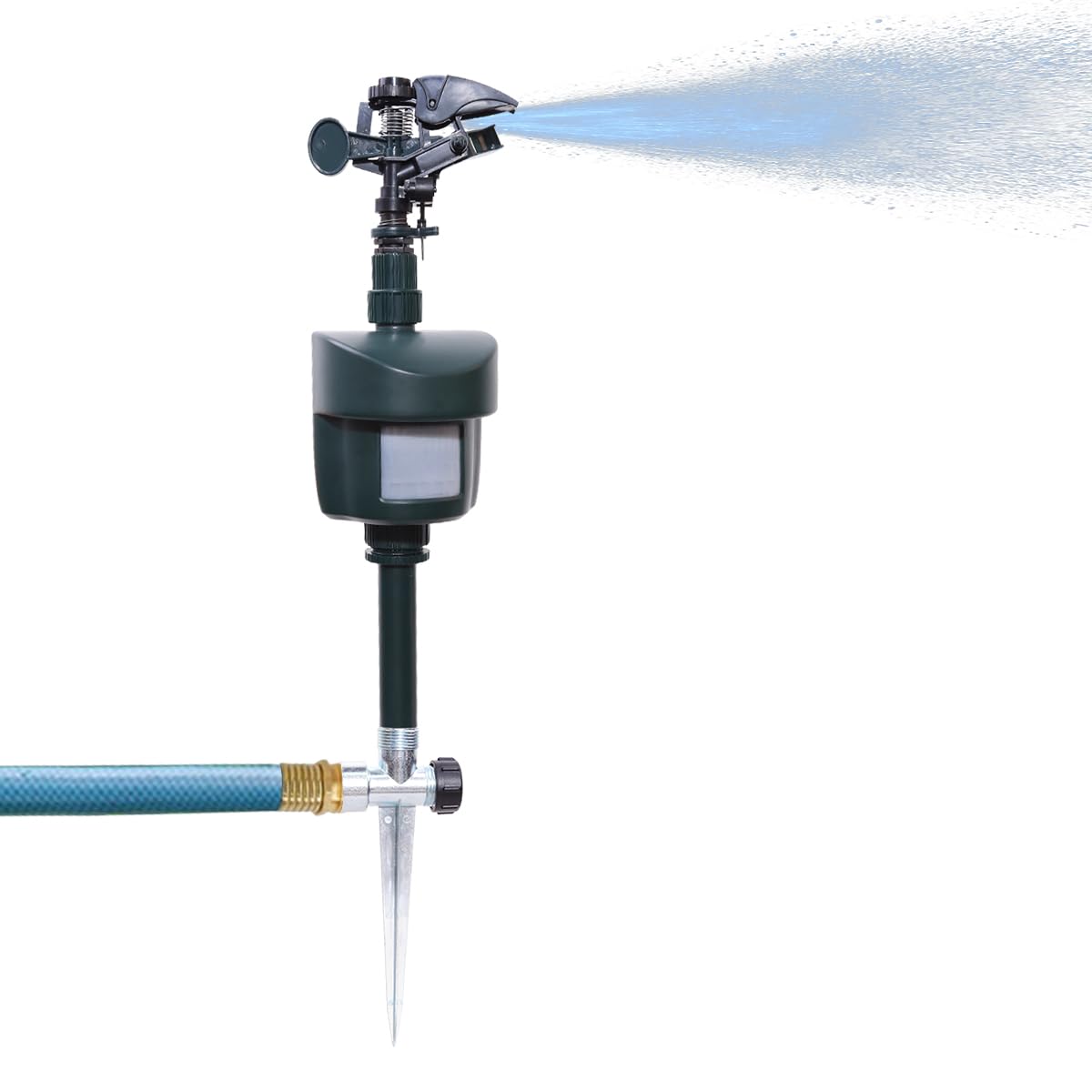
Birds and stray cats share one reliable trait — they hate getting sprayed with water. The Yardeen motion-activated sprinkler turns your garden hose into an automated sentry that only fires when movement triggers the PIR sensor. The sensitivity adjusts from 1 to 10 meters, giving you control over the protected zone up to roughly 100 square meters. It works equally well day or night, which matters when nocturnal raccoons or opossums are causing trouble.
The rotary spray nozzle covers a wide arc, and the metal stake keeps the unit anchored even on windy days. Installation is straightforward — stake it into the ground, connect a standard garden hose, and insert batteries. The adjustable sensitivity lets you dial in the range so passing cars or mail carriers don’t trigger false alarms. It also deters deer, skunks, foxes, and roaming cats, making it a multi-pest investment rather than a single-species tool.
This sprinkler is the closest thing to a “set it and forget it” deterrent for ground-level bird problems. It never habituates because water startles every time. The catch is temperature — the manufacturer advises against use above 45 degrees Celsius or below 5 degrees, so extreme climates may shorten its lifespan. If you’re dealing with birds raiding your vegetable beds or grass, this delivers reliable, humane, and laughably satisfying protection.
Why we love it
- No habituation — birds never get used to water
- Covers large ground areas effectively
- Deters multiple animal types at once
- Simple hose-and-stake installation
Good to know
- Not suitable for extreme heat or freezing temps
- Requires batteries and consistent water pressure
3. XPCARE 33.6 Ft Stainless Steel Bird Spikes
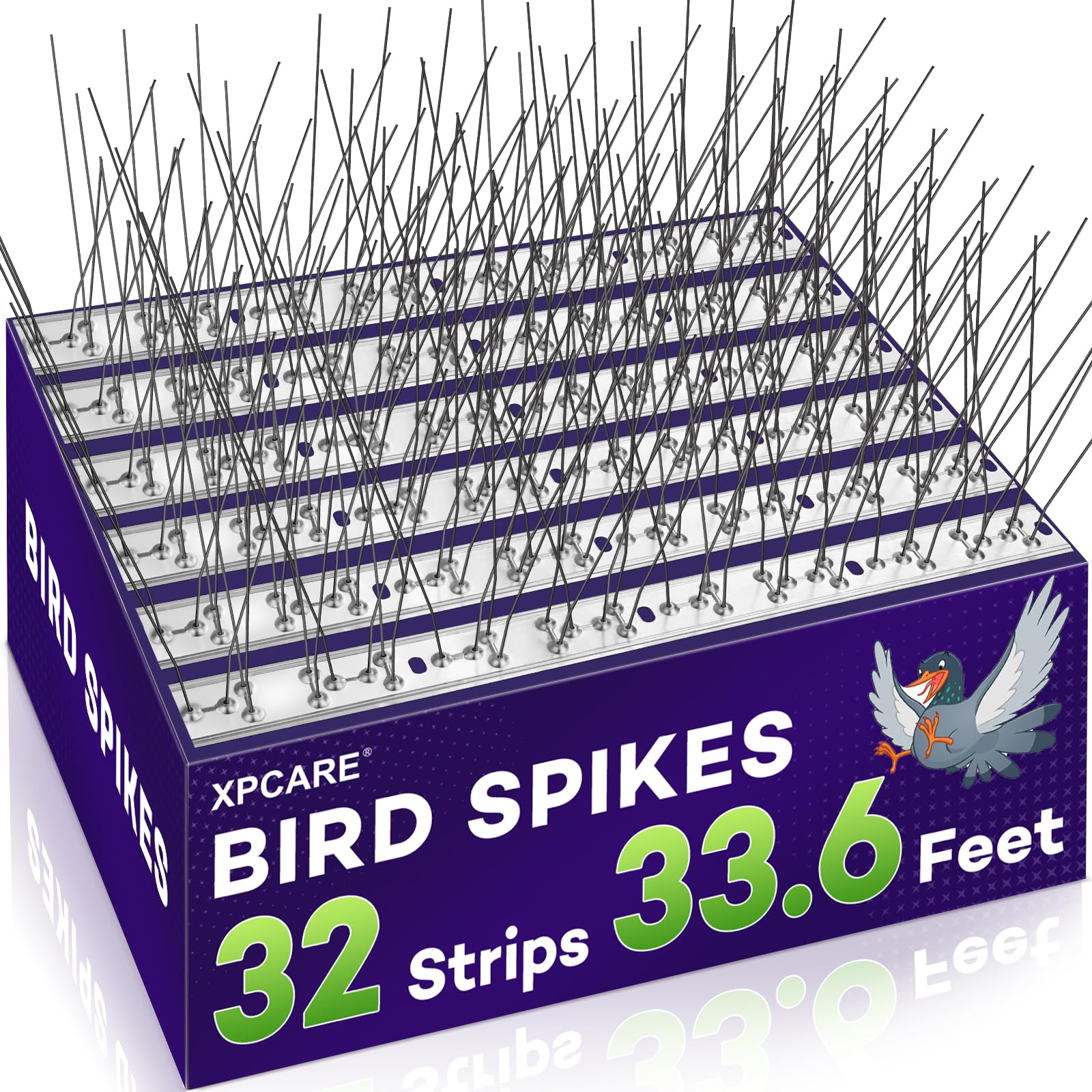
When you need a permanent, no-nonsense barrier for ledges, window sills, or rooflines, stainless steel spikes are the gold standard. The XPCARE set includes 32 strips covering 33.6 linear feet, each strip made from 304 stainless steel with a matching steel base. The manufacturer rates the service life at 15 years, which is realistic given the material’s resistance to rust and UV damage. Unlike plastic spikes that become brittle and snap in winter, these stay intact through snow, rain, and direct sun.
Each strip has six staggered rows of spikes covering 360 degrees, making it impossible for birds to find a comfortable landing spot. The design includes four mounting holes per strip, and you can use screws, cable ties, construction adhesive, or heavy-duty double-sided tape for installation. The spikes can be bent to follow inside or outside corners, and you can cut them with standard tools to fit narrow spaces. This flexibility means one kit can handle a balcony railing, a window sill, and a small roofline section.
For anyone tired of cleaning droppings off railings or preventing pigeons from nesting under solar panels, these spikes provide a maintenance-free solution once installed. The premium over plastic spikes is justified by the dramatic difference in longevity — plastic may last 2-3 years, while stainless steel will outlast your current home. They are also completely humane, simply making perching uncomfortable rather than causing injury.
Why we love it
- 15-year service life with zero maintenance
- 304 steel resists rust and weather damage
- 360-degree spike coverage blocks all landing angles
- Bendable and cuttable for custom fit
Good to know
- Installation requires tools and effort
- Not suitable for curved or irregular surfaces
4. Flyonte Bird Hawk Flying Kite with Pole

For acres of garden, farmland, or orchard, stationary decoys lose their impact because the sheer space dilutes their visual presence. The Flyonte Hawk Kite solves that by riding the wind — a 2-meter wingspan hawk silhouette that flaps and glides with real movement, triggering an instinctive predator avoidance response in birds. The kit includes a 4-meter telescopic fiberglass pole and a ground stake, letting you fly the kite at a height where it is visible from hundreds of feet away.
The polyester fabric is laser-cut and stitched for durability, and the realistic bird-of-prey coloration and patterns add to the illusion. It flies in light winds — as low as 3-5 mph — and remains stable in stronger gusts thanks to the fiberglass frame and balanced design. The effective coverage area is rated at 200 to 500 square meters, which is substantial for a single device. When the wind dies, you can lower the pole and store the kite until conditions improve.
This is a specialized tool best suited for open spaces where other deterrents would be impractical or too expensive to install. It won’t work on still days or in sheltered courtyards, but for farmers, large-scale gardeners, or anyone protecting a big property, the movement-based deterrence is uniquely effective. Birds that have habituated to stationary decoys often react immediately to the hawk kite’s flapping motion — fresh stimuli restart the fear response.
Why we love it
- Realistic flapping motion prevents habituation
- Covers 200-500 square meters per kite
- Quick setup with telescopic pole
- Lightweight and portable storage
Good to know
- Requires wind to operate effectively
- Not suitable for small or sheltered spaces
5. Owlsome Solar Red Owl with Flashing Eyes

The Owlsome Red Owl brings the core concept of a decoy predator to life with motion-activated responses that make it feel alive. When its sensor detects movement within 20 feet, the head rotates, eyes flash red, and the owl emits a hooting sound. The motion detector is more advanced than standard infrared — it can detect targets approaching from behind the owl, which is a common blind spot for cheaper decoys. At 11.6 inches tall, it is slightly smaller than the Ugold but still visible enough for balcony and patio duty.
Hand-painted details give it a realistic texture, and the red color variant stands out against green foliage or gray architecture. The silent mode is a practical addition for residential settings where neighbors might complain about repeated hooting at all hours. Solar charging keeps the battery topped up during sunny weather, and the included USB cable ensures it stays operational during cloudy stretches. The waterproof housing allows year-round outdoor use in most climates.
For a budget-conscious entry into active decoy deterrence, the Owlsome delivers solid performance at a lower cost than the premium Ugold. The flashing red eyes and rotating head create enough unpredictability to delay habituation for several weeks. Just plan to move it to a new spot every 7-10 days to keep birds guessing. The plastic construction is durable but not indestructible — bringing it indoors during severe storms will extend its service life.
Why we love it
- Motion detects from all directions, including behind
- Hand-painted for realistic appearance
- Silent mode for noise-sensitive areas
- Dual solar and USB charging
Good to know
- Needs repositioning every 7-10 days
- Plastic housing vulnerable in severe storms
6. BORHOOD Bird Spikes, 20 Pack
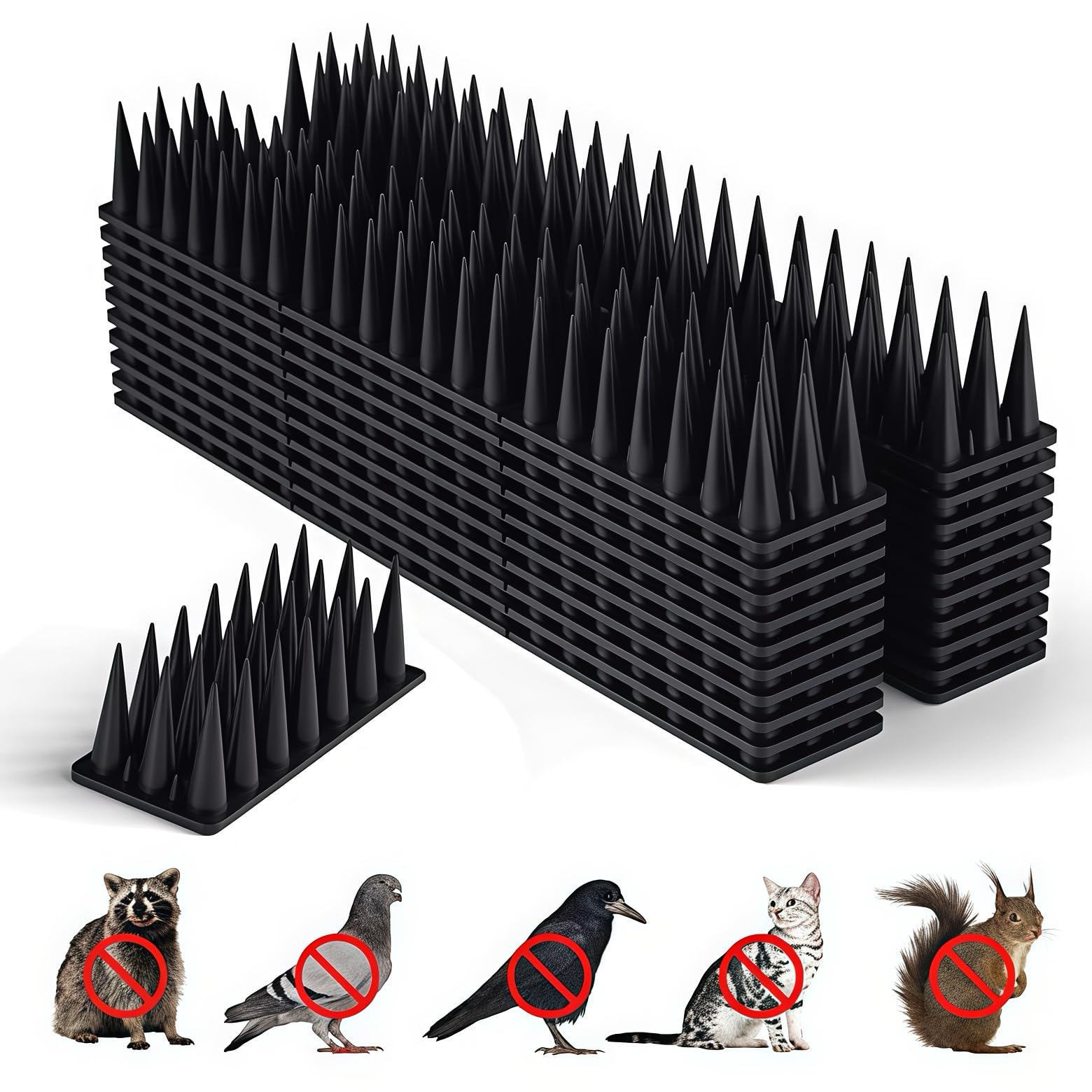
When you need a quick, affordable fix for a small ledge or gutter line, the BORHOOD plastic spikes offer a functional solution without the cost or installation complexity of stainless steel. Each pack contains 20 strips that can be divided into custom lengths with standard scissors. The acrylic plastic construction won’t rust, and the dual-length spike design — pairing longer spikes with shorter ones — makes perching uncomfortable for birds without posing an injury risk to pets or other wildlife.
Installation is flexible: you can use nails, screws, heavy-duty double-sided tape, construction glue, or zip ties depending on your surface. The spikes work on rafters, roofs, window sills, balcony railings, garden fences, and shed eaves. Each strip measures 11.22 inches long and 1.57 inches wide, so 20 strips cover roughly 18-19 linear feet. The black color blends reasonably well with most dark surfaces and roof materials.
These are an excellent entry-level option for renters or homeowners who need immediate relief from roosting pigeons but aren’t ready to commit to stainless steel installation. The trade-off is longevity — acrylic plastic will eventually become brittle after 2-3 years of sun exposure, and the shorter spike design may not deter larger birds like crows or seagulls as effectively as taller stainless alternatives. For small birds like sparrows and pigeons, however, they get the job done at a fraction of the cost.
Why we love it
- Budget-friendly entry into physical barriers
- Easy to cut and install with common tools
- Multiple mounting options for any surface
- Rust-proof plastic won’t stain surfaces
Good to know
- Plastic becomes brittle after 2-3 years
- May not deter larger or more determined birds
7. RIFNY Bird Netting 13 x 40 FT
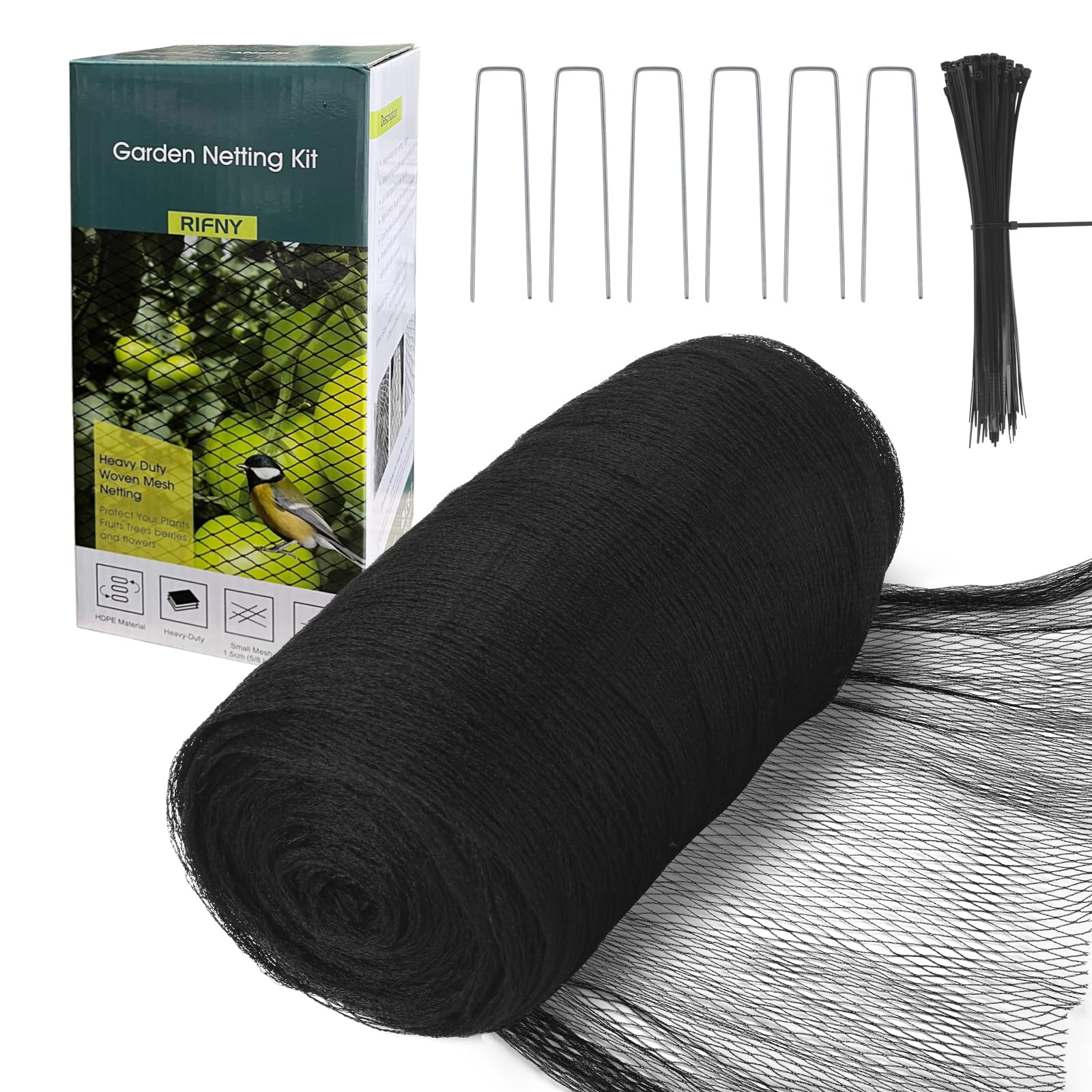
For fruit trees, vegetable gardens, and berry patches, netting remains the most reliable defense because it doesn’t depend on scaring birds — it physically blocks them. The RIFNY netting uses high-density polyethylene (HDPE), which is stronger and more weather-resistant than standard polypropylene netting. The 5/8-inch mesh is small enough to keep out sparrows, finches, and even poultry, yet large enough to avoid entangling beneficial insects or smaller animals. At 13 by 40 feet, one roll covers a substantial garden or several fruit trees.
The extreme temperature range is remarkable — it remains flexible and functional from -58°F to 212°F, meaning it won’t crack in winter or sag in summer heat. The UV and rot resistance add to its multi-season usability, and the included landscape staples and twist ties make installation straightforward. Cut it with scissors to your desired shape, drape it over plants or a support frame, and secure the edges. The netting is also reusable — rinse it off at the end of the season and store it for next year.
Gardeners who have battled birds for years will appreciate the simplicity and effectiveness of this solution. It also keeps out deer, squirrels, and rabbits, adding value beyond bird control. The only real downside is the initial setup — draping netting over large trees without tangling requires patience and sometimes a second pair of hands. Once installed, though, you can harvest your blueberries and strawberries without finding half-eaten remnants on the ground.
Why we love it
- HDPE material outperforms standard netting
- Extreme temperature range (-58°F to 212°F)
- 5/8″ mesh blocks birds without tangling
- Reusable and UV/rot resistant
Good to know
- Installation over large trees can be tricky
- Edge anchoring is critical to prevent birds sneaking under
Safety & Care Tips
Installation Safety Around Pets
When installing spikes or netting, always inspect the area first for existing nests. In many regions, disturbing active nests is illegal under the Migratory Bird Treaty Act. Keep installation tools and loose fasteners away from curious pets. For netting, ensure there are no loose loops or gaps that a paw or beak could become caught in. Check the perimeter weekly during the first month to confirm the deterrent stays secure and hasn’t shifted into a hazardous position.
Maintenance and Seasonal Storage
Solar decoys need periodic cleaning of the solar panel to maintain charging efficiency — a quick wipe with a damp cloth every two weeks makes a noticeable difference. Plastic spikes should be inspected before winter for cracks that could worsen in freezing temperatures. Stainless steel spikes require virtually no maintenance but benefit from an annual check to ensure mounting screws haven’t loosened. Netting should be removed and stored indoors during heavy snow seasons to prevent collapse under accumulated weight.
Habituation Prevention Strategies
Active deterrents lose effectiveness over time as birds realize no real danger follows the initial scare. To delay habituation, rotate your decoy’s position every 7-14 days. Combine two different deterrent types — for example, spikes on ledges plus a motion sprinkler in the garden — so birds face different threats in different zones. If using a kite, alternate its location and vary the height at which you fly it. The goal is to make your property unpredictable rather than a predictable obstacle to overcome.
Humane and Legal Considerations
All the products recommended in this guide are designed to deter without causing harm. Never use poisons, glue traps, or lethal methods — they pose serious risks to pets, raptors, and children, and many are illegal for outdoor use. Focus on exclusion and gentle discouragement. If you discover an active nest with eggs or chicks, wait until the young have fledged before installing deterrents. A humane approach not only keeps your pets safe but also builds a healthier ecosystem in your yard.
FAQ
Do bird deterrents work on all bird species?
How long does it take birds to habituate to decoy owls?
Can bird spikes hurt my dog or cat?
Are solar-powered deterrents reliable in cloudy climates?
Final Thoughts: The Verdict
For most pet parents, the best bird deterrent devices winner is the Ugold Solar Owl because it combines realistic hand-painted design with motion-activated responses and reliable dual charging — all at a price that undercuts premium decoys with inferior features. If you want permanent, maintenance-free protection for your ledges and railings, grab the XPCARE Stainless Steel Spikes. And for keeping your vegetable garden and fruit trees safe, nothing beats the coverage and durability of the RIFNY HDPE Bird Netting.