
An outdoor cat faces more than just cold air — wind chill, damp ground, and the constant need for an escape route define whether a shelter is a real refuge or just an open box. A self-warming cat bed for outdoor cats must solve three competing problems: retain enough body heat to keep the animal comfortable, resist moisture without trapping it, and sit inside or form a shelter that does not leave the cat exposed.
I’m Mo Mahin — the founder and writer behind Furric. I spend months comparing product specifications against real-world owner feedback and horticultural shelter data to find which materials and designs actually hold up when temperatures drop and rain hits.
A shelter-only pad that soaks in dampness is worse than no pad at all, which is why identifying the right self warming cat bed for outdoor cats depends less on buzzwords and more on whether the construction actively wicks moisture, insulates from the ground, and matches the cat’s natural denning instincts.
How To Choose The Best Self Warming Cat Bed For Outdoor Cats
Selecting the right shelter-based warming pad for outdoor cats requires more than picking the thickest fleece. You need to evaluate moisture resistance, insulation against ground chill, and the cat’s own trust of the enclosure. These four decision points cover the critical distinctions.
Electric vs Passive Self-Warming: Which Is Less Risky Outdoors
Passive self-warming beds use a reflective Mylar layer or thick fleece to capture and reflect the cat’s own body heat back upward. They require zero power, pose no electrical hazard in rain or snow, and are appropriate for sheltered locations like a covered porch or inside a weatherproof cat house. Electric versions offer a higher peak temperature but demand a dry environment and a chew-resistant cord path. If the location cannot guarantee dry power access, a passive thermal bed is the safer choice.
Bottom Insulation and Moisture Blocking
Heat loss through the floor is the primary failure of outdoor cat bedding. A bed that sits flush against a cold concrete or wooden porch floor will drain warmth faster than the cat can produce it. Look for beds with at least a 0.5-inch foam or polyester-fill base. Even more important is a waterproof bottom layer — either a PVC backing or a separate waterproof liner — that prevents ground moisture from wicking up into the fleece. Without this barrier, the bed becomes damp within hours of use and actually accelerates cooling.
Enclosed Shelter vs Open Mat: Matching the Product to the Scenario
Some products function as a complete shelter with a roof, walls, and door flap, while others are flat mats meant to be placed inside an existing cat house or on a covered porch. A fully enclosed heated shelter is better for unsheltered backyards and exposed decks because it blocks wind and traps a pocket of warm air around the cat. A flat mat is lighter and portable but depends entirely on the protective structure you provide around it. Decide whether you are furnishing an existing shelter or building one.
Door Configuration and the Escape Instinct
Feral and semi-outdoor cats are naturally wary of entering any space that feels like a trap. Shelters with two exit openings — often called “escape doors” — drastically reduce hesitation because the cat knows it cannot be cornered. A single entrance with a heavy flap can deter use. Look for models that include a second door or a removable flap that allows the cat to see through the exit while still blocking wind. This small design detail often separates beds that are adopted from beds that are ignored.
Quick Comparison
On smaller screens, swipe sideways to see the full table.
| Model | Category | Best For | Key Spec | Amazon |
|---|---|---|---|---|
| MEWTOGO Heated Cat House | Enclosed Shelter | Complete all-weather shelter setup | 25W heating pad, 104-131°F auto shutoff | Amazon |
| K&H A-Frame Outdoor Cat House | Enclosed Shelter | Dual-exit security for wary ferals | 20W heated bed, 2 clear door flaps | Amazon |
| Texsens Heated Cat House | Enclosed Shelter | Larger space for multiple cats | UL-tested pad + cooling mat, roof window | Amazon |
| K&H Thermo-Pet Cave | Heated Cave Tent | Portable indoor/outdoor cave shelter | 4W smart heater, washable fleece interior | Amazon |
| PETNF Outdoor Heating Pad | Electric Mat | Warming mat inside an existing shelter | 3.5-layer protection, V-0 flame retardant | Amazon |
| Kiroto Outdoor Heating Pad | Electric Mat | Budget-friendly electric pad for covered areas | 35W, waterproof fleece top, 6-ft cord | Amazon |
| AUPETEK Foam Bed + Heating Pad | Electric Combo | Orthopedic foam bed plus separate heating mat | 1.8″ memory foam, MET certified heating pad | Amazon |
In‑Depth Reviews
1. MEWTOGO Heated Cat House for Outdoor Cats
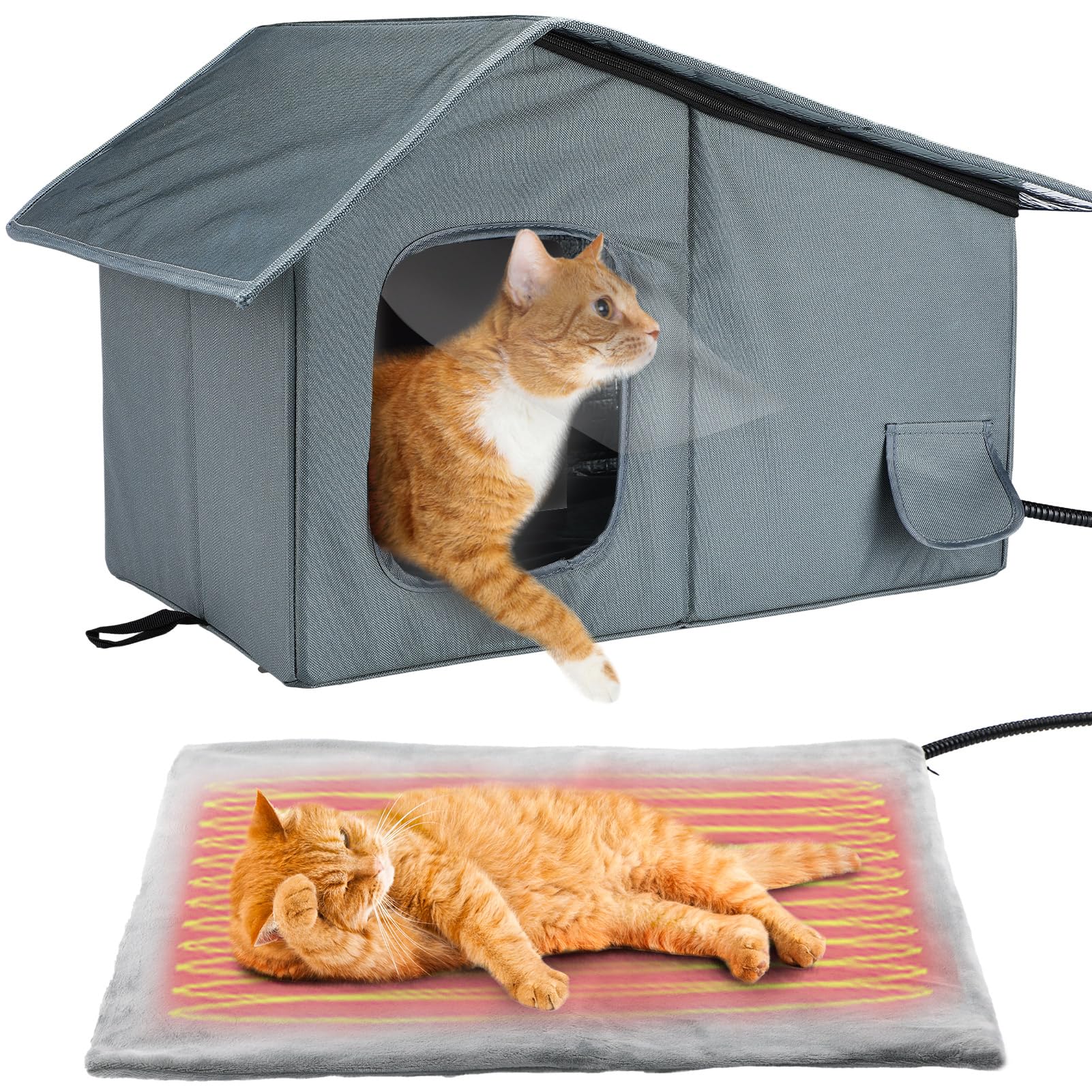
The MEWTOGO is a full outdoor cat house that pairs an insulated PVC-coated roof with a dedicated thermostatic heating pad. The pad operates at 25 watts and maintains a surface temperature between 104°F and 131°F, with an automatic shutoff if it overheats. The house dimensions — 21 inches long by 13.4 inches wide by 15.4 inches tall — fit one to two cats comfortably, and the aluminum inner film layer adds an extra radiant barrier that reduces heat loss through the ceiling.
The double-sided pad offers a fleece side for winter warmth and a cooling side for milder months, making this a four-season shelter rather than a single-purpose cold-weather box. The PVC door curtain blocks wind effectively, and the rear safety door provides the escape route that hesitant ferals need before they commit to entering. The roof attaches via a full-length zipper, which is convenient for access but is a potential wear point after repeated opening in cold weather.
Assembly takes roughly ten minutes and requires no tools beyond attaching the roof section. Owners of multiple cats report that the size is sufficient but not spacious for two large cats. The heating pad’s 6.6-foot cord means the house must sit within reach of an outdoor GFCI outlet, so location planning matters. For anyone wanting a turnkey heated shelter without building their own, this is the most complete package in the list.
Why we love it
- Complete shelter with heating pad included — no separate housing needed
- Double-sided pad accommodates both winter warmth and summer cooling
- Safety door at rear reduces cat hesitation about entering
Good to know
- Zippered roof attachment may wear over time with repeated use
- Full-size interior is a tight fit for two large adult cats
2. K&H Pet Products Heated Outdoor Cat House A-Frame

K&H’s A-Frame shelter is a purpose-built structure for feral and community cats, featuring two exit doors with removable clear vinyl flaps. The 20-watt heated bed inside is MET Safety Listed and includes a weight-activated sensor — the pad only warms when a cat is present, which conserves energy and reduces the risk of overheating an empty house. The A-frame shape sheds rain and snow naturally, and the polyester fabric exterior resists wind-driven moisture when placed in a sheltered location.
The double-exit design is this shelter’s strongest advantage for attracting shy cats. Each opening measures roughly 5.5 inches high by 7 inches wide, which works well for average-sized cats but can be too small for larger tomcats. Some owners report that their cats prefer the clear flaps removed entirely during the first week of introduction, then reattach them once the cat is comfortable. The 14-inch depth means a single cat can curl up tightly, but multiple cats will not both fit.
Assembly is straightforward — the frame pops open and the clear windows attach with Velcro strips. The shelter works best when placed inside a larger, wind-protected kennel or against a wall that blocks prevailing wind. Do not mistake the 20-watt pad for a space heater; it raises the internal temperature only a few degrees above ambient, which is exactly what a cat’s fur coat needs as a boost. The real warmth comes from the cat’s own body heat being retained by the insulated walls and the pad.
Why we love it
- Two escape exits dramatically increase usage by nervous ferals
- Weight-activated pad saves electricity and runs only when occupied
- MET Safety Listed certification for electrical safety peace of mind
Good to know
- Door openings are too small for large adult tomcats
- Best placed inside a larger windbreak for severe winter conditions
3. Texsens Heated Cat House for Outside

The Texsens heated shelter stands out for its interior volume — 25.2 inches long by 13 inches wide by 16.9 inches tall — which comfortably fits one large cat plus a second smaller cat. The package includes a UL-tested heating pad, a soft cotton mat, and a separate cooling mat for warmer months, making it a year-round system. The raised base sits 2.75 inches off the ground, which prevents cold floor conduction and keeps the interior dry even on damp grass or muddy porches.
The design includes an observation window on the roof that lets you check on the cat without opening the main door — useful for monitoring whether a shy feral has entered. Dual exits with removable clear door flaps give cats the necessary escape route, and reflective strips on the exterior improve low-light visibility to prevent accidental kicks or vehicle strikes. The polyester awning extends past the walls to deflect rain away from the entrance.
Owners note that assembly takes about 15 minutes with the included stakes and elevated base pieces. The unit weighs 7.8 pounds, so it is stable but still liftable for seasonal repositioning. The heating pad draws power through a standard outdoor cord and includes a 1-year warranty. The main limitation is that the structure is fabric-based, not rigid plastic or wood, so it may sag under heavy snow loads without interior reinforcement like a straw fill around the walls.
Why we love it
- Largest interior shelter in the group, fits two cats side by side
- Roof observation window allows non-disruptive monitoring
- Includes both heating pad and cooling mat for all-season use
Good to know
- Fabric exterior may need supplemental straw fill for heavy snow loads
- Assembly requires time to secure the elevated base and stakes
4. K&H Pet Products Thermo-Pet Cave Cat Bed
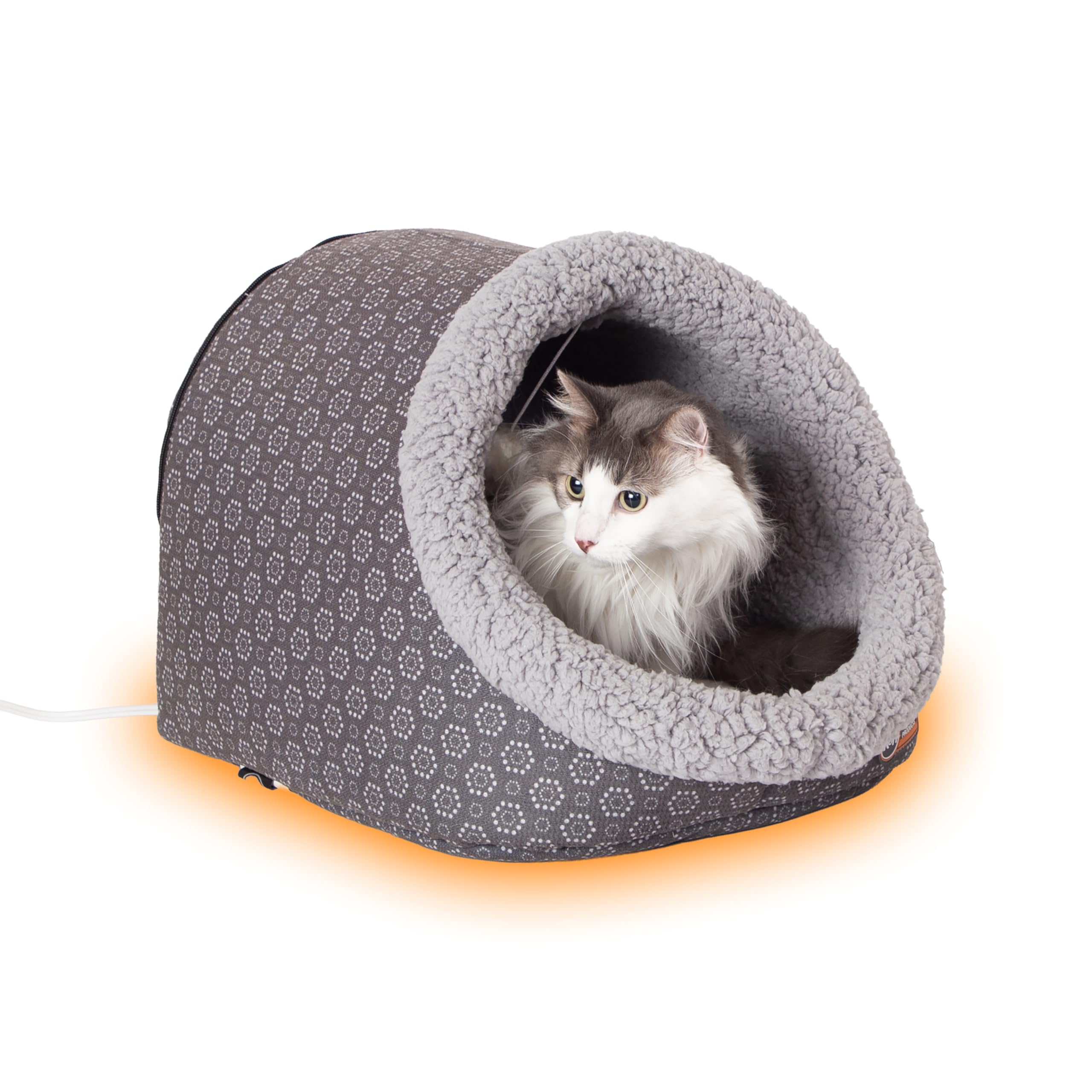
The Thermo-Pet Cave is a heated tent-style bed that converts from an enclosed cave into an open tunnel via a zippered top. The 4-watt smart heater is MET-certified and uses a weight-activated thermostat that only warms the interior surface when a cat is inside. The foam walls hold their shape without collapsing, and the fleece interior provides a soft tactile surface that many cats prefer to exposed plastic heating pads.
At 17 inches wide by 15 inches deep by 13 inches tall, the cave is suitable for cats up to about 16 pounds, though a cat larger than 14 pounds may find it snug in the curled position. The outer fabric is a modern polyester print, and the entire bed is machine washable after removing the heater — a major advantage for outdoor use where mud, dampness, and debris accumulate quickly. The low wattage means it costs pennies per day to run, making it an economical choice for continuous use on a covered porch.
The cave performs best when placed under a roof overhang, inside a deck box, or within a larger outdoor cat house. It is not fully waterproof and should not be left exposed to direct rain or snow. The smart thermostat holds the surface to about 105°F, which is warm enough to relieve joint stiffness in older cats but not hot enough to cause burns. For caregivers who need a portable indoor-outdoor heated bed that can be moved between locations easily, this is the most flexible option.
Why we love it
- Low 4-watt draw is extremely economical for continuous outdoor use
- Convertible cave-to-tunnel design gives cats two configurations
- Machine washable fleece interior makes seasonal cleaning simple
Good to know
- Not fully waterproof — requires overhead shelter from rain
- Limited padding on the floor may need a blanket underneath for cold concrete
5. PETNF Outdoor Pet Heating Pad for Cats
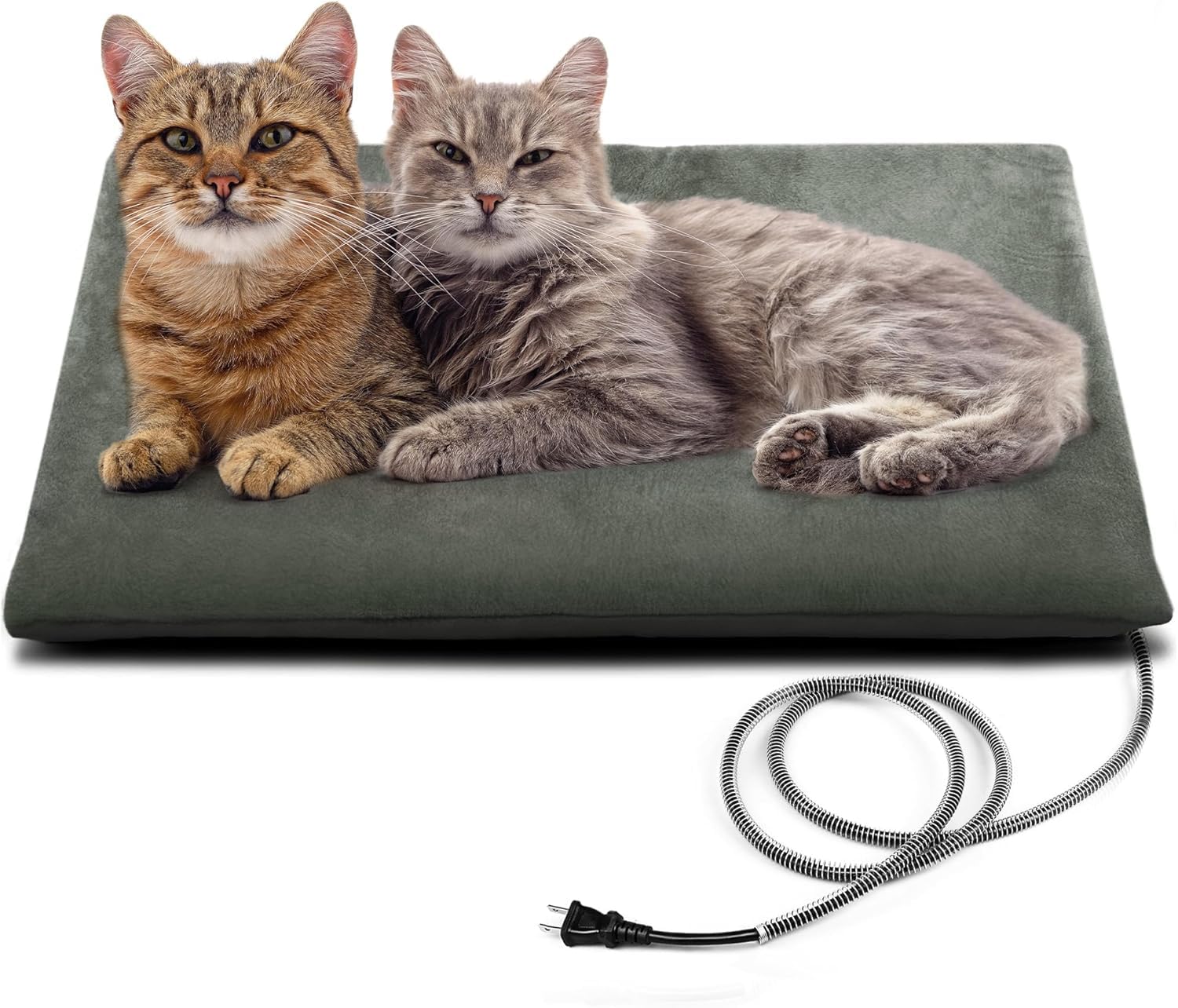
The PETNF heating pad uses a 7-layer protective structure that includes a V-0 flame-retardant PVC envelope, a built-in overheat sensor, and a 5-foot steel-encased chew guard on the power cord. This level of electrical safety is rare in the budget-friendly tier and makes the pad suitable for use inside wooden cat houses, straw-filled shelters, or anywhere the cord might be accessible to chewing animals. The double-layer sponge core provides 1.2 inches of cushioning, which insulates from cold floors better than the thinner 0.6-inch pads often seen at this price point.
The auto-thermal system maintains a 100.4°F to 107.6°F surface temperature — right in the veterinarian-recommended range for outdoor cats. The top fabric is plush flannel, and the bottom layer is a waterproof velvet cloth that resists ground moisture. The cover is removable and machine washable, which matters for hygiene when the pad is used in a shelter with multiple visiting cats. At 20 inches by 16 inches, it fits most standard cat houses without needing to fold.
Owners report that the pad works well inside plastic storage-bin shelters and wooden crates. The cord length of 6 feet is adequate for most porch or garage setups. The pad does not have a weight-activated sensor, meaning it stays warm whenever plugged in, unlike the K&H models. This is not a safety issue — the built-in thermostat prevents overheating — but it does mean constant power draw even when no cat is present. Factor that into electricity cost expectations if the pad runs all winter.
Why we love it
- Steel-encased chew guard on cord adds critical electrical safety around animals
- V-0 flame-retardant rating exceeds basic pet pad standards
- 1.2-inch foam core provides real ground insulation, not just warmth
Good to know
- Runs continuously while plugged in — no weight-activated on/off sensor
- Cover washing instructions require careful removal of electrical components
6. Kiroto Outdoor Pet Heating Pad for Cat Dog

The Kiroto heating pad is a straightforward electric mat that prioritizes low cost and easy setup. The auto-thermal system holds the surface between 100.4°F and 107.6°F using 35 watts of power, and the 6-foot cord provides enough reach for most covered porch or garage placements. The outer blanket cover is polyester fleece, which feels soft but lacks the waterproof backing found on the PETNF pad, so it must be used inside a dry shelter rather than in direct exposure to rain.
The pad measures 20 inches by 16 inches with a thickness of just 0.6 inches — noticeably thinner than the foam-core options. This means it provides less physical separation from cold floors. Owners using it inside a well-insulated cat house with a thick straw base report excellent results, but those placing it directly on a concrete slab often note that the top surface stays warm while the cat still feels cold from below. The pad is best viewed as a supplemental heat source within a larger insulation strategy, not a standalone solution.
The energy consumption of 35 watts translates to roughly – per month in continuous use, depending on local electricity rates, making it one of the more power-efficient options in the electric category. The pad has a non-slip bottom that keeps it from sliding around inside a shelter. The major trade-off is the thin profile and the lack of a dedicated waterproof barrier on the pad itself. For a low-cost entry point into electric heating, it works — just pair it with a proper outdoor shelter.
Why we love it
- Low monthly electricity cost — roughly – for continuous winter operation
- Non-slip bottom keeps pad in place inside dog houses and shelters
- Simple plug-and-play setup with no controller to configure
Good to know
- Thin 0.6-inch profile provides minimal floor insulation on concrete
- Fleece cover lacks built-in waterproofing — needs dry shelter environment
7. AUPETEK Heated Pet Bed for Indoor/Outdoor Cat & Dog
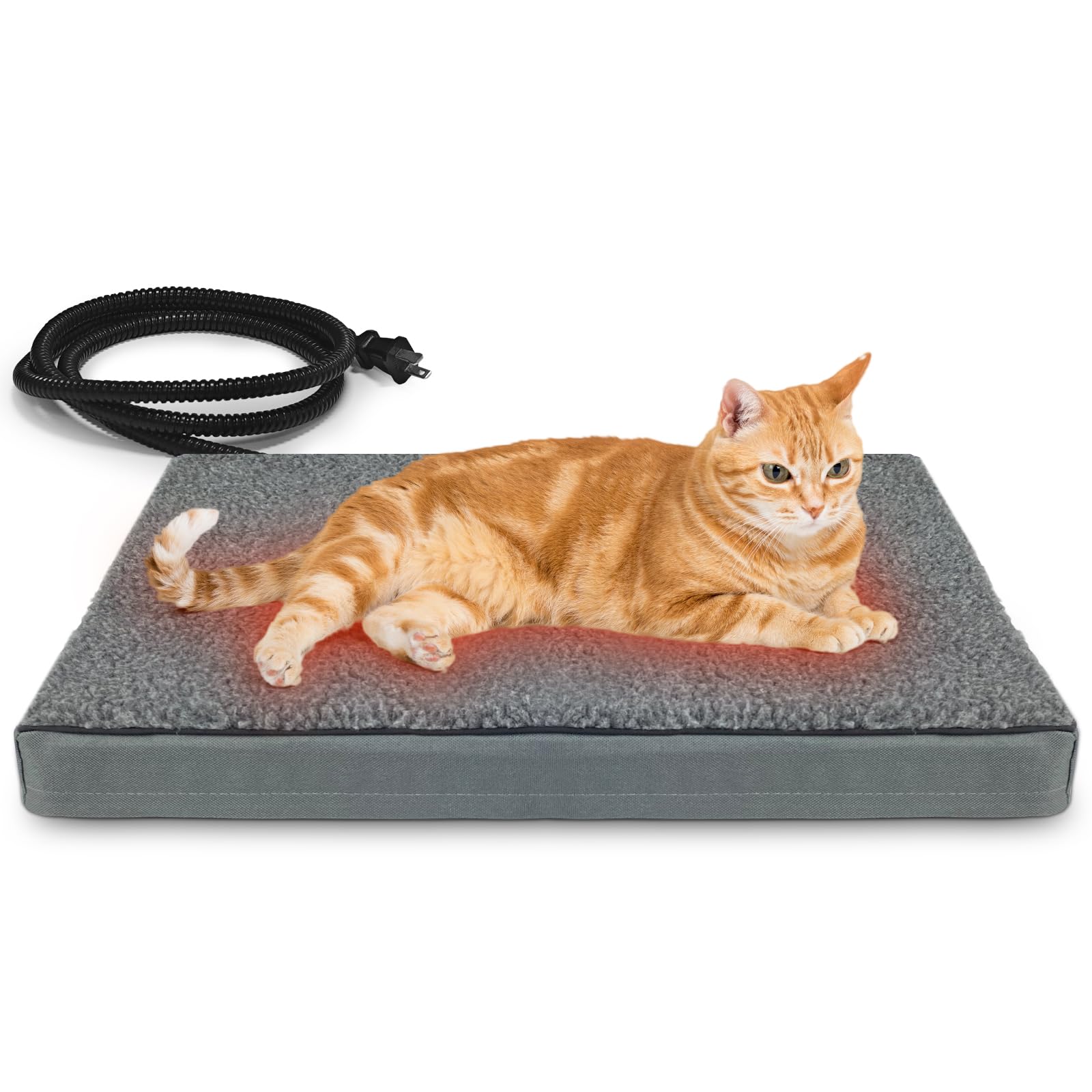
The AUPETEK bundle includes a separate foam bed and a standalone heating pad, giving you the flexibility to use the heating pad inside other shelters while keeping the foam bed for indoor use or as a standalone warm surface. The foam bed uses 1.8-inch high-density support foam with a sponge core, which provides the thickest cushioning of any pad in this list — helpful for older cats with joint stiffness. The heating pad itself is MET-certified with two built-in bi-metal thermostats that maintain a surface temperature between 95°F and 108°F.
The foam bed dimensions are 20 inches by 16 inches with the foam thickness at 1.8 inches. The waterproof liner sits between the foam and the outer polyester cover, protecting the interior from accidents and ground moisture. The heating pad is placed on top of the foam bed, so the cat lies directly on the warm surface rather than feeling warmth through the foam — this concentrates heat against the body. The outer cover is washable, though the foam core should be spot-cleaned only.
This system is best for a sheltered outdoor location like a covered porch or a garage, where the foam bed won’t get rain-soaked. The maximum weight capacity of 75 pounds is generous and means even a large Maine Coon breed will not compress the foam to the point of losing insulation value. The main drawback is that the two separate pieces can shift apart if the cat is active during sleep. Some owners choose to attach the heating pad to the foam bed with elastic straps or safety pins to keep the assembly aligned.
Why we love it
- 1.8-inch memory foam is the thickest padding for joint relief in this range
- MET-certified pad with dual thermostats provides redundant overheat protection
- Separate pieces allow flexible use of the heating pad in multiple shelters
Good to know
- Foam bed and heating pad can shift apart during use — may need securing
- Foam core is not machine washable; only the outer cover is removable
FAQ
Will a self-warming bed alone keep a cat warm at freezing temperatures?
How often should I replace an outdoor cat bed or heating pad?
Can I use an indoor heated bed outside on a covered porch?
Stray cats ignore the new shelter — how do I get them to use it?
Final Thoughts: The Verdict
For most caregivers managing outdoor cats, the self warming cat bed for outdoor cats winner is the MEWTOGO Heated Cat House because it combines a full weatherproof shelter with a thermostatically controlled heating pad and a rear safety exit in one ready-to-use package. If you need a smaller heated cave that can move between a covered porch and an indoor spot, grab the K&H Thermo-Pet Cave. And for the most secure electrical protection at a budget-friendly tier, nothing beats the PETNF Outdoor Heating Pad with its steel-encased chew guard and V-0 flame-retardant construction.