
A polished show ring finish or a lean, market-ready carcass doesn’t happen by luck. The difference between a ribbon and a third-place slot often lives inside the feed bag — specifically, the protein percentage, the fiber balance, and whether the mineral profile supports top-line muscle without packing on wasted belly fat. Show goats have uniquely high metabolic demands, and generic livestock rations almost always miss the mark, leaving you with a coat that lacks bloom or a frame that stalls out mid-growth.
I’m Mo Mahin — the founder and writer behind Furric. I’ve spent years cross-referencing feed tags, poring over ruminant nutrition research, and matching specific ingredient lists to real-world owner results reported across competitive show circuits.
After working through the data, I’ve filtered down the options to seven standout contenders that consistently deliver the right amino acid profile, copper-to-zinc ratio, and palatability for a winning herd. This complete guide to the best show goat feed covers exactly what to look for and why it matters.
How To Choose The Best Show Goat Feed
Selecting a show goat feed isn’t just about grabbing a bag off the shelf with “goat” on the label. The wrong ration can cause ruminal upset, poor coat quality, or excess fat deposition that judges will immediately dock. Here are the three most important specs to check before you buy.
Protein level and amino acid profile
Show goats in active growth or lactation need between 15% and 18% crude protein. Anything below 14% is maintenance-level feed that won’t support the kind of top-line muscle development you need for a competitive frame. Lysine and methionine are the limiting amino acids — look for a feed that either includes them directly or sources them from high-quality soybean meal or alfalfa.
Copper-to-zinc ratio and hoof support
Goats are sensitive to copper toxicity, but they also need adequate copper for coat pigmentation and immune function. The ideal ratio in a show feed is roughly 4:1 copper to zinc. Zinc supports hoof wall integrity, and a brittle hoof will ruin an otherwise perfect stance assessment. Avoid feeds formulated primarily for sheep, as they deliberately remove copper.
Formulated for show vs. maintenance growth
Textured sweet feeds offer higher palatability but can lead to selective eating if goats pick out the grains. Pellets force a consistent intake of every nutrient in the bag. Whole-grain mixes provide slower starch release, but they’re harder to balance precisely. For show purposes, a uniform pellet or a tightly controlled textured ration with added probiotics is generally the safest route.
Quick Comparison
On smaller screens, swipe sideways to see the full table.
| Model | Category | Best For | Key Spec | Amazon |
|---|---|---|---|---|
| New Country Organics Goat Pellets | Premium Pellet | Organic show prep & milkers | 15% protein, certified organic | Amazon |
| Manna Pro Goat Kid Milk Replacer | Milk Replacer | Smooth kid transition post-colostrum | 23% protein, Opti-Gut probiotics | Amazon |
| Stampede Alfalfa Pellets | Forage Pellet | Supplementing roughage on show days | 100% pure alfalfa, no binders | Amazon |
| RIDLEY 16826 Sheep/Goat Block | Mineral Block | Pasture mineral supplementation | 33lb free-choice block | Amazon |
| Purina All Stock Sweet Feed | Sweet Textured | Multi-species herd feeding | High energy sweet feed, 50lbs | Amazon |
| H and H All Natural Sheep and Goat Feed | Soy-Free Mix | Sensitive digestion mixed herds | Soy-free, corn-free, 20lb bag | Amazon |
| Wholesome Harvest All-Grain Goat Feed | Balanced Grain | Everyday 16% protein maintenance | 16% protein, plant-based grain | Amazon |
In‑Depth Reviews
1. New Country Organics Goat Feed Pellets

This 40-pound pellet from New Country Organics is as close to a no-compromise show ration as you will find. Formulated at 15% crude protein, it sits right in the maintenance-to-moderate-growth sweet spot, and the protein comes entirely from organic, non-GMO, soy-free grains. That matters because soy is a common allergen trigger in goats that can cause bloat or loose stools right before a show. The feed is also fortified with probiotics and chelated minerals, which means the copper and zinc are more bioavailable for coat gloss and hoof hardness.
The bag includes clear feeding guidelines: 1–2 pounds per goat daily for maintenance, and up to 1 pound per 3 pounds of milk production for lactating does. This precision is rare in a bagged feed and makes it easy to match intake to your show schedule. Pellets are uniform in size, which discourages selective eating — every bite delivers the same nutrient profile. The paper bag is sturdy enough to store in a dry tack room without tearing prematurely at the seams.
Some owners note that the 15% protein ceiling may not be enough for peak growth on heavy-muscle breeds like Boers during maximum frame fill. If your goat is in a rapid lean-gain phase, you may want to top-dress with a high-protein supplement. But for everyday conditioning during show prep, this is the cleanest, most balanced bag you can buy without mixing your own.
Why we love it
- Certified organic and non-GMO with zero soy fillers
- Probiotic fortification supports steady digestion on show day
- Uniform pellets eliminate selective eating behavior
Good to know
- 15% protein may require top-dressing for peak muscle fill
- Paper bag needs dry storage to avoid moisture damage
2. Manna Pro Goat Kid Milk Replacer

Show success starts before weaning. Manna Pro’s Goat Kid Milk Replacer delivers 23% all-milk protein and 26% fat — numbers that mirror the rich composition of natural goat milk. That high fat content is critical for energy reserves in young kids, especially if they will face the stress of early handling, hauling, and show ring exposure. The formula includes Manna Pro’s Opti-Gut system, a blend of probiotics and prebiotics designed to colonize the gut with beneficial bacteria from day two through weaning.
Powder form means you mix fresh bottles for each feeding, which takes extra effort but ensures every meal is as fresh as possible. The powder dissolves quickly with minimal clumping compared to generic replacers, and the all-milk protein base avoids the intestinal upsets that plant-based proteins cause in neonatal kids. Each 8-pound bag yields roughly 10–12 gallons of mixed milk replacer, depending on feeding rate, so it’s a practical quantity for a small to medium kidding season.
Owners raising show kids consistently report smoother coats and fewer scouring episodes with this formula versus economy brands. The main tradeoff is cost per pound — it lands squarely in premium territory. Also, it is strictly a milk replacer; once kids are on solid feed, you will need to transition to a grower pellet. For the earliest stages of a show career, though, this is the foundation that sets the frame.
Why we love it
- 23% all-milk protein matches natural composition
- Opti-Gut probiotics reduce scouring in sensitive kids
- Quick-mix powder saves bottle-prep time
Good to know
- Premium cost per pound vs. generic replacers
- Only suitable for pre-weaning stage
3. Stampede Alfalfa Pellets

Alfalfa is the gold standard forage for show goats — high in calcium, moderate in protein, and packed with the carotene that supports coat bloom. Stampede’s version takes sun-cured alfalfa and compresses it into pellets with no binders, no molasses, and no grain fillers. Each 40-pound bag is essentially concentrated hay, which is useful for goats that waste loose hay or for days when turnout pasture is limited. The sun-curing process retains more natural vitamin content than kiln-dried alternatives.
These pellets work best as a supplemental forage source rather than a complete feed. At roughly 14–16% protein depending on the cutting, they should be paired with a grain-based show ration to hit the 16–18% protein target needed for active muscle gain. The lack of binders means the pellets break down quickly in water — if you soak them, they return to a mash that mimics wet hay, which some goats prefer during hot weather when dry feed intake drops.
Owners using Stampede report that after a 30-day transition, goats show noticeably deeper, glossier coats and firmer stool consistency compared to goats fed coastal hay alone. The 40-pound bag is heavy but compact, storing easily in a standard feed bin. Just note that because it is 100% alfalfa, it is higher in calcium, so it is not suitable as the sole ration for mature bucks prone to urinary calculi unless balanced with a low-calcium grain.
Why we love it
- Zero binders or grain fillers — just pure alfalfa
- Sun-cured process preserves natural vitamins for coat health
- Pellets reduce waste compared to loose hay
Good to know
- Requires pairing with grain feed to hit show protein targets
- High calcium — use caution with mature bucks
4. RIDLEY 16826 Sheep/Goat Block
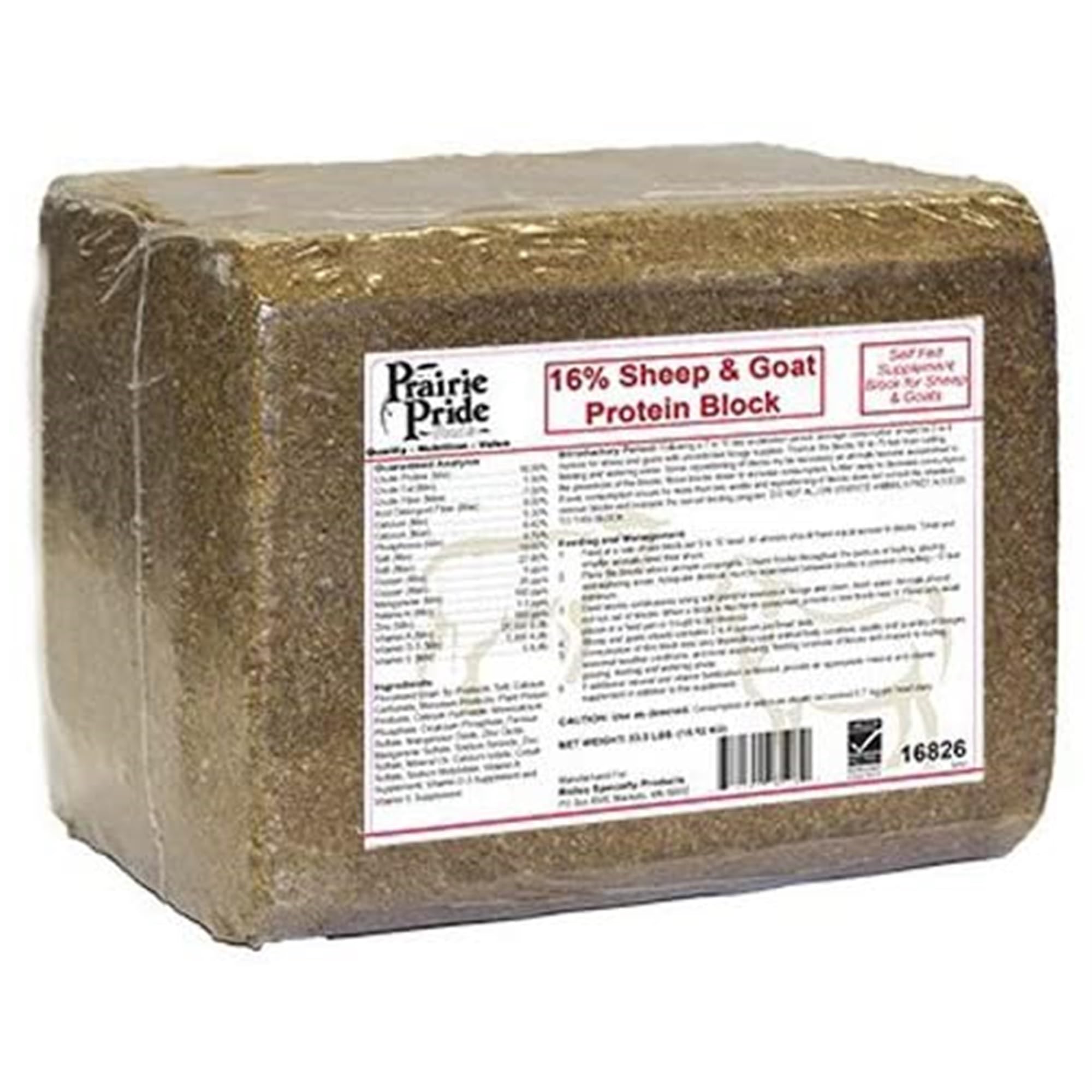
A mineral block is not a complete feed, but managing mineral intake is just as important as hitting protein numbers for show condition. The RIDLEY 16826 block is 33 pounds of compressed minerals designed for sheep and goats, providing a free-choice source of salt, calcium, phosphorus, and trace minerals. Goats that lick this block steadily typically show better hoof integrity and a shinier hair coat within a few weeks, because the consistent zinc and copper intake supports keratin production.
The block format is exceptionally convenient for pastured herds: you set it in a feeder or hang it, and the goats self-regulate. No scooping, no wastage. At 32.1 pounds per block, a single unit lasts a small herd several weeks. However, because the block is formulated for both sheep and goats, the copper level is deliberately moderate — sheep are copper-sensitive, so this block avoids the higher copper levels that dedicated goat minerals often carry. For goats on intensive show rations that already include chelated minerals, this block is a fine complement rather than a mineral source.
Note that the Amazon listing metadata references “sanding blocks” and air-powered tools — this appears to be a listing error. The actual product shipped is the livestock mineral block, and owners confirm it matches the brown, barrel-shaped block shown in images. If you buy this, check the physical label upon arrival to confirm it is the feed-grade mineral block intended for livestock, not construction supplies.
Why we love it
- Free-choice format eliminates daily mineral mixing
- 33lb block lasts weeks even for multiple goats
- Supports hoof and coat quality through steady trace mineral intake
Good to know
- Moderate copper level — not a high-copper goat-specific mineral
- Amazon listing metadata contains conflicting product descriptions
5. Purina All Stock Sweet Feed

Purina’s All Stock Sweet Feed is a textured, high-energy ration formulated for cattle, horses, sheep, and goats. It is a sweet feed, meaning it includes molasses-coated grains that boost palatability — useful when your show goat is a picky eater during travel or stress. The protein level is intentionally modest to suit maintenance across multiple species, so while it works as a base ration for a mixed herd, it will not push growth hard enough on its own for a competitive show animal.
The texture encourages chewing and saliva production, which buffers rumen pH and reduces the risk of acidosis — a real concern when goats are fed high-starch pellets without adequate forage. Each 50-pound bag is widely available and affordably priced for its volume. Owners feeding small herds appreciate that one bag feeds horses, goats, and sheep simultaneously, reducing inventory complexity in the feed room.
For show purposes, plan to top-dress this sweet feed with a protein concentrate or feed it alongside a 16–18% pellet. The molasses coating, while appealing, does mean slightly higher sugar intake; monitor your goat’s body condition to avoid excess fat deposition around the shoulders and loin — two areas judges examine closely. This feed works best as the energy-dense component of a blended ration, not the sole source.
Why we love it
- High palatability from molasses coating — great for picky show goats
- Versatile for multi-species herds
- Widely available and cost-effective per pound
Good to know
- Protein too low for sole show ration — needs top-dressing
- Higher sugar content can cause fat deposits if overfed
6. H and H All Natural Sheep and Goat Feed

For show goats with known digestive sensitivity to soy or corn, the H and H All Natural Feed eliminates both without sacrificing nutritional density. This 20-pound bag is a seed-based, mixed-herd ration that relies on alternative protein sources. It is freshly milled, which means the oils in the seeds have not had time to oxidize, preserving the natural vitamin E content that supports immune health during the stressful show season. The inclusion of Fertrell-brand vitamins and minerals adds a traceable, premium mineral package that is far cleaner than generic premixes.
Owners feeding this to mixed herds of sheep and goats note that goats readily clean up the ration despite the absence of molasses coatings, which suggests the seed base is naturally palatable. The soy-free formulation reduces bloating episodes that commonly occur when goats transition to soy-heavy commercial pellets. With the 20-pound bag size, it works best for small herds or as a trial bag to see how your animals respond before committing to larger volumes.
The main limitation is scale: 20 pounds disappears quickly if you have more than three or four goats, and the price per pound runs higher than standard show feeds. It is also a mixed-herd formula, so you may need to add a targeted copper supplement if your goats show signs of copper deficiency, such as faded coat color or poor hoof quality over time. For sensitive goats, though, this is a clean, low-risk starting point.
Why we love it
- Absolutely no soy or corn — ideal for sensitive digestion
- Freshly milled seeds retain natural vitamin E levels
- Fertrell minerals provide traceable quality
Good to know
- 20lb bag is small for larger herds
- Mixed-herd formula may need a copper booster for goats
7. Wholesome Harvest All-Grain Goat Feed
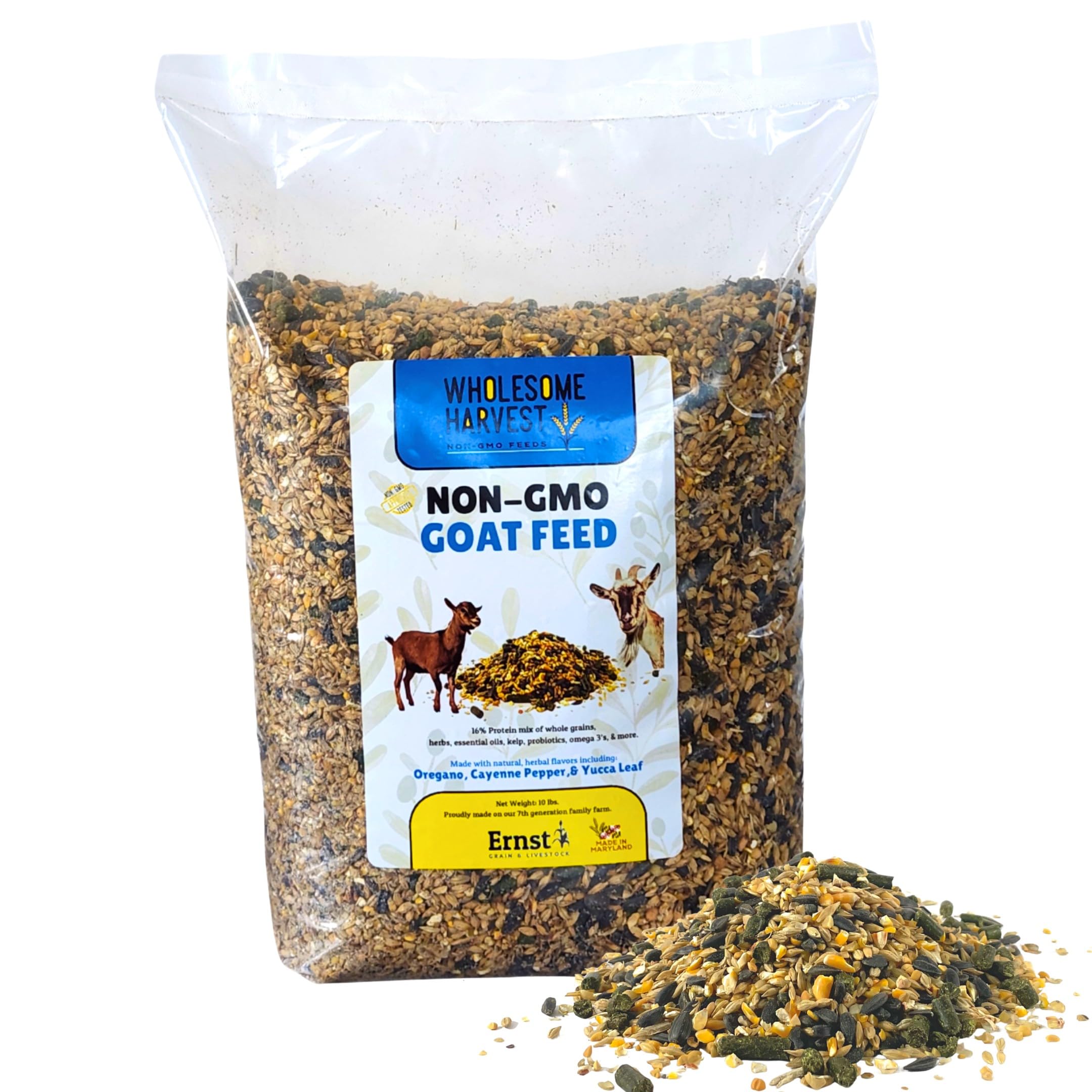
If you are looking for a straightforward, wallet-friendly ration to cover the daily nutritional baseline, Wholesome Harvest delivers a clean 16% protein from plant-based grains. It is supplemented with probiotics, kelp, and omega-3s — bonuses that support gut motility and coat shine without complicated ingredient lists. The all-grain base means it provides steady energy release throughout the day, which is helpful for goats on pasture that need sustained rumen fermentation.
The 10-pound bag size is small enough to test a new feed without committing to a 50-pound investment, and the non-GMO claim on the label aligns with the standards many show exhibitors prefer. Owners switching from lower-protein maintenance feeds report noticeable improvements in muscle definition and top-line firmness within two to three weeks. The kelp inclusion adds natural trace minerals that support thyroid function and metabolic rate.
Because this is a 10-pound bag, the cost per pound is higher compared to buying in bulk. It is best suited for owners with one or two goats, or as a transitional feed when you are introducing a new protein level gradually. The plant-based protein sources are adequate, but for maximum growth rates, you may need to combine this with a higher-protein alfalfa pellet or a soybean meal top-dress. For a start, however, this is a solid, honest feed without fillers.
Why we love it
- Solid 16% protein from clean plant-based grains
- Includes probiotics and kelp for digestion and coat gloss
- Small bag size perfect for testing or small herds
Good to know
- 10lb bag is economical upfront but higher cost per pound
- Plant-based protein may need boosting for peak show growth
FAQ
How much protein does a show goat need in its daily feed?
Can I feed my show goat the same ration I give my sheep?
What is the difference between textured sweet feed and pellets for show goats?
Why does my goat’s feed need probiotics?
Final Thoughts: The Verdict
For most exhibitors, the best show goat feed winner is the New Country Organics Goat Pellets because it combines a clean 15% protein base with certified organic, soy-free ingredients and probiotic support — all in a uniform pellet that prevents selective eating. If you need specialized gut health for kids from day two through weaning, grab the Manna Pro Goat Kid Milk Replacer. And for a pure forage supplement that boosts coat bloom without fillers, nothing beats the Stampede Alfalfa Pellets.