
A large aquarium is a complex ecosystem, and the single most critical piece of hardware keeping its inhabitants alive is the heater. A unit that cycles erratically or fails entirely can crash your water temperature in hours, stressing or killing sensitive fish, corals, and plants. With tanks over 50 gallons, the margin for error shrinks dramatically, and a sub-1000 watt unit simply cannot maintain stable temps across that water volume without the right design.
I’m Mo Mahin — the founder and writer behind Furric. I’ve spent years analyzing the commercial aquarium equipment market, comparing wattage-to-volume ratios, thermostat accuracy specs, material durability data, and long-term owner reliability reports to separate the heaters that actually hold a set point from those that drift.
Whether you are stocking a discus breeding tank or a mixed reef setup, picking the wrong unit can be a disaster. This guide breaks down the top performing aquarium heaters for large tanks based on real technical specifications and aggregate owner feedback.
How To Choose The Best Aquarium Heaters For Large Tanks
Selecting a heater for a large tank is not just about buying the highest wattage unit you can find. You must match the heater’s output to your specific water volume, consider the material’s resistance to saltwater corrosion, and evaluate how precisely the thermostat controls temperature swings.
Wattage Guidelines for Large Tanks
The general rule is 3 to 5 watts per gallon, but that range shifts depending on ambient room temperature and tank placement. A 75-gallon tank in a cold basement might need a full 375 watts, while the same tank in a heated living room could do fine with 250 watts. For tanks over 100 gallons, consider using two smaller heaters placed at opposite ends for more even heat distribution rather than one massive unit.
Heating Element Material: Glass vs. Quartz vs. Titanium
Standard glass heaters are affordable but shatter easily and corrode faster in saltwater. Quartz glass heaters offer better thermal conductivity and higher shatter resistance, making them a safer mid-range choice. Titanium heaters are nearly indestructible and completely corrosion-resistant, which is why they dominate the reef and high-end freshwater market, though they come at a premium price.
Thermostat Accuracy and Controller Type
Built-in bimetallic strip thermostats drift over time and offer poor accuracy. Digital controllers with a separate temperature probe maintain set points within ±1°F. For large systems, an external controller with a remote probe is the gold standard — it lets you place the heater itself anywhere while the sensor sits in the main water flow for a true average reading.
Quick Comparison
On smaller screens, swipe sideways to see the full table.
| Model | Category | Best For | Key Spec | Amazon |
|---|---|---|---|---|
| HiTauing 300W | Mid-Range | Budget-minded 40-75 gal setups | Digital display, 8.2 ft cord | Amazon |
| Marineland Precision 250W | Mid-Range | Reliable mica core for up to 70 gal | Mica core + mesh element | Amazon |
| Aqueon 200W | Mid-Range | Precise 1°F setting for up to 75 gal | Shatter-resistant glass, 200 watt | Amazon |
| hygger 800W | Premium | Large tanks 66-135 gal with digital controller | Explosion-proof quartz, 10.1 ft cord | Amazon |
| hygger Titanium 200W | Premium | Saltwater/reef tanks needing shatterproof build | Titanium tube, ±0.5°C accuracy | Amazon |
In‑Depth Reviews
1. HiTauing Aquarium Heater 300W

The HiTauing 300W packs a digital LED display and dual safety protections — an over-max temp warning that triggers HH code auto-stop at 94°F and an out-of-water E1 alarm — into a 10.6-inch quartz body rated for 40 to 75 gallon tanks. The nickel-chromium heating wire is encased in an explosion-proof ABS shell with quartz sand filler, offering better drop resistance than standard glass units.
The variable temperature range spans from 63°F to 94°F with one-degree increments, while a color-coded LED (red/heating, green/steady) gives instant status feedback. Users note the 8.2-foot power cord offers flexibility for larger stands, though the controller must remain above water as it is not fully submersible. The included two suction cups hold well on clean glass, but the mounting bracket design feels light compared to premium competitors.
For the price point, the dual safety cutoffs and digital readout make this a strong entry-level option for mid-range large tanks. The ABS plastic housing avoids the breakage risk of all-glass heaters, though long-term durability in saltwater environments has yet to match titanium builds. It is a solid choice for freshwater planted tanks and community setups where budget is a primary factor.
Why we love it
- Digital LED display with real-time temperature readout
- Automatic shutoff on over-temp and low water level
- Quartz sand reinforced housing adds shatter resistance
Good to know
- Controller must stay above water line
- Suction cups may lose grip over time on textured glass
- ABS shell, not titanium — less corrosion resistant for reef tanks
2. Marineland Precision Submersible Heater 250W
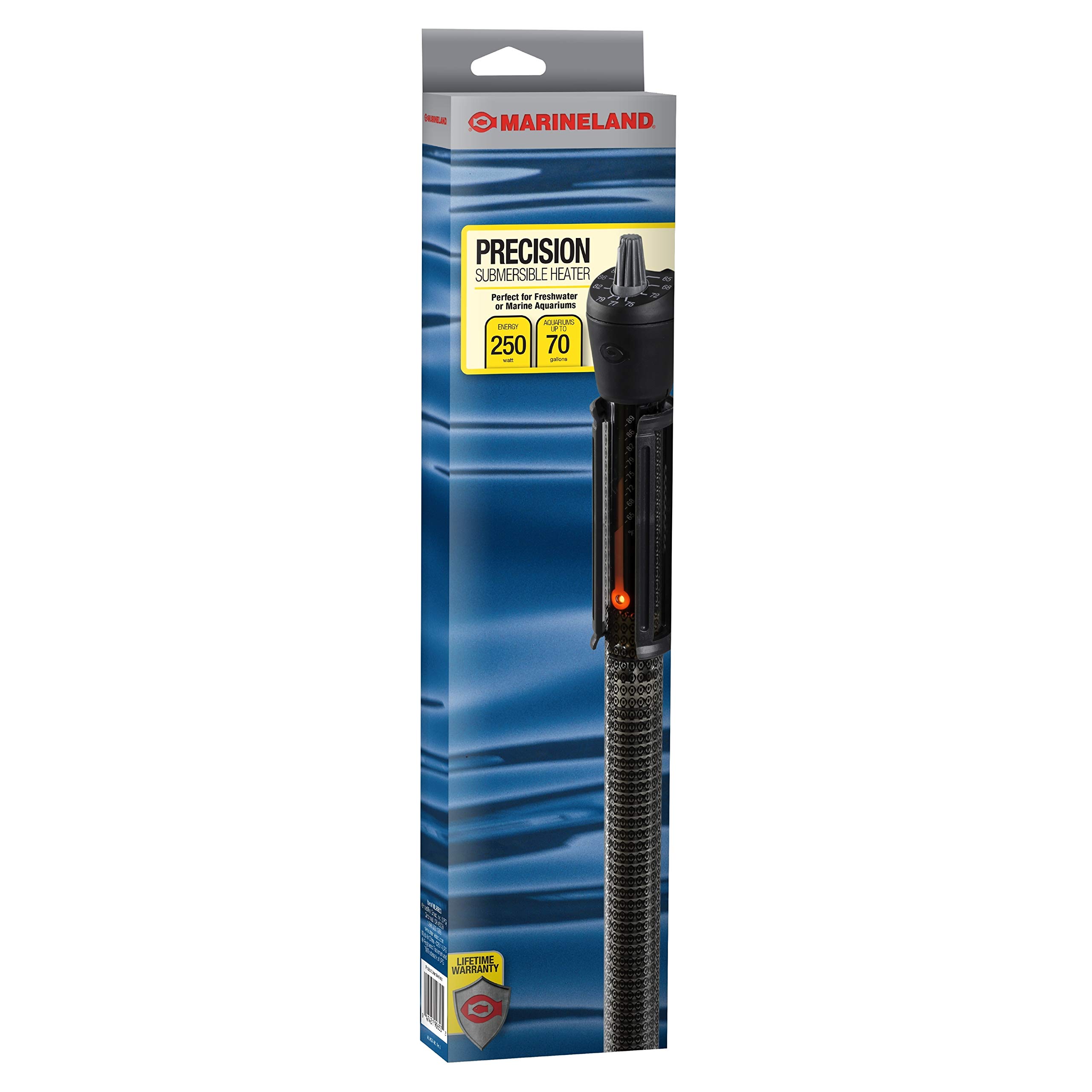
The Marineland Precision 250W differentiates itself from the glass-heater crowd with a mica core surrounded by a mesh heating element, a design that transfers heat more efficiently and with greater durability than basic resistance wire. Rated for aquariums up to 70 gallons, this fully submersible unit features a click-dial that adjusts the temperature one degree per rotation, giving tactile feedback without guessing.
The thermal switch automatically cuts power when internal temperature exceeds a preset threshold and resets once it cools — a mechanical failsafe that does not rely on electronics. Owner feedback consistently highlights the heater’s long service life, with many users reporting years of stable operation without drift. The sliding scale on the side and the top-dial view provide two angles to read the set temperature, which helps during placement in tight sumps or behind decor.
At 11.5 ounces and 15.8 inches long, the form factor is slender enough to fit vertically or at a shallow angle in most tanks. The mica core avoids the hot-spot cracking issues seen in pure quartz heaters when placed near strong flow. For the aquarist who values proven mechanical reliability over flashy digital features, this unit represents a dependable backbone for a medium-large freshwater or saltwater system.
Why we love it
- Mica core with mesh element for superior heat transfer
- Mechanical thermal switch auto-resets after overheat
- Dual viewing angles for temperature setting
Good to know
- No digital display — relies on analog dial and scale
- Suction cups may need replacement after extended use
- Not designed for tanks over 70 gallons
3. Aqueon Submersible Heater 200W

The Aqueon 200W heater is built with shatter-resistant glass and an electronic thermostat that stops heating precisely when the set temperature is reached, rather than overshooting like bimetallic designs. It covers up to 75 gallons with a set-point range of 68°F to 88°F in one-degree Fahrenheit adjustable increments, and an integrated LED illuminates during active heating for immediate status feedback.
Owner reports consistently praise the unit’s temperature hold accuracy, with users on 75-gallon setups noting minimal fluctuation once the target is reached. The automatic safety shutoff and overheat protection provide peace of mind, and the limited lifetime warranty from a major brand reduces long-term replacement cost risk. Some users note the dial can be slightly imprecise — the click-stops are defined but the printed scale is small — so using an external thermometer to confirm the set point is recommended.
Made in the USA and designed for both fresh and saltwater, this heater’s 200-watt output is on the lower side for a full 75-gallon tank in a cold room, so it performs best in moderate ambient temperatures or as one half of a dual-heater setup. For the aquarist who prioritizes a trusted name, a lifetime warranty, and proven customer support, this is a solid medium-large tank solution.
Why we love it
- Limited lifetime warranty from a major aquarium brand
- Electronic thermostat stops at set temp, no overshoot
- Shatter-resistant glass construction
Good to know
- 200 watts is modest for 75 gallons in cold climates
- Temperature dial scale is small and hard to read
- No digital display — status only via LED glow
4. hygger Aquarium Heater 800W with Digital Controller

The hygger 800W model is engineered for serious large tanks from 66 up to 135 gallons, using explosion-proof quartz glass with a nickel-chromium heating wire that ramps up temperature quickly and distributes heat evenly. The standout feature is the external digital LED controller that mounts on the tank rim, keeping the adjustment interface out of the water while displaying current temperature, set temperature, and working power simultaneously.
Safety protection is comprehensive: the unit automatically stops heating if water exceeds 94°F (HH error code), drops below the minimum immersion level (Auto shut off + alarm), or detects a low-temperature condition (LL code). The included heater guard made of high-quality PC plastic prevents direct contact between fish and the hot quartz surface, reducing burn risk. The 10.1-foot power cord is generous for routing behind large cabinets.
Owners running 100+ gallon tanks report stable temperature hold with minimal variance, and the three suction cup mounting system holds securely even in high-flow sump environments. The external controller eliminates the need to pull the heater out for adjustments, a real convenience for reef keepers. The primary consideration is that the heater itself is 10.8 inches — shorter than some lower-wattage units — which helps fit into smaller sump chambers despite the high output.
Why we love it
- External digital controller with dual temperature display
- Multiple error-code safety alarms for overheat and low water
- Heater guard included to prevent fish burns
Good to know
- Heater element is quartz, not titanium — not fully shatterproof
- Controller requires edge mounting; not fully remote
- Alarm system can be loud during error states
5. hygger Pinpoint Saltwater Heater 200W Titanium

The hygger Pinpoint heater abandons glass entirely in favor of a heavy-duty titanium tube, making it completely shatterproof and highly corrosion-resistant — a critical advantage for saltwater reef tanks where stray voltage and metal leaching are constant concerns. The separate external thermostat controller with dual LCD display shows the tank temperature on the top and the set point on the bottom, with control accuracy of ±0.5°C (±0.9°F).
The heater must be installed horizontally, and the recommendation to place it near strong water flow ensures even heat distribution throughout the tank. Owners of discus and reef setups consistently report near-perfect temperature hold at high set points like 90°F, with most seeing no more than one degree of fluctuation even during cooler nights. The heater turns back on when the temperature drops by one degree, maintaining a tight band around the target.
While the 200-watt version is better suited for 20-45 gallon tanks, the hygger line offers higher wattage variants for large systems. Some users have reported controller failures after a few months, though the seller has been responsive with replacements under warranty. For the aquarist running a high-value saltwater or discus tank where temperature stability and absolute shatter-resistance are non-negotiable, this titanium design sets the standard.
Why we love it
- Shatterproof titanium tube — zero glass breakage risk
- ±0.5°C digital thermostat accuracy
- Dual LCD display shows tank temp and set point
Good to know
- 200W version only covers up to 45 gallons
- Horizontal placement required for proper function
- Some users experienced early controller failure
FAQ
How many watts do I need per gallon for a large tank?
Is glass or titanium better for saltwater reef tanks?
Can I use two heaters instead of one big unit in my large tank?
What does the error code HH mean on my heater display?
Should I leave my aquarium heater on all the time?
Final Thoughts: The Verdict
For most gardeners, the aquarium heaters for large tanks winner is the Marineland Precision 250W because the mica core delivers reliable heat transfer and the mechanical thermal switch provides foolproof overheat protection without relying on electronics. If you want a digital interface with error-code diagnostics for a 100+ gallon system, grab the hygger 800W with external controller. And for a reef or discus setup where shatter-resistance and ±0.5°C accuracy are non-negotiable, nothing beats the hygger Pinpoint Titanium 200W.