
A harness that doesn’t stop pulling is just an expensive collar. Every owner of a strong dog knows the frustration: you attach the leash, step out the door, and immediately feel your shoulder yank forward as your dog lunges after a squirrel. The right pet harness changes that dynamic entirely, shifting leverage from the neck to the chest where you actually have control.
I’m Mo Mahin — the founder and writer behind Furric. I’ve spent years studying market data, comparing tensile-strength ratings, analyzing breathability layering, and cross-referencing real owner feedback on no-pull geometry across hundreds of harness models.
Whether you’re training a 70-pound puller or outfitting a calm senior dog for daily walks, choosing the right best pet harness means understanding how chest-clip leverage, strap adjustability, and material density work together to prevent escapes and eliminate choking.
How To Choose The Best Pet Harness
The pet harness market is flooded with options that look identical on a shelf but perform completely differently once your dog lunges. You need to focus on the structural details that separate a training tool from a fashion accessory with straps.
Front Clip vs. Back Clip: Where Control Actually Happens
A back-clip harness turns your dog into a sled dog — the attachment point sits behind the center of gravity, so pulling feels natural and rewarding. A front-clip harness connects the leash at the sternum, so when your dog pulls, the harness redirects their front end sideways toward you. This subtle rotation discourages pulling without any pain or choking. For training or strong pullers, dual-clip models that offer both front and back rings give you the flexibility to switch between training mode and casual walk mode.
Sizing Beyond the Label: Chest Girth Is the Only Number That Matters
Breed labels like “Large” or “Medium” vary wildly between brands. A Golden Retriever might wear a Large from one manufacturer and an XL from another. Always measure your dog’s chest girth — the widest part behind the front legs — and compare it directly to the harness’s size chart before ordering. Neck strap circumference matters too, especially for deep-chested breeds like Greyhounds or Great Danes, where a too-short neck strap can rub the throat raw.
Material Density and Buckle Strength: Where Cheap Harnesses Fail
Polyester oxford cloth and nylon webbing with bar-tack stitching hold up to daily pulling far better than thin polyester mesh. Quick-release buckles should use reinforced plastic or metal hardware — cheap buckles snap at the worst moment, usually when your dog spots a squirrel mid-walk. Reflective stitching or trim is a non-negotiable safety feature for evening walks, not a decoration.
Quick Comparison
On smaller screens, swipe sideways to see the full table.
| Model | Category | Best For | Key Spec | Amazon |
|---|---|---|---|---|
| Carhartt Nylon Duck No Pull Dog Harness | Premium | Rugged daily use in wet conditions | 500-denier polyester with DWR | Amazon |
| Tactical Dog Harness and Leash Set (MOOGROU) | Premium | Full training kit with patches & leash | 4 quick-release buckles, 2 D-rings | Amazon |
| AUNZO No Pull Dog Harness | Mid-Range | Heavy large breeds needing neck buckle | Oxford surface, 2 metal clips | Amazon |
| rabbitgoo Dog Harness No Pull | Mid-Range | Medium dogs, no-choke training walks | 4 adjustable straps, 2 fast-release buckles | Amazon |
| Auroth Tactical Dog Harness | Entry-Level | Budget tactical setup with Molle system | Nylon with 4 metal adjustment rings | Amazon |
In‑Depth Reviews
1. Carhartt Nylon Duck No Pull Dog Harness

Carhartt brings its workwear DNA directly into the pet aisle with this nylon duck harness, and the difference is immediate in the hand. The 500-denier polyester with Rain Defender DWR technology actively repels light rain, so a wet morning walk doesn’t leave the harness waterlogged and heavy. The martingale chest strap creates the no-pull function without needing a front clip — as your dog pulls forward, the chest strap tightens gently, discouraging lunging without choking the throat.
The over-the-head yoke design means no struggling to get a leg through straps, which matters when your dog is already excited about the walk. Four adjustability points — chest and belly straps — let you dial in the fit precisely around the ribcage. The spacer mesh backing on the interior prevents heat buildup, so your dog stays cooler during warmer walks. Reflective low-light stitching runs along the edges, offering visibility without bulky tape that can fray over time.
One trade-off: this is a back-clip only design. If you specifically want a front chest ring for redirection training, you’ll need to look at a dual-clip model. Also, the buckles are high-quality plastic rather than metal, though Carhartt’s reputation for durability suggests they’ll hold up under normal use. For owners who want a rugged, weather-resistant harness that looks and feels like serious equipment, this is the strongest daily driver in the list.
Why we love it
- Water-repellent fabric handles rain and mud without absorbing moisture
- Martingale chest strap reduces pulling without front-clip complexity
- Over-the-head design eliminates leg-threading struggle
Good to know
- No front chest clip for active redirection training
- Buckles are plastic, not metal, despite rugged fabric
2. MOOGROU Tactical Dog Harness and Leash Set
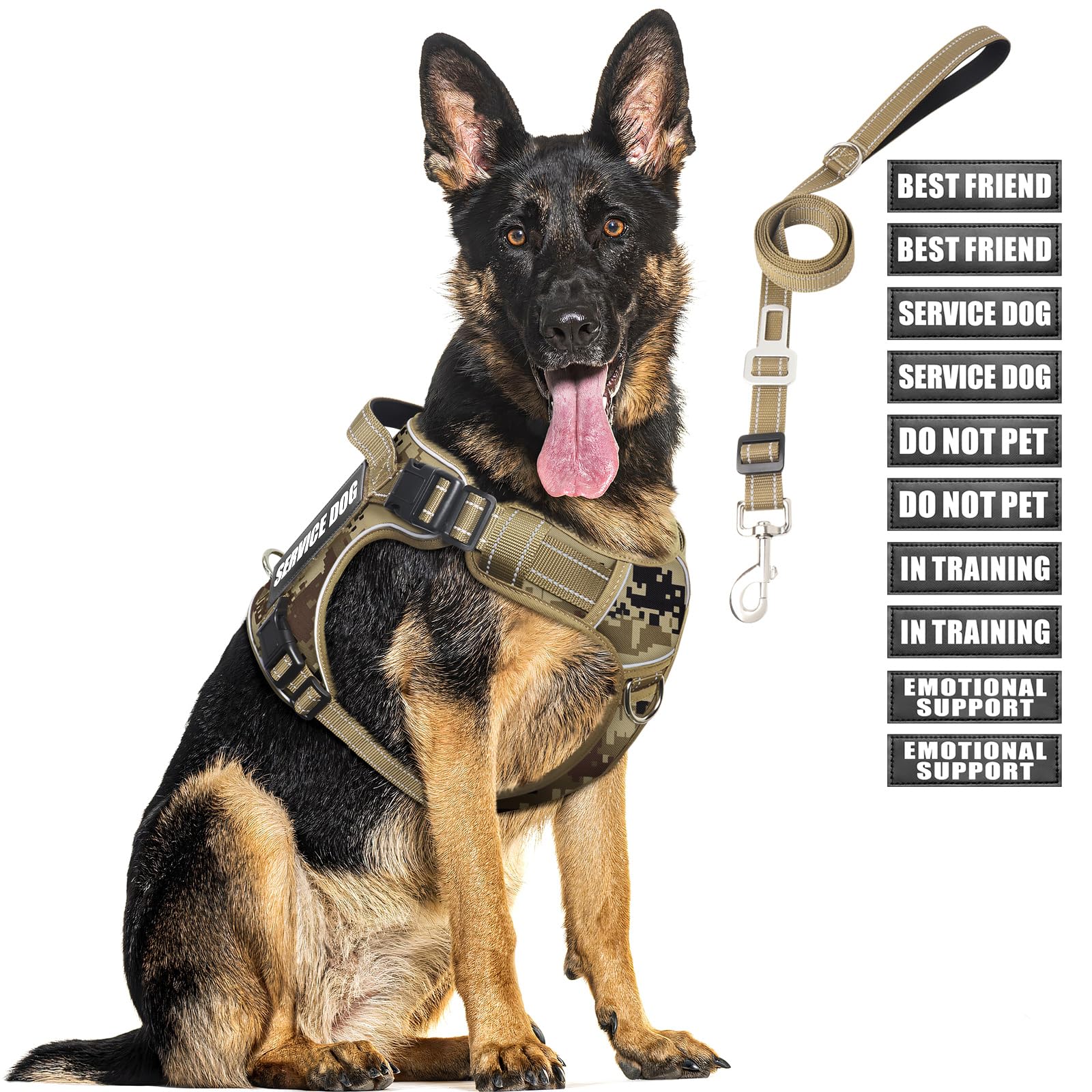
This is a complete system, not just a harness. The MOOGROU set includes a padded tactical vest, a leash that converts into a car seat belt tether, a transparent ID card window, and ten interchangeable patches — “SERVICE DOG”, “IN TRAINING”, “EMOTIONAL SUPPORT”, and “DO NOT PET” among them. That makes this the strongest option if you’re training a service dog or simply want to signal your dog’s temperament during public outings.
The harness uses four quick-release buckles, meaning you don’t have to pull anything over your dog’s head. You unclip both sides, lay the harness flat, wrap it around your dog, and snap it closed — a huge advantage for dogs who hate things going over their ears. Two metal D-rings provide both front-clip training control and a back-clip for casual walks. The soft padded handle on the back lets you lift or guide your dog without bending over, useful for navigating crowded sidewalks or helping an older dog up stairs.
The breathable air mesh lining keeps large breeds comfortable during longer training sessions, and the seat belt conversion means the leash doubles as a floor anchor in the car. One note: the harness runs slightly small, so if your dog falls between sizes on the chart, size up. The patches attach via Velcro panels that hold securely even during active movement. For owners who want everything in one box — harness, leash, patches, ID window — this set delivers serious value without cutting corners on stitching or hardware.
Why we love it
- Complete kit with harness, leash, ID window, and 10 patches
- Front and back metal D-rings for versatile training control
- Four-buckle design eliminates overhead pulling for head-shy dogs
Good to know
- Tends to run small — size up if between measurements
- Leash is included but basic compared to standalone models
3. AUNZO No Pull Dog Harness for Large Dogs
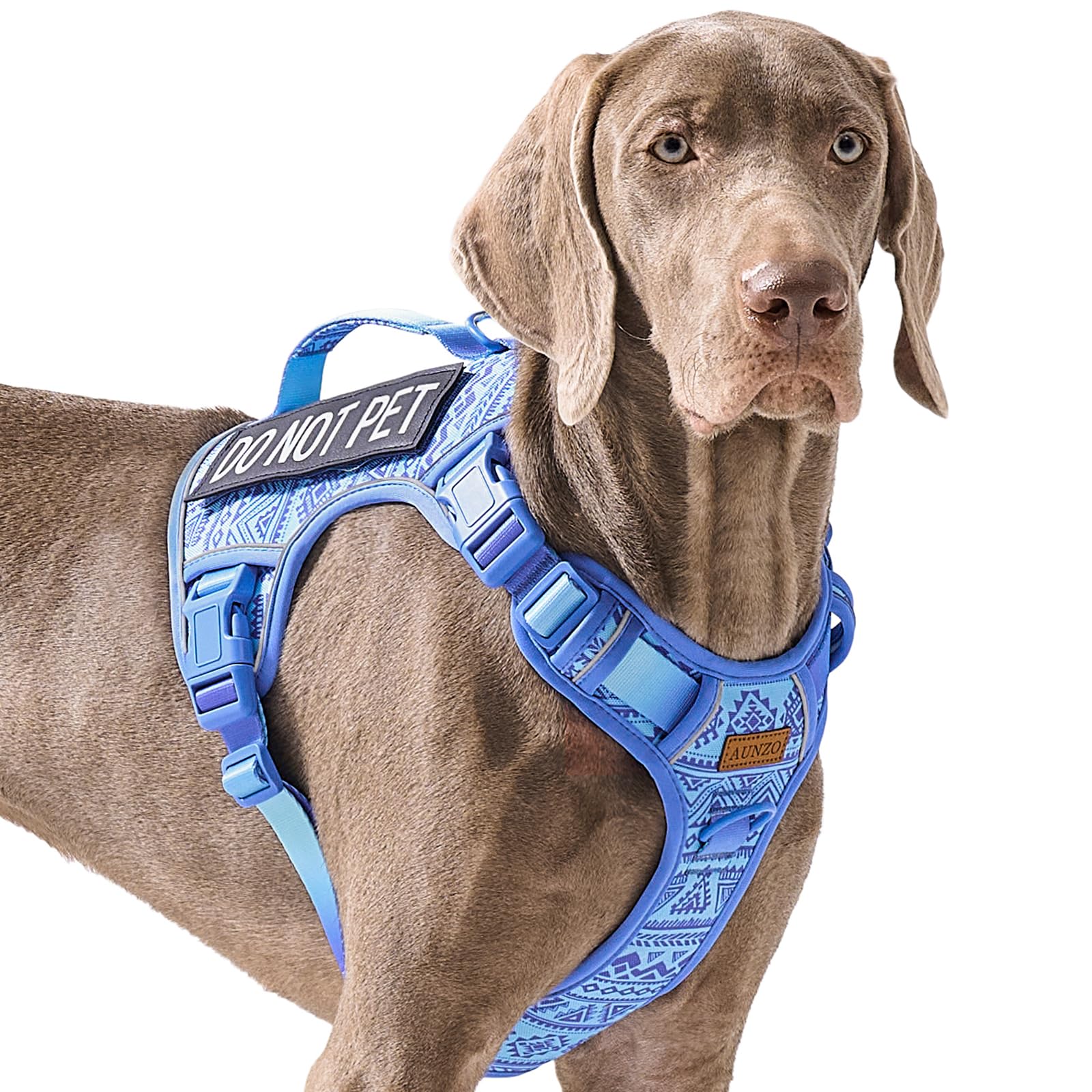
The AUNZO harness solves one specific problem that large-breed owners know well: getting the harness over a dog’s head when that dog has a thick neck and zero patience for overhead wrestling. An additional neck buckle lets you open the neck strap completely, wrap it around the dog’s throat, and buckle it closed. You never have to drag the harness past ears and snout, which dramatically reduces the morning struggle with breeds like German Shepherds and Akitas.
The harness body uses durable Oxford fabric — a dense woven polyester that resists tearing even when a 90-pound dog throws its full weight against the leash. Two metal leash clips provide both front and back attachment points, giving you the training leverage of a chest ring and the convenience of a back ring for casual walks. The reflective trim wraps around the edges, not just a single center stripe, which improves visibility from multiple angles during dusk walks.
Lightweight at 0.34 kg (under 0.75 pounds), this harness won’t weigh down a dog that already carries significant mass. The breathable mesh lining keeps airflow moving during warmer runs. One owner with a 135-pound Rhodesian Ridgeback noted that front-leg positioning allowed their dog to slip out occasionally — check that the lower chest strap is snug enough before trusting it for escape artists. For large breeds that hate overhead harnesses, the neck-buckle design is a genuine quality-of-life upgrade.
Why we love it
- Neck buckle eliminates overhead harness wrestling for large dogs
- Durable Oxford fabric resists tearing under heavy pullers
- Lightweight design adds minimal bulk to large breeds
Good to know
- Some dogs can slip out if lower chest strap isn’t snug
- Adjustment process is a bit finicky initially
4. rabbitgoo Dog Harness No Pull
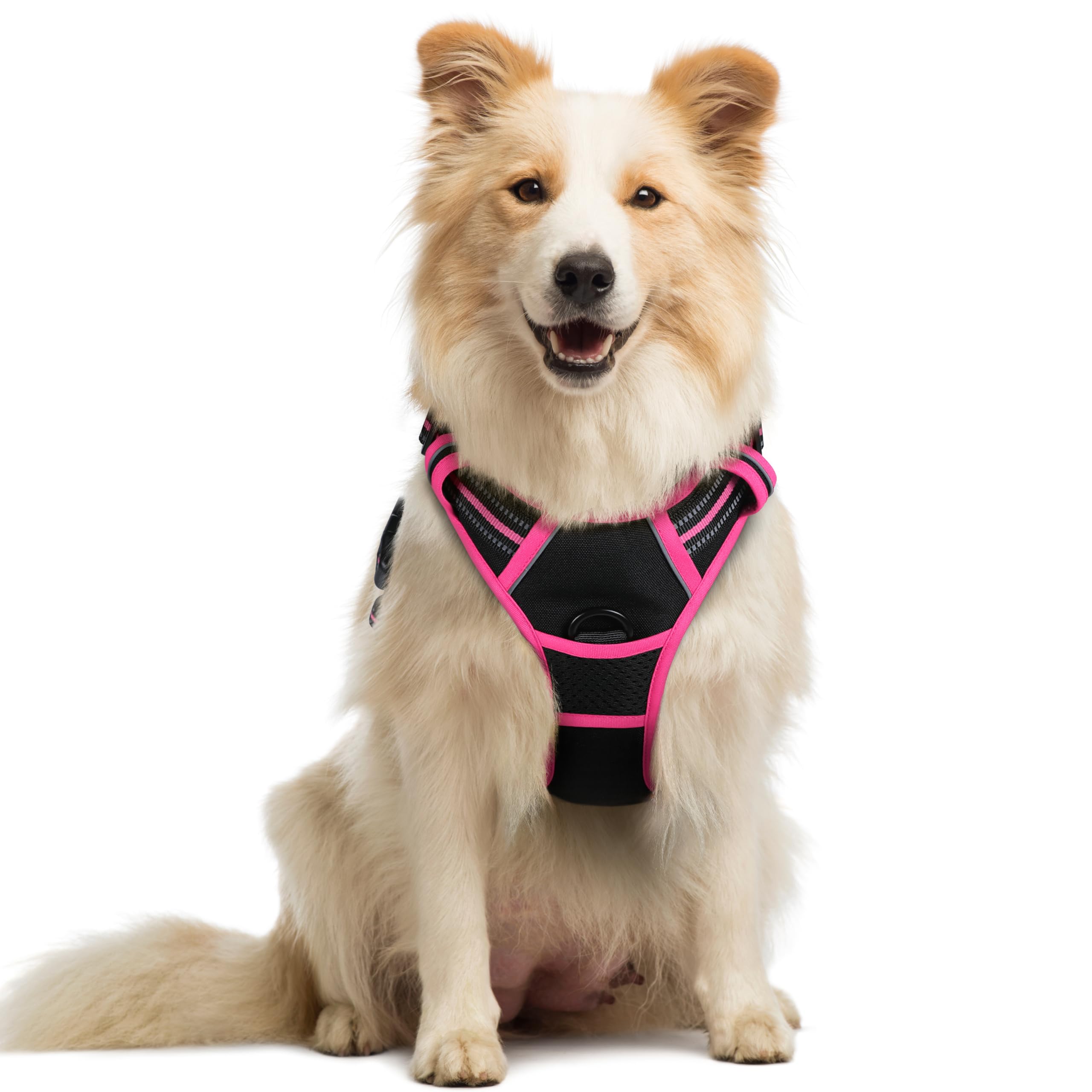
rabbitgoo has earned a loyal following among medium-breed owners, and this Black & Hot Pink model shows why. The harness uses a no-choke design philosophy — instead of tightening around the neck when your dog pulls, the pressure distributes across the chest and shoulders via the front leash clip. The two metal leash rings operate like a standard dual-clip system, so you get both training control and casual walking flexibility without needing to swap hardware.
Four easy-adjusting straps — two around the neck, two around the chest — let you customize the fit for deeper-chested medium breeds like Border Collies and Shiba Inus that don’t fit well in one-size-fits-all harnesses. The polyester oxford outer layer holds up to daily use, while the padded interior cushion prevents chafing even during longer hikes. The bright reflective strips provide high contrast in low light, a genuine safety upgrade for early morning or evening walks.
One owner noted the Large size ran slightly tight around the legs for their dog, so careful measurement before ordering is essential. The two fast-release buckles make entry and exit quick once adjusted properly. Overall, this is a solid mid-range option for medium dogs, balancing no-pull training capability with everyday comfort and a price point that won’t make you wince if you need to replace it after a few years of daily use.
Why we love it
- No-choke design distributes pulling force across chest, not neck
- Four-point adjustment system fits non-standard body shapes
- Bright reflective strips improve low-light visibility significantly
Good to know
- Some sizes run tight around the leg openings
- Adjustment process requires patience on first fitting
5. Auroth Tactical Dog Harness for Large Dogs

The Auroth Tactical Harness bridges the gap between an everyday walking harness and a working K9 vest without the premium price tag. The defining feature is the Molle system — rows of heavy-duty nylon webbing strips on both sides that allow you to attach pouches, water bottles, training bags, or ID patches. For owners of working breeds like Belgian Malinois or Dutch Shepherds who need their dog to carry gear during hikes or training sessions, this unlocks functionality that standard harnesses simply don’t offer.
Four fully adjustable metal rings — two on the shoulders, two on the chest — provide a level of fit precision uncommon at this price tier. The nylon construction with reinforced bar-tack stitching handles the pulling force of strong dogs without failing at the seams. Two leash attachment points offer the same front/back flexibility as dual-clip harnesses. The breathable air mesh lining paired with padded cotton cushion at pressure points prevents chafing during extended wear.
The included ID badge reads “BEST FRIEND” and uses a Velcro panel, compatible with any standard morale patch for customization. One trade-off: the adjustment system requires some trial and error to get right, especially for first-time tactical harness users. The buckles are durable but plastic rather than metal. For owners who want tactical capability, a secure fit for strong pullers, and the ability to carry gear without buying a separate vest, this harness packs impressive function into a budget-friendly build.
Why we love it
- Molle system allows gear attachment for hiking and training
- Four metal adjustment rings provide precise, secure fit
- Front and back D-rings for training and casual walking
Good to know
- Adjustment takes effort to dial in initially
- Buckles are plastic, not metal
FAQ
How do I know if my dog’s harness is too tight or too loose?
Should I use the front clip or back clip for a dog that pulls?
Can a harness cause shoulder problems in dogs?
How often should I replace my dog’s harness?
Final Thoughts: The Verdict
For most dog owners, the best pet harness winner is the MOOGROU Tactical Dog Harness Set because it delivers premium features — dual metal D-rings, four-buckle entry, breathable mesh, and a complete leash-and-patches kit — at a price that undercuts standalone harnesses with fewer features. If you want rugged weather resistance and a proven brand name, grab the Carhartt Nylon Duck No Pull Harness. And for large-breed owners who are tired of fighting to get a harness over their dog’s head, nothing beats the AUNZO No Pull Dog Harness with its neck-buckle convenience.