
Managing a cat with Inflammatory Bowel Disease means every meal is a landmine of potential triggers. You’re not just feeding your cat — you’re balancing nutrition against flares, vomiting, and loose stools. Finding canned cat food that soothes rather than inflames is the core battle, and the difference between a restful night and a trip to the vet.
I’m Mo Mahin — the founder and writer behind Furric. Over thousands of hours researching ingredient decks, parsing veterinary diet recommendations for sensitive felines, and analyzing owner-reported outcomes across dozens of canned formulations specifically for IBD management, I’ve turned data into a clear shortlist.
This guide lays out five proven options that respect a cat’s inflamed gut by sticking to short ingredient lists and single protein sources, helping you find the right canned cat food for ibd without the trial-and-error wreckage.
How To Choose The Best Canned Cat Food For IBD
IBD in cats is a chronic condition where the gastrointestinal lining becomes inflamed, often reacting to common proteins, thickeners, or preservatives. Choosing a food means reducing the variables that trigger that immune response. Focus on three pillars: the protein source, the ingredient count, and the texture.
Prioritize a Single, Novel Protein
Cats with IBD have often been exposed to chicken and fish for years, making those proteins common sensitizers. A single novel protein like rabbit, turkey (if chicken-naïve), or even pure chicken breast from a trusted source with no other meat meals gives the gut a break. Look for recipes that list exactly one meat source and nothing else in the protein family.
Eliminate Carrageenan and Thickening Gums
Carrageenan is a seaweed-derived thickener that some studies have linked to intestinal inflammation in sensitive animals. Xanthan gum and guar gum can also trigger reactions in IBD cats. The safest formulations use broth or water-based recipes with zero gums, or a pate that holds shape without these additives.
Match Texture to Tolerance
A cat with active IBD might vomit chunks or struggle with shreds. Smooth pates and finely flaked recipes in thin broth digest more easily than chunky meat pieces or gelatin-heavy gravies. If your cat has dental issues alongside IBD, broth-soaked flakes require less chewing and reduce stomach upset.
Quick Comparison
On smaller screens, swipe sideways to see the full table.
| Model | Category | Best For | Key Spec | Amazon |
|---|---|---|---|---|
| Instinct Limited Ingredient Diet Turkey | Single Protein Pate | Turkey-sensitive IBD diets | 1 animal protein + 1 vegetable | Amazon |
| Instinct Original Minced Rabbit | Grain Free Novel Protein | Chicken-allergy IBD cats | Farm raised rabbit, no chicken | Amazon |
| Reveal Chicken Breast in Broth | Pure Flakes | Extremely limited diets (2-3 ingredients) | Chicken, salt, water only | Amazon |
| Applaws Tuna Fillet in Broth (12×2.47oz) | Limited Ingredient Flake | Portion control & novel fish rotation | 2.47 oz single-serve cans | Amazon |
| Applaws Tuna Fillet in Broth (12×5.5oz) | Large Limited Ingredient Can | Multi-cat IBD households | 5.5 oz full-size cans | Amazon |
In‑Depth Reviews
1. Instinct Limited Ingredient Diet Turkey
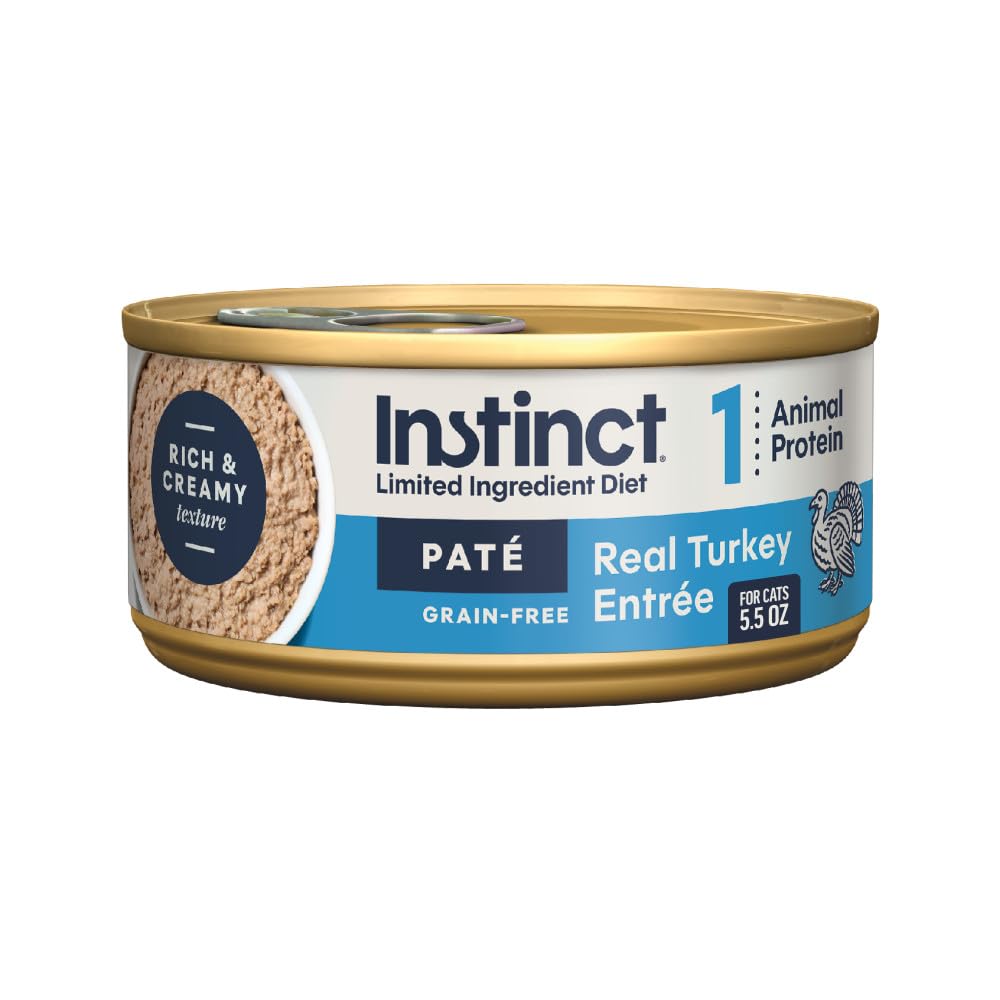
Instinct’s Limited Ingredient Turkey pate uses exactly one animal protein — cage-free turkey — and one vegetable (often pumpkin or pea) plus essential nutrients. This radical simplicity makes it an excellent baseline for IBD cats who haven’t reacted to turkey before. The smooth pate texture breaks down easily in the stomach, reducing mechanical irritation that chunky foods can cause.
Owner feedback consistently highlights that cats with previously undiagnosed sensitivities settle after a week on this recipe. The formula excludes chicken, beef, fish, dairy, eggs, and grain — seven common triggers compressed into a single recipe. For IBD cats that do well on poultry but can’t handle chicken, this is often the missing puzzle piece.
Some picky eaters may reject the pate consistency initially. A tablespoon of warm water stirred in softens the texture and releases aroma. Note that a minority of owners report it can be dense and requires thorough mashing for very senior cats with dental issues.
Why we love it
- Only one meat source eliminates cross-protein confusion
- No carrageenan, no guar gum, no artificial anything
- Pate texture minimizes stomach upset
Good to know
- Some cats dislike the dense pate consistency
- Not suitable if your cat already reacts to turkey
2. Instinct Original Minced Rabbit

Rabbit is one of the best novel proteins for IBD cats because most commercial diets rarely include it. Instinct’s minced rabbit cups use farm raised rabbit as the single meat source, paired with whole food vegetables like carrots and spinach in a savory gravy. The 3.5-ounce cup format is especially useful for portion control — one cup is a full meal with no leftover half-can to store.
Customer reports indicate strong acceptance among picky cats, with multiple owners confirming it’s the only food their chicken-allergic IBD cat can eat without vomiting. The gravy adds moisture, which supports hydration in cats with IBD who are at higher risk for dehydration due to loose stools. The soft minced texture is gentler than large chunks but more substantial than a flake.
A quieter nuance: some cats find the gravy too rich initially and need a gradual transition over five days. Others have noted the rabbit flavor is potent and may be off-putting to extremely sensitive noses. The cups are slightly more expensive per ounce than canned equivalents.
Why we love it
- Novel rabbit protein perfect for chicken-sensitive IBD cats
- Gravy boosts hydration for cats with diarrhea
- Easy-serve cup reduces waste compared to cans
Good to know
- Strong rabbit aroma may require slow introduction
- Higher calorie density — watch weight in less active cats
3. Reveal Chicken Breast in Broth
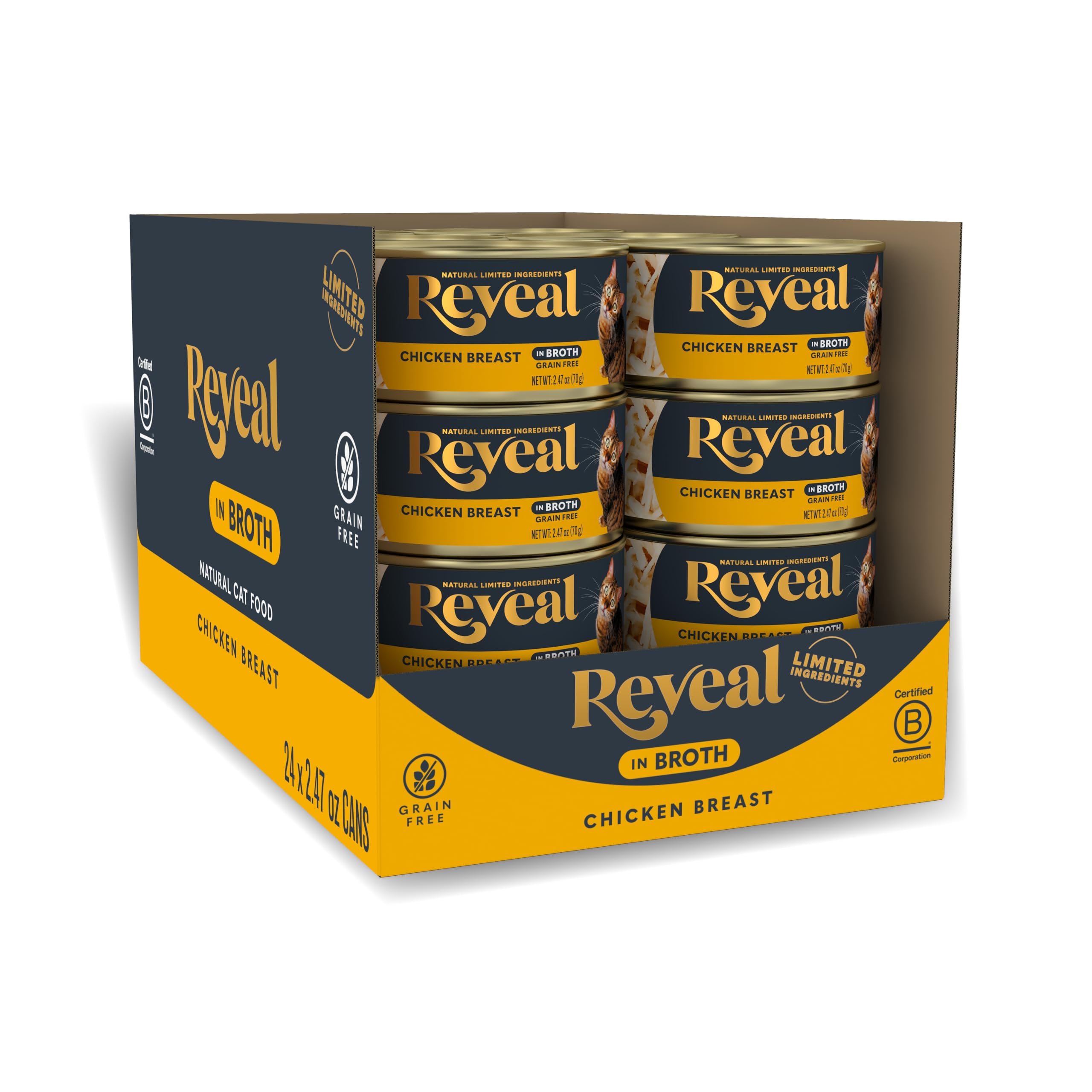
Reveal takes minimalism to its logical endpoint: chicken breast, water, and salt. That’s it. There are no thickeners, no gums, no vitamins or binders — just whole muscle meat in a hydrating broth. For IBD cats who tolerate chicken but react to the stabilizers found in most wet foods, this recipe eliminates every potential additive trigger.
Reviews highlight that cats who refused all other foods during an IBD flare accepted Reveal’s chicken flakes readily. The flake-in-broth texture is extremely gentle and requires no chewing, making it suitable for cats with nausea or mouth sensitivity. Owners treating IBD alongside chronic kidney disease report it as a go-to for its low phosphorus and high moisture content.
The trade-off is that this is a complementary food, not a complete balanced diet on its own. It lacks added taurine, vitamins, and minerals. You’ll need to pair it with a balanced base diet or a veterinarian-recommended supplement to avoid nutritional deficiencies over the long term.
Why we love it
- Virtually impossible to trigger a chemical sensitivity
- High moisture content supports hydration during flares
- Real chicken texture appeals to the most finicky eaters
Good to know
- Not nutritionally complete — must be supplemented
- Chicken can still be a trigger for some IBD cats
4. Applaws Tuna Fillet in Broth (12×2.47oz)

Applaws builds its recipe around a limited ingredient philosophy using tuna fillet as the primary protein. The 2.47-ounce single-serve cans are a logistical asset for IBD management — you open one per meal with zero refrigeration or reheating. The flaked texture in thin broth is extremely low in fat and skips thickeners that might upset a sensitive tract.
The variety pack mixes Tuna Fillet, Tuna with Salmon, and Tuna with Crab, offering diversity without switching brands. Each recipe stays under 10 recognizable ingredients. The broth-based formulation provides moisture without the heavy gravy that some IBD cats reject. Many owners rotate Applaws alongside a complete pate to add variety without introducing new trigger ingredients.
One important caveat: like Reveal, Applaws is labeled as a complementary cat food and lacks complete nutritional balance. It works best as a topper or rotation alongside a complete AAFCO-approved limited ingredient pate. The small cans also mean higher packaging waste per meal.
Why we love it
- Every can is a fresh single meal — no leftovers
- Flaked broth texture is extremely gentle on the stomach
- Minimal ingredient list with no artificial anything
Good to know
- Not a complete diet — needs pairing with balanced food
- Tuna may be overfished; consider rotation with other proteins
5. Applaws Tuna Fillet in Broth (12×5.5oz)
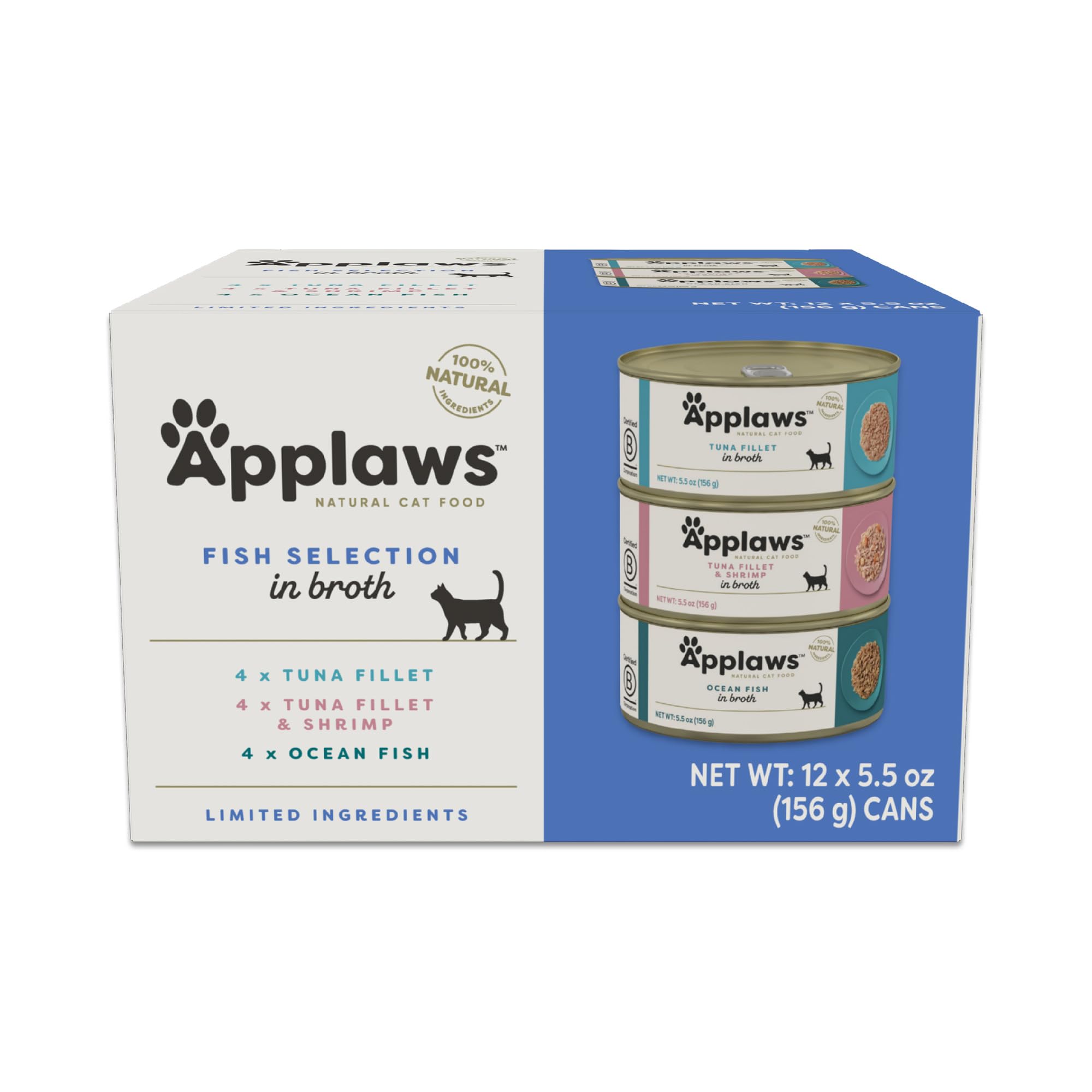
This is the same Applaws limited ingredient philosophy scaled to a full 5.5-ounce can. The larger format is ideal for multi-cat households or for IBD cats with larger appetites. Each can contains tuna fillet in broth, with no artificial colors, flavors, or preservatives. The flaked texture in thin liquid is identical to the smaller version, so you can mix sizes within the same protocol.
Owners feeding multiple cats with varying sensitivities appreciate that one can serves two meals, reducing the number of different foods to stock. The broth adds significant moisture, which is especially valuable if your IBD cat also has concurrent issues like constipation or early kidney concerns. The simple recipe means even if a cat is in a vomiting phase, the food comes back up with minimal irritation compared to heavy pates.
The same complementary diet caveat applies — this is not a stand-alone balanced food. The fish protein also means this may not be suitable for cats already sensitized to fish. If your cat has been on a fish-heavy diet before IBD symptoms started, test with a very small portion first.
Why we love it
- Full-size cans reduce packaging waste per meal
- Consistent limited ingredient formula across sizes
- Hydrating broth supports gut motility
Good to know
- Not nutritionally complete — must be supplemented
- Fish protein may be a past dietary trigger
FAQ
Is grain free canned food necessary for a cat with IBD?
How quickly should I see improvement after switching food?
Can I feed complementary foods like Reveal as a permanent diet?
Final Thoughts: The Verdict
For most IBD cats, the canned cat food for ibd winner is the Instinct Limited Ingredient Diet Turkey because its single protein and vegetable approach provides both safety and complete nutrition in one can. If your cat needs a truly novel protein away from poultry, grab the Instinct Original Minced Rabbit — the rabbit is gentle and the gravy adds critical hydration. And for a pure minimal diet you can use as a reset during flares, nothing beats the Reveal Chicken Breast in Broth for stripping away every possible additive trigger.