
One bottle of concentrate is the difference between a herd hiding under trees, stomping and tail-swishing all day, and a herd grazing calmly without a cloud of horn flies on their backs. The chemical warfare starts with choosing the right permethrin percentage and delivery method for your specific setup.
I’m Mo Mahin — the founder and writer behind Furric. I spend my time comparing label concentrations, studying residual kill periods, cross-referencing target-species lists, and filtering thousands of owner reports so you get the exact active-ingredient data that actually matters.
Whether you run a dairy parlor, a feedlot, or a small hobby barn, finding the right fly spray for cattle means reading the fine print on permethrin percentages and dilution ratios — not grabbing the cheapest aerosol off the shelf.
How To Choose The Best Fly Spray For Cattle
The active ingredient count is everything. Most effective livestock fly sprays rely on permethrin as the primary pyrethroid, and the concentration — typically 10% or 13.3% — dictates how much concentrate you mix per gallon of water. A higher percentage does not automatically mean better results; it means more caution with dilution accuracy.
Permethrin Percentage vs. Dilution Volume
A 10% permethrin concentrate is the industry standard for cattle premises and direct application because it balances efficacy with an acceptable safety margin for large animals. A 13.3% concentrate, like the Country Vet FarmGard option, gives you slightly more active ingredient per ounce, which changes your mixing math. Always check the label’s dilution table — over-concentrating wastes product and risks skin irritation, and under-diluting leaves flies alive after 48 hours.
Target Species Label: Beef vs. Dairy
Not every permethrin spray is labeled for lactating dairy cattle. If you milk, you must choose a product that explicitly lists dairy cattle under the “target species” field. The Durvet and Bonide labels both include dairy cattle, while some concentrates are restricted to beef and beef premises only. Using a non-labeled product on milk cows can violate withholding periods and inspector-grade regulations.
Residual Duration and Reapplication Timing
Most permethrin-based sprays claim four weeks of residual control on surfaces, but real-world barn conditions — rain, sunlight, bedding dust, and animal rubbing — break that down to two to three weeks in peak summer. A product with a four-week claim, such as the Bonide Barn & Stable concentrate, gives you a longer window before respraying barn walls, feed bunks, and loafing sheds.
Quick Comparison
On smaller screens, swipe sideways to see the full table.
| Model | Category | Best For | Key Spec | Amazon |
|---|---|---|---|---|
| Bonide Barn & Stable Fly Spray | Concentrate | Premise + animal application | Up to 4-week residual | Amazon |
| Neogen Insectrin X | Concentrate | Multi-premise spraying | 10% permethrin, 32 oz | Amazon |
| Durvet Permethrin EC 10% | Concentrate | Treating all livestock types | Targets dairy & beef cattle | Amazon |
| Country Vet FarmGard Permethrin 13.3% | Concentrate | Perimeter & premise barrier | 13.3% high-concentration, case of 6 | Amazon |
| Gordon’s Permethrin 10 | Concentrate | Barn & chicken yard | 32 oz quart bottle | Amazon |
In‑Depth Reviews
1. Bonide Barn & Stable Fly Spray

Bonide’s label is the most comprehensive in this group — it covers horses, beef and dairy cattle, goats, sheep, swine, poultry, and dogs, which means one concentrate handles every animal on your operation. The residual claim of up to four weeks holds up well inside barns and covered feedlots where UV breakdown is minimal. At a mid-range price point, this offers the best value for someone running multiple species under one roof.
The formula works through foggers, misters, low-pressure sprayers, back rubbers, and even sponge-on application, so you can switch between premise treatments and direct animal spraying without buying a second product. Several owner reports confirm effective knockdown of horn flies and stable flies within 24 hours of application.
Because it lists dairy cattle directly on the label, you avoid the headache of finding a separate product for your milk herd. The scent is listed as “Dairy” on the bottle — it carries a slight chemical note that dissipates quickly after drying, making it tolerable for indoor milking parlor use.
Why we love it
- Explicitly labeled for dairy and beef cattle
- Four-week residual control on surfaces
- Works in foggers, sprayers, and back rubbers
Good to know
- 16 oz bottle is smaller than competitors’ quart sizes
- Must reapply more often under direct sunlight
2. Neogen Insectrin X – 32 Ounce
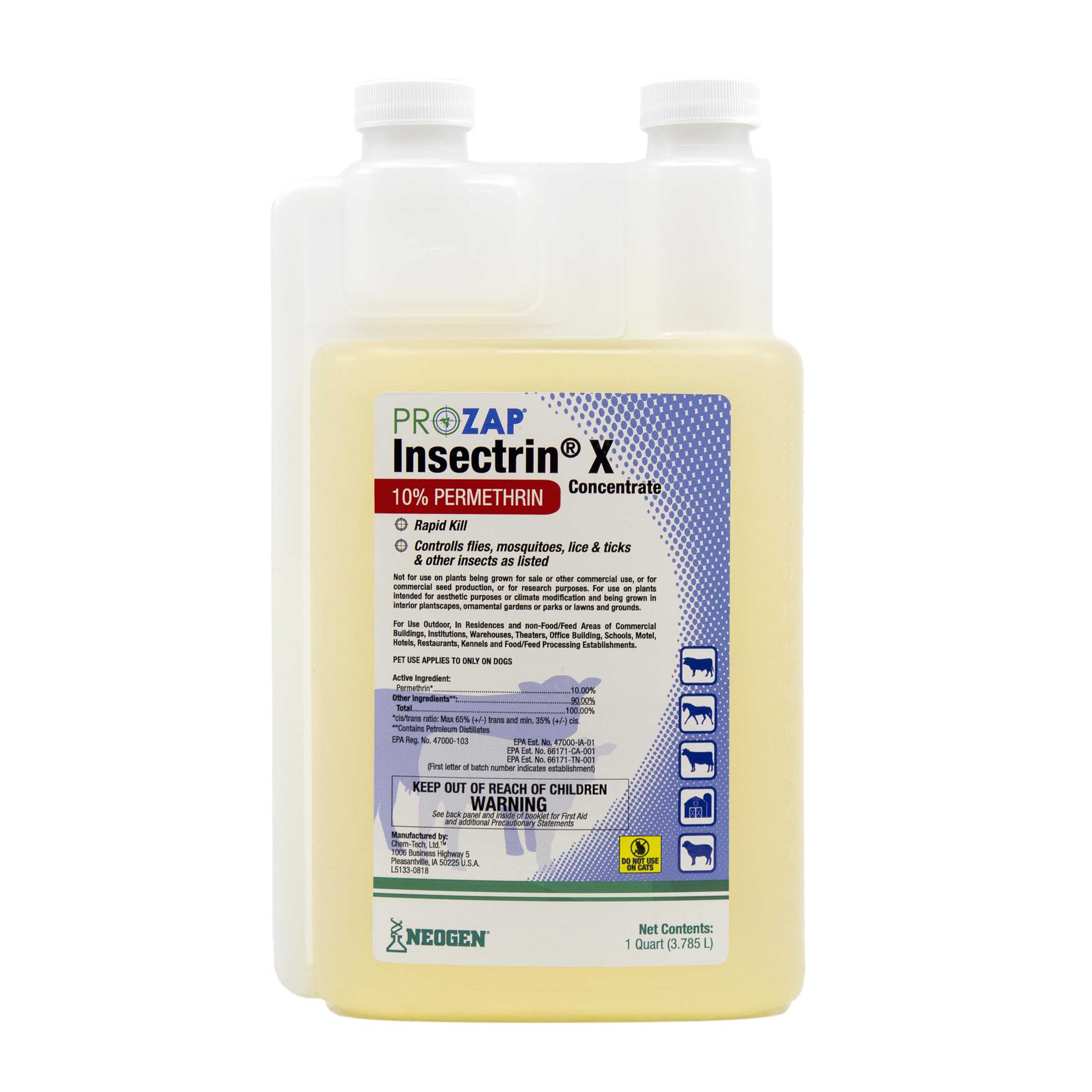
Neogen brings a full quart of 10% permethrin at a price that undercuts most premium brands, making it the strongest cost-per-ounce play in this lineup. The formula is designed for spot treatment, diluted spray, and backrubber use, giving you flexibility across different application methods. Owner reports consistently mention effective control of flies, ticks, mosquitoes, and lice after a single application.
The active ingredient is quick-acting — users note dead flies within hours of a direct premise spray. Residual action holds for several weeks on protected surfaces, though the strong chemical smell is a common complaint. Multiple reviewers recommend wearing a mask and gloves during mixing, as the odor lingers noticeably more than other permethrin brands.
One experienced user reported mixing 1.5 ounces per quart for general yard treatment and 3 ounces per quart for instant chigger and tick knockdown. That dilution flexibility means you can adjust the strength based on infestation severity without buying multiple products.
Why we love it
- 32 oz bottle provides more volume per dollar
- Versatile application: spot, spray, or backrubber
- Fast knockdown of horn flies and mosquitoes
Good to know
- Strong chemical smell that persists after drying
- Not labeled for direct use on dairy cattle
3. Durvet Permethrin EC 10-Percent

Durvet’s label reads like a livestock encyclopedia — dairy cattle, beef cattle, horses, sheep, goats, dogs, swine, and poultry all appear on the target species list. That wide approval makes this the safest choice if you run a mixed-species farm and want one concentrate that covers every animal. The “Rapid Kill Insecticide Concentrate” claim means the permethrin EC formula starts working on contact, not just as a residual barrier.
One notable advantage is the safety note regarding older dogs. Permethrin can cause adverse reactions in canines at high concentrations, but Durvet specifically flags its formula as tested safe for use in very old dogs when applied according to directions — a level of detail that signals careful formulation.
The product ships as a 16-ounce bottle, which is smaller than the quart-sized competitors, so you will need to buy more frequently for large-scale premise spraying. However, for direct animal treatment against horn flies and lice, the smaller volume lasts several application cycles.
Why we love it
- Label covers dairy, beef, horses, and poultry
- Tested safe for use on older dogs
- Contact kill plus residual action
Good to know
- Only 16 oz — better for direct treatment than large premises
- Higher per-ounce cost compared to quart bottles
4. Country Vet FarmGard Permethrin 13.3% Concentrate
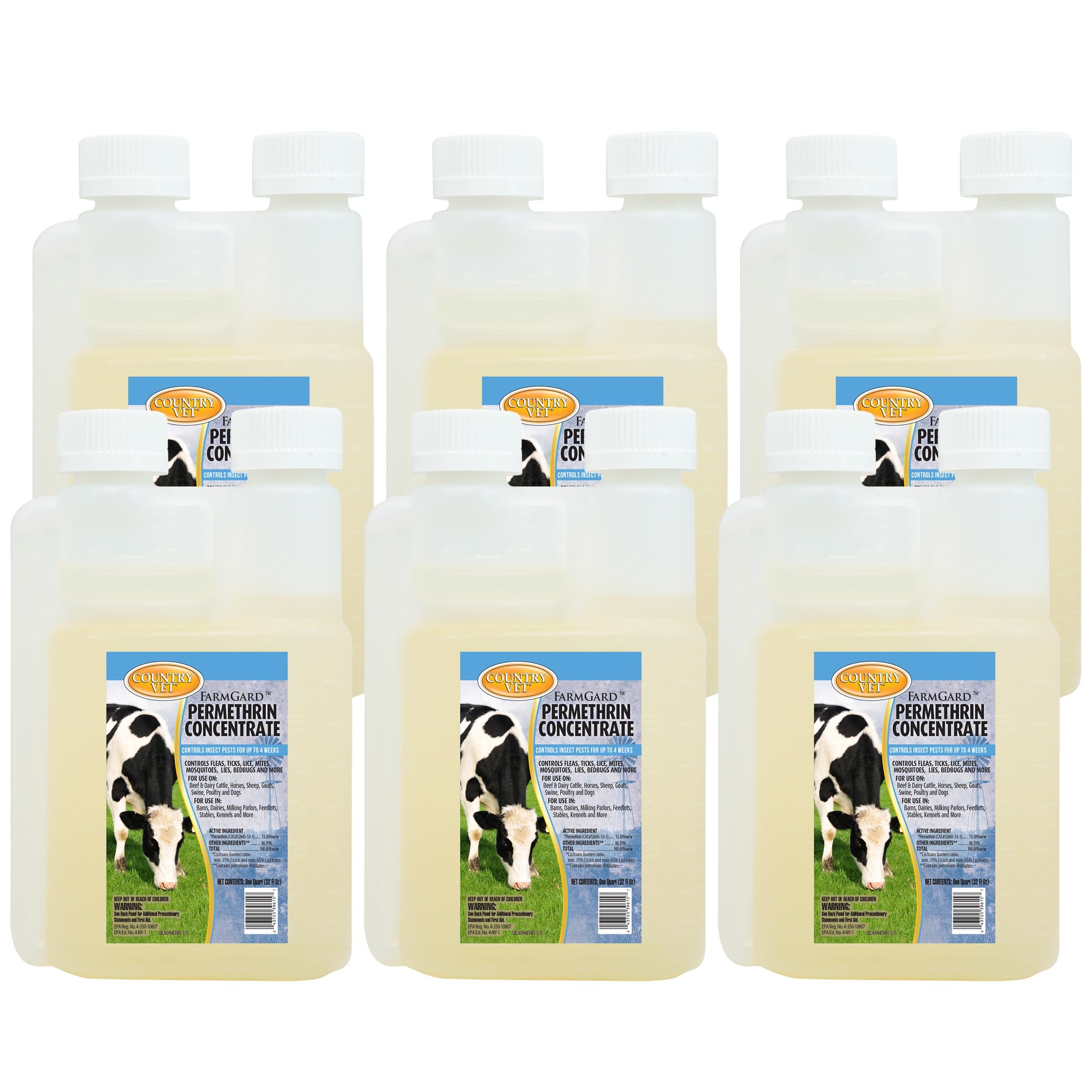
At 13.3% permethrin, Country Vet’s FarmGard concentrate packs more active ingredient per ounce than any other product in this list, which changes your dilution math significantly — you use less concentrate per gallon of water compared to 10% formulations. The label explicitly names beef and cattle, horses, sheep, goats, swine, and poultry, making it a solid perimeter option for barns, chicken runs, dog areas, and sheds where you want a long-lasting barrier against ticks, mosquitoes, and flies.
This one ships as a case of six 32 oz bottles rather than a single bottle, so the upfront cost is higher — but it works out to a competitive per-ounce price for anyone treating multiple buildings or a larger herd across a season. Reviewers confirm effective knockdown on flies and lice, with several using it as a back-rub or on-animal spray once diluted per the label.
Because of the elevated concentration, mixing precision matters more with this product. A miscalculation can quickly go from effective to overwhelming. Keep mixing and storage in a well-ventilated barn space, and only buy the full case if you have the storage room and the ongoing need to use it.
Why we love it
- Highest permethrin concentration at 13.3%
- Label covers beef, cattle, horses, sheep, goats, swine, and poultry
- Case of six 32 oz bottles lasts a full season
Good to know
- Sold only as a 6-bottle case, higher upfront cost
- Easy to over-concentrate if you misread the dilution table
5. Gordon’s Permethrin 10 Livestock & Premise Spray

Gordon’s brings a straightforward 10% permethrin formulation in a full quart bottle, which offers the best balance between concentrate strength and total volume for medium-sized barn operations. Multiple verified reviews confirm its effectiveness against horn flies around livestock and mites in chicken coops, with noticeable results within 24 hours of spraying. The formula mixes easily with water and sprays evenly through standard pump sprayers.
Several owners use Gordon’s as a perimeter spray around their homes after noticing millipede and spider activity dropping significantly within days of application. The product is labeled as cost-friendly for animal premises, and users consistently mention that it outperforms their previous spray solutions at a lower effective cost per gallon of mixed solution.
One limitation: the label does not explicitly list dairy cattle as a target species, which means it is best suited for beef operations, horse stables, and poultry barns. If you are only treating premises and not applying directly to lactating animals, this restriction is not a problem.
Why we love it
- Full quart bottle at a budget-friendly price point
- Noticed results within 24 hours on horn flies
- Easy mixing and even spray coverage
Good to know
- Not explicitly labeled for dairy cattle
- Residual duration drops in direct sunlight
FAQ
What is the difference between 10% and 13.3% permethrin for cattle?
Can I apply fly spray directly to my cattle’s skin?
How long does permethrin spray last in a barn?
Final Thoughts: The Verdict
For most cattle operations, the fly spray for cattle winner is the Bonide Barn & Stable Fly Spray because it covers dairy and beef cattle on a single label with a four-week residual that works in sprayers, fogs, and backrubbers. If you want the strongest gallon-count and need to treat large premises on a budget, grab the Neogen Insectrin X. And for a mixed-species farm with horses, poultry, and older dogs in the same space, nothing beats the Durvet Permethrin EC 10% for its broad target-species approval.