
A planted tank is a living ecosystem. The plants compete with algae for nutrients, the fish produce waste, and the whole system depends on water flow that reaches every leaf without uprooting delicate stems. The wrong filter leaves the surface covered in biofilm, blows CO₂ out of the water, or creates dead zones where detritus rots. The right one keeps the water column clear, the substrate clean, and the plants thriving.
I’m Mo Mahin — the founder and writer behind Furric. I’ve spent thousands of hours cross-referencing filter flow curves against planted tank volumes, studying media capacity for biological filtration, and analyzing owner-reported longevity data across dozens of aquarium filter models.
Whether you’re battling green water, fine debris, or surface film, this guide breaks down the concrete specs that matter — flow rate adjustability, UV sterilization, media compartment design — to help you find the best filter for planted tank that matches your specific aquascape.
How To Choose The Best Filter For Planted Tank
Choosing a filter for a planted aquarium isn’t the same as picking one for a fish-only tank. Plants demand gentle water movement, stable CO₂ levels, and minimal nutrient stripping. A filter that works beautifully for a cichlid tank can wreck a planted scape. Here are the three specs you need to prioritize.
Flow Rate and Adjustability
Planted tanks need lower flow than fish-only tanks — typically 3-5 times the tank volume per hour instead of 6-10 times. High flow stresses stem plants, uproots carpeting species, and drives CO₂ out of solution. A filter with adjustable flow lets you dial in the right current for your specific aquascape, from a gentle ripple for a low-tech tank to moderate circulation for a high-tech CO₂ setup.
Media Configuration and Biological Capacity
Plants consume ammonia and nitrates directly, so biological filtration doesn’t need to be as aggressive as in a fish tank. But you still need enough surface area for beneficial bacteria to handle the fish and food load. Look for filters with dedicated media compartments that accept ceramic rings, Bio‑Balls, or sintered glass media — not just disposable cartridges. A filter that lets you customize media layers (mechanical, biological, optional chemical) gives you control over nutrient export.
UV Sterilization and Surface Skimming
Green water is the planted tank’s nemesis — a single algae bloom can block light and crash plant growth. UV filters kill free-floating algae cells without chemicals. Surface film (biofilm) also blocks gas exchange and light penetration. A filter with an integrated UV light or a surface skimmer attachment addresses both problems without adding extra hardware. For planted tanks with shrimp or nano fish, make sure the intake slots are fine enough to prevent livestock from being pulled in.
Quick Comparison
On smaller screens, swipe sideways to see the full table.
| Model | Category | Best For | Key Spec | Amazon |
|---|---|---|---|---|
| AquaMiracle SV-800 | Internal UV | Green water & algae control | 225 GPH flow, 6W UV | Amazon |
| Marineland Penguin 350 | HOB Bio-Wheel | High biological filtration | 350 GPH, Bio-Wheel | Amazon |
| hygger HOB 210 | HOB Adjustable | Mid-range planted tanks | 210 GPH, adjustable flow | Amazon |
| TARARIUM IX-120 | Internal Waterfall | Turtle & low-water tanks | 290 GPH, ceramic bio-balls | Amazon |
| OASE CrystalSkim 350 | Surface Skimmer | Biofilm removal | 350 L/h, adjustable skimmer | Amazon |
In‑Depth Reviews
1. AquaMiracle SV-800
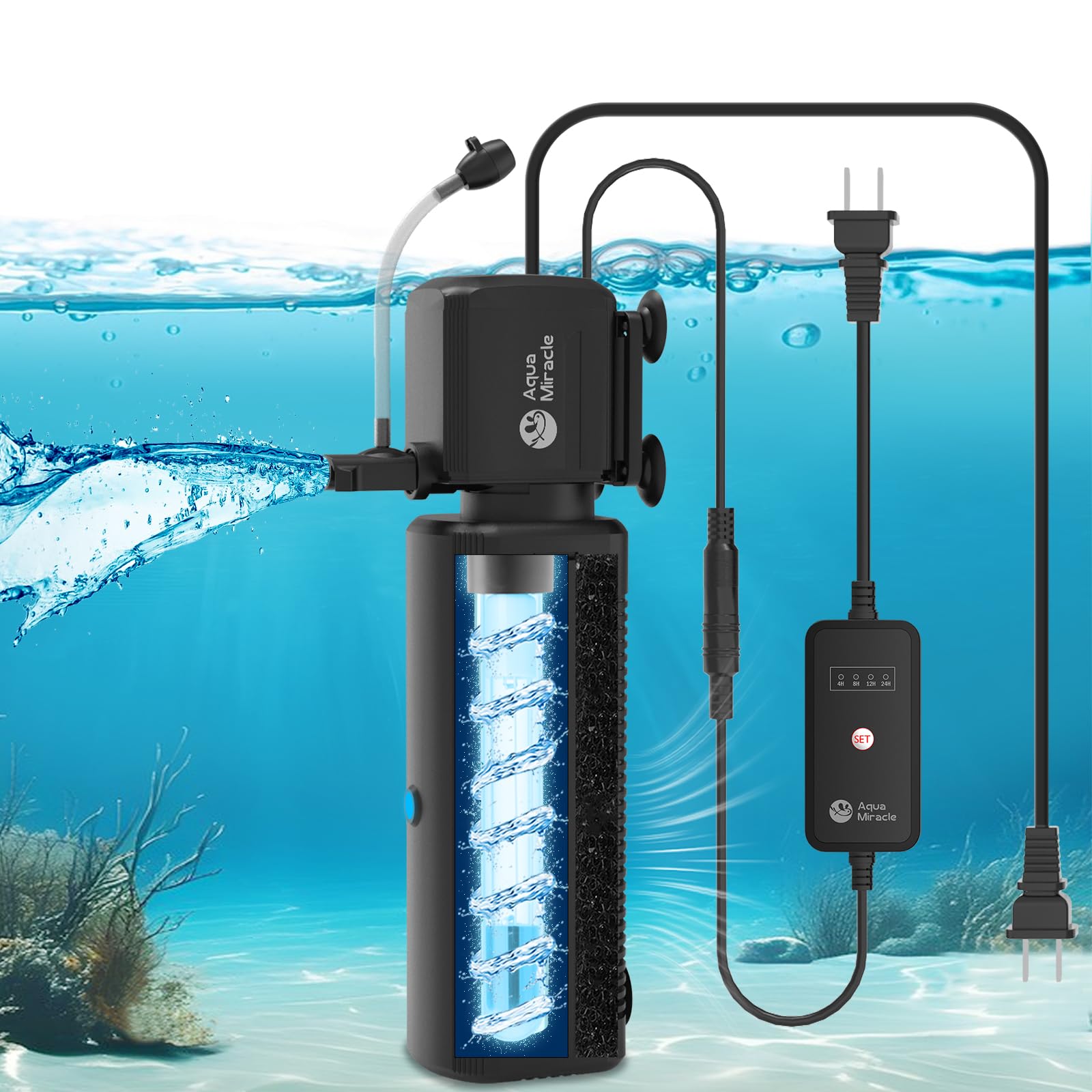
The AquaMiracle SV-800 is purpose-built for the planted tank owner whose biggest frustration is green water. With a 6W UV sterilizer that includes a timer (4/8/12/24-hour settings), you can target algae blooms without running the light 24/7 — a smart approach for planted tanks where UV exposure can affect beneficial microfauna. The pump delivers 225 GPH, suitable for tanks between 20 and 70 gallons, which puts it squarely in the range most aquascapers work in.
The dual-mode output is genuinely useful for planted setups. Aerating mode uses an air venturi to boost oxygen during the night when plants stop producing it, while Rainfall mode disperses water through a spray bar that creates gentle surface agitation — enough to break up biofilm without blasting CO₂ out of solution. The 8W pump draws modest power, and the 1.7-pound weight makes it easy to position without stressing the tank rim.
Owner feedback consistently highlights how quickly the UV clears green water — multiple reviews mention visible improvement within 24 hours. The observation window on the housing lets you confirm the UV light is working without disassembling anything. One note: the timer controls the light only, not the pump, so circulation continues when the UV is off. Some owners wished the intake slots were slightly finer for shrimp safety, but the included sponge pre-filter addresses that concern.
Why we love it
- Integrated UV sterilizer with programmable timer targets green water without running constantly
- Dual output modes (aeration + rainfall) give planted tanks versatile flow options
- Observation window lets you verify UV operation at a glance
Good to know
- Timer controls only the UV light, not the pump — must manage separately if needed
- Sponge pre-filter recommended for tanks with shrimp or nano fish
2. Marineland Penguin 350

The Marineland Penguin 350 is a classic HOB filter that has earned its place in the aquarium world through sheer reliability and the patented Bio-Wheel technology. The rotating wheel provides wet/dry biological filtration — bacteria colonies get exposed to both water and air, which some keepers believe boosts nitrification efficiency. At 350 GPH, this filter moves a lot of water, so it’s best suited for larger planted tanks (55-90 gallons) where the current won’t stress the plants.
Multi-stage filtration comes standard: mechanical via the Rite-Size cartridges, chemical via activated carbon in those same cartridges, and biological via the Bio-Wheel. The media system is simple to maintain — swap the cartridge monthly, rinse the wheel during water changes. For planted tank owners who run high fish loads alongside heavy plant growth, the extra biological capacity helps handle ammonia spikes without crashing the cycle.
Keep in mind that the Penguin 350 does not include a UV sterilizer or adjustable flow control. The flow is fixed at maximum, which can be too turbulent for delicate stem plants or carpeting species like Monte Carlo or Dwarf Hairgrass. Owners typically pair this filter with a spray bar or diffuser to break up the return flow. It also runs on the louder side compared to internal or canister options — the Bio-Wheel spinning produces a distinct hum that some find noticeable in quiet rooms.
Why we love it
- Patented Bio-Wheel technology enhances biological filtration with wet/dry exposure
- Proven reliability — same design has been a market staple for years
- Rite-Size cartridges make media replacement quick and mess-free
Good to know
- Fixed flow rate — no adjustability for low-flow planted setups
- Louder operation from the spinning Bio-Wheel; can be audible in quiet rooms
3. hygger HOB 210
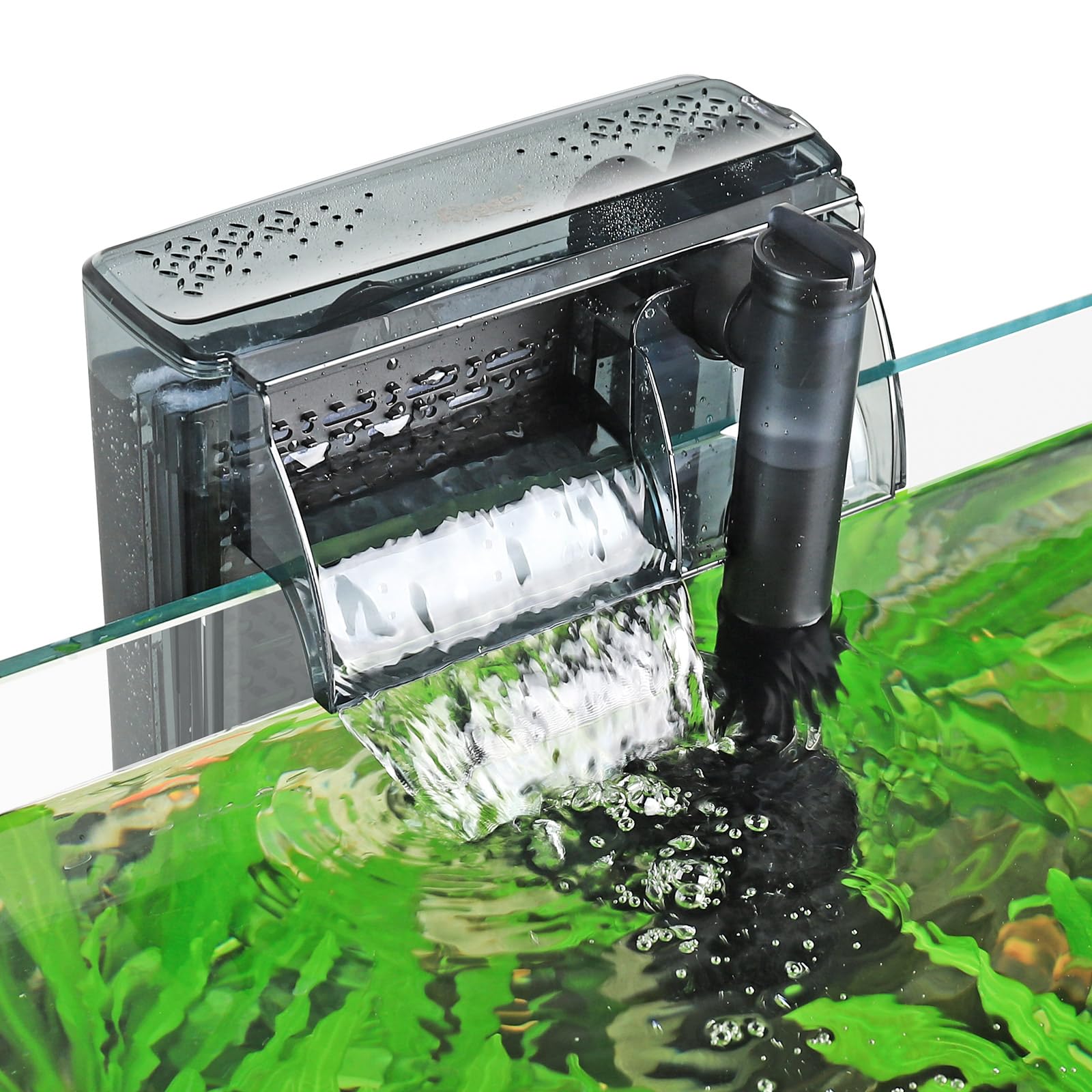
The hygger HOB 210 targets the mid-range planted tank owner who values quiet operation and the ability to fine-tune water movement. At max flow of 210 GPH, this filter is sized for 15 to 40-gallon tanks — the sweet spot for many aquascapers running low-tech or medium-light planted setups. The adjustable flow knob lets you dial the current down to a whisper, which is critical for keeping CO₂ in solution and preventing stem plants from bending.
One standout feature is the LED indicator light that turns on when water starts overflowing the filter chamber — a signal that the cartridge is clogged and needs replacement. This removes the guesswork from filter maintenance, especially useful for planted tanks where decaying plant matter can clog media faster than in bare-bottom setups. The filter ships with two types of media: a dual-sided sponge and carbon cartridge for mechanical/chemical filtration, plus a bio-filter plate for bacterial colonization.
The intake tube extends to accommodate different tank depths, and the water inlet includes a sponge cover to prevent shrimp and small fish from being sucked in — a thoughtful detail for planted tanks with Neocaridina or nano species. Some owners note the waterfall return creates a trickling sound that can be minimized by keeping the water level high. The media compartment is on the smaller side, limiting how much extra bio-media you can add. But for its target tank size range, the stock media configuration provides adequate filtration capacity.
Why we love it
- Adjustable flow lets you match current to plant needs — critical for low-flow aquascapes
- Clog indicator light eliminates guesswork for media replacement timing
- Sponge-covered intake protects shrimp and nano fish from being pulled in
Good to know
- Media compartment is compact — limited room for adding extra biological media
- Waterfall return produces trickling noise unless water level is kept near the rim
4. TARARIUM IX-120

The TARARIUM IX-120 is an internal filter that packs a 290 GPH pump into a compact body designed for tanks from 20 to 75 gallons. What sets it apart for planted tank owners is the three-stage media system: a dense double-sided mesh sponge traps large debris and fine particles in stages 1 and 2, while stage 3 uses ceramic bio-balls that provide a high surface area for nitrifying bacteria. The open porosity of the bio-balls also helps adsorb discoloration and odors.
The waterfall output design serves dual purposes — it returns filtered water to the tank while creating surface agitation that boosts oxygen exchange. For planted tanks running low-tech (no injected CO₂), this aeration is beneficial because it helps stabilize pH and prevents anaerobic pockets in the substrate. The adjustable flow gives you control over the waterfall’s intensity, from a gentle trickle to a more vigorous cascade. The lowest water level requirement is just 2.6 inches, making this filter viable for shallow tanks, ripariums, or turtle setups where water depth varies.
Ease of maintenance is a strong point — the top-lid canister opens for quick sponge rinsing and bio-ball access without disconnecting the filter from the tank. The unit works in both freshwater and saltwater, though most planted tank owners will run it in freshwater. Some users note the included media is adequate for moderate bioloads but recommend supplementing with additional ceramic rings if the tank is heavily stocked with fish alongside the plants. The pump runs quietly enough for a bedroom setup, though the waterfall sound is present at higher flow settings.
Why we love it
- Three-stage filtration with ceramic bio-balls provides robust biological capacity
- Ultra-low 2.6-inch minimum water level works for shallow tanks and ripariums
- Easy-access top canister simplifies media cleaning and replacement
Good to know
- Stock bio-ball quantity is modest — may need supplementation for heavy fish loads
- Waterfall design creates audible splashing at higher flow settings
5. OASE CrystalSkim 350
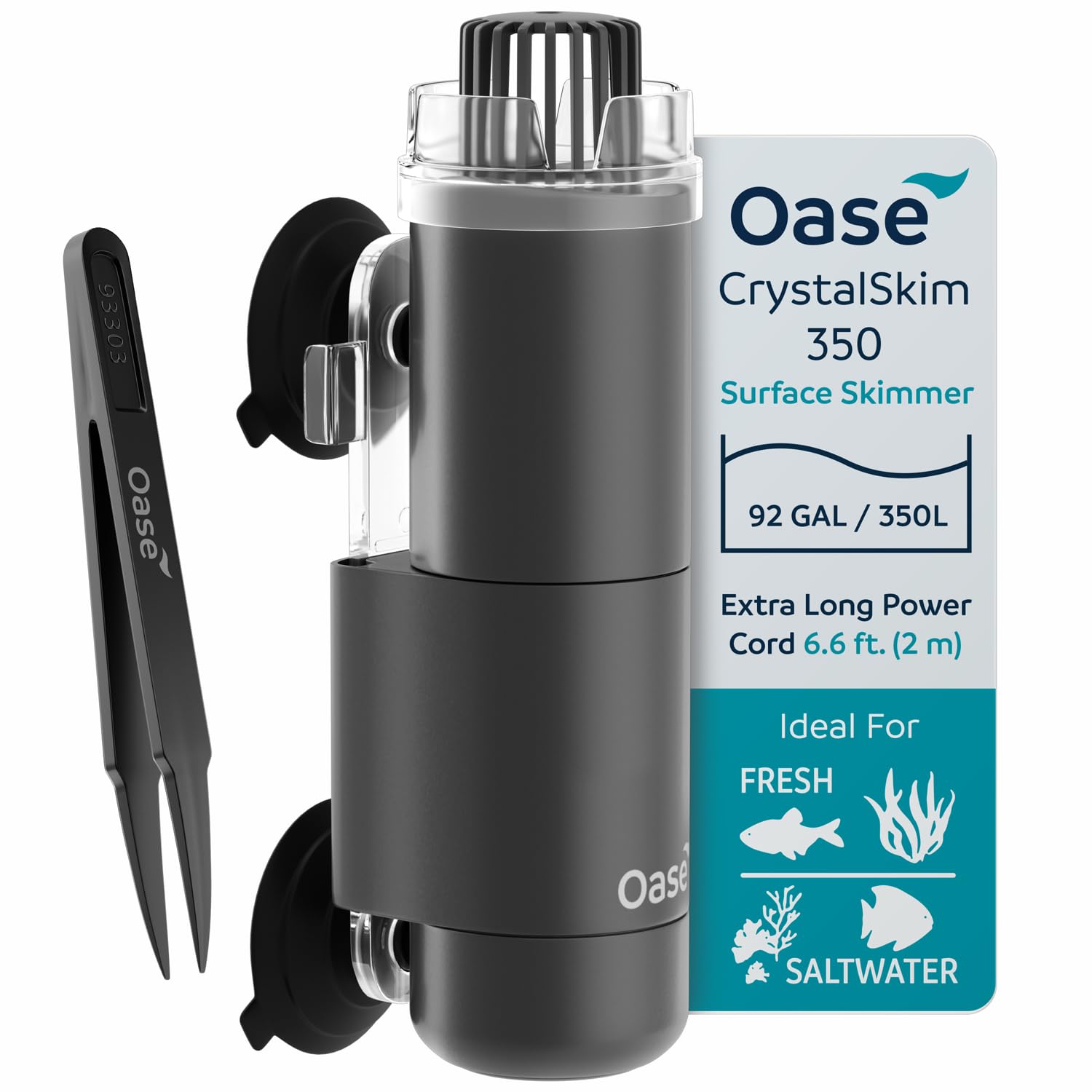
The OASE CrystalSkim 350 is not a full-spectrum filter — it is a dedicated surface skimmer designed to solve one specific problem that plagues planted tanks: biofilm and surface film. That oily layer of protein and bacteria that forms on the water surface blocks light transmission, reduces gas exchange, and makes even clear water look dingy. This compact internal unit mounts via suction cups and uses a floating ring to automatically adjust to water level changes, keeping the skimming action consistent.
The standout engineering feature is the downward-facing outflow. Unlike traditional skimmers that blast filtered water back at the surface (which can disturb CO₂ diffusion), the CrystalSkim pushes water downward, creating gentle circulation in the middle and lower zones where detritus tends to settle. The adjustable flow rate lets you dial in just enough skimming action to clear the surface without creating turbulence. The fine intake slots in the collection basket are shrimp-safe, making this a popular choice for planted tanks with Neocaridina or Caridina colonies.
At 350 L/h capacity, the CrystalSkim is rated for tanks up to 92 gallons, but it works as a supplementary unit alongside a main filter. Owners praise its effectiveness at clearing biofilm within hours of installation. Some find the cord management fussy — the power cord tends to float and requires strategic placement or a clip to keep it tidy. A few users on the lowest setting still find the flow too strong for very small tanks (under 20 gallons). The 3-year warranty (with online registration) adds confidence for the investment.
Why we love it
- Downward outflow prevents CO₂ stripping while improving mid-water circulation
- Floating ring auto-adjusts to water level changes for consistent skimming
- Shrimp-safe intake slots protect delicate livestock
Good to know
- Power cord tends to float and requires management for a clean appearance
- Even at lowest setting, flow may be too strong for nano tanks under 20 gallons
FAQ
What flow rate is ideal for a planted tank filter?
Do planted tanks need a UV sterilizer?
Can I use a HOB filter on a planted tank?
How long should I run a UV sterilizer in a planted tank?
Final Thoughts: The Verdict
For most aquascapers, the best filter for planted tank is the AquaMiracle SV-800 because its integrated UV sterilizer with programmable timer directly addresses the number one filtration complaint in planted tanks — green water — while offering dual-output modes that let you tailor flow to your specific scape. If you need heavy biological filtration for a heavily stocked planted tank, the Marineland Penguin 350 brings decades of proven Bio-Wheel reliability. And for persistent surface film or biofilm issues, the OASE CrystalSkim 350 is the most effective dedicated surface skimmer on the market for planted tanks.