
The moment your dog steps through the back door scratching at a fresh tick bite, or you find a flea crawling on your ankle after ten minutes of yard work, you realize the grass holds a hidden menace. The right yard treatment breaks that cycle at its source, turning your lawn back into a safe zone instead of an insect highway.
I’m Mo Mahin — the founder and writer behind Furric. After weeks of parsing pesticide active ingredient ratios, reading through EPA registration details, and cross-referencing real owner feedback on how each concentrate behaves under rain exposure and grass height, I built this guide around what actually works without wasting your time or money.
Whether you need a ready-to-hose attachment or a concentrated formula to mix yourself, this roundup of the top contenders for the best yard spray for fleas and ticks isolates exactly which active chemistry makes the difference between a pest-free summer and a losing battle.
How To Choose The Best Yard Spray For Fleas And Ticks
Not every yard spray fights the same pest profile. A flea lifecycle breaker needs different chemistry than an immediate tick knockdown. Understanding the active ingredient, the residual window, and your application gear prevents the frustration of reapplying every week.
Active Ingredient: Permethrin vs Natural Oils
Permethrin EC concentrates at 10% or higher deliver rapid knockdown and weeks of residual activity on grass blades and soil litter. Essential-oil blends (cedarwood, lemongrass, clove) offer lower mammalian toxicity but typically require more frequent reapplication and break down faster under UV light. For heavy infestations near wooded edges, synthetic pyrethroids win on persistence.
Residual Duration and Rainfastness
Check the label for rainfastness — the time the spray needs to dry before a rain event won’t wash it off. Most permethrin formulations become rainfast within one hour. Essential oil formulations often need two hours and lose efficacy faster when grass stays damp. A longer residual translates to fewer total applications per season.
Application Method: Hose-End vs Concentrate
Hose-end bottles (like the TropiClean yard spray) let you mix and spray in one pass, ideal for lawns up to 5,000 square feet. Concentrated liquids require a separate pump or backpack sprayer but allow precise control over dilution ratios and coverage area. If you treat more than 10,000 square feet, a quart of 10% permethrin concentrate is far more cost-efficient per gallon mixed.
Quick Comparison
On smaller screens, swipe sideways to see the full table.
| Model | Category | Best For | Key Spec | Amazon |
|---|---|---|---|---|
| Durvet Permethrin EC 10% | Concentrate | Broad-acre tick suppression | 10% permethrin EC | Amazon |
| TropiClean Natural Yard Spray | Hose-End | Quick hose-on application | 32 oz essential oil blend | Amazon |
| GORDON’S Permethrin 10 | Concentrate | Large property perimeter | 1 qt, 10% permethrin | Amazon |
| Harris Flea and Tick Killer | Ready-to-Spray | Indoor-outdoor multi-surface | 1 gallon ready-to-use | Amazon |
| Wondercide Flea & Tick Spray | Essential Oil | Chemical-sensitive households | 16 oz, cedarwood oil | Amazon |
In‑Depth Reviews
1. Durvet Permethrin EC 10%

The Durvet Permethrin EC 10% is the concentrated powerhouse that property owners with serious tick pressure turn to. At full 10% permethrin, a single 16-ounce bottle mixes into enough spray volume to cover an entire acre when diluted at the standard 1 oz per gallon rate. Owner reports confirm near-instant knockdown on contact and residual activity lasting through multiple mowing cycles.
Where this concentrate shines is versatility — it labels for livestock premises, kennel runs, perimeter fencing, and even direct application on dogs (for very old dogs the label specifically notes safety testing). The synthetic pyrethroid base resists UV degradation better than any essential oil formula, meaning fewer reapplications during peak mosquito and tick season. You will need a separate sprayer, but the cost per treated square foot is dramatically lower than any ready-to-use bottle.
The main caveat is the ecological footprint. Owner reviews openly warn that overspray onto flowering plants will kill bees and beneficial insects. Application timing matters — treating at dusk when pollinators are inactive is non-negotiable. If you need a broadacre solution that works and you’re willing to manage the application window, this is the most effective chemistry on the list.
Why we love it
- Exceptional residual activity across large areas — weeks of tick suppression per application
- Very economical cost per gallon mixed compared to ready-to-use sprays
- EPA-registered and tested safe for use on dogs including seniors
Good to know
- High toxicity to bees and aquatic life — must avoid drift onto flowering plants
- Requires a separate pump or backpack sprayer for application
2. GORDON’S Permethrin 10 Livestock & Premise Spray

GORDON’S Permethrin 10 delivers the same 10% permethrin concentrate as the Durvet but in a full quart format — doubling your mixing capacity for roughly the same per-ounce investment. This is the go-to for property owners managing perimeter treatments around barns, pastures, and large fenced yards where tick pressure is constant.
The formulation is identical in efficacy to other 10% EC products, but the quart size reduces reorder frequency for anyone treating more than 10,000 square feet per cycle. Mixed at the standard 1 oz per gallon of water, one quart produces 32 gallons of finished spray — enough to cover a half-acre perimeter with a properly calibrated backpack sprayer. Owners consistently report dramatic reductions in chigger and tick encounters after the first application dries.
The same environmental cautions apply as with any synthetic pyrethroid. This is not a spot-treat product for flower beds or vegetable gardens. Timing applications for late evening and avoiding pooled runoff into storm drains is essential. For pure cost-per-acre performance in a livestock or rural setting, this quart jug is hard to beat.
Why we love it
- Quart size delivers high value for large property treatments
- Consistent 10% permethrin concentration reliable for tick knockdown
- Excellent for perimeter barrier sprays around barns and kennels
Good to know
- Not for use on edible crops or near open water sources
- Requires careful mixing and personal protective equipment during application
3. TropiClean Natural Maximum Strength Flea and Tick Spray for Yard
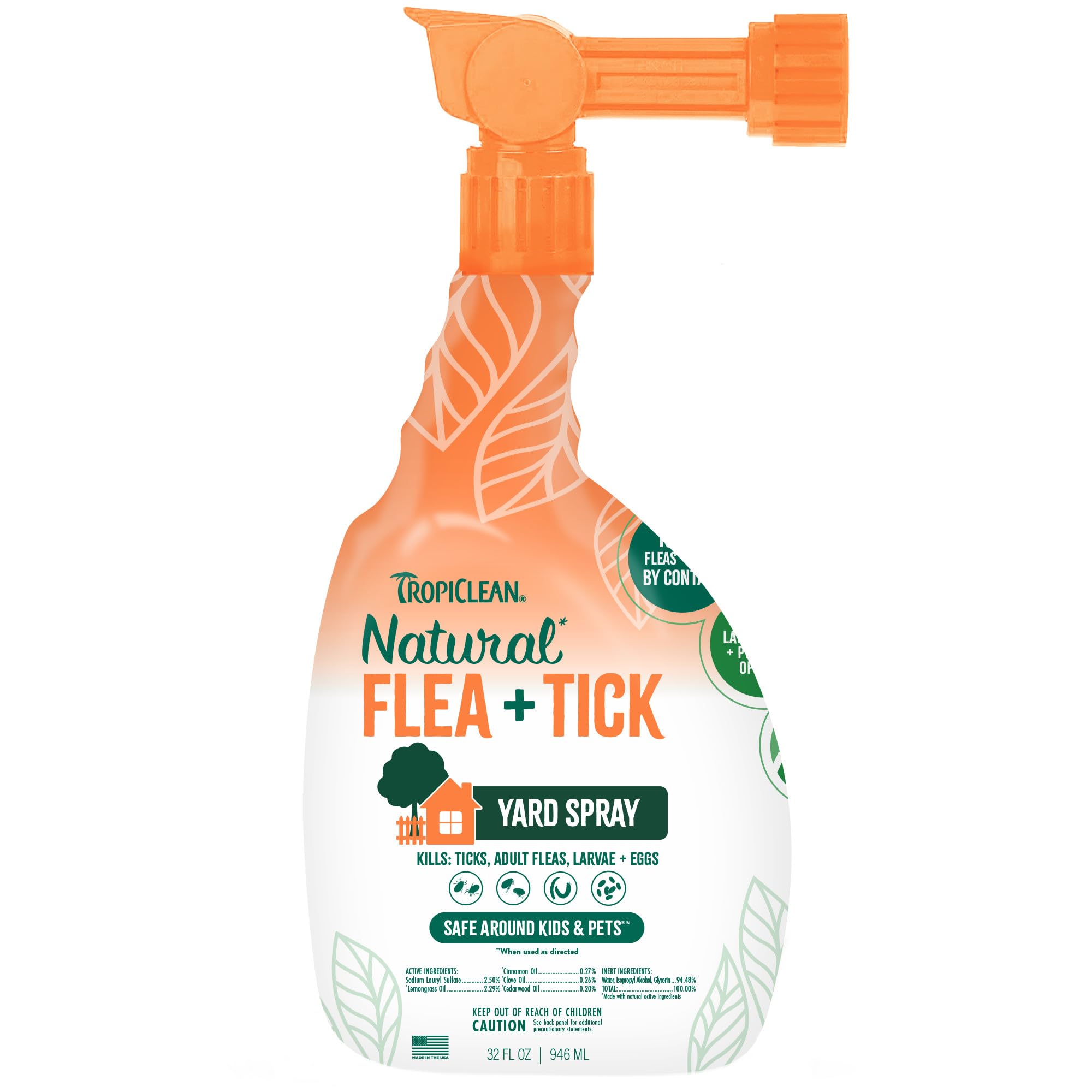
If the thought of mixing concentrates and calibrating a sprayer feels overwhelming, the TropiClean Natural Yard Spray is the turnkey alternative. The 32-ounce bottle screws directly onto a standard garden hose — the built-in nozzle meters the concentrate as water flows, so you simply walk the perimeter and spray. The formula uses a clove and lemongrass essential oil blend to kill fleas, ticks, and mosquitoes on contact.
This is a contact-kill product rather than a long-residual barrier. The essential oils break down under sunlight within a few days, so weekly reapplication is realistic for maintaining protection, especially after rain. The citrus scent dissipates quickly and is far less aggressive than the chemical odor of permethrin, making it a better fit for families who use their yard daily for play or lounging.
For a low-effort maintenance spray that keeps mosquito and flea numbers down without requiring a hazmat mindset, the TropiClean hose-end system delivers exactly that convenience.
Why we love it
- No mixing or measuring — screw onto hose and spray directly
- Pleasant citrus scent family-friendly for daily yard use
- Safe around all pets and kids once dry
Good to know
- Shorter residual requires weekly reapplication for continuous protection
- Essential oils break down faster in full sun and heavy rain
4. Harris Flea and Tick Killer Liquid Spray

Harris Flea and Tick Killer fills the gap between indoor-safe sprays and outdoor treatments. The one-gallon ready-to-use formula comes with an extended trigger sprayer that reaches under furniture, along baseboards, and into carpet fibers — not just grass. The odorless, non-staining formula makes it viable for kennel floors, patio cushions, and pet bedding without leaving residue or chemical smell.
The extended residual claims are supported by the EPA registration (No. 3-11) and owner reports describe it continuing to kill fleas and ticks for weeks after the initial spray dries. The lack of odor is a meaningful advantage for indoor-outdoor mixed use. You can spray the perimeter of a screened porch and the yard edge without driving everyone out with fumes.
The gallon jug is heavy but delivers immediate value because you don’t need a sprayer. For smaller yards (under 2,000 square feet) where you also want to treat dog houses, garage corners, and patio cracks, this eliminates the need to buy a separate indoor product. Just note the label: not for sale in Connecticut, and it is not a concentrate, so coverage area is limited to what the gallon can stretch across.
Why we love it
- Odorless and non-staining — works on fabric, carpet, and grass without damage
- Extended trigger sprayer reaches tight spots under furniture and into kennel corners
- Weeks-long residual activity after drying
Good to know
- Coverage limited to gallon volume — not economical for large acreage
- Not available in Connecticut per state regulations
5. Wondercide Flea, Tick & Mosquito Spray

Wondercide takes the most chemical-averse approach in this lineup, relying on cedarwood oil as the primary active ingredient. The 16-ounce ready-to-use spray targets fleas, ticks, and mosquitoes through contact kill and a strong repellent effect. Lab testing cited on the label shows 98–100% kill rates, and the formula breaks the flea lifecycle by eliminating eggs and larvae on contact.
Owner feedback reveals a split that matters. Many users with chemical-sensitive pets or children love the safety profile — gentle enough for puppies, kittens, and senior animals. But a significant update from a long-term user warns that natural-only protection failed to prevent Lyme disease transmission in their dog after a year of exclusive use. That review underscores the limitation: essential oils repel and kill on contact but do not provide the sustained residual barrier that synthetic pyrethroids do.
This product works best as a supplemental spot-treatment or as a daily perimeter refresher in a layered defense strategy. Use it on pet bedding, kennel interiors, and patio furniture where family and pets spend direct time. For heavy tick zones near wooded areas, pair it with a perimeter synthetic concentrate rather than relying on it alone.
Why we love it
- Safe for all life stages including puppies, kittens, and seniors
- Pleasant lemongrass scent and non-toxic feel on fabrics
- Breaks flea lifecycle by killing eggs and larvae on contact
Good to know
- Frequent reapplication needed — residual protection is short-lived
- Not sufficient as sole protection in high Lyme-disease pressure areas
FAQ
Can I spray a 10% permethrin concentrate directly on my dog?
How often should I retreat my yard during peak tick season?
Will the yard spray kill fleas and ticks on contact or only repel them?
Final Thoughts: The Verdict
For most gardeners, the best yard spray for fleas and ticks winner is the Durvet Permethrin EC 10% because it delivers the most reliable residual tick knockdown per dollar mixed, covering large acreage with a single bottle. If you want a low-effort hose-end spray that avoids mixing chemicals, grab the TropiClean Natural Yard Spray. And for chemical-sensitive households where daily family use of the yard is the priority, nothing beats the Wondercide spray for safety and peace of mind.