
A warbler flits in the shadows thirty yards out, and your compact binoculars just won’t resolve that field mark. You need a spotting scope that bridges the gap between your eyes and the bird without introducing a fog of chromatic aberration or a wobbly tripod mount. This guide separates the scopes that deliver true color fidelity and edge-to-edge sharpness from those that leave you guessing.
I’m Mo Mahin — the founder and writer behind Furric. I have spent hundreds of hours cross-referencing manufacturer spec sheets, analyzing ED glass performance data, and studying aggregated owner feedback on optical clarity, dual-focus mechanisms, and waterproofing integrity across the major spotting scope brands.
Whether you are scanning a marsh at dawn or digiscoping a perched raptor, the right tool makes the difference between a confirmed ID and a frustrating blur. We have reviewed the best models on the market to help you choose the best spotting scope for birding that matches your field style and budget.
How To Choose The Best Spotting Scope For Birding
Selecting a spotting scope for birding is different from choosing one for target shooting or astronomy. Birders prioritize color accuracy, lightweight carry, and the ability to focus on subjects as close as 15 feet and as far as a mile. Every specification below directly affects your ability to identify birds in variable light.
ED Glass vs. HD Glass
Extra-low Dispersion (ED) glass reduces chromatic aberration — the purple or green fringing you see along high-contrast edges like a white egret against dark foliage. HD glass is a marketing term for high-definition coatings, but true ED glass is a material change in the objective lens. Scopes with ED glass (like the Celestron Regal M2 series) render sharper, truer colors than standard fully multi-coated optics, especially in low dawn/dusk light.
Magnification and Objective Lens Size
Birding scopes typically range from 20x to 60x magnification. The objective lens diameter (measured in millimeters, e.g., 65mm, 80mm, 85mm) determines light-gathering ability. Larger objectives (80mm+) deliver brighter images at high magnification but add weight. A 65mm objective is lighter and often sufficient for daylight birding, while 80mm+ excels in low-light forest or early-morning marsh conditions.
Straight vs. Angled Eyepiece
Angled eyepieces (45 degrees) are preferred by most birders because they allow the scope to be positioned lower on the tripod, reducing wobble, and make it easier to share the view with a group without adjusting tripod height. Straight eyepieces are simpler to use when scanning from a vehicle window but require a taller, more stable tripod.
Close Focus Distance
Birders often need to inspect birds at close range — 15 to 25 feet. A scope with a close focus distance of 15 feet or less lets you observe nearby warblers and sparrows without backing up. Many entry-level scopes have a close focus of 20 feet or more, which can be restrictive in dense habitat.
Quick Comparison
On smaller screens, swipe sideways to see the full table.
| Model | Category | Best For | Key Spec | Amazon |
|---|---|---|---|---|
| Vortex Diamondback HD | Premium | All-around birding & low light | 85mm objective, HD optical system | Amazon |
| Celestron Regal M2 80ED | Premium | Digiscoping & critical ID | 80mm ED objective, XLT coatings | Amazon |
| Celestron Regal M2 65ED | Premium | Lightweight carry with ED glass | 65mm ED objective, 16-48x zoom | Amazon |
| Vanguard Endeavor HD | Mid-Range | Budget ED glass alternative | 65mm ED objective, 15-45x zoom | Amazon |
| Athlon Argos HD | Mid-Range | 85mm light gathering on budget | 85mm objective, HD glass, argon purged | Amazon |
| WOZEL 25-75×100 | Mid-Range | Maximum magnification for open habitats | 100mm objective, 25-75x zoom | Amazon |
| Gosky 20-60×80 | Mid-Range | Value with phone adapter included | 80mm objective, BAK4 prism, phone adapter | Amazon |
| Bushnell Trophy Xtreme | Budget | Entry-level with window mount kit | 20-60x, includes tripod & cases | Amazon |
| Athlon Talos 20-60×80 | Budget | Low-cost entry to 80mm objective | 80mm objective, nitrogen purged | Amazon |
In‑Depth Reviews
1. Vortex Optics Diamondback HD Spotting Scope

The Vortex Diamondback HD represents the sweet spot where optical performance meets field-ready durability. The HD optical system cuts chromatic aberration effectively, delivering edge-to-edge sharpness and true color rendition that birders need when separating a sharp-shinned from a Cooper’s hawk at distance. The 85mm objective gathers ample light for those early-morning warbler walks.
The built-in helical focus wheel allows fast coarse adjustments and then fine-tuning without shifting your grip — critical when tracking a moving bird. The Arca-Swiss compatible base mates directly with modern tripod heads without an adapter plate, saving weight and setup time. The armored rubber exterior and O-ring sealed, argon-purged construction mean this scope survives rain, fog, and field knockabout without losing nitrogen purge integrity.
User feedback consistently praises the brightness across the entire 20-60x magnification range, noting that the image remains crisp even at the highest zoom — a feat many scopes at this tier cannot match. The tethered lens caps and neoprene cover show thoughtful design for daily carry, and the Vortex VIP warranty adds peace of mind for long-term ownership.
Why we love it
- Excellent edge-to-edge sharpness with HD optics
- Helical focus wheel enables precise adjustments
- Arca-Swiss compatible for quick tripod mounting
Good to know
- Heavier than some 65mm competitors at 3.8 pounds
- Premium pricing places it above entry-level budgets
2. Celestron Regal M2 80ED Spotting Scope
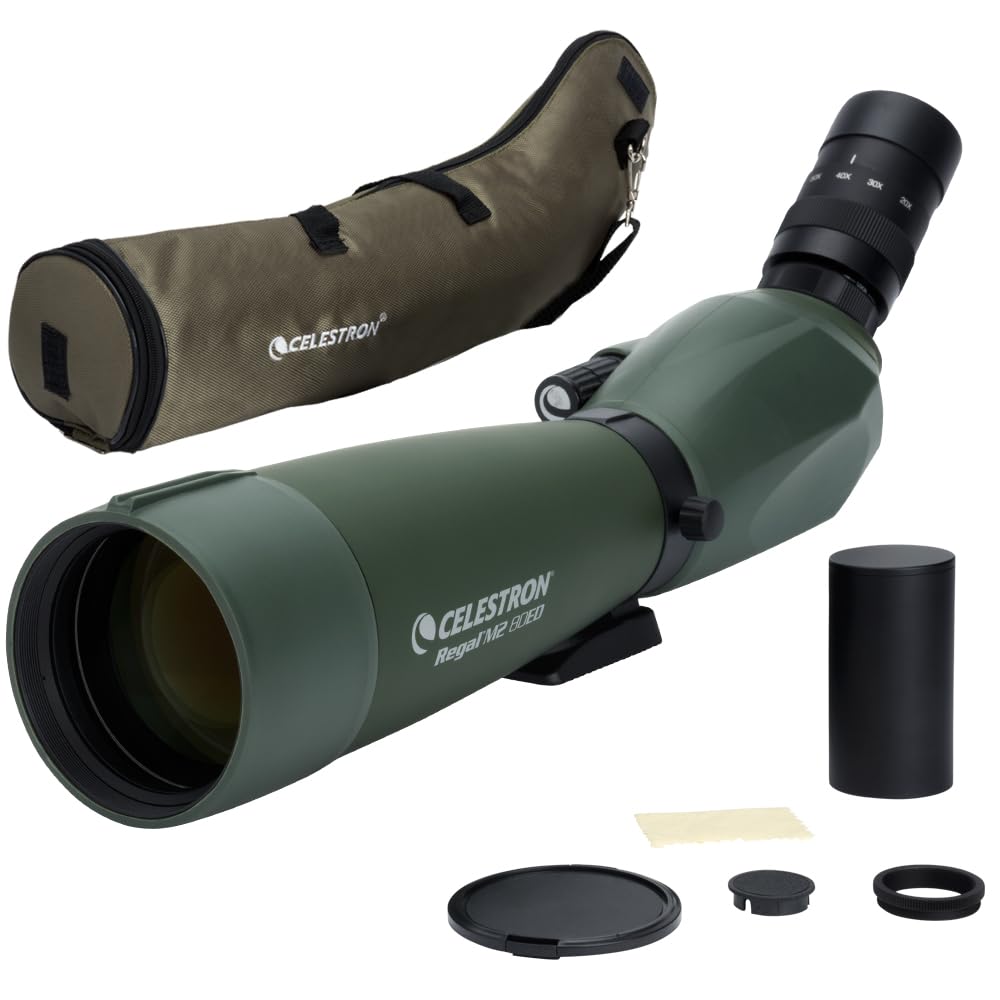
The 80mm ED objective on the Celestron Regal M2 is the star of this scope. Extra-low dispersion glass virtually eliminates chromatic aberration, rendering a great blue heron’s wing feathers with zero purple fringing. Celestron’s proprietary XLT coatings — borrowed from their observatory-grade telescopes — maximize light transmission, making this scope exceptionally bright even as the sun dips below the treeline.
The dual-focus mechanism is a birder’s dream: a coarse knob brings the bird into view rapidly, then the fine-focus ring dials in perfect sharpness on the eye of a distant kingfisher. The rotating tripod mount lets you adjust the eyepiece angle without re-leveling the tripod, a huge advantage when sharing views at a birding festival. It accepts standard 1.25-inch astronomical eyepieces, expanding your magnification options beyond the included 20-60x zoom.
The included soft carrying case is padded and view-through compatible, meaning you can pack the scope while keeping the objective covered yet accessible. The T-mount adapter for digiscoping DSLR cameras is also bundled — a rarity at this level. The magnesium alloy body keeps weight to 4.5 pounds, reasonable for an 80mm ED scope, and the lifetime warranty from Celestron adds long-term confidence.
Why we love it
- True ED glass eliminates chromatic aberration
- Smooth dual-focus knobs for precise birding
- Includes T-mount adapter for digiscoping
Good to know
- Requires a sturdy tripod due to 4.5-pound weight
- Premium price reflects ED glass quality
3. Celestron Regal M2 65ED Spotting Scope

The 65mm version of the Regal M2 packs the same ED glass and XLT coatings as its larger sibling but in a lighter, more packable body. At 4 pounds, it is easier to carry on long hikes through marsh trails or up coastal bluffs where every ounce matters. The 16-48x zoom range is slightly less ambitious than the 20-60x, but the lower minimum magnification gives a wider field of view for scanning open areas before zooming in on a target.
Birders who compare this scope directly against the Vortex Viper HD 65 often report that the Regal M2 holds its own in color fidelity and resolution, with some preferring the Celestron’s smoother focus mechanism. The rotating tripod ring works identically to the 80ED version, allowing comfortable angled viewing without adjusting the tripod head. The included T-adapter for digiscoping DSLR bodies is a serious bonus for bird photographers.
The close focus distance of approximately 15 feet makes this scope usable for backyard feeders and close woodland trails where larger scopes would be out of range. The Kellner-design zoom eyepiece provides adequate eye relief for eyeglass wearers, though some users replace it with a premium 1.25-inch eyepiece for even better contrast. Considering ED glass at this weight and price point, the Regal M2 65ED is a compelling choice for mobile birders.
Why we love it
- ED glass in a lightweight 65mm package
- Broad 16-48x zoom range for scanning
- Digiscoping kit included with T-adapter
Good to know
- At 48x max, less reach than 60x competitors
- Eyepiece upgrade improves contrast further
4. Vanguard Endeavor HD Angled Eyepiece Spotting Scope

The Vanguard Endeavor HD offers ED glass at a price point that undercuts many competitors, making it an attractive entry point for birders who want color correction without paying premium-tier dollars. The 65mm objective keeps the scope portable, and the 15-45x zoom range is well-suited for midday birding where maximum magnification is less critical than image clarity.
The dual-focus mechanism includes both a coarse and fine adjustment wheel, enabling precise focus on distant birds without overshoot. The detachable angled eyepiece has a long 19-20mm eye relief, accommodating eyeglass wearers comfortably. The rubber-armored magnesium body includes a built-in sunshield that reduces glare in bright conditions — a thoughtful feature for open-sky birding.
Owner reviews highlight that while the ED glass significantly reduces fringing, the optical performance approaches but does not equal that of scopes in the + range, especially at the higher end of the zoom range.
Why we love it
- ED glass at an accessible price point
- Long eye relief for eyeglass users
- Built-in sunshield reduces glare
Good to know
- Image softens slightly above 40x
- At 51 ounces, heavier than some 65mm options
5. Athlon Optics Argos HD 20-60×85 Spotting Scope

The Athlon Argos HD brings an 85mm objective and HD glass to the mid-range tier, delivering impressive low-light performance for dawn and dusk birding sessions. The fully multi-coated lenses produce bright images with good color accuracy, though it uses HD glass rather than true ED glass, so some chromatic aberration is visible at the edges of high-contrast subjects.
The 45-degree angled eyepiece with a rotating tripod ring allows flexible viewing positions without moving the tripod. The dual-focus mechanism — a large coarse ring and a smaller fine-focus ring — mirrors the ergonomics of much more expensive European scopes. The argon-purged, O-ring-sealed body ensures fogproof and waterproof performance even in wet coastal conditions or sudden rain showers.
Users consistently note that the Argos HD offers image quality approaching that of Vortex scopes costing significantly more, making it a smart pick for birders who prioritize objective size and brightness over absolute chromatic correction. The included soft case and lens caps are functional, and the rubber armor provides a secure grip in wet conditions. Pair this scope with a stable tripod to fully exploit the 85mm light-gathering ability.
Why we love it
- 85mm objective excels in low light
- Argon purged for reliable fogproof performance
- Ergonomic dual-focus rings
Good to know
- HD glass shows some CA at edge
- Requires a heavy-duty tripod for stability
6. WOZEL 25-75×100 Spotting Scope
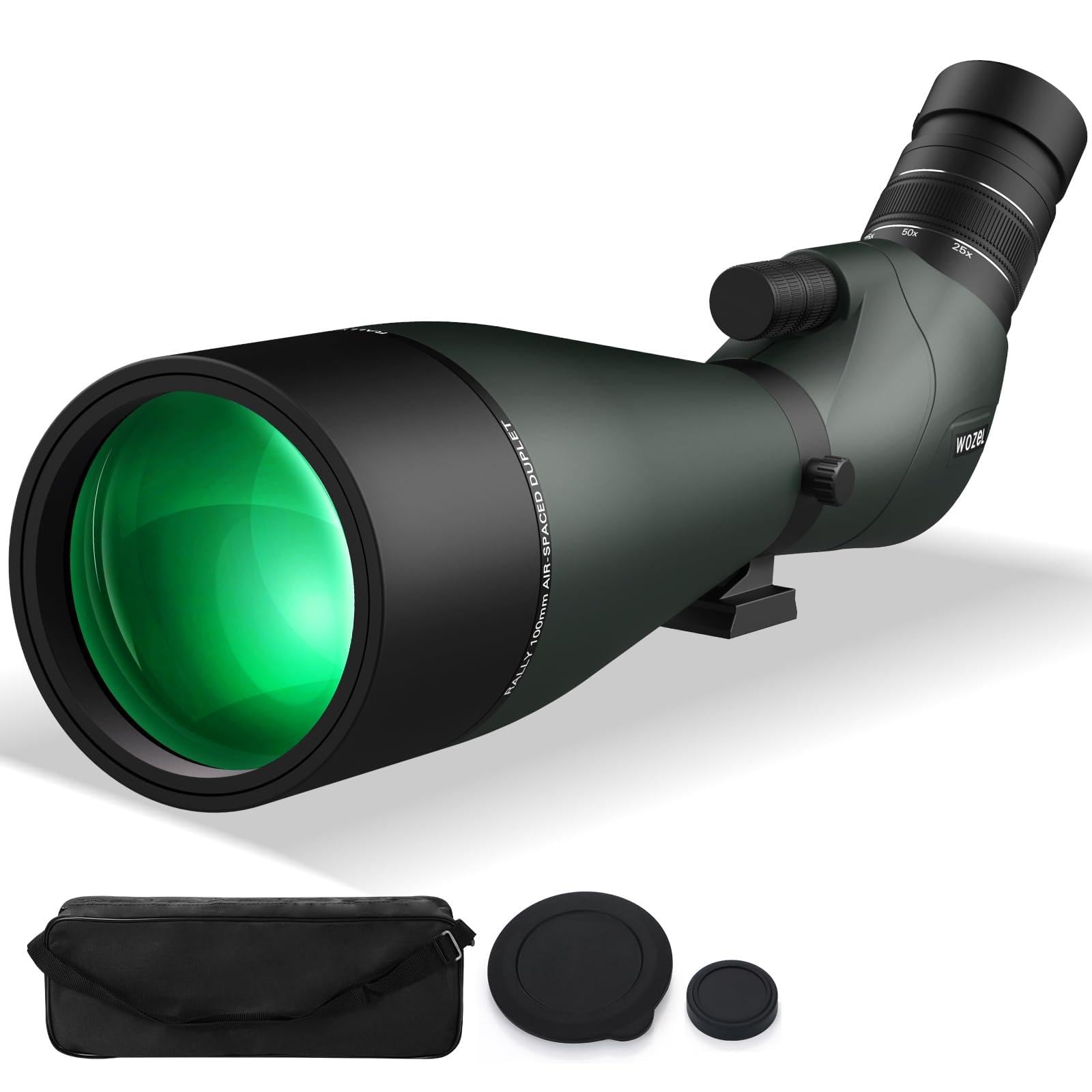
The WOZEL 25-75×100 is built for birders who need extreme reach across open habitats like coastal estuaries, vast wetlands, or alpine ridges. The 100mm objective lens is among the largest in this category, gathering enough light to keep the image bright even at 75x magnification. The BAK4 prisms and fully multi-coated lenses deliver high-contrast images with reduced internal scattering.
The 45-degree angled eyepiece with a leather-textured exterior provides a comfortable grip even in damp conditions. The retractable visor built into the main barrel reduces glare from overhead sun, helping maintain contrast on distant subjects. The weatherproof design with O-ring seals protects against moisture and dust, though the scope is heavy enough that it requires a robust tripod with a fluid head.
Owner feedback is overwhelmingly positive regarding the clarity at mid-range magnifications (25-50x), with many noting that the image quality at 75x is usable but begins to show atmospheric distortion and chromatic aberration on bright days. The included carrying bag is adequate, and the lifetime customer service adds confidence. For open-country birding where magnification matters most, this scope delivers serious reach.
Why we love it
- Extreme 75x magnification for distant birds
- 100mm objective for bright high-power views
- BAK4 prisms improve contrast
Good to know
- Heavy build needs a sturdy tripod
- CA visible at maximum zoom
7. Gosky 20-60×80 Spotting Scope
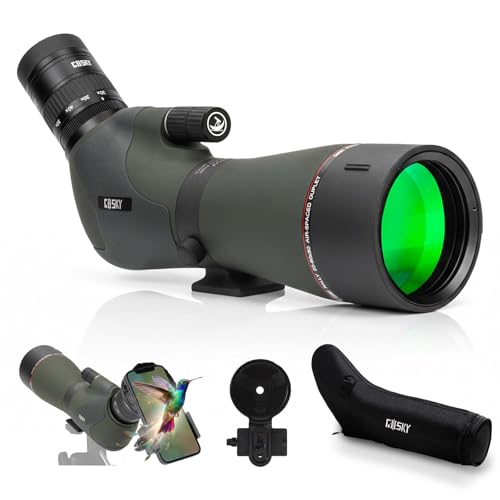
The Gosky 20-60×80 has become a popular choice for birders who want a functional scope without breaking the budget. The 80mm objective and fully multi-coated BAK4 prism deliver bright, clear images at 20x that compare favorably with mid-range options, though image quality degrades more noticeably at 60x than premium scopes. The included smartphone adapter is a practical addition for casual digiscoping.
The dual-focus mechanism is a standout at this price level — the coarse knob brings the subject into view, and the fine-focus ring allows subtle adjustments. However, some users report the fine-focus knob feels slightly loose, and care is needed to avoid overshooting focus. The waterproof and fogproof construction with O-ring seals means this scope survives field conditions, though it is not argon-purged like higher-end models.
Where this scope excels is value: it includes a carrying case, the phone adapter, and lens covers, so you can start birding and digiscoping immediately without extra purchases. Many users compare it favorably to scopes costing twice as much, especially for daytime use. The trade-offs in high-magnification sharpness are acceptable for the budget-conscious birder upgrading from binoculars.
Why we love it
- Excellent value with included phone adapter
- BAK4 prisms provide good base image quality
- Waterproof/fogproof for field use
Good to know
- Image softens noticeably above 50x
- Fine focus knob feels imprecise to some users
8. Bushnell Trophy Xtreme Spotting Scope

The Bushnell Trophy Xtreme is an entry-level scope aimed at the birder who needs a complete kit without researching tripods and adapters separately. It ships with a tabletop tripod, a car window mount, a hard case, and a soft case — everything needed to get started from a vehicle or stationary position. The fully multi-coated optics and BAK4 prism deliver usable brightness for daytime birding.
The 20-60x magnification range covers typical birding needs, though the image at 60x is noticeably dimmer and less sharp than mid-range options due to the smaller objective lens diameter. The straight eyepiece design works well for window-mount use but is less convenient for group viewing from a tripod. The individual focus mechanism is simple to operate, though it lacks the precision of a dual-focus system.
Owner reviews frequently praise the rugged build quality and the comprehensiveness of the included accessories. The scope is not fogproof and lacks nitrogen or argon purging, so it is best suited for dry-weather use. For the birder on a tight budget who wants one box with everything to start, the Bushnell Trophy Xtreme provides a functional stepping stone into spotting scopes.
Why we love it
- Includes tripod, window mount, hard and soft cases
- Rugged build suitable for car birding
- Fully multi-coated optics for the price
Good to know
- Not fogproof or argon-purged
- Image dims significantly at 60x
9. Athlon Optics Talos 20-60×80 Spotter Scope

The Athlon Talos 20-60×80 is one of the few budget-friendly scopes to include nitrogen purging, making it waterproof and fogproof in humid or rainy conditions — a significant advantage over some rivals at this tier. The 80mm objective and fully multi-coated lenses produce a reasonably bright image at 20x, adequate for identifying common waterfowl and wading birds at moderate distances.
The aluminum body feels solid in hand, though the scope lacks the rubber armor of more expensive models. The focus mechanism is single-speed, which means fine-tuning at 60x requires a steady hand and patience. The straight eyepiece is straightforward to use but less ideal for extended group sessions. The field of view at 1.57 degrees (roughly 82 feet at 1000 yards) is narrow compared to premium scopes, making target acquisition slower.
For the entry-level birder who wants waterproof protection without spending above the base tier, the Talos provides a functional tool. Many users report satisfactory performance for daytime shorebird observation and backyard feeder watch. The trade-offs in contrast and high-magnification sharpness are expected at this level, but the nitrogen-purged body means the optics stay clear season after season — a rare find in the entry segment.
Why we love it
- Nitrogen purged for waterproof/fogproof reliability
- 80mm objective at an entry-level price
- Solid aluminum construction
Good to know
- Narrow field of view hampers scanning
- Single-speed focus struggles at 60x
FAQ
Is ED glass worth the extra cost for birding?
What magnification range is best for birding?
Should I get a straight or angled eyepiece for birding?
How do I know if a spotting scope is waterproof and fogproof?
Can I use any spotting scope for digiscoping?
Final Thoughts: The Verdict
For most gardeners, the best spotting scope for birding winner is the Vortex Diamondback HD because the HD optical system, helical focus wheel, and Arca-Swiss compatibility deliver the highest overall image quality and ease of use without exceeding a reasonable mid-range spend. If you want true ED glass with digiscoping capabilities, grab the Celestron Regal M2 80ED. And for maximum magnification across open habitats, nothing beats the WOZEL 25-75×100.