
An indoor bunny’s safety and comfort hinge almost entirely on the one thing you choose to contain them. Too small and they’re cramped; poorly constructed and they chew their way to trouble; hard-to-clean designs turn a daily routine into a chore. Whether you are bringing home a lop-earred new friend or upgrading a dilapidated wire cage, the difference between a happy, healthy rabbit and a stressed one often comes down to floor space, bar spacing, and tray quality.
I’m Mo Mahin — the founder and writer behind Furric. I’ve spent years dissecting the structural integrity, material safety, and real-world usability of small animal housing, comparing specifications against what dozens of rabbit owners report after months of daily use.
Buying the wrong enclosure can mean urine leaks, bent wires, or a bunny that escapes through an oversized gap, which is why this guide targets the best cage for indoor bunny that balances real living space, easy maintenance, and long-term durability.
How To Choose The Best Cage For Indoor Bunny
A cage isn’t just a pen; it’s your rabbit’s den, lookout, and retreat. Get the dimensions wrong or skip a single guard feature, and you’ll spend the next year cleaning messes off your floor or replacing chewed trim.
Size and Floor Space
Rabbits need room to stretch, hop, and stand on hind legs. The minimum for a single small breed is roughly 30 by 24 inches of continuous floor area, but larger breeds or bonded pairs need significantly more. Watch overall height as well — a rabbit should be able to sit upright without its ears touching the roof. Two-level cages add vertical territory, but only if the ramp angle is gentle enough for a rabbit to climb safely.
Bar Spacing and Material
Standard spacing for a rabbit is about one inch between wires. Any wider and a determined bunny can squeeze through or get its head stuck. On the material side, a full-wire cage offers ventilation and visibility, but a wood-and-wire hybrid gives more privacy and insulation. In either case, check the tray rim — rabbits love chewing plastic edges, so look for aluminum-reinforced frames or metal guards around high-contact zones.
Cleaning and Leak Protection
The number-one daily complaint from rabbit owners is cleaning time. A cage with a pull-out plastic tray that is at least five inches deep will hold bedding and contain most messes. Even better are trays with raised urine guards or baffles that prevent liquid from seeping onto your floor. Removable top grates also speed up spot-cleaning. If you prefer a two-level hutch, make sure the upper tray slides out independently so you aren’t lifting the whole cage.
Mobility and Door Access
Rabbits are active at dawn and dusk, so you’ll want a cage that can roll to a sunny spot during the day and lock in place at night. Four metal casters with at least two brakes make repositioning effortless. At the same time, large front and top doors let you reach in for feeding, petting, or cleaning without twisting your wrist. A door that swings wide also encourages your bunny to hop out on its own rather than being pulled.
Quick Comparison
On smaller screens, swipe sideways to see the full table.
| Model | Category | Best For | Key Spec | Amazon |
|---|---|---|---|---|
| FunXplore 2-Tier | Premium Wood | Chew-resistant & odor control | 0.43″ bar gap, aluminum edges | Amazon |
| MidWest 158XL | Premium Wire | XL single-level floor space | 47.2″L x 23.6″W footprint | Amazon |
| GDLF 58″ Wooden | Spacious Wood | Long, two-level layout | 58″ L total, 11mm bar gap | Amazon |
| PetsCosset 40″ | Mid-Range Wood | Indoor/outdoor hybrid use | UV-proof panels, fir wood | Amazon |
| MidWest Wabbitat 158 | Value Wire | Simple assembly, sturdy base | 5.5″ deep base pan | Amazon |
| Aivituvin Wooden | Value Wood | Two deep trays & lockable wheels | 40.6″L x 26″W x 37.6″H | Amazon |
| PawHut 35″ | Budget Wire | Compact setup for dwarf breeds | 35″L x 17.25″W x 17″H | Amazon |
In‑Depth Reviews
1. FunXplore 2-Tier Rabbit Cage & Bunny Hutch
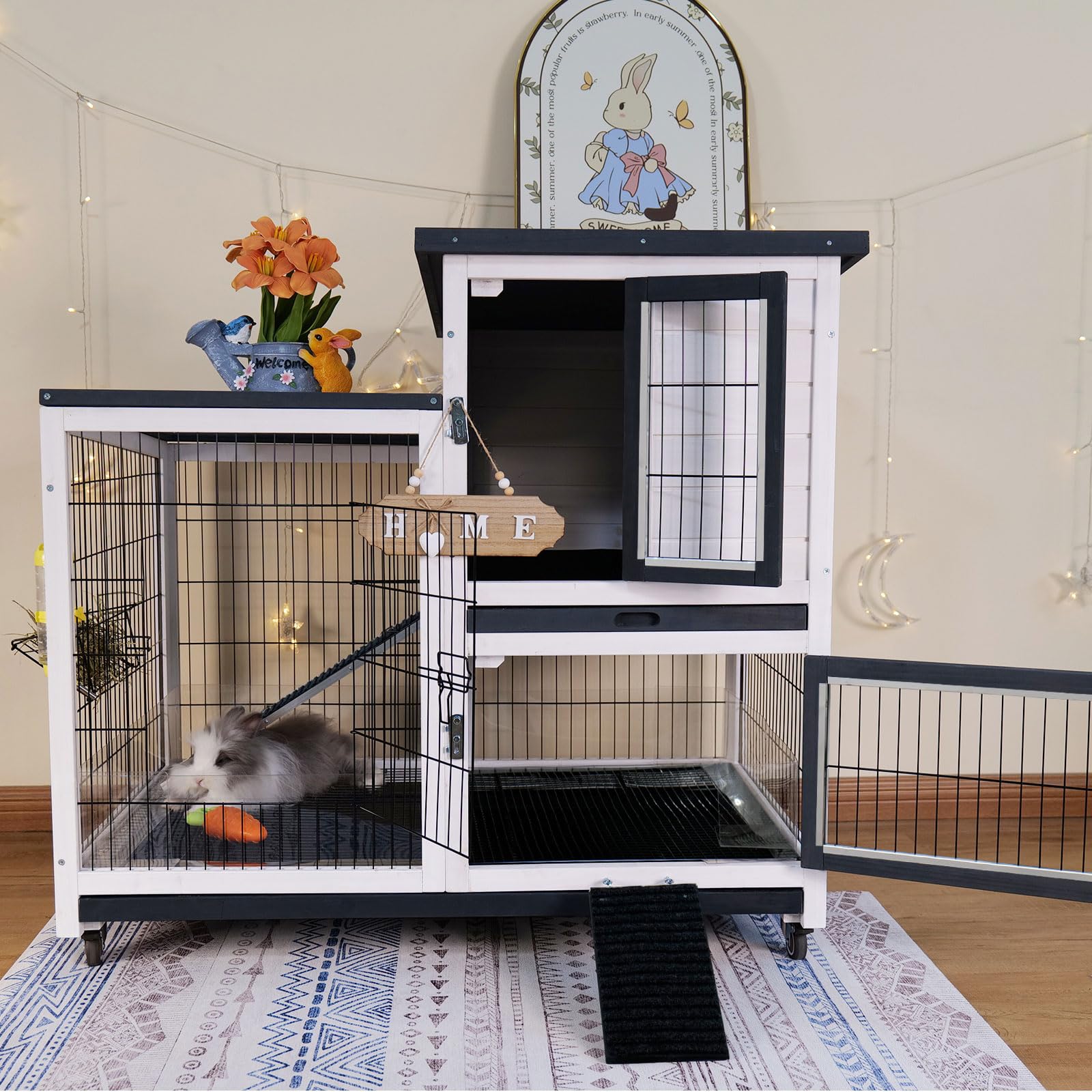
The FunXplore two-tier cage solves the two biggest headaches in rabbit housing: chewing and mess. The door frames and ramps are reinforced with aluminum edges that withstand persistent gnawing far better than raw wood or thin wire. Owners who have dealt with chewed-through corners will immediately appreciate this upgrade.
Cleaning is equally well thought out — dual deep pull-out trays sit beneath built-in urine guards that prevent liquid from seeping onto the floor. The upper grid uses a narrow 0.43-inch wire spacing, so delicate rabbit feet never slip through, while the 40.6 by 26-inch footprint gives a medium bunny plenty of room to stretch. Four metal wheels with two locks make relocation simple.
The openable roof and three access doors mean you can reach any corner without moving the cage. Assembly is direct with pre-drilled panels, and the weatherproof roof makes it usable indoors with a patio-door view. For owners who want a durable, easy-clean home that actually looks good, this is the top pick.
Why we love it
- Aluminum-reinforced edges resist destructive chewing
- Urine guards and deep trays stop leaks completely
- Narrow 0.43″ bar spacing protects small feet
Good to know
- Wood panels are solid but not coated for outdoor rain exposure
- Ramp slope may be steep for elderly or disabled rabbits
2. Midwest Homes for Pets Deluxe XL Rabbit & Guinea Pig Cage

The MidWest 158XL is the gold standard for a single-level, no-nonsense wire cage. Its footprint stretches 47.16 inches long and 23.62 inches wide — notably larger than the standard Wabbitat — giving an active bunny room to run a few binkies without hitting a wall. The 5.5-inch deep base pan contains litter and bedding effectively.
Assembly requires zero tools: the wire panels snap together with plastic corner clips, and the full side door plus top door allow easy access. The included hay feeder, water bottle, and elevated feeding bowl are functional extras that save a separate purchase. Owners consistently report the cage holds up well even with cats climbing on top.
Bar spacing is rabbit-safe at roughly one inch, and the metal construction wipes down quickly. The main drawback is the lack of a second level or ramp, but the wide floor compensates. This is the best option if you prioritize open floor space and simple setup over vertical features.
Why we love it
- Extra-long 47-inch floor space for active bunnies
- Tool-free snap assembly in under 20 minutes
- Compatible with separate extension add-ons
Good to know
- Wire floor can irritate feet without solid resting mats
- Plastic base edges are chewable if a rabbit is determined
3. GDLF Two Floors 58″ Wooden Indoor Bunny Hutch

The GDLF hutch stretches 58 inches end-to-end, making it the longest two-level wooden cage in this lineup. That extended floor plate gives a bonded pair of rabbits or a trio of guinea pigs genuine running space without needing a separate exercise pen. The spruce wood construction is coated with eco-friendly, non-toxic varnish that neutralizes odor concerns many wood cages carry.
Two full-width sliding trays sit beneath each level, and the wire spacing is a tight 11 millimeters — small enough that baby rabbits can’t push through. The ramp has timber ridges to prevent slipping, and the five access doors let you reach any corner. Assembly is straightforward thanks to pre-drilled holes and numbered hardware bags.
Mobility comes from six wheels, all locking, so the cage stays put during playtime. The only trade-off is the 18-inch depth, which is narrower than other wooden models; long-bodied rabbits will appreciate the length but may want a wider turn radius. For floor-space-maximizing layouts, this is a strong contender.
Why we love it
- 58-inch length fits more than one rabbit comfortably
- Tight 11mm bar spacing blocks small escapes
- Six lockable casters for easy room-to-room movement
Good to know
- Only 18 inches deep — less turning space for larger breeds
- Wood is soft; aggressive chewers may dent corners
4. PetsCosset Rabbit Hutch Indoor 40″ L 2 Story

PetsCosset built this hutch with a clever twist — the side panel removes to convert the two-level design into a single, wide ground-level enclosure. That flexibility makes it useful for bunnies that struggle with ramps or for owners who want to change the layout seasonally. The fir wood frame is treated with UV-resistant panels and a waterproof asphalt roof, so it transitions easily from a living room corner to a covered patio.
The two deep pull-out trays measure generously at the base, and the clear acrylic windows on the second level let you observe your rabbit without opening the door. Pre-drilled holes and a labeled manual keep assembly under an hour with two people. Owners report the ramp angle is gentle enough for most rabbits to use confidently.
The 40.2 by 23.2-inch footprint is mid-sized, and the 7.11 square feet of internal space comfortably houses one medium rabbit. The metal feeder included is a nice touch, though the ramp lattice could be wider. For versatility across indoor and covered outdoor use, this cage earns serious consideration.
Why we love it
- Convertible side panel turns two-level into one open floor
- UV-resistant fir wood with waterproof asphalt roof
- Clear acrylic windows for easy observation
Good to know
- Assembly is much easier with two people
- Ramp section is narrow — large rabbits may hesitate
5. MidWest Homes for Pets 158 Wabbitat Deluxe Rabbit Home

The standard Wabbitat 158 has been a go-to entry-level wire cage for years, and for good reason. Its 39.5 by 23.75-inch floor area meets the minimum recommendation for a small-to-medium rabbit, and the 5.5-inch deep plastic base keeps hay and litter contained. The top and side doors both open fully, making it easy to scoop out soiled bedding or offer a treat.
Assembly is tool-free with sturdy snap-lock corners, and the included three-piece accessory set — hay feeder, water bottle, and bowl — covers the basics. The elevated feeding area sits off the floor, which reduces the amount of hay that gets soiled. Owners report the cage remains stable even with cats jumping on top, and many have kept it for four-plus years without structural issues.
The wire spacing sits at roughly one inch, suitable for adult rabbits. The base tray edges are plastic, so a determined chewer could damage them over time. For a straightforward, time-tested wire cage that leaves budget for extra toys and litter, the Wabbitat is a solid choice.
Why we love it
- Tool-free snap assembly in minutes
- Deep 5.5″ base holds bedding without spills
- Proven durability over many years of use
Good to know
- Wire floor needs a fleece pad or resting board
- Included water bottle can arrive deformed
6. Aivituvin Rabbit Hutch Large Wooden Bunny House

Aivituvin’s hutch stands out for its dual deep pull-out trays — a lower tray and an upper tray that both slide out independently. This means you can clean one level while the rabbit stays on the other, a huge time-saver. The removable wire netting grid above the bottom tray prevents the rabbit from standing in its waste, which reduces odor and keeps fur dry.
The wooden frame is topped with a metal roof hinge that opens upward, and the sliding door on the side lets you separate the up and down areas — useful for bonding new rabbits or confining a mess. Four wheels with two brakes make it easy to roll into sunlight for a few hours. The 40.6 by 26-inch footprint is generous for a single rabbit, and the 37.6-inch height gives plenty of headroom.
Customer feedback notes that the wood can absorb odors if not sealed, and some assembly screws require careful handling to avoid stripping the soft wood. For the price, the two-tray convenience and locking wheels are a compelling package.
Why we love it
- Two independent sliding trays make cleaning fast
- Wire grid above bottom tray keeps rabbit off waste
- Sliding door divider for separating levels
Good to know
- Wood pores can absorb urine smell over time
- Soft wood requires careful drilling to avoid cracks
7. PawHut 35″ L Small Animal Cage
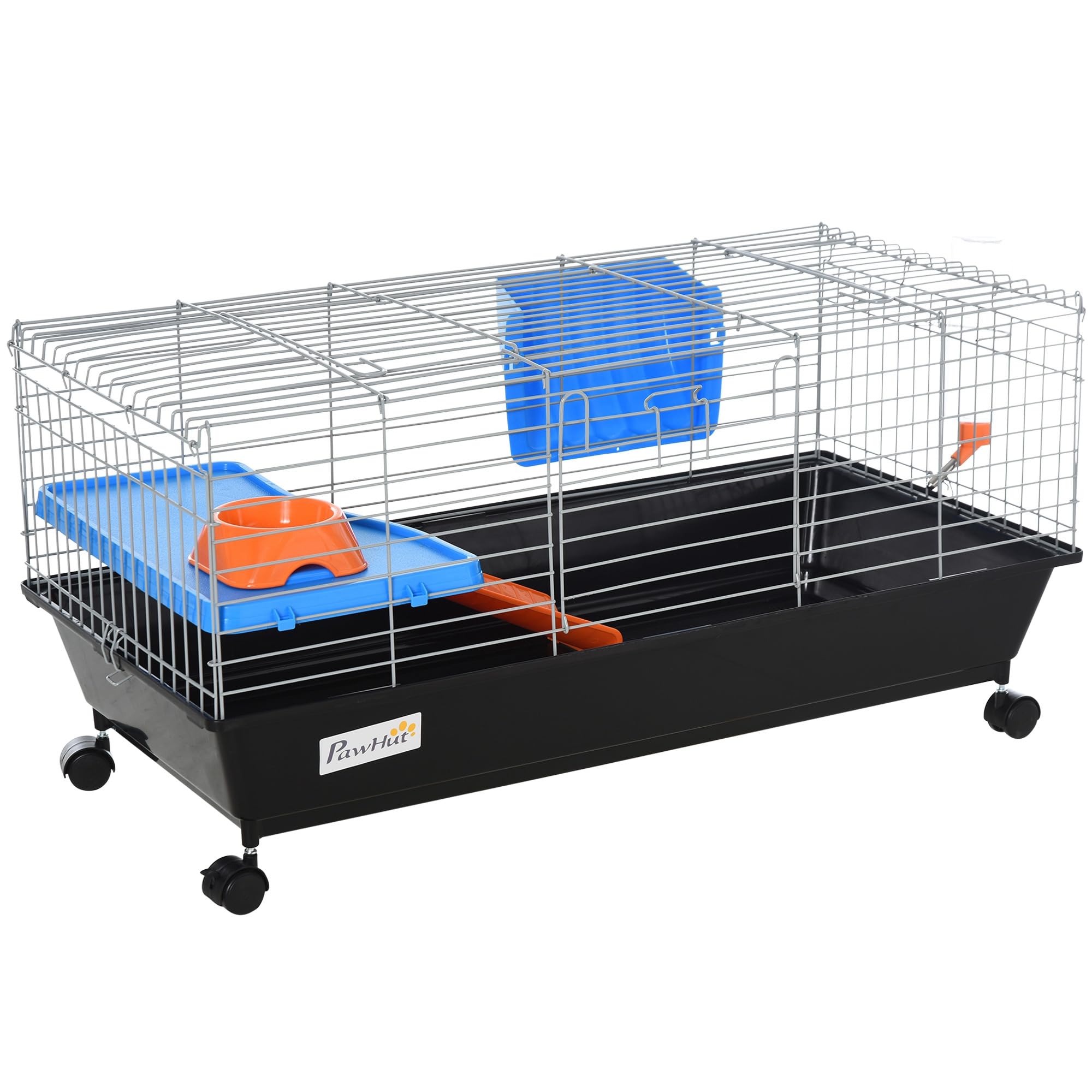
The PawHut 35-inch cage is a budget-friendly starter enclosure aimed at dwarf rabbits, guinea pigs, or chinchillas. Its 35 by 17.25-inch floor is compact but workable for a small netherland dwarf or a single guinea pig. The wire frame uses a bite-proof metal coating that resists the kind of gnawing that quickly destroys thin wire cages.
Both the top and front doors open wide, giving good access for cleaning the plastic tray — which measures 33.75 by 16.5 by 5.5 inches deep. The included food bowl, hay feeder, and water bottle mean you don’t need to buy accessories separately. Four wheels roll smoothly, though they lack locks, so the cage can drift on hard floors.
The main limitation is bar spacing: reviews note that baby rats and very small rabbits can potentially squeeze through. The overall height at 17 inches also means a larger rabbit will feel cramped. For a temporary or back-up cage for a tiny breed, it works well, but it is not a permanent home for a standard-size bunny.
Why we love it
- Bite-proof metal wire coating resists gnawing
- Includes bowl, bottle, and hay feeder at no extra cost
- Top opening simplifies cleaning access
Good to know
- 17″ height is too low for larger rabbit breeds
- Bar spacing may allow very small rabbits to escape
FAQ
What is the minimum bar spacing for an adult rabbit cage?
Can a wooden bunny hutch be used safely indoors?
How often should I replace the removable trays in a rabbit cage?
Final Thoughts: The Verdict
For most indoor rabbit owners, the best cage for indoor bunny overall is the FunXplore 2-Tier because its aluminum-reinforced edges, leak-proof dual trays, and narrow 0.43-inch bar spacing address the three biggest failure points of typical cages. If you want a single-level floor that gives a large rabbit room to sprint, grab the MidWest 158XL. And for owners who need a long, multi-animal enclosure at a budget-friendly price, nothing beats the GDLF 58″ Wooden Hutch.