
Watching a starling or a grackle drain a suet cake in hours while the woodpeckers wait their turn is a common backyard frustration. A properly designed feeder that uses gravity, cage spacing, or perching mechanics to block these bully birds changes the feeding dynamics entirely — but only when the construction, the mesh gauge, and the weight distribution are dialed in for the right species.
I’m Mo Mahin — the founder and writer behind Furric. I spend hundreds of hours each quarter studying product specifications, cross-referencing supplier manufacturing data, and analyzing aggregated owner feedback to map which design details hold up across seasons and which shortcuts waste your money.
Whether you want to stop starlings cold or finally give your pileated woodpeckers a stable perch, this breakdown of the best options will walk you through the real mechanical differences. Here is my complete guide to finding the best squirrel proof suet feeder for your yard in 2025.
How To Choose The Best Squirrel Proof Suet Feeder
Not every “squirrel proof” suet feeder lives up to the label. Many designs rely on flimsy wire or a cage that large squirrels can squeeze through, and some block the very birds you want. Below are the three most critical factors to evaluate before buying.
Feeding Mechanism: Upside-Down vs. Cage Style
An upside-down feeder forces birds to hang below the suet cake to eat. Starlings and grackles struggle to hold that posture, while woodpeckers, nuthatches, and chickadees do it naturally. Cage-style feeders with narrow bars (about 1.5 inches spacing) can also block larger bully birds, but they require precise bar spacing that still allows a downy woodpecker or a tufted titmouse to slip through.
Tail Prop Length and Stability
Woodpeckers brace their stiff tail feathers against a prop for leverage while feeding. A short prop (under 5 inches) works for smaller downy woodpeckers, but pileated and hairy woodpeckers need a tail prop of at least 7 to 17 inches to feed comfortably. If the prop is too short or textured badly, larger woodpeckers will visit less often or avoid the feeder altogether.
Construction Material and Weather Resistance
Solid cedar resists moisture naturally and can be sanded or repaired if squirrels chew corners. Recycled poly lumber (HDPE-based) won’t crack, split, or fade over many seasons, but it is heavier and harder to modify. Vinyl-coated wire mesh keeps the suet cage rust-free and smooth against bird beaks, but if the coating peels over time — as some owners report after three to five years — birds may ingest plastic flakes. Stainless-steel hardware is non-negotiable for long-term outdoor exposure.
Quick Comparison
On smaller screens, swipe sideways to see the full table.
| Model | Category | Best For | Key Spec | Amazon |
|---|---|---|---|---|
| Songbird Essentials Upside Down | Upside-Down | Bully bird deterrence, easy cleaning | 7.5 x 3 x 7.25 inches | Amazon |
| Kingsyard Recycled Plastic Double | Cage-Style | Two-cake capacity, rainproof roof | 9.8 x 4.7 x 10 inches | Amazon |
| Birds Choice w/ Tail Prop | Tail Prop | Woodpecker stability, recycled material | 8 x 3 x 12 inches | Amazon |
| Kettle Moraine Cedar Double | Premium Wood | Dual cake, natural cedar, USA-made | 7 x 3.5 x 17 inches | Amazon |
| Birds Choice Pileated Long Prop | Specialty | Pileated woodpeckers, extra-long prop | 8 x 3 x 22.5 inches | Amazon |
In‑Depth Reviews
1. Songbird Essentials Upside Down Suet Feeder-Driftwood

The Songbird Essentials Upside Down feeder addresses the bully bird problem at its root: starlings and grackles lack the core strength to hang upside down and peck at the suet, while woodpeckers, chickadees, and nuthatches feed comfortably in that position. Owner reports confirm that blackbird and starling emptying drops dramatically, often within the first few days of installation. The feeder body is constructed from a dense poly-wood composite (driftwood finish) that scrubs clean with a standard kitchen brush — an important maintenance advantage since upside-down feeders collect drips from the suet above.
Measuring just 7.5 by 3 by 7.25 inches, this is a compact, single-cake feeder that hangs easily from a shepherd’s hook or a tree branch. The vinyl-coated metal cage holds the suet securely and resists rust, and the overall build feels sturdier than most mid-range plastic options. Several verified owners noted that woodpeckers took a day or two to adjust to the inverted angle, but once they did, they became regular visitors. The 100-year unconditional guarantee is unusual at this price point and signals long-term manufacturer confidence.
One trade-off: upside-down feeders generally limit the bird species you attract. If you want goldfinches, cardinals, or other perching birds that feed upright, they will not use this style. For the specific goal of saving suet for woodpeckers, nuthatches, and chickadees while starving out starlings, this design is exceptionally effective. The lack of a tail prop means larger woodpeckers may need to hover or brace against the cage, but most adapt quickly.
Why we love it
- Consistent starling/grackle exclusion without complex cage spacing
- Very easy to clean — poly-wood surface resists staining
- Included 100-year guarantee is rare for the price bracket
Good to know
- No tail prop — larger woodpeckers may need to adapt
- Single-cake capacity requires more frequent refilling for heavy feeding areas
- Not suitable for ground-feeding or perching bird species
2. Kingsyard Recycled Plastic Double Suet Feeder with Rainproof Roof

The Kingsyard Double Suet Feeder leans into the cage-style approach with two separate suet compartments and a wide rainproof roof that extends past the cage edges — a design advantage in wet climates where standard suet cakes can turn into a soggy mess within hours. The body is made from high-density recycled plastic that absorbs impact well and does not splinter, unlike cedar or pine. Each cage opens via a sliding latch for refilling, and the 9.8-inch width allows multiple birds to feed simultaneously.
The included sturdy hanging rope and large hook make installation straightforward, and the overall weight of 0.93 kg keeps it stable even during wind. The material is weather-resistant by nature, so UV fading and cracking are minimal over the first few years. The rainproof roof is a genuine differentiator — it channels water away from the suet entry points, reducing spoilage and cleaning frequency.
The main limitation is that this is not a squirrel-proof feeder by mechanical exclusion. The cage bars are spaced widely enough that a determined squirrel can cling to the roof and reach into the cage. However, the solid plastic construction can withstand chewing better than thin metal or wood alternatives. This is best viewed as a durable, high-capacity feeder for birds, with moderate resistance to squirrels rather than full exclusion. The double capacity means you can offer two flavors or suet types and reduce refill trips.
Why we love it
- Two-cage capacity reduces refill frequency
- Rainproof roof protects suet from mold and saturation
- Durable recycled plastic withstands weathering and minor chewing
Good to know
- Wide cage spacing allows some squirrel access from the roof
- Larger and heavier than single-cake feeders
- Plastic body cannot be sanded or repaired like wood
3. Birds Choice Suet Feeder with Tail Prop
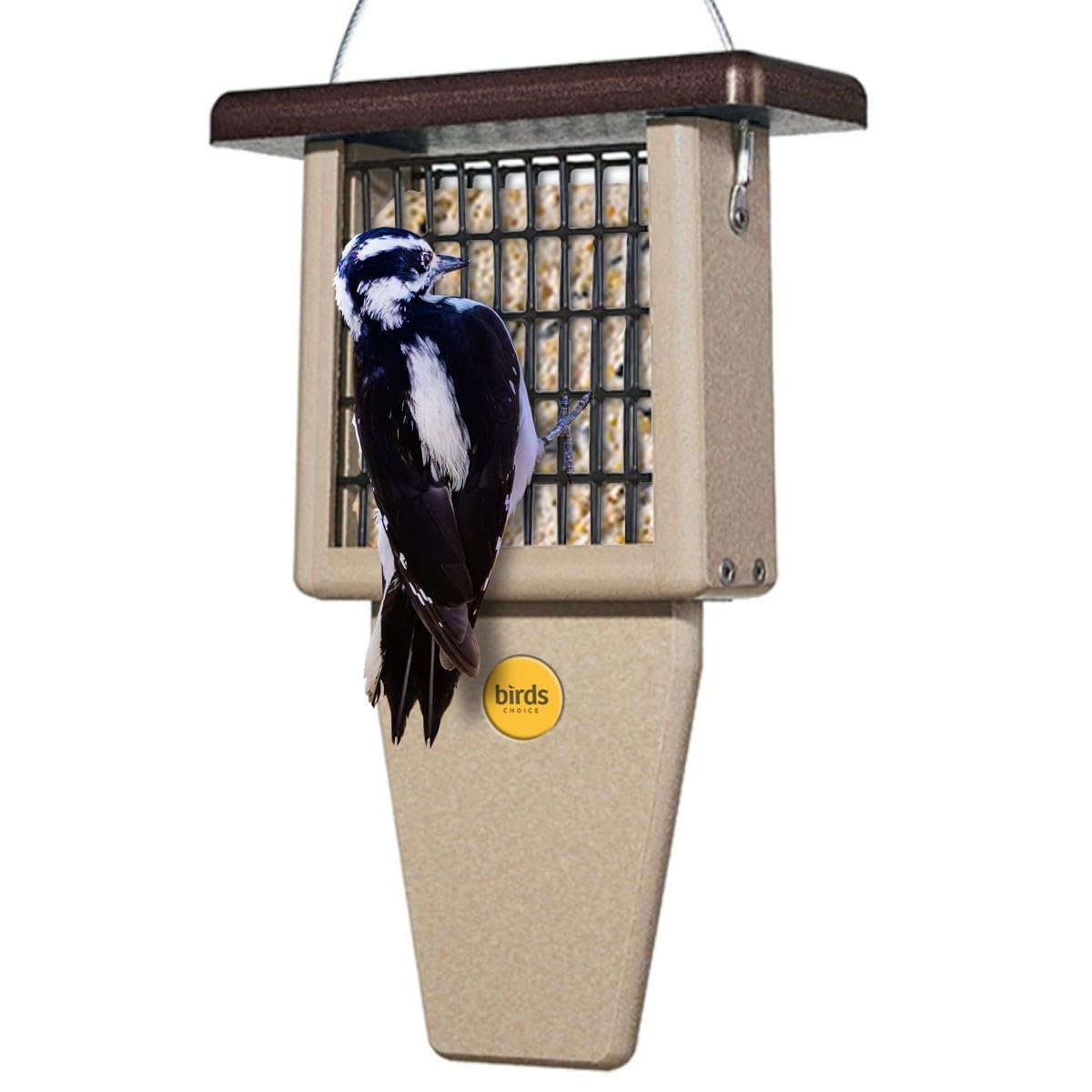
Birds Choice has built a reputation among birders for functional, no-frills feeders made from recycled poly lumber, and this single-cake model with a 5.5-inch tail prop targets the specific needs of medium-sized woodpeckers like the downy, hairy, and red-bellied. The tail prop gives these birds a stable brace point, reducing wing-flutter energy and encouraging longer feeding visits. The body measures 8 inches long by 3 inches wide by 12 inches tall, an unobtrusive size that fits easily even on smaller shepherds’ hooks.
The vinyl-coated wire grid holds one standard suet cake and resists rust, while the stainless-steel screws running through the recycled poly lumber frame prevent corrosion at the joints. Owners consistently praise how easy the feeder is to fill — the top flips open without tools. The recycled plastic material is slightly heavier than cedar, which adds stability but also means the feeder will not swing as aggressively in high wind. The 1-pound total weight helps keep it planted.
The tail prop length is adequate for most woodpeckers but is not long enough for pileated woodpeckers, which generally need a prop of 10 inches or more to avoid tail-bending. The recycled poly lumber surface is smooth and does not require painting or sealing, but it can show grease stains from suet more prominently than darker woods. If your primary audience is downy, hairy, and red-bellied woodpeckers plus nuthatches and chickadees, this feeder is a perfect match.
Why we love it
- Tail prop provides genuine stability for medium woodpeckers
- Stainless-steel hardware and vinyl-coated mesh resist rust
- Recycled poly lumber won’t crack or split over seasons
Good to know
- Tail prop is too short for pileated woodpeckers
- Single-cake capacity limits multi-bird feeding
- Smooth poly surface can show suet grease stains
4. Kettle Moraine Cedar Double Suet Cake Tail Prop Feeder

The Kettle Moraine feeder is built from thick, knot-free cedar with stainless-steel hardware and a heavy-gauge vinyl-coated wire mesh cage that holds two standard suet cakes. The 17-inch overall height incorporates a generous tail prop that comfortably supports larger woodpeckers, and the natural cedar finish blends into tree trunks and garden structures without the plastic look of recycled materials. This feeder is hand-assembled in the USA and reflects woodworking care that mass-produced plastic feeders cannot replicate.
The double-cake capacity is a practical advantage for heavy-feeding areas — you can offer two types of suet (e.g., straight beef fat and a berry blend) without needing a second feeder. The stainless-steel hanging cable is more durable than standard chain or rope and will not fray or snap under the weight of a clinging squirrel. Owners note that woodpeckers, nuthatches, chickadees, and even bluebirds and titmice visit regularly, and larger downy and red-bellied woodpeckers use the tail prop immediately.
One long-term concern reported by repeat buyers: after three to five years of continuous outdoor exposure, the vinyl coating on the wire mesh can begin to peel. Birds may occasionally peck at the loose coating, which is not ideal. Replacing the mesh cage is not straightforward because the frame is riveted. The cedar body itself, however, remains structurally sound if periodically sealed or left to weather naturally. If you live in a wet climate, occasional cedar oil treatment extends the feeder’s life significantly.
Why we love it
- Solid American cedar resists rot and looks natural
- Double-cake capacity reduces refills and allows suet variety
- Tail prop suits medium and some larger woodpeckers
Good to know
- Vinyl-coated mesh may peel after 3-5 years in direct sun/rain
- Heavier than single-cake feeders — needs stable mount
- Repairing or replacing the mesh cage is DIY-prohibitive
5. Birds Choice Pileated Suet Feeder with Extra Long Tail Prop

The Birds Choice Pileated feeder is purpose-built for the largest North American woodpecker — the pileated — with an extra-long tail prop of 17 inches that lets the bird brace fully without bending or scraping tail feathers. Despite the name, the feeder attracts downy, hairy, red-bellied, and even red-headed woodpeckers just as readily. The total height of 22.5 inches makes it one of the tallest suet feeders on the market, but the 8-inch length and 3-inch width keep the footprint compact for storage and mounting.
The body uses recycled poly lumber (taupe base with a brown roof) that is extremely weather-resistant and will not crack, split, or fade. The vinyl-coated wire cage holds two suet cakes, and the top flips open easily for refilling. The stainless-steel screws and hanging cable add long-term corrosion resistance. Verified owners in western North Carolina and the Pacific Northwest report that pileated woodpeckers began visiting within days, sometimes hours, and that smaller woodpeckers fed comfortably on the opposite side of the dual cage.
Mounting on a thick branch or a heavy-duty shepherds hook is recommended. The recycled poly surface is smooth and easy to clean with a brush and hose. No assembly is required — the feeder arrives ready to hang. If you have pileated woodpeckers in your area and want to give them a dedicated feeding station, this is the most specific and functional solution available.
Why we love it
- Extra-long 17-inch tail prop accommodates pileated woodpeckers
- Two-cake capacity with easy top-fill access
- Recycled poly lumber resists all weather without maintenance
Good to know
- Tall profile is less stable in strong wind — use secure mount
- Premium price reflects specialized tail prop construction
- Not designed to exclude starlings mechanically (prop gives them access)
FAQ
Will an upside-down suet feeder keep squirrels away completely?
What length tail prop do pileated woodpeckers need?
How do I prevent suet from melting or spoiling in hot weather?
Can I use a standard suet cake in a woodpecker-specific tail prop feeder?
Final Thoughts: The Verdict
For most backyard birders, the squirrel proof suet feeder winner is the Songbird Essentials Upside Down because its gravity-based feeding mechanism blocks starlings and grackles mechanically without fragile cage bars, and the poly-wood construction is easy to clean and backed by a 100-year guarantee. If you want a dedicated feeding station for pileated woodpeckers with a full-length tail prop, grab the Birds Choice Pileated Feeder. And for a budget-friendly double-cage option that holds two suet cakes and protects them from rain, nothing beats the Kingsyard Recycled Plastic Double.