
A dog treat dispenser toy does more than drop kibble — it transforms mealtime into a mental challenge that slows fast eaters and burns pent-up energy. The wrong one either frustrates your dog with impossible mechanics or dumps all treats in seconds, defeating the purpose entirely.
I’m Mo Mahin — the founder and writer behind Furric. I spend my time comparing feeder mechanisms, studying enrichment psychology in canines, and cross-referencing thousands of owner feedback patterns to identify which dispensing designs actually hold a dog’s attention beyond the first five minutes.
After analyzing structural durability, food-release consistency, and difficulty scalability across the top contenders, I’ve zeroed in on the five models that justify a spot in your home. This guide breaks down my picks for the best dog treat dispenser toy across skill levels and feeding goals.
How To Choose The Best Dog Treat Dispenser Toy
Not every dispensing toy challenges the same skill level or accepts the same food type. Three variables separate a toy your dog masters in one session from one that stays engaging for weeks.
Difficulty Tier and Problem-Solving Style
Low-level toys rely on rolling or nosing — the dog bumps the object and food falls out automatically. Intermediate puzzles require spinning layers, sliding compartments, or sequential actions where one move unlocks the next reward. Advanced designs involve flipping flaps, lifting blocks, or rotating dials that hide treats in hidden wells. Match the tier to your dog’s persistence: a clever dog bored by a simple roll ball will ignore it, while a novice overwhelmed by a six-step puzzle may give up entirely.
Food-Release Mechanism and Adjustability
The hole size and dispersion pattern determine whether the toy works with your dog’s regular kibble or only with tiny training treats. Adjustable dials that widen or narrow the opening let you control flow rate — a slow trickle encourages licking and nosing, while a wider gap rewards quick success for impatient pups. Fixed-hole toys suit owners who feed one kibble size and do not want to fiddle with settings.
Material Durability and Cleanability
Dispensers see repetitive pawing, dropping, and rolling on hard floors. Hard ABS or PC plastic holds shape under moderate force but can crack if a heavy chewer applies jaw pressure. Natural rubber withstands biting better but may retain odors from wet food or peanut butter. Dishwasher-safe parts reduce daily cleaning friction — toys that require hand-washing every crevice tend to accumulate bacteria in the seams.
Quick Comparison
On smaller screens, swipe sideways to see the full table.
| Model | Category | Best For | Key Spec | Amazon |
|---|---|---|---|---|
| StarMark Bob-A-Lot | Mid-Range | Structured intermediate puzzle play | Adjustable 2-oz food reservoir | Amazon |
| Outward Hound Dog Tornado | Mid-Range | Spin-and-guess intermediate challenge | 3 rotating layers with 1/2-cup capacity | Amazon |
| Jokepy Treat Ball | Mid-Range | Adjustable-speed rolling dispenser | 3-speed dial + built-in rolling whistle | Amazon |
| luckdoor Alien Spaceship | Budget | Frozen licking enrichment for anxious dogs | Natural rubber with freezer-safe design | Amazon |
| Forfon 9-Piece Set | Budget | Entry-level variety for small dogs | 3 difficulty levels across 2 lick mats + 3 balls | Amazon |
In‑Depth Reviews
1. StarMark Bob-A-Lot Interactive Dog Toy

The Bob-A-Lot uses a weighted, rounded base that wobbles unpredictably as the dog noses it, forcing the animal to adjust technique with each tap. The small version holds roughly two ounces of kibble with an adjustable opening that lets you fine-tune the treat flow from a slow trickle to a rapid dump — a rare level of control in this price band. The transparent body lets you see exactly how much food remains, which prevents the dog from abandoning the toy prematurely.
The interior reservoir design keeps treats inside until the toy rocks past a certain angle, so dogs learn that persistence pays rather than brute force. Owners report that even food-motivated dogs stay engaged for 15 to 25 minutes per session, and the wobble action works well on both carpet and tile without skittering under furniture. The two-piece construction twists apart for cleaning, though hand-washing is recommended to preserve the weighted base seal.
Some heavy chewers may scratch the plastic surface over months, but the lack of sharp edges or small detachable parts makes it safe for supervised solo play. The weighted base also prevents the toy from tipping over during enthusiastic nudging — a frustration point on lighter dispensing balls that roll away too fast. For dogs that have outgrown simple roll balls but are not ready for multi-step puzzles, this sits at the ideal intermediate difficulty.
Why we love it
- Adjustable dispensing opening lets you match treat flow to your dog’s patience level
- Weighted wobble base keeps the toy upright and engaged without rolling under couches
- Transparent reservoir helps you monitor food level during play
Good to know
- Hand-wash only to avoid water damage to the weighted base seal
- Small size holds only about 2 ounces of kibble — refills needed for larger meals
2. Outward Hound Dog Tornado by Nina Ottosson

Nina Ottosson’s Dog Tornado operates on a tiered rotation principle: the dog must spin each of three stacked bone-shaped compartments to align the hidden treat chambers with the exit slots. The level 2 intermediate rating is accurate — it takes most dogs a few sessions to grasp that the top layer must rotate independently from the middle and bottom. The 1/2-cup capacity means it works best as a meal-time puzzle rather than a treat-only dispenser.
The plastic construction feels dense enough to survive daily use, and the compartments lift out for quick rinsing under warm water. The puzzle lies flat during play, so there is no rolling away risk — the dog stays in one spot and works through each layer sequentially. Owners of senior dogs or breeds with short muzzles appreciate that the paw-push required is minimal compared to rolling balls.
A common adjustment strategy: start with all compartments unlocked and visible, then gradually rotate them closed as the dog learns the spinning motion. The included tip sheet from the manufacturer outlines this progression, which extends the toy’s useful life from weeks to months. The only real limitation is that soft treats or sticky paste will not work in the sliding compartments — dry kibble or small hard biscuits are ideal.
Why we love it
- Three independent spinning layers create a genuine sequential challenge, not just random rolling
- Flat, stationary design prevents skittering and works well on any floor surface
- Manufacturer provides difficulty progression tips to keep the puzzle fresh
Good to know
- Only accepts dry kibble or hard treats — wet food and paste will not dispense cleanly
- Some determined chewers may crack the plastic bone compartments over time
3. Jokepy Treat Dispensing Ball
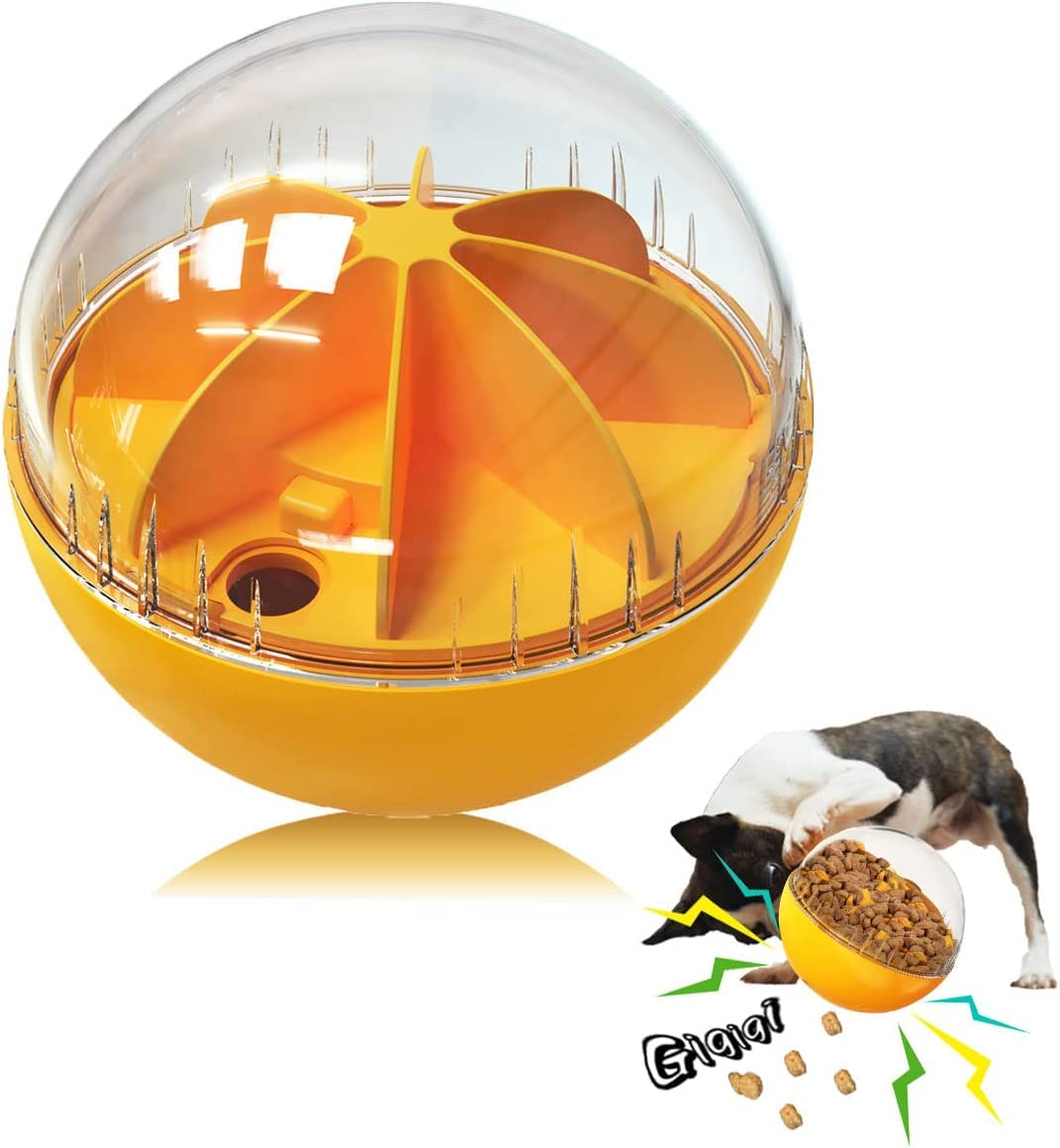
This spherical dispenser distinguishes itself with a three-speed internal dial that controls how many of the exterior holes remain open — from a single small gap to three full openings. The dial clicks into position securely so it does not shift during rolling, and the ball’s 5.6-inch diameter works for most medium-sized dogs. An internal whistle activates when the ball rolls fast enough, adding an auditory reward that many dogs find more compelling than the treat itself.
The food-grade ABS and PC plastic withstands moderate pawing and dropping from couch height, though it is not designed for sustained chewing. The two-part shell twists apart for cleaning, and the smooth interior rinses easily under warm soapy water. The whistle chamber is sealed inside the ball, so aggressive rolling will not dislodge or damage it — a thoughtful detail given how hard some dogs pursue the sound.
Because the dispenser relies on rolling motion to release food, it works best on uncarpeted floors where the ball can travel freely. Dogs that prefer to carry toys away rather than nose them may need encouragement to roll instead of fetch. Owners report that the audible cue helps less persistent dogs stay on task — the whirring whistle reignites interest when the ball stops moving.
Why we love it
- Three-speed dial adjusts treat hole configuration without swapping parts
- Internal rolling whistle adds an extra sensory reward layer
- Food-grade plastic disassembles fully for thorough cleaning
Good to know
- Requires hard, uncarpeted flooring for optimal rolling and dispensing
- Not suitable for heavy chewers — plastic can crack under sustained jaw pressure
4. luckdoor Alien Spaceship Enrichment Toy

The luckdoor dispenser takes a different approach: instead of releasing kibble through rolling, it relies on licking. The four-inch sphere splits open to reveal a hollow core where you smear peanut butter, yogurt, or wet food, then freeze it. The dog licks the frozen paste from the interior, which extends feeding time to 20–30 minutes depending on thickness. The natural rubber construction has slight give, making it gentler on teeth than hard plastic.
The spaceship-shaped exterior with colored spheres is visually engaging for dogs that respond to bright objects, and the rubber’s non-porous surface resists odor buildup better than silicone alternatives. Owners of anxious dogs report that the sustained licking action has a calming effect similar to a lick mat, making this a useful option for post-walk decompression or crate settling. The material holds up well to moderate chewing but will tear if a determined power chewer sinks molars into it.
The obvious limitation: this is not a drop-and-dispense toy. You must prepare the filling, freeze it, and supervise the dog while they work. However, for dogs that need soothing enrichment rather than hunting simulation, the slow-release licking provides mental engagement that no rolling ball can replicate. The manufacturer advises rubbing oil on the threaded cap if it becomes stiff after freezing — a simple maintenance step that extends the toy’s usable life.
Why we love it
- Frozen licking action provides 20–30 minutes of calming enrichment per session
- Natural rubber material is food-grade, non-toxic, and gentle on teeth
- Odor-resistant surface holds up well to repeated wet food use
Good to know
- Requires advance preparation and freezing — not a grab-and-go dispenser
- Will not survive aggressive chewing from power chewers
5. Forfon 9-Pack Dog Puzzle Toy Set
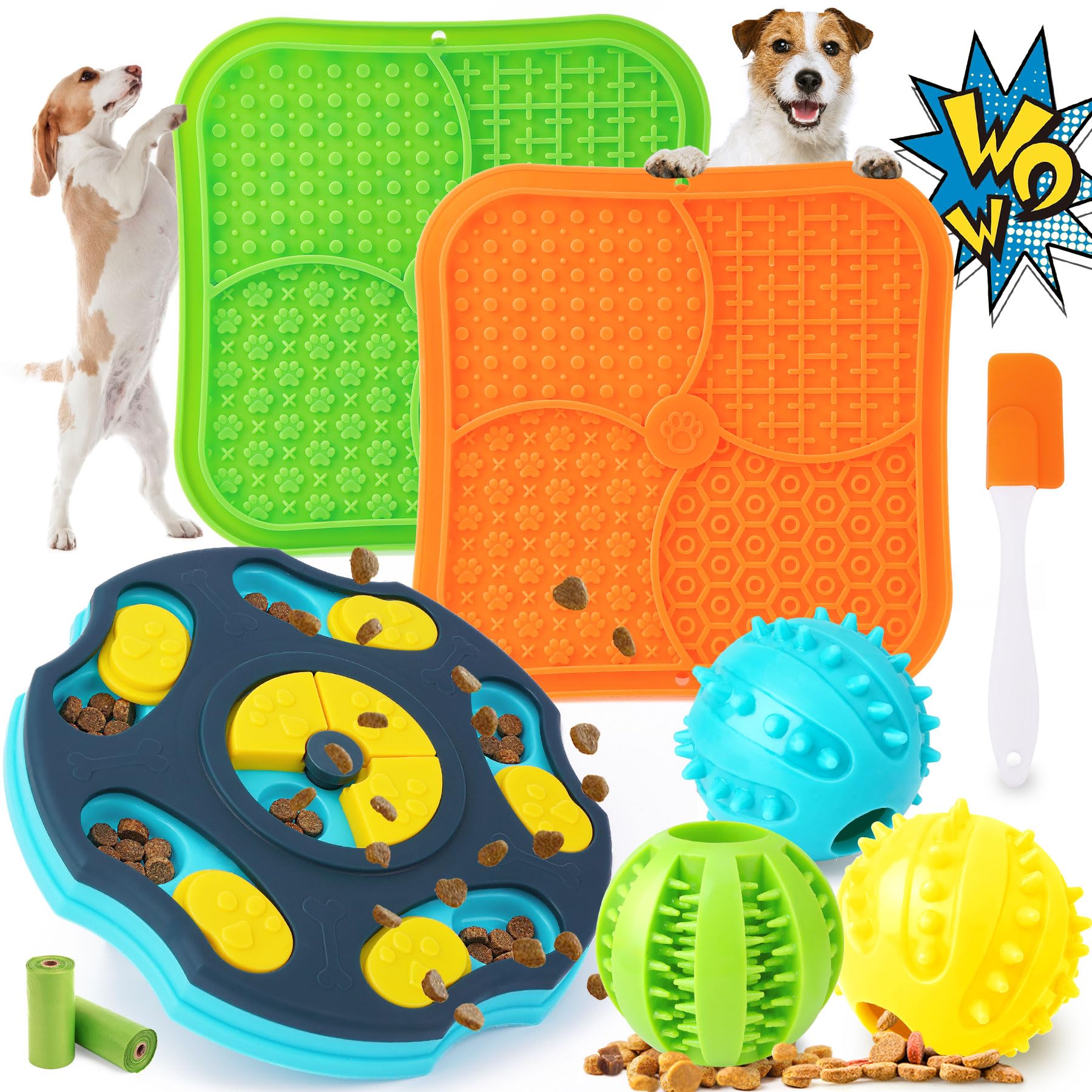
Forfon bundles two lick mats with suction cups, one plastic puzzle toy, three treat balls, a silicone spatula, and two cleanup bags into a single package — essentially a starter kit for owners new to enrichment feeding. The lick mats have raised ridges and suction cups that adhere to tile or stainless steel bowls, while the treat balls feature small openings that release kibble as the dog bats them around. The puzzle toy uses a simple sliding cover mechanism suited for small to medium dogs.
The natural rubber and silicone materials are dishwasher-safe, which reduces the daily cleaning burden compared to toys with intricate crevices. The three-dimensional variety — flat mats vs. rolling balls vs. sliding puzzle — lets owners rotate options to prevent boredom without buying separate products. The included silicone spatula is a small but practical inclusion for spreading wet food onto the lick mats without cross-contaminating pantry utensils.
The trade-off for the multi-item format is that individual components lack the durability of single-piece dispensers. The treat balls’ plastic feels thinner than standalone alternatives, and the puzzle toy’s sliding cover may loosen over repeated use. But as an entry-level collection for testing which enrichment style your dog prefers, the set offers more flexibility than any single dispenser at the same price point.
Why we love it
- Three distinct enrichment styles (lick mat, treat ball, puzzle) in one purchase
- All components are dishwasher-safe for easy daily cleaning
- Included suction cups prevent lick mats from sliding around during use
Good to know
- Individual pieces are less durable than dedicated single-toy alternatives
- Designed primarily for small to medium dogs — larger breeds may overpower the puzzle components
FAQ
How do I introduce a treat dispenser toy to a dog that has never used one?
Can I leave my dog unsupervised with a treat dispenser toy?
Why does my dog whine or paw excessively at the dispenser instead of working the mechanism?
Final Thoughts: The Verdict
For most dog owners looking for a reliable daily feeder that builds problem-solving skills without causing frustration, the clear winner is the Outward Hound Dog Tornado because its three-layer spinning design offers genuine sequential challenge that stays engaging for weeks. If you prefer a rolling dispenser with adjustable flow and an auditory reward cue, grab the Jokepy Treat Ball. And for nervous dogs that need calming licking enrichment rather than puzzle-solving, nothing beats the luckdoor Alien Spaceship for sustained, low-stress engagement.