
An invisible ammonia spike kills fish faster than almost anything else, yet you cannot see, smell, or touch it until your tank’s ecosystem crashes. Without a liquid-reagent test kit that measures individual parameters in parts per million, you are flying blind through every cycle, water change, and new-fish introduction.
I’m Mo Mahin — the founder and writer behind Furric. I’ve spent years comparing reagent titration curves, analyzing pH buffer ranges, and cross-referencing thousands of owner reports on test kit longevity and cross-contamination between bottles.
Whether you run a nano reef or a 75-gallon planted community, the right aquarium test kit delivers actionable ppm readings so you can correct water chemistry before your fish show stress.
How To Choose The Best Aquarium Test Kit
Selecting a test kit means deciding between convenience and precision. Test strips deliver a quick overview but lack the resolution to catch a .25 ppm ammonia climb. Liquid reagent kits take more steps but give you the control needed to manage the nitrogen cycle and keep sensitive species alive.
Liquid Reagent vs. Test Strips
Liquid kits use chemical titration — you add drops to a water sample and compare the color change to a printed chart. They measure down to 0.25 ppm for ammonia and nitrite, which matters during cycling or after a fish death. Strips are fine for weekly maintenance on a stable tank but miss low-level shifts that kill fry and shrimp.
Parameter Coverage and Test Count
A master kit should cover pH, high-range pH, ammonia, nitrite, and nitrate at minimum. Add GH/KH if you keep shrimp or rift lake cichlids. Check the total number of tests per bottle — a kit claiming 800 tests often means 200 per bottle across four parameters, so a 4-bottle set yields 800 total drops, not 800 full panels.
Shelf Life and Storage
Liquid reagents degrade when exposed to heat or light. Look for kits with sealed foil pouches for strips or opaque bottles for liquids. An unopened kit stored below 80°F lasts 2–3 years; opened bottles should be used within 6–12 months for maximum accuracy. Cross-contamination from dipping a dirty test tube back into the reagent bottle is the fastest way to ruin a kit.
Quick Comparison
On smaller screens, swipe sideways to see the full table.
| Model | Category | Best For | Key Spec | Amazon |
|---|---|---|---|---|
| API FRESHWATER MASTER TEST KIT | Liquid Reagent | Freshwater planted & community tanks | 800 tests (pH, Ammonia, Nitrite, Nitrate) | Amazon |
| API SALTWATER MASTER TEST KIT | Liquid Reagent | Saltwater reef & FOWLR tanks | 550 tests (High Range pH, Ammonia, Nitrite, Nitrate) | Amazon |
| Gold Label Pet Care Master Test Kit | Liquid Reagent | Budget-minded freshwater keepers | 950+ tests, includes gloves & brush | Amazon |
| Advatec 9 in 1 Test Strips | Test Strips | Quick weekly checks & multi-tank owners | 100 strips, 9 parameters including Iron & Copper | Amazon |
| SJ WAVE 11 in 1 Test Strips | Test Strips | Entry-level monitoring with extended supply | 150 strips, includes ammonia-specific strips | Amazon |
In‑Depth Reviews
1. API FRESHWATER MASTER TEST KIT

This kit has been the gold standard for freshwater hobbyists for nearly two decades. The seven bottles of liquid reagent let you measure pH, high-range pH, ammonia, nitrite, and nitrate with titration-level accuracy — you can catch a 0.25 ppm ammonia reading that strips would miss entirely. Four capped test tubes with color card make side-by-side comparison simple.
The 800-test claim breaks down to roughly 200 tests per bottle when you use the proper 5 ml sample volume. That is enough for weekly testing on a single tank for close to two years. The color chart covers a broad enough gradient that you can estimate intermediate values between the printed blocks, which helps when you are tracking a slow pH drop.
One minor irritation: the reusable plastic tube caps can loosen over time, and if you leave the tubes full of sample water between tests, you risk contaminating the next drop. Rinsing with distilled water and air-drying after each use solves this. For the price and reliability, this is the reference kit every freshwater keeper should own.
Why we love it
- Industry-standard liquid reagent accuracy for cycling and troubleshooting
- Massive 800-test capacity with clear color gradient chart
- Includes both low-range and high-range pH bottles for planted and alkaline tanks
Good to know
- Test tube caps may loosen after repeated use
- Instructions recommend shaking reagents vigorously each time, which is easy to forget
2. API SALTWATER MASTER TEST KIT

Designed exclusively for saltwater aquariums, this six-bottle kit monitors high-range pH, ammonia, nitrite, and nitrate. The high-range pH reagent reads from 7.4 to 8.8, which covers the tight 8.0–8.4 window that reef tanks and FOWLR systems require. The ammonia test uses a salicylate-based formula that compensates for saltwater interference, giving you true readings instead of false positives.
The 550-test count is sufficient for a typical reef keeper testing twice a week for about a year. Each bottle has a narrow dropper tip that lets you count single drops consistently — crucial when the instructions call for exactly 14 drops of one reagent and 5 of another. The color card is laminated and holds up to splashes better than paper charts.
It does not cover calcium, magnesium, alkalinity, or phosphate, so advanced reefers will need supplementary kits for those parameters. But for basic water quality and cycle monitoring, this kit provides the resolution needed to keep SPS and LPS corals stable. The USA-based manufacturing means consistent reagent quality batch to batch.
Why we love it
- Salicylate ammonia reagent designed for saltwater salinity levels
- High-range pH scale covers the critical 7.4–8.8 range for marine tanks
- Laminated color card resists salt creep and moisture damage
Good to know
- Does not include KH, calcium, or phosphate tests needed for coral health
- Bottles are relatively small — heavy testers may run out faster than expected
3. Gold Label Pet Care Master Test Kit
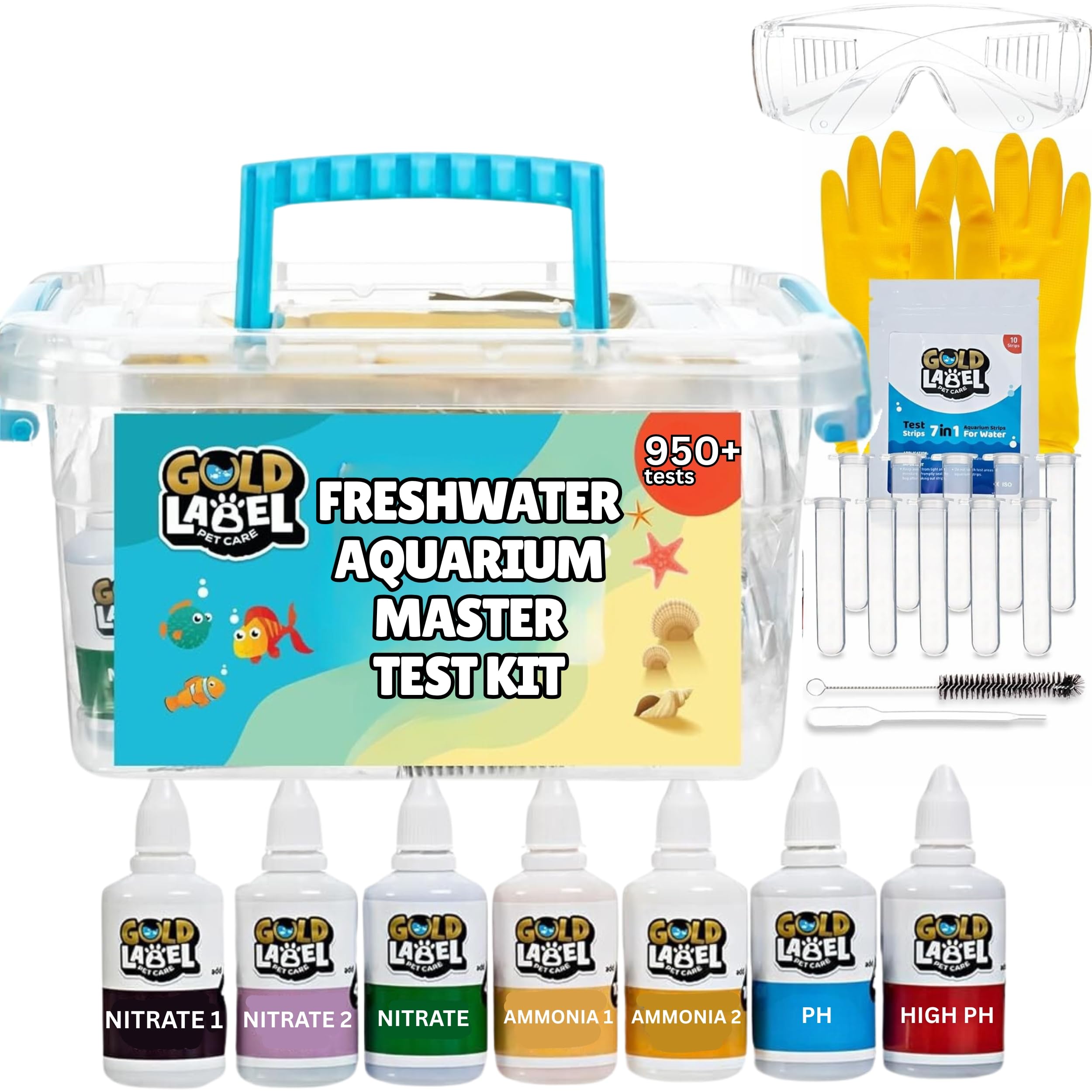
Gold Label’s entry competes directly with API by offering a higher test count and extra accessories at a lower outlay. The kit includes seven test bottles for pH, high-range pH, ammonia, nitrite, and nitrate, plus ten test tubes, a dropper, a cleaning brush, safety glasses, gloves, and ten bonus water test strips. The 950+ test claim covers all drop-based tests combined.
The real draw here is the bundled accessories — most kits make you buy gloves and a brush separately. The test tubes are slightly thinner glass than API’s, but they fit standard rack holders. The cleaning brush is long enough to reach the bottom of the tubes, which matters because dried reagent residue skews future readings if not scrubbed off.
Accuracy holds up well in side-by-side comparisons with API on freshwater samples. The color chart uses larger blocks, which makes it easier to read under yellow-tinted room lights. One catch: the instructions are printed small and the font is light, so older hobbyists may need a magnifier. Still, for the total package, this kit delivers strong value per test.
Why we love it
- Highest test count in the value tier with 950+ individual tests
- Includes safety glasses, gloves, brush, and bonus test strips
- Large color blocks are easier to read in varied lighting
Good to know
- Test tubes are thinner-walled and less durable than API tubes
- Instruction booklet uses a small, light font that is hard to read
4. Advatec 9 in 1 Test Strips
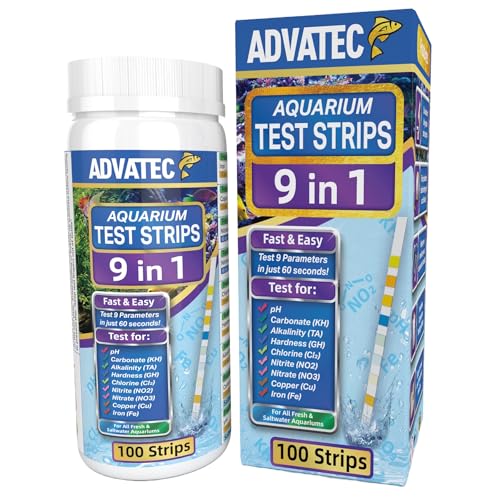
Advatec’s 9-in-1 strips test Iron, Copper, Nitrate, Nitrite, Chlorine, Total Hardness, Total Alkalinity, Carbonate, and pH — including parameters like iron and copper that liquid master kits usually skip. That makes this strip kit particularly useful for planted tanks where iron dosing matters, or for tanks treated with copper-based medications where you need to track residual levels.
Each strip has nine separate pads spaced so the colors do not bleed into each other during the 60-second development time. The color chart is printed on the bottle label, which eliminates the risk of losing a separate card. The bottle includes a desiccant packet and the cap seals tightly, which extends the shelf life after opening better than a canister with a loose lid.
Resolution is the trade-off — these strips read nitrate in broad 20 ppm increments rather than the 5 ppm steps you get from liquid nitrate tests. If you run a high-tech planted tank or a low-biomass shrimp tank, the liquid kit remains the safer choice for nitrate management. But for quick weekly snapshots across multiple tanks, the convenience is hard to beat.
Why we love it
- Includes Iron and Copper pads not found in standard liquid master kits
- Color chart printed on the bottle — no separate card to misplace
- Desiccant inside the bottle preserves strip freshness after opening
Good to know
- Nitrate reads in 20 ppm increments — not precise enough for planted or shrimp tanks
- No ammonia pad included; need separate ammonia test for cycling
5. SJ WAVE 11 in 1 Test Strips

SJ WAVE packs 150 strips into this kit — 100 strips in sealed bags and 50 in a bottle — plus 50 separate ammonia-specific strips and a digital thermometer. The ammonia strips are a standout because most strip kits skip ammonia entirely, leaving you blind during the cycle. With these, you can check ammonia without moving to a liquid dropper kit.
The 11 parameters cover pH, carbonate, total alkalinity, free chlorine, total hardness, nitrite, nitrate, copper, iron, and temperature (via the included thermometer). The two-part storage system — sealed bags plus a bottle — means you can keep 100 strips fresh while you work through the bottle. Once opened, SJ WAVE recommends using the bottle strips within 3 months for best accuracy.
The ammonia detection range is broad enough to catch spikes above 0.5 ppm, but it cannot resolve down to 0.25 ppm like liquid salicylate tests can. For a beginner who wants one purchase that covers the basics, this kit provides the widest strip parameter range and the highest strip count at a very accessible entry point.
Why we love it
- 150 test strips plus 50 dedicated ammonia strips — highest quantity in its tier
- Includes a digital thermometer for quick temperature checks
- Sealed bag storage keeps 100 strips fresh for longer shelf life
Good to know
- Ammonia strips lack the 0.25 ppm resolution of liquid reagent kits
- Bottle strips degrade faster once opened — use within 3 months
FAQ
Why does my liquid test kit show different readings than my test strips?
How often should I test my aquarium water with a master test kit?
Can I use a freshwater test kit on my saltwater tank?
What does it mean when my test kit says 800 tests versus 400 tests?
Final Thoughts: The Verdict
For most freshwater hobbyists, the aquarium test kit winner is the API FRESHWATER MASTER TEST KIT because it combines laboratory-grade liquid reagent accuracy with an 800-test capacity that lasts over a year of weekly testing. If you run a saltwater reef system, grab the API SALTWATER MASTER TEST KIT for its salicylate-based ammonia test and high-range pH scale. And for multi-tank keepers who need quick readings across nine parameters, nothing beats the convenience of the Advatec 9 in 1 Test Strips.