
Walking to the incubator on Day 21 only to find a cold, still egg is a specific kind of heartbreak that beginner poultry keepers know too well. Most failed hatches aren’t bad luck — they come down to equipment that can’t hold a steady temperature or manage humidity through the critical lockdown phase. Getting the first pip is actually simpler than the forums make it sound, provided the machine does the heavy lifting for you.
I’m Mo Mahin — the founder and writer behind Furric. I’ve spent over a decade studying the mechanical and environmental requirements of small-scale incubation, comparing thousands of spec sheets, and analyzing aggregated owner reports to separate marketing hype from hardware that actually finishes a hatch.
Whether you’re setting your first dozen eggs or moving up from a borrowed still-air box, the right egg incubator for beginners automates the two variables that trip up most new keepers: temperature stability and humidity management during the final three days.
How To Choose The Best Egg Incubator For Beginners
Beginner incubators sit in a specific sweet spot: they must be automated enough to prevent user error but simple enough that a first-timer doesn’t need a degree in embryology to operate them. The units below share forced-air circulation, digital temperature control, and automatic egg turning — the three features that separate a 50% hatch rate from an 85% one. What varies is capacity, humidity management style, and the precision of the sensor package.
Forced-Air vs. Still-Air: The Non-Negotiable Start
Every incubator on this list uses a fan to circulate warm air. Still-air units create temperature stratification — hotter at the top, cooler at the bottom — that can exceed 5°F across a single tray. Forced-air keeps the entire egg mass within 0.5°F of the set point, which is the difference between a uniform hatch and half the eggs developing late or not at all.
Humidity Control: The Beginner’s Blind Spot
Maintaining 40–50% humidity for Days 1–18 and then spiking to 65–75% for lockdown is the most common failure point. Machines with external water ports or pull-out trays let you add water without opening the lid. The best units in this range go further with automatic humidity sensors that trigger a pump or alert you the moment the reading strays outside the safe band.
Egg Turning: Interval Flexibility Matters
A turner that cycles every two hours is standard, but the ability to adjust that interval — 60, 90, 120, or 180 minutes — gives you control when incubating larger eggs like duck or goose, which benefit from less frequent rotation. Every unit here also auto-stops turning during the final three or four days, preventing the embryo from being repositioned when it’s positioning itself to pip.
Quick Comparison
On smaller screens, swipe sideways to see the full table.
| Model | Category | Best For | Key Spec | Amazon |
|---|---|---|---|---|
| Chickcozy 25 Egg | Premium | Large batches & complete beginners | 2-zone humidity trays + anti-slip mat | Amazon |
| MQUPIN 18 Egg | Premium | Dual-size trays for mixed species | Dual trays: 18 chicken / 8 goose | Amazon |
| MATICOOPX 20 Egg | Mid-Range | Quail & small-bird hatchers | External water refill port | Amazon |
| WONEGG 12 Egg | Mid-Range | Precision control & smart alerts | Auto humidity pump 20-75% range | Amazon |
| Sailnovo 24 Egg | Mid-Range | One-touch preset species modes | 4 presets: chicken/duck/quail/manual | Amazon |
| Onsju 18 Egg | Mid-Range | Customizable turning intervals | 3 interval settings: 60/120/180 min | Amazon |
| CluckRun 12 Egg | Budget | First-timers on a tight budget | 2-in-1 humidity + 360° airflow | Amazon |
In‑Depth Reviews
1. Chickcozy 25 Egg Incubator

The Chickcozy jumps to the top because it solves the two biggest beginner problems — humidity management and chick safety — with well-thought-out hardware. The dual watering zones (C & D) let you dial in humidity without guessing, and the pull-out drawer design means you never have to open the lid and dump heat during lockdown. The 2-inch protective wall and anti-slip mat are rare at this price, preventing splay leg and foot injuries that cheap units ignore.
The 25-egg capacity is generous for a beginner machine, and the 360° clear dome makes it a crowd-pleaser for families or classrooms. The hour-interval egg turning mimics natural brooding more closely than the standard two-hour cycle found on most competitors, which translates to better development across the full 21 days. Setup is straightforward — the manual walks you through the 24-hour calibration run clearly enough that a first-timer can follow it without second-guessing.
At this capacity and feature depth, the Chickcozy sits at the premium end of the beginner range, but the two-year warranty backs the investment solidly. The plastic-metal hybrid construction feels more substantial than the all-ABS shells on cheaper units, and the detachable top fan makes post-hatch cleaning much less of a chore. If you want a single machine that will carry you through several broods without frustration, this is the one.
Why we love it
- Pull-out water drawer prevents heat loss during humidity adjustments
- Protective wall and anti-slip mat reduce chick injury risk
- 25-egg capacity with compact 14×14-inch footprint
Good to know
- Premium price point compared to 12-egg starter units
- One-year warranty requires registration confirmation
2. MQUPIN 18 Egg Incubator
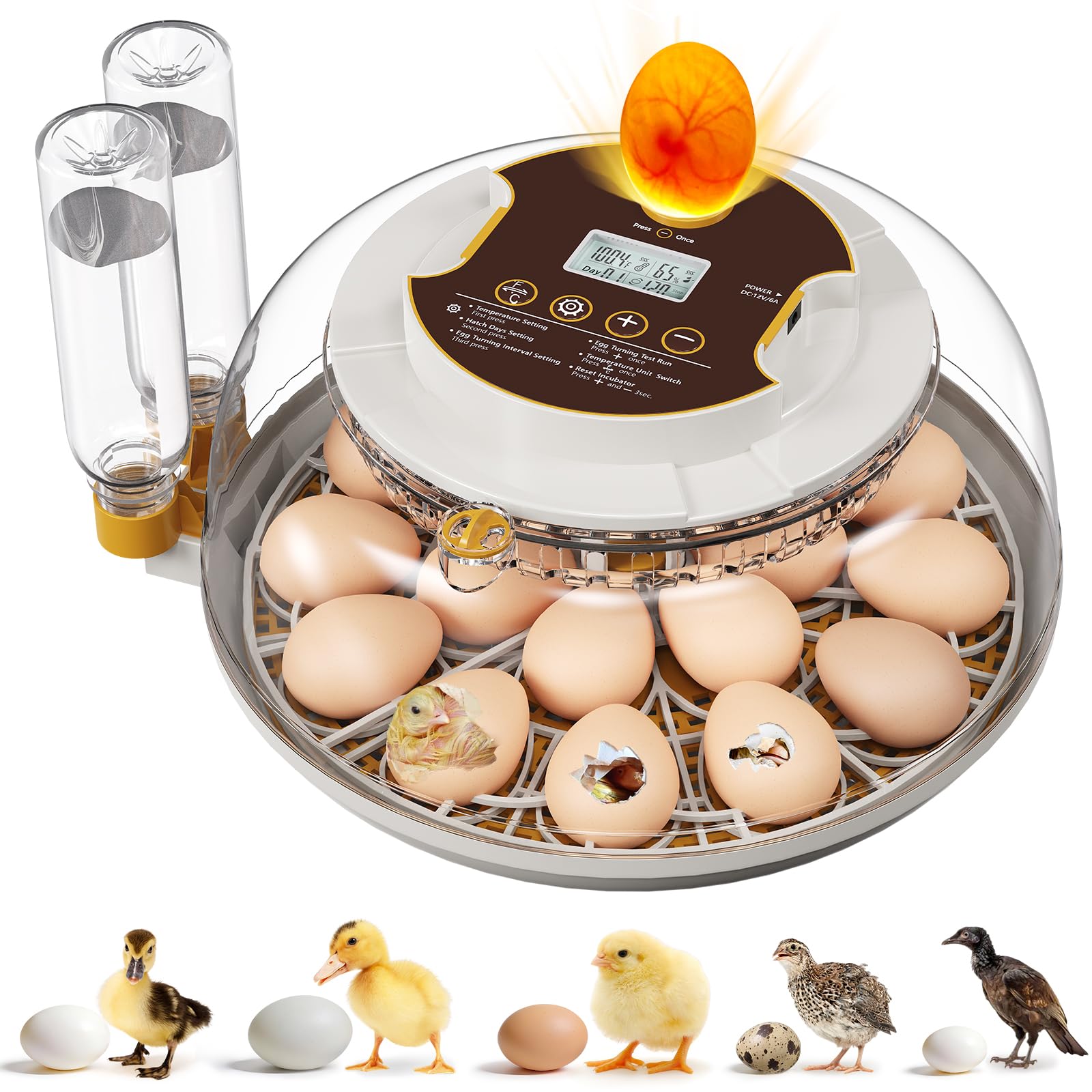
What sets the MQUPIN apart from the crowd is its dual-tray system — a standard 18-egg tray for chicken eggs plus a larger tray that holds up to 8 goose or duck eggs. Most beginner incubators force you to choose one egg size and stick with it, but this unit lets you switch batches without buying a second machine. The 360° clear dome and built-in LED candler give you full visibility without cracking the seal during incubation.
The climate control system holds temperature within the 68–104°F range and humidity between 40–80%, with real-time digital readouts and an alarm that triggers the moment values drift. You can set the turn interval to 60, 120, or 180 minutes depending on the species, and the auto-stop kicks in three days before lockdown. The included foam insulation shell is a thoughtful extra for users in colder basements or garages where ambient temperature swings could destabilize the chamber.
The instruction guide includes a six-point success checklist that covers location selection, lockdown humidity targets, and cleaning protocol — exactly the kind of hand-holding that keeps a beginner from making the common mistakes. The only trade-off is the 18-egg capacity, which is adequate for a hobbyist but limits you if you plan to scale up quickly. For anyone wanting flexibility across egg sizes from quail to goose, this is the best mid-range option available.
Why we love it
- Dual trays accommodate chicken eggs and goose/duck eggs in one machine
- Foam insulation shell stabilizes temperature in cooler rooms
- Adjustable turn intervals for different species requirements
Good to know
- 18-egg capacity may feel small for mixed-batch hatchers
- Tray swap requires partial disassembly between batches
3. MATICOOPX 20 Egg Incubator

The MATICOOPX delivers a straightforward, no-fuss incubation experience with a 20-egg capacity that sits comfortably between the 12-egg starter units and the larger 25-egg machines. The circulating fan keeps temperature even across all 20 positions, and the side-to-side automatic turning at 60-minute intervals mimics natural hen movement better than the two-hour cycles on older designs. The auto-stop feature halts turning three days before hatch day, giving embryos the stillness they need for positioning.
The external water refill port is the standout feature here — you can top off humidity without opening the lid, which prevents the sudden temperature drop that causes condensation and stuck membranes. The built-in egg candler is bright enough to check fertility on Day 7 and track development through Day 18 without needing a separate flashlight. The 6.8-pound weight makes it reasonably portable for moving between a spare bedroom and a garage hatch room.
Where the MATICOOPX comes up short is the lack of a dedicated humidity control system — you still manage moisture manually through the external port, and there’s no automatic pump to maintain a set point. This is fine for beginners who check twice daily, but for someone who wants true set-and-forget, the units with auto-pumps are a step up. The one-year warranty is standard, but the customer support response time has been reported as inconsistent.
Why we love it
- External water refill prevents lid-opening heat loss
- 60-minute turning interval for natural development rhythm
- 20-egg capacity balances size and footprint well
Good to know
- No automatic humidity pump — requires manual monitoring
- Customer support responsiveness varies by region
4. WONEGG 12 Egg Incubator
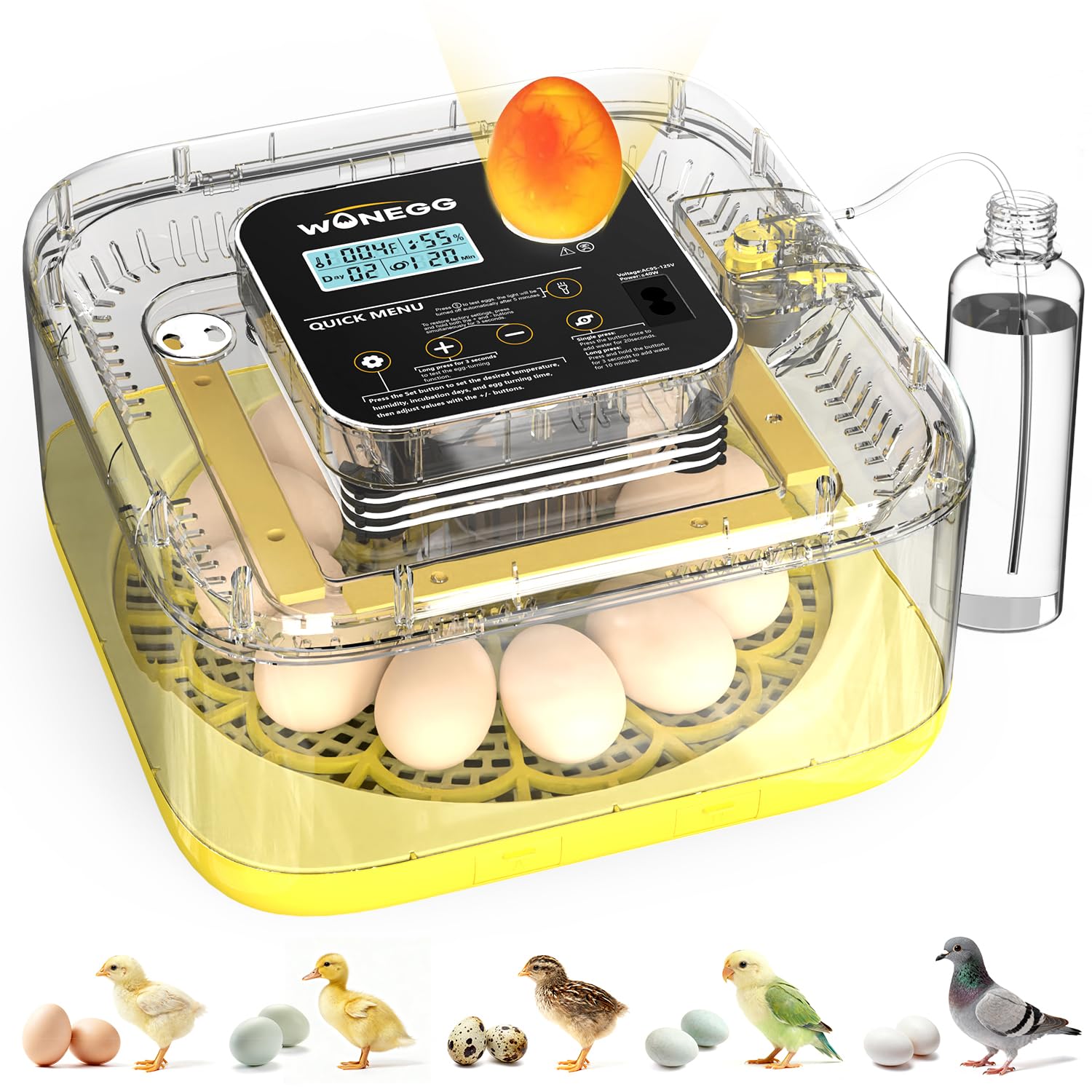
The WONEGG packs an automatic humidity pump into a compact 12-egg frame, and that single feature justifies its place for beginners who want to eliminate the most common failure variable. You set the desired humidity between 20% and 75% with one touch, and the built-in pump draws water from the external bottle to maintain that level without you touching the lid. The alarm system adds another layer of safety — audible and strobe warnings trigger when temperature deviates by 2°F or humidity by 10%.
The large LCD screen shows incubation day count, current temperature, humidity percentage, and egg-turning time simultaneously, so you can monitor the entire status at a glance. The universal round egg tray handles chicken, duck, quail, and pigeon eggs with equal stability. The transparent 360° lid gives full visibility, and the square footprint makes efficient use of counter space compared to the rounder domes on some competitors.
The downside is the 12-egg limit — if you plan to hatch more than one dozen per cycle, this isn’t the machine for you. Some users also reported that the plastic feels lighter than the premium units, though the ABS construction holds up well over multiple hatches if cleaned properly. For the beginner who values precision and automation above raw capacity, the WONEGG is a superb introduction to the hobby.
Why we love it
- Automatic humidity pump maintains set point without manual intervention
- Audible and strobing alarms for temperature and humidity drift
- Universal round tray fits multiple species without adapter
Good to know
- 12-egg capacity is limiting for larger hatches
- ABS plastic feels less substantial than hybrid construction
5. Sailnovo 24 Egg Incubator
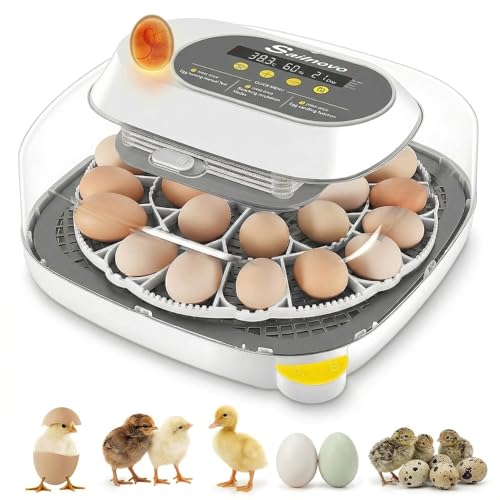
The Sailnovo takes the guesswork out of species-specific incubation by offering three factory-preset modes — chicken, duck, and quail — plus a manual mode for custom settings. A beginner simply selects the bird type and the incubator sets the optimal temperature and humidity targets automatically. This removes the need to cross-reference incubation charts, which is the single biggest source of anxiety for first-time hatchers.
With a 24-egg capacity, it hits a sweet spot larger than the 12-egg starters but still compact enough at 14.76 inches square to fit on a kitchen counter. The automatic egg turner cycles every two hours and stops three days before lockdown. Humidity tracking is handled by a built-in LED sensor, and you add water through external A/B ports that keep the interior sealed. The removable egg trays and turner are dishwasher-safe, which makes post-hatch cleanup dramatically easier than units that require hand-washing every component.
The main caveat is that the humidity management is not fully automatic — you still adjust water levels manually based on the display reading. The manual explicitly warns against dry incubation, requiring water at two-thirds port height. For a beginner who wants the species presets but doesn’t mind checking humidity once or twice a day, this is a strong mid-range choice with a 1-year warranty backing it.
Why we love it
- Species presets eliminate the need for incubation chart lookup
- 24-egg capacity in a compact square footprint
- Dishwasher-safe trays simplify cleaning between hatches
Good to know
- Humidity requires manual adjustment — no automatic pump
- Water level must stay at 2/3 port height for stable operation
6. Onsju 18 Egg Incubator
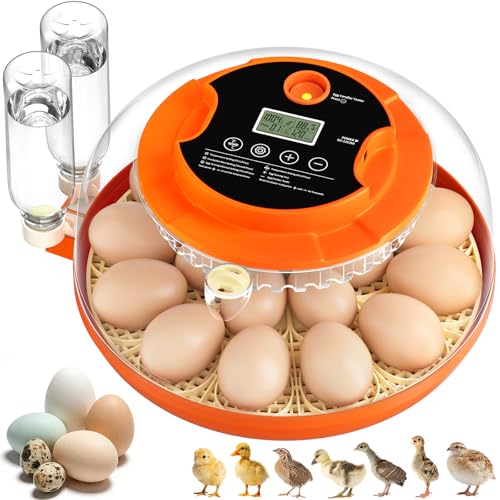
The Onsju earns its spot by offering three customizable turning intervals — 60, 120, or 180 minutes — which gives you direct control over embryo development timing. Larger eggs like duck or goose benefit from the longer 180-minute interval, while smaller quail eggs develop better with the 60-minute cycle. The smart system auto-stops exactly 96 hours before the scheduled hatch date, and the display shows a “STOP” indicator so you know the function has disengaged properly.
The auto-regulated humidity system uses a sealed construction and smart replenishment that adjusts moisture output across the three development stages. The high-intensity LED candling light paired with the 360° clear dome gives you clear visibility for checking fertility and development without cracking the seal. At 5.52 pounds, it’s light enough to move between rooms, and the 11.73-inch square base fits on most shelves or countertops.
The 18-egg capacity (or 40 quail eggs with the smaller tray configuration) is versatile, but the manual reset process after power interruptions can confuse beginners who don’t read the instructions thoroughly. Several reports mention that the audible alarm is quieter than competitors, so it may not wake you if a temperature deviation occurs overnight. For the hatch-at-home hobbyist who wants per-species interval control, this is a capable and fairly priced option.
Why we love it
- Three turn interval settings optimizable per egg species
- Stops turning exactly 96 hours before scheduled hatch
- Compact 11.73-inch footprint for tight spaces
Good to know
- Audible alarm is quieter than most competitors
- Power interruption requires manual reset and recalibration
7. CluckRun 12 Egg Incubator
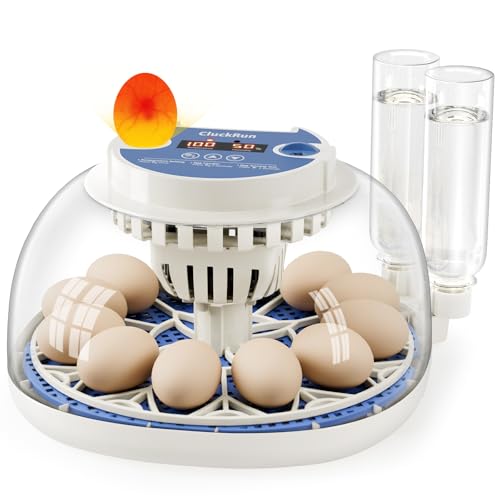
The CluckRun is the budget-conscious entry point that still delivers the three essential features — forced-air circulation, digital temperature control, and automatic egg turning — without cutting corners on safety. The advanced 2-in-1 humidity control system uses AB trays plus dual external water bottles to maintain moisture levels, and the 360° airflow system eliminates hot spots that plague cheaper still-air units. The detachable design makes cleaning straightforward, with removable trays that wash out easily.
The digital display shows temperature and humidity readings in real time, and the adjustable air vent gives you manual fine control over air exchange. The automatic turner mimics a hen’s natural behavior and can be removed entirely during the final three days for lockdown. At 3.6 pounds, it’s the lightest unit here, but the compact 10.2-inch square size is genuinely convenient for a desk, shelf, or small table — it takes up less space than a dinner plate.
The trade-offs are predictable at this price point. The 12-egg capacity is the smallest on this list, and the 2-in-1 humidity system, while functional, lacks the precision of the automatic pumps on the WONEGG or the dual-zone drawers on the Chickcozy. Beginners in dry climates may need to refill the external bottles more frequently than advertised. Still, the three-year warranty and lifetime technical support are exceptional for a budget unit, making it the safest low-cost bet for someone who just wants to try incubation without a big upfront risk.
Why we love it
- Three-year warranty and lifetime tech support at a budget price
- Compact 10.2-inch footprint fits anywhere
- 360° airflow prevents hot spots in a small chamber
Good to know
- 12-egg capacity is the smallest on this list
- Humidity management may require frequent refills in dry climates
FAQ
How long should I run an incubator before setting eggs for the first time?
What humidity level should I target for chicken eggs during lockdown?
Can I hatch different bird species in the same batch?
Final Thoughts: The Verdict
For most first-time hatchers, the egg incubator for beginners winner is the Chickcozy 25 Egg because its pull-out humidity drawer, protective wall, and anti-slip mat remove the two biggest failure modes — moisture management and chick injury — right out of the box. If you want tray flexibility across chicken and goose eggs, grab the MQUPIN 18 Egg. And for the tightest budget with a three-year warranty, nothing beats the CluckRun 12 Egg.