
If your cat inhales kibble in three seconds then looks at you for more, you already know the problem isn’t hunger — it’s boredom. Cat food puzzles force that laser-focused predator brain to work for its reward, turning a ten-second scarf-down into a fifteen-minute mental expedition that actually tires them out harder than a wand chase. But not every puzzle holds a determined paw’s attention past the first five tries.
I’m Mo Mahin — the founder and writer behind Furric. I’ve spent years digging into the design logic behind feline enrichment, analyzing owner feedback across thousands of sessions, and comparing the specific modular features, material safety, and difficulty curves that separate a puzzle a cat loves from one they ignore.
After evaluating the market’s strongest contenders on durability, washability, and true engagement depth, the best cat food puzzles listed here represent the safest, most stimulating options for slowing down meals and sharpening natural instincts.
How To Choose The Best Cat Food Puzzles
A food puzzle is only as good as its ability to hold a cat’s attention meal after meal. That staying power comes down to three specific variables that many buyers overlook in favor of cute designs.
Difficulty Curve vs. Frustration Ceiling
Cats that give up and walk away didn’t fail the puzzle — the puzzle failed them. Level 1 sliders and open-flap designs work for kittens and seniors, while Level 2 and 3 configurations with sliding blocks, swivel compartments, and hidden chambers keep experienced foragers engaged. A puzzle with adjustable difficulty (removable panels or repositionable obstacles) lets you tune the challenge as your cat’s technique improves, extending its useful life from weeks to months.
Material Safety and Cleaning Realities
Ceramic and glass bowls are non-porous and dishwashable, making them the gold standard for wet food puzzles that encounter saliva and bacteria daily. Cardboard boxes (even reinforced plant-based ones) degrade over time and cannot be sanitized — they are disposable enrichment, not a feeding system. BPA-free plastics fall in between but can develop scratches that harbor residue. The best choice depends on whether this is an occasional treat dispenser or your cat’s primary slow-feeder.
Compartment Volume and Opening Geometry
If the puzzle holds less than three tablespoons of kibble, you will refill it mid-meal, which defeats the purpose. Look for compartments sized to hold a full portion of your cat’s daily dry food. Equally important: opening diameter. Holes smaller than an adult cat’s paw pad cause frustration; holes larger than a half-inch allow a determined gulper to scoop kibble out whole, skipping the puzzle entirely. The sweet spot is an opening that forces a paw or nose nudge without jamming.
Quick Comparison
On smaller screens, swipe sideways to see the full table.
| Model | Category | Best For | Key Spec | Amazon |
|---|---|---|---|---|
| Cat Amazing MEGA | Cardboard Maze Box | Advanced Foraging Play | 27 compartments, 15.5″ x 11″ x 11″ | Amazon |
| TRIXIE Poker Box | Plastic Strategy Game | Multi-Session Mental Stimulation | 4 sliding modules, 12.2″ x 12.2″ | Amazon |
| Outward Hound Hide N’ Slide | Plastic Slider Puzzle | Intermediate Level Training | 1/4 cup capacity, 11.6″ x 11.6″ | Amazon |
| PETTOM Elevated Slow Feeder | Ceramic & Bamboo Bowl | Anti-Vomit Slow Eating | 2.8cm raised rim, 3″ stand height | Amazon |
| PTOBER Flower Maze Bowl | Ceramic Obstacle Bowl | Budget-Friendly Portion Control | 6 oz capacity, 6.3″ diameter | Amazon |
In‑Depth Reviews
1. Cat Amazing MEGA – Interactive Treat Maze Box

This Shark Tank alumnus packs twenty-seven separate obstacles — flaps, tunnels, and hidden pockets — into a collapsible box that forces a cat to circle, spring, and paw-nudge for every single treat. The irregular 15.5 x 11-inch footprint sprawls across the floor like a mini obstacle course, and the multiple entry points mean a clever cat can work multiple routes simultaneously rather than hitting one locked door.
The cardboard construction is a deliberate trade-off: it is lightweight, 100% plant-based, and fully biodegradable, but it will start showing wear after a few weeks of daily batting and pouncing. Owners report a typical lifespan of two to three months before the flaps lose their structural tension. The upside is that the material keeps noise low — no plastic clatter on hardwood floors during a midnight session.
Veterinarians routinely recommend this specific design because the staggered hole sizes cater to different paw dexterity levels. The MEGA works best as a standalone foraging event rather than an everyday slow-feeder, since the 3.4-pound box requires assembly and a dedicated floor space. For a household with high-drive cats that finish small puzzles in under a minute, this is the endurance challenge they need.
Why we love it
- Massive 27-section setup keeps clever cats engaged for 20+ minutes per session
- Plant-based, biodegradable material eliminates long-term plastic waste
- Veterinarian-recommended design that taps into natural foraging sequences
Good to know
- Cardboard will degrade within 2–3 months of heavy daily use
- Assembly required; not usable right out of the box
2. TRIXIE Cat Activity Poker Box Strategy Game

TRIXIE’s Poker Box breaks feeding into four separate covered compartments — each requiring a distinct manipulation: slide the lid forward, nudge the drawer out, or lift the flap from below. This modular approach prevents a cat from brute-forcing all the treats at once and forces them to shift strategy between compartments, which mimics the unpredictability of real prey movement.
The 12.2 x 12.2-inch footprint sits flat on any surface, and the 2.5-inch height keeps treats visible enough to motivate without being reachable without effort. Constructed from BPA-free plastic with a non-toxic finish, the entire unit survives the top rack of a dishwasher, making it one of the few multi-module puzzles that can be fully sanitized between wet food feedings.
Owners of both kittens and senior cats report that the difficulty lands squarely at Level 2 — challenging enough to hold an adult cat’s attention but not so complex that it causes frustration-induced abandonment. The included instruction booklet suggests starting with all four compartments open, then progressively closing flaps as the cat masters each step. This teachability makes it a rare puzzle that grows with the cat rather than being outgrown.
Why we love it
- Four distinct sliding and lifting mechanisms prevent memorization and keep sessions fresh
- Dishwasher-safe construction allows thorough cleaning after wet food use
- Adjustable difficulty via removable flaps suits kittens through senior cats
Good to know
- Empty compartments can be flipped over by very determined cats unless supervised
- Plastic surface may show light scratching after repeated paw swipes
3. Outward Hound Hide N’ Slide – Level 2 Puzzle Toy

Designed primarily for dogs but equally effective for determined cats, the Hide N’ Slide presents a single-layer grid of sliding blocks and swivel flippers. Each block conceals a treat well underneath, and the cat must paw the block sideways or flip the cover upward to access the reward. The max 1/4-cup capacity is modest, but it is precisely calibrated for a single enrichment session rather than a full meal replacement.
The purple plastic base and sliding tiles are lightweight enough for a cat to reposition by pawing, yet the non-skid feet anchor the puzzle during aggressive play. Unlike deeper maze bowls, this flat configuration lets you see exactly how quickly your cat works through each quadrant, making it a useful diagnostic tool for assessing your cat’s problem-solving pace and frustration threshold.
Intermediate cats typically solve all eight compartments in under three minutes by the third session, which means the puzzle shines as a warm-up before a more complex challenge. The included tips-and-tricks guide offers difficulty escalation methods — like wedging a treat deeper under each flipper — that extend the puzzle’s shelf life by roughly two more weeks before the cat masters every variation.
Why we love it
- Clear visual layout lets owners track which compartments are solved first
- Non-skid feet keep the puzzle anchored on tile and hardwood floors
- Tips guide provides progressive difficulty hacks to delay mastery
Good to know
- 1/4-cup capacity requires refilling for full-meal feeding sessions
- Some cats solve all compartments within three minutes after a few tries
4. PETTOM Slow Feeder Cat Bowl with Elevated Stand
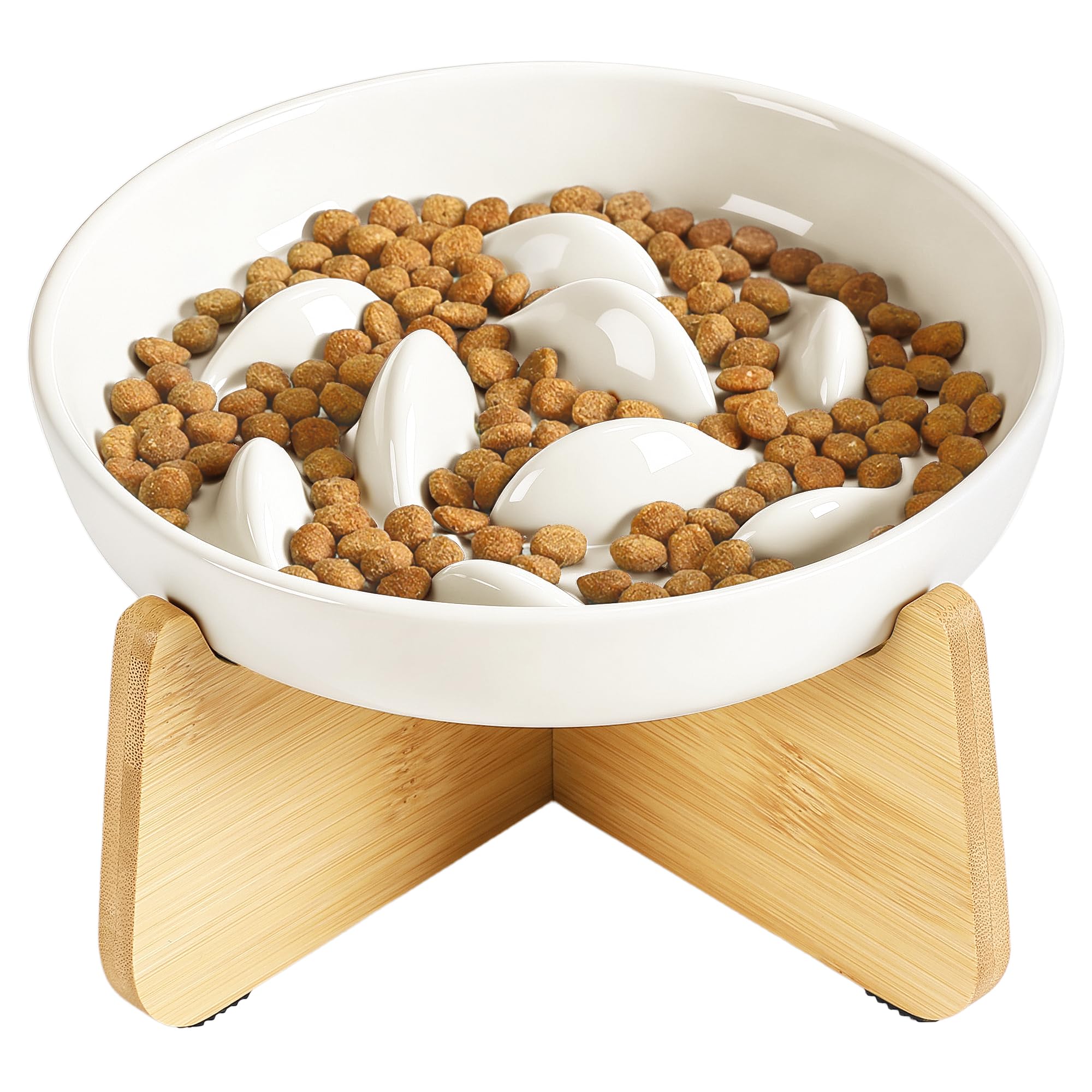
This ceramic bowl tackles the twin problems of speed-eating and posture strain simultaneously. The fish-pool raised interior creates a maze of low ridges that break the kibble stream into smaller mouthfuls, while the detachable bamboo stand lifts the bowl 3 inches off the floor — enough to align with a cat’s natural eating height and reduce the neck craning that contributes to re-gurgitation.
The 6.38-inch diameter and 1.14-inch depth provide a whisker-friendly feeding space that prevents the edge-sensitivity many cats exhibit with deeper bowls. The smooth ceramic glaze fires at high temperature, creating a non-porous surface that resists staining from fish-based wet food and does not absorb odors between washes. Both the bowl and stand withstand dishwasher cycles, though the bamboo base should be wiped dry rather than soaked to prevent warping.
Where this puzzle differs from purely mental enrichment toys is its primary goal: slowing consumption rather than stimulating hunting. The raised ridges add roughly 45 seconds to a typical one-minute bowl-clean, which is enough to reduce vomiting in fast eaters but not enough to replace a dedicated challenge puzzle for a cat that needs cognitive engagement. It works best paired with a separate foraging toy for meals and treats respectively.
Why we love it
- Elevated stand reduces neck strain and promotes natural swallowing posture
- Food-grade ceramic resists staining and is fully dishwasher safe
- Whisker-friendly width prevents the defensive eating behavior caused by tight bowls
Good to know
- Bamboo stand requires drying after washing to avoid moisture damage
- Slow-feeding ridges add time but do not provide significant cognitive challenge
5. PTOBER Flower Maze Elevated Slow Feeder Bowl

The PTOBER bowl approaches slow feeding through a sculptural flower maze: raised petal-shaped obstacles rise from the ceramic base, forcing the cat to eat around and between each barrier to reach the food. The 6-ounce capacity is appropriate for single-cat meals, and the 6.3-inch diameter gives enough surface area that the maze does not overcrowd the bowl and cause whisker fatigue.
Like the PETTOM model, this bowl pairs with a natural bamboo stand that elevates the feeding surface by roughly 3 inches. The anti-slip stickers on each leg prevent the assembly from sliding on tile or laminate, which is a common failure point for lighter ceramic bowls. The stand itself separates from the bowl, so you can microwave the ceramic portion for warming wet food without damaging the bamboo.
Color options (blush pink, green, and white) make this a visibly attractive addition to a kitchen or feeding station, but the real draw is the entry-level price point for a slow-feeder that includes both a maze and a stand. Owners of gulpers report a visible reduction in post-meal regurgitation within the first week, though the maze’s relatively open layout means a determined cat can still scoop food over the petals if bowl placement allows a running start.
Why we love it
- Attractive flower-maze design adds visual appeal to feeding stations
- Ceramic bowl and bamboo stand both made from food-safe, non-toxic materials
- Aesthetic color options match various kitchen or cat-room décors
Good to know
- Open maze layout can be bypassed by cats that paw food out sideways
- 6-ounce capacity may require a second refill for larger portion meals
FAQ
What difficulty level should I start with for a cat that has never used a food puzzle before?
How does the compartment size affect whether a cat will engage with the puzzle long-term?
Can I use wet food or puree treats in a cardboard puzzle box?
How do I clean a multi-module plastic puzzle that has deep crevices?
Final Thoughts: The Verdict
For most cat owners looking to combine slow feeding with genuine cognitive enrichment, the best cat food puzzles winner is the TRIXIE Poker Box because its four-module design offers the cleanest balance of difficulty, washability, and adjustability across different life stages. If your primary goal is to stop a scarf-and-barf cycle in its tracks, grab the PETTOM Elevated Slow Feeder Bowl. And for a high-drive cat that chews through smaller puzzles in under a minute, nothing beats the sprawling endurance challenge of the Cat Amazing MEGA.