
The difference between a standard furnace filter and a dedicated electronic air cleaner is measurable in microns of captured particulate and the volume of air scrubbed per hour. Most homeowners settle for a 30-day pleated filter that misses the smallest irritants — pollen, bacteria-sized particles, and fine smoke — while their HVAC blower works harder against added resistance. An electronic air cleaner tackles the invisible load, capturing up to 98% of airborne particles without choking airflow, keeping your system efficient and your indoor air genuinely clean.
I’m Mo Mahin — the founder and writer behind Furric. I spend my time comparing filtration spec sheets, analyzing MERV-rating data against real-world CADR performance, and researching how ionization and electrostatic precipitation technology holds up in ducted HVAC systems over years of use.
Whether you are retrofitting an existing forced-air furnace or planning a new installation, choosing the right best electronic air cleaner for furnace means understanding coverage area, filter maintenance, and how the unit integrates with your ductwork.
How To Choose The Best Electronic Air Cleaner For Furnace
Picking the right unit for your forced-air system comes down to matching three technical parameters: the physical design (in-duct vs. portable), the filtration mechanism (ionization vs. electrostatic vs. HEPA hybrid), and the system’s compatibility with your furnace blower and duct dimensions. Below are the key considerations that separate efficient whole-home cleaning from a costly mis-step.
In-Duct vs. Portable: The Ductwork Decision
In-duct units like the iWave-R and the RGF Reme Halo install directly into your HVAC return or supply plenum, treating every cubic foot of air the furnace moves. Portable HEPA purifiers serve a single room. For whole-home coverage, an in-duct electronic air cleaner eliminates the need for multiple floor units and avoids the floor space consumption that comes with free-standing purifiers.
Filtration Mechanism: Ionization, Electrostatic, and HEPA
Needlepoint bipolar ionization (NPBI) systems — used by the iWave-R and RGF Reme Halo — produce ionized hydro-peroxides that cluster around particles and pathogens, causing them to fall out of the airstream or be caught by existing furnace filters. Electrostatic precipitators (like the Aprilaire 5000) charge particles and trap them on oppositely charged collector plates. Units with washable pre-filters and HEPA-grade media (like the Nuwave OxyPure ZERO) offer the highest particle capture but are not typically installed in-duct without bypass ducting.
Coverage Area and Airflow Resistance
An electronic air cleaner should handle your home’s square footage without creating static pressure that strains the blower. Look at the manufacturer’s specified coverage (often in square feet per hour) and check the pressure drop rating — especially when retrofitting into older ductwork. High-performance in-duct units typically add less than 0.10 inches of water column resistance, compared to 0.30+ from thick MERV 13 media filters.
Maintenance: Washable vs. Replaceable Components
One of the strongest arguments for electronic air cleaners is reduced consumable cost. Many premium units (Nuwave Forever, Aprilaire 5000) feature washable electrostatic cells or stainless-steel pre-filters that never need replacement. Others require periodic carbon or ozone-removal filter changes every 6 to 12 months. Factor in the annual consumable cost and the labor of cleaning collector plates when comparing total ownership expense.
Quick Comparison
On smaller screens, swipe sideways to see the full table.
| Model | Category | Best For | Key Spec | Amazon |
|---|---|---|---|---|
| Aprilaire 5000 | In-Duct Electronic | Whole-Home Bacteria Removal | 98% bacteria-sized particle capture | Amazon |
| RGF Reme Halo (24V) | In-Duct Ionizer | Low-Maintenance IAQ | Zinc catalyst + no-tool cell | Amazon |
| iWave-R (i-Wave-R) | In-Duct Ionizer | Self-Cleaning IAQ | Needlepoint bipolar ionization | Amazon |
| Nuwave OxyPure ZERO | Portable HEPA/Electrostatic | Washable Zero-Waste Filtration | 100% particle capture at 0.1 microns | Amazon |
| Nuwave Forever | Portable HEPA/Electrostatic | Never-Replace Filter System | 7-stage washable filtration | Amazon |
| PuroAir 400 | Portable HEPA | Large Room HEPA + Carbon | Covers 2,000 sq ft / 99.9% filtration | Amazon |
| WINIX 5520 | Portable True HEPA | AHAM-Verified Smart Purification | CADR 250 smoke / 23.5 dB quiet | Amazon |
| LEVOIT Vital 200S-P | Portable HEPA | Smart Whole-Room HEPA | CO2: 1875 sq ft / CADR 289 pollen | Amazon |
| Air Purifier for Large Room | Portable HEPA | Budget Large-Room 3-Stage | 2400 sq ft in 30 min / 20 dB sleep | Amazon |
In‑Depth Reviews
1. Aprilaire 5000 Air Cleaner

The Aprilaire 5000 is a dedicated in-duct electronic air cleaner that targets respirable dust, airborne bacteria, and pollen with lab-verified retention rates — 94% for dust small enough to trigger asthma, 98% for bacteria-sized particles, and 99% for pollen and mold spores. It is designed to install into the return duct of a forced-air furnace, treating every cubic foot that passes through the HVAC system rather than a single room.
Its electrostatic collector plates are washable, eliminating the recurring expense of disposable filter replacements. The unit’s HEPA-grade final filter captures what the electronic cell misses, delivering a combined MERV-equivalent performance that rivals central air systems without the pressure drop that chokes older blowers. The 5000 is best suited for homeowners who want medical-grade whole-home filtration and are comfortable with an installed, duct-integrated appliance.
Installation is not a DIY snap — it requires cutting into the ductwork and wiring the unit to a 120V source, ideally by an HVAC professional. The initial cost is substantial, but when you amortize the washable components over a decade of service, the per-year cost is lower than replacing MERV 13 media filters every three months.
Why we love it
- Electrostatic cells capture sub-micron particles without adding restrictive airflow resistance.
- Washable collector plates and final filter drastically reduce consumable waste and long-term expense.
- Removes 98% of airborne bacteria-sized particles — verified performance for allergy and asthma households.
Good to know
- Requires professional installation into existing ductwork; not a plug-and-play portable unit.
- Heavy unit at over 25 pounds; needs secure mounting in the plenum or return.
- Initial purchase price places it in the premium tier, though long-term consumable savings offset the upfront cost.
2. RGF Reme Halo (24 Volt) In-Duct Air Purifier System

The RGF Reme Halo is a 24-volt in-duct ion generator that uses advanced oxidation technology to produce ionized hydro-peroxides, which circulate through the HVAC system and neutralize airborne pollutants, bacteria, and odors at the molecular level. The latest model features an enhanced catalyst infused with zinc for faster kill rates on microbial contaminants, making it a popular choice with HVAC contractors who want to offer indoor air quality upgrades without adding duct resistance.
Cell replacement is tool-free, and the adjustable ion output lets you dial in the cleaning intensity based on your home’s air quality challenges. Because it installs in the supply plenum, it treats the entire conditioned space — no floor units, no filter changes, no washable media. The Reme Halo is particularly effective at reducing kitchen and pet odors and has a proven track record in commercial and residential IAQ applications.
The unit does produce a trace amount of ozone as a byproduct of the ionization process, though it operates within UL-recommended limits for indoor use. It is not a substitute for HEPA filtration in households with severe particulate allergies — it shines as a complementary whole-home microbial and odor control system.
Why we love it
- Zero maintenance — no filters to wash or replace; the catalyst cell is the only periodic replacement.
- Treats the entire home via the HVAC ductwork, eliminating the need for multiple portable purifiers.
- Adjustable ion output with zinc-enhanced catalyst for faster microbial neutralization.
Good to know
- Produces trace ozone as a byproduct of ionization, which may be a concern for ozone-sensitive individuals.
- Does not capture particulates directly — relies on existing furnace filter for dust and pollen removal.
- Professional installation recommended for proper mounting and 24V wiring in the plenum.
3. iWave-R/iWave-R Residential IAQ Ion Generator

The iWave-R is a needlepoint bipolar ionization (NPBI) device that installs directly into the HVAC ductwork and requires zero maintenance — no filters, no cells to clean, no consumable parts. It creates positive and negative ions that bond with airborne particles, viruses, and mold spores, causing them to cluster and either fall onto surfaces or be captured by the furnace’s existing filter. The self-cleaning design uses mounting magnets for a quick attach-and-forget installation inside the duct.
At just 5 pounds and measuring roughly the size of a shoe box, the iWave-R is one of the most compact in-duct solutions available. It operates on standard residential voltage and draws negligible power, making it an energy-efficient IAQ upgrade. The unit is particularly effective at reducing odors from cooking, pets, and smoke, as well as controlling surface mold growth inside the HVAC system itself.
Like all ionization-based units, the iWave-R does not mechanically capture particles — it relies on agglomeration and the system’s existing filter media. For homes that already run a high-MERV filter, the iWave-R adds microbial and odor control without increasing static pressure. It is a complementary technology rather than a standalone particulate solution.
Why we love it
- True zero-maintenance operation — no washable plates, no replacement cells, no consumable filters.
- Ultra-compact 5-pound design mounts inside the duct with simple magnets.
- Reduces HVAC system microbial growth and neutralizes VOCs and odors at the ion source.
Good to know
- Does not independently capture particulate matter — performance depends on the duct filter’s rating.
- Trace ozone production is inherent to NPBI technology, though within indoor safety standards.
- Best suited as a supplementary IAQ device for homes already using a mechanical air filter.
4. Nuwave OxyPure ZERO Smart Air Purifier

The Nuwave OxyPure ZERO is a portable, freestanding air purifier that uses a hybrid approach — combining a stainless-steel pre-filter, dual Bio-Guard electrostatic filters, and ozone emission removal filters — to capture 100% of airborne particles down to 0.1 microns. It is Intertek-certified to purify a 2,002 sq ft area in one hour, making it one of the largest-coverage standalone units available. The dual 4-stage filtration system is entirely washable, meaning zero filter replacements and zero consumable waste over the life of the unit.
An adjustable 30°, 60°, or 90° vent panel lets you direct the clean air stream precisely where you need it, mimicking the control of an HVAC register. The smart app provides remote monitoring and control, while the night-time sleep mode drops noise to a virtually silent 21.41 dB. The unit eliminates toxic ozone to less than 1 ppb, meeting California Air Resources Board standards and leaving the air cleaner than EPA safety thresholds require.
At 22 pounds, the OxyPure ZERO is heavy and designed as a furniture-grade appliance rather than an in-duct component. It requires floor space and does not integrate directly with the furnace ductwork. For homes that already have a good central filter, this unit serves as a powerful dedicated zone purifier for the largest living area.
Why we love it
- All filters are washable and reusable, eliminating recurring replacement costs and environmental waste.
- Certified 100% capture of 0.1-micron particles, including smoke, dust, and pollen.
- Adjustable vent panel with three angles allows targeted clean air delivery.
Good to know
- Portable floor unit — does not connect to HVAC ductwork for whole-home distribution.
- Heavy 22-pound build requires a dedicated spot in the room.
- Initial cost is mid-to-premium, though zero consumable spend offsets it over several years.
5. Nuwave Forever Smart Air Purifier

The Nuwave Forever takes the zero-waste concept a step further than the OxyPure ZERO with a seven-stage filtration process that includes dual stainless-steel pre-filters, dual Bio-Guard filters, ozone removal filters, and the Bio-Guard 360 filter. Like its sibling, every filter is washable and reusable — except the ozone removal media, which lasts significantly longer than disposable alternatives. The unit covers the same 2,002 sq ft footprint in one hour and is Energy Star certified.
Auto mode uses both particle and odor sensors to continuously adjust the six-speed fan. The adjustable flow panel offers 30°, 60°, and 90° vent positioning, and the WiFi-enabled app provides full remote control. The Forever unit is designed for users who want the highest possible stage count in a portable purifier without ever buying replacement filters again. The 21.85-pound cabinet houses robust internals that feel built for decades of service.
Staged electrostatic filtration of this depth creates notable airflow resistance at higher fan speeds. While the seven-stage design captures an extremely broad spectrum of contaminants, the fan motor works harder on the highest setting compared to simpler three-stage units. It remains quiet in sleep mode but should be placed thoughtfully in the room to avoid blocking the intake.
Why we love it
- Seven-stage washable filter system achieves deep contaminant capture without any filter replacement cost.
- Auto mode with dual particle and odor sensors provides responsive real-time fan speed adjustment.
- Adjustable flow panel with app control gives precise, room-specific clean air direction.
Good to know
- Ozone removal filters are the only non-washable component, though they have a long service life.
- High stage count creates measurable airflow resistance at max fan speed.
- Large footprint and 22-pound weight require dedicated floor space in the room.
6. PuroAir 400 HEPA Air Purifier
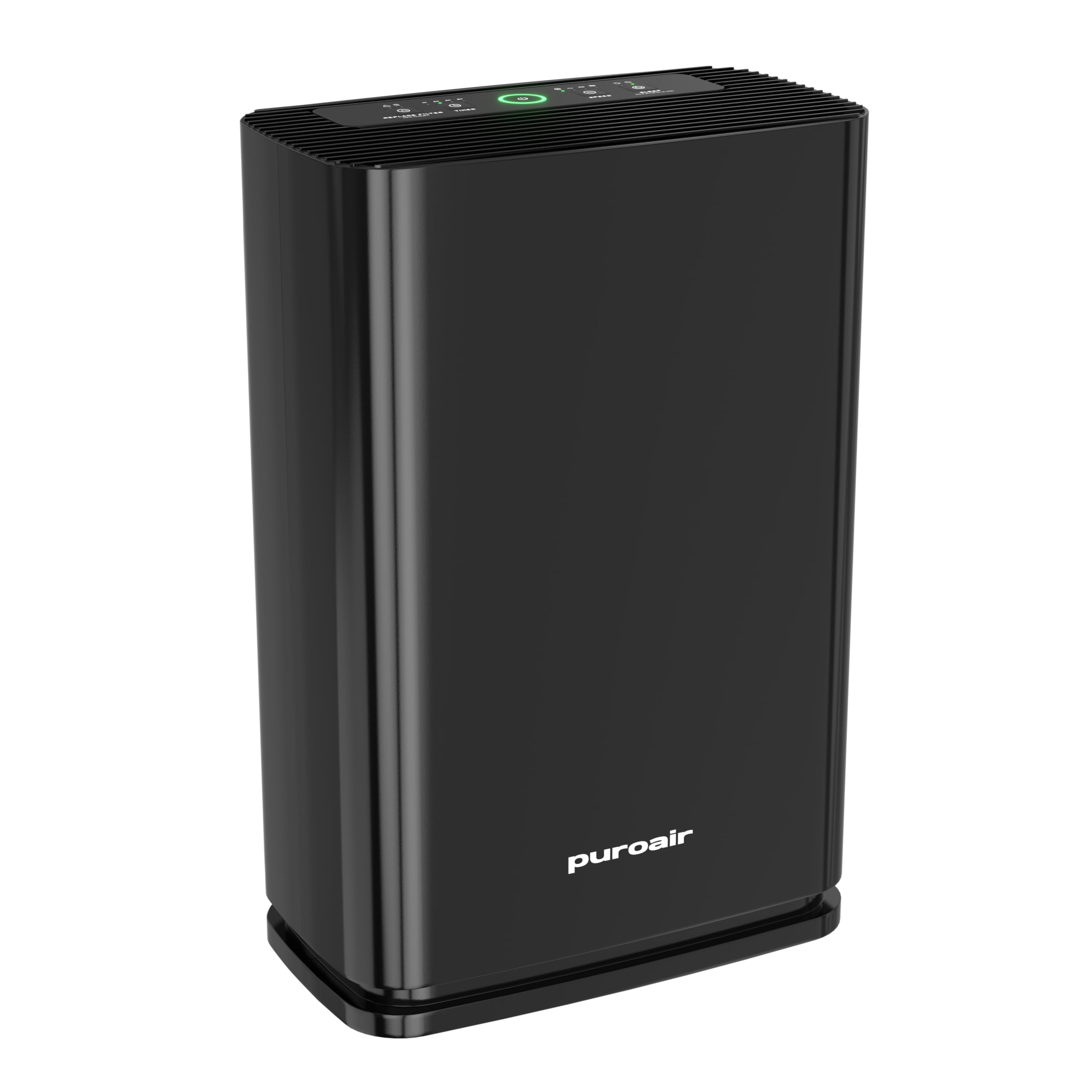
The PuroAir 400 uses a three-layer system — pre-filter, true HEPA filter, and activated carbon — to capture up to 99.9% of airborne pollutants in rooms up to 2,000 sq ft. Independent lab testing in an ISO 17025-certified facility verified its ability to filter particles as small as 0.01 microns, which is about 700 times smaller than the diameter of a human hair. It is CARB, ETL, ISO, and UL certified, meeting strict California ozone and safety standards.
A built-in smart particle sensor monitors real-time air quality and adjusts fan speed automatically. Sleep mode operates at whisper-quiet levels, making it suitable for bedroom use. The 14.73-pound cabinet sits on the floor without the need for duct integration, and the front-loading filter design makes replacements straightforward. PuroAir includes a two-year risk-free warranty, which provides confidence for buyers investing in a dedicated home purification appliance.
Because this is a portable HEPA unit rather than an in-duct electronic air cleaner, it treats only the room it occupies. For whole-home coverage, you would need multiple units or a central solution. The activated carbon layer handles VOCs and odors effectively, but the filter replacements are disposable, creating recurring cost over the machine’s lifespan.
Why we love it
- ISO 17025 lab-verified 99.9% filtration of particles down to 0.01 microns.
- CARB, ETL, and UL certified for safety and low ozone emissions.
- Smart particle sensor with auto-adjusting fan and near-silent sleep mode.
Good to know
- Portable unit — does not integrate with furnace ductwork for whole-home cleaning.
- Annual disposable filter replacements add to total cost of ownership over time.
- Best for large single-room or open-concept zone, not whole-house dust control.
7. WINIX 5520 Air Purifier
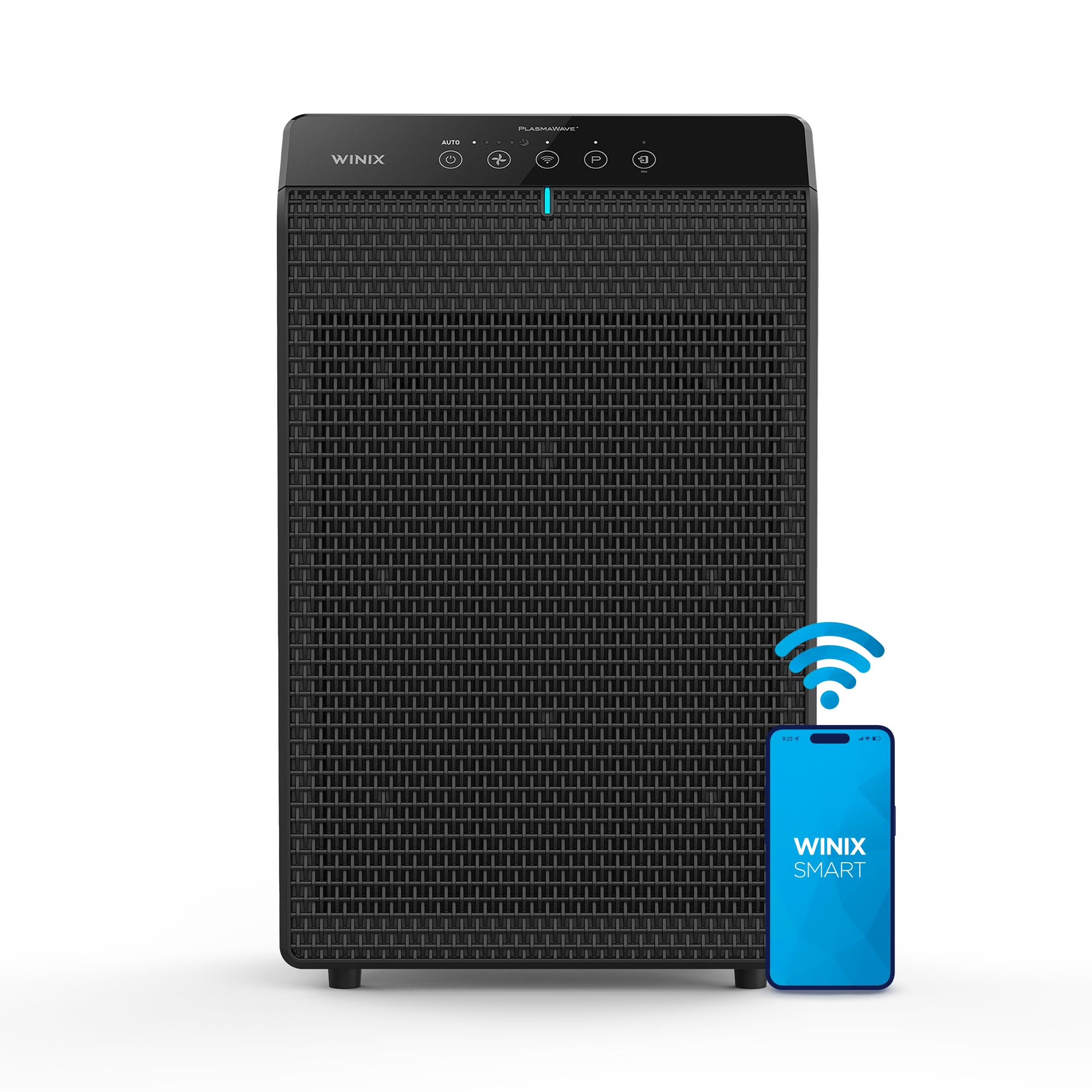
The WINIX 5520 is AHAM Verified at 392 sq ft for its standard clean air delivery rate, but the unit can cycle air in rooms up to 1,882 sq ft in one hour. Its True HEPA filter captures 99.99% of airborne allergens down to 0.01 microns, while the AOC (advanced odor control) carbon filter targets VOCs and household odors from cooking, pets, and smoke. The washable fine mesh pre-filter extends the life of the HEPA and carbon elements.
Built-in smart sensors measure real-time air quality and adjust the fan speed automatically, with an LED indicator that shifts from blue (clean) to red (polluted). The unit’s light-automated sleep mode activates when the room darkens, dropping noise to a near-silent 23.5 dB on the lowest speed. Winix Smart App compatibility adds remote control and monitoring via Amazon Alexa voice commands.
The 5520 uses a proprietary AOC carbon filter that must be replaced every 6 to 12 months, adding a consumable cost to the upfront investment. Its 13.3-pound weight and 22.7-inch height make it a mid-sized portable unit that fits under furniture or in a corner, but it is not designed for duct integration. For a balanced combination of HEPA capture, odor reduction, and smart features, the WINIX 5520 delivers strong value in the mid-size portable category.
Why we love it
- AHAM Verified with CADR ratings of 250 CFM smoke, 254 CFM dust, and 289 CFM pollen.
- Washable pre-filter reduces maintenance intervals for the HEPA and carbon stages.
- Near-silent 23.5 dB operation on low speed, with automated light-based sleep mode.
Good to know
- Carbon filter replacement is required every 6 to 12 months, adding ongoing cost.
- Standalone portable unit — does not connect to HVAC for whole-home distribution.
- Best for rooms up to 392 sq ft at AHAM-rated CADR; larger room coverage is based on air changes.
8. LEVOIT Vital 200S-P Air Purifier

The LEVOIT Vital 200S-P is AHAM VERIFIDE certified with clean air delivery rates of 250 CFM smoke, 254 CFM dust, and 289 CFM pollen. It covers rooms up to 1,875 sq ft in one hour, making it a strong mid-range portable option for large bedrooms, living rooms, and open-concept homes. Its three-stage filtration includes a washable pre-filter, an efficient middle filter, and an activated carbon layer designed to trap ultrafine particles as small as 0.1 microns.
The smart functionality sets this unit apart for home automation users. The VeSync app allows scheduling, fan speed selection, and real-time air quality monitoring from anywhere. The light sensor automatically dims the display in a dark room, and HEPA Sleep Mode ensures quiet operation during rest hours. The U-shaped air intake design reduces clogging from pet hair and larger airborne debris.
Like other portable HEPA units, the Vital 200S-P treats one zone at a time and does not integrate with furnace ductwork. The three-stage filter system requires periodic replacement of the middle and carbon layers, adding consumable cost. It is an excellent value for users who want app-controlled whole-room purification and do not need an in-duct solution.
Why we love it
- AHAM VERIFIDE with independently tested CADR ratings for smoke, dust, and pollen.
- Full VeSync app integration with scheduling, timers, and third-party voice assistant control.
- Washable pre-filter plus U-shaped intake reduce pet hair clogging and extend media filter life.
Good to know
- Standalone portable unit — does not connect to furnace ductwork for whole-home purification.
- Middle and carbon filter layers require periodic replacement, adding recurring cost.
- Best suited for single-room use; multiple units needed for whole-house coverage.
9. Air Purifier for Large Room (HAP602)

This budget-friendly standalone HEPA purifier claims a 2,400 sq ft coverage in 30 minutes, using a three-stage filtration system that combines a pre-filter, a HEPA-grade layer, and an activated carbon element. The built-in PM2.5 sensor provides real-time air quality readings on the touch display, with LED colors shifting from green to red as particle levels rise. Auto mode accelerates the fan speed when the sensor detects deterioration in air quality.
Sleep mode drops noise to a claimed 20 dB, making it one of the quieter options in the entry-level portable category for bedroom use. The child lock feature prevents unintended setting changes, which matters in households with curious kids or pets. The 6.6-pound weight makes it easy to move between rooms, unlike heavier purifiers that stay in one spot permanently.
The disposable filter requires replacement every 3 to 6 months, and the manufacturer explicitly states it must not be washed or exposed to liquids. While the coverage claim of 2,400 sq ft is aggressive for a unit in this tier, the actual CADR performance in rooms above 500 sq ft will be lower than larger, pricier units. It is a functional entry point for renters or first-time buyers wanting measurable air quality feedback on a minimal budget.
Why we love it
- Real-time PM2.5 display with color-coded LED provides immediate air quality feedback.
- Sleep mode at 20 dB is one of the quietest available in the entry-level portable segment.
- Light 6.6-pound build allows easy relocation between rooms.
Good to know
- Filter is disposable and non-washable, requiring replacement every 3 to 6 months.
- Aggressive coverage claim of 2,400 sq ft likely does not match real-world CADR performance.
- Best suited for smaller rooms up to ~500 sq ft despite the large-room marketing.
FAQ
What is the difference between an electronic air cleaner and a standard furnace filter?
Can I install an in-duct electronic air cleaner myself?
How often do I need to clean the collector plates in an electrostatic air cleaner?
Is an in-duct electronic air cleaner better than a portable HEPA purifier for whole-home use?
Does an electronic air cleaner increase my electricity bill?
Final Thoughts: The Verdict
For most homeowners seeking whole-home air quality improvement, the best electronic air cleaner for furnace integration is the iWave-R because it installs silently inside the ductwork, requires zero maintenance, and adds microbial and odor control without increasing static pressure on the blower. If you want the highest particle capture rate with washable components that eliminate ongoing filter purchases, the Aprilaire 5000 delivers 98% bacteria-sized particle removal in a robust duct-mounted system. And for those who prefer a portable unit with maximum stage count and zero consumable waste, the Nuwave OxyPure ZERO offers certified 0.1-micron capture with fully washable filters and app-based smart controls.