
The challenge with most cat doors isn’t the cat — it’s the break in your home’s envelope. A poorly sealed flap leaks conditioned air, invites drafts, and undermines the very security you count on. Owners typically face a trade-off: choose a flimsy insert that installs in minutes but fails to insulate, or tackle a wall installation that demands precision cutting for a weather-tight seal. The right solution eliminates that compromise entirely.
I’m Mo Mahin — the founder and writer behind Furric. I’ve spent years comparing specification sheets, studying installation tolerances, and analyzing aggregated owner feedback to determine which cat doors actually perform as advertised.
This guide breaks down the best options available today — framed around real-world metrics like frame material, flap seal integrity, and locking mechanism quality — so you can confidently choose a cat door that keeps your pet comfortable and your home energy efficient.
How To Choose The Best Cat Doors
Selecting a cat door that balances freedom for your pet with insulation for your home requires attention to a few non-negotiable specifications. Here are the three factors that separate a reliable install from a regret.
Frame Material: Plastic vs. Aluminum vs. Steel
The frame is the structural backbone that resists clawing, weather exposure, and physical stress. Plastic frames (common on budget units) are lightweight and easy to cut but can warp under direct sun or crack in freezing temperatures. Aluminum frames resist rust and hold paint well, making them a durable mid-range choice. Steel frames offer the highest impact resistance but require proper galvanization to prevent corrosion in exterior wall mounts. For exterior doors, prioritize aluminum or steel; for interior room dividers, a reinforced plastic frame can suffice.
Flap Seal Technology and Energy Efficiency
Draft reduction is the primary concern for homeowners. Single flaps with basic magnets allow measurable air leakage. Dual magnetic flaps — two independent sheets that create an air pocket — reduce energy transfer by over 50% compared to single-flap designs. High-density dust strips along the flap perimeter stop insects and fine debris. If the door leads to an unconditioned space like a garage or backyard, look for double magnetic flaps with full perimeter gaskets. Interior no-flap designs (solid cutouts without a swinging door) completely eliminate air leakage but also remove the pet’s ability to see through.
Locking Mechanism and Access Control
A 4-way locking mechanism (locked, unlocked, in-only, out-only) gives you granular control over your cat’s movement. Push-and-turn dials are secure but require dexterity to adjust. Sliding lock panels provide a simpler binary choice: fully open or fully sealed. For wall-mounted units, sliding panels that lock from both sides prevent the door from being a point of entry for unwanted animals or people. Consider what level of restriction you need — if you only want to keep your cat in at night, a simple lock is sufficient; if you need to train a new pet, the “in-only” or “out-only” settings are genuinely useful.
Quick Comparison
On smaller screens, swipe sideways to see the full table.
| Model | Category | Best For | Key Spec | Amazon |
|---|---|---|---|---|
| PetSafe Big Cat Door | Mid-Range | Flexible multi-pet access control | 4-way Push-&-Turn lock | Amazon |
| Fairy® Door Interior Pet Door | Mid-Range | Hidden litter box room access | 10.24 x 10.63 in opening | Amazon |
| Gnome® Door Cat Door | Mid-Range | Stylish interior door concealment | Wood frame, 8×10 in opening | Amazon |
| VOSOIR All Aluminum Frame | Premium | Exterior door energy efficiency | All-aluminum alloy frame | Amazon |
| TBC PET Wall Door | Premium | Wall-mount for tiny pets | Steel frame, telescoping tunnel | Amazon |
| Decormax Wall Cat Door | Premium | All-weather wall installation | Double magnetic flaps + lock panels | Amazon |
| ClawJaw Wall Pet Door | Premium | Durable black metal wall mount | Metal frame, 3.9–7.87 in tunnel | Amazon |
In‑Depth Reviews
1. PetSafe Big Cat Door

The PetSafe Big Cat Door earns its top position because it addresses the two biggest pain points in one compact unit: security and draft reduction. Its Push-&-Turn 4-way locking mechanism — the only design in this class that requires two distinct actions to change settings — prevents accidental lock changes and gives you full control over in-only, out-only, locked, and unlocked modes. The flap operates silently thanks to GentleClose technology, which moderates the closing speed so a cat’s tail or paw never gets pinched.
Fitting doors 1 to 2 inches thick, this 11×12-inch unit works for cats and small dogs up to 25 lb. The plastic frame feels sturdy enough for interior and sheltered exterior use, though prolonged direct sun exposure could degrade it faster than aluminum alternatives. The weather stripping around the flap perimeter reduces cold airflow noticeably, and the built-in magnets pull the flap shut after every pass. Installation follows a standard cut-and-screw pattern with a provided template.
Owner feedback consistently praises the 4-way lock’s ease of use and the absence of the loud slamming sound typical of cheaper flaps. The only common note is that the included screws could be slightly longer for thick, solid-core exterior doors. For a versatile, multi-pet household needing adjustable access, this door delivers the broadest functionality at a reasonable price point.
Why we love it
- Unique push-and-turn dial prevents accidental lock mode changes
- Soft-close flap operates silently and safely
- Fits both interior and standard exterior doors
Good to know
- Plastic frame may warp under extended direct sunlight
- Maximum door thickness of 2 inches limits some exterior applications
2. Fairy® Door Interior Pet Door

The Fairy Door takes a completely different approach — no swinging flap at all. This interior-only design is a solid plastic cutout that installs into a hollow or solid core door, creating a private passage to a separate room for litter boxes or feeding stations. Without a flap, there’s zero air leakage and no noise, making it ideal for homeowners who prioritize room separation over the cat’s ability to see through the passage.
Constructed from ABS plastic with a smooth white finish, the frame measures 10.24 x 10.63 inches — large enough for cats up to 20 lb. A sliding lock panel on the interior side lets you close off the passage when needed, such as during guest visits or cleaning. The whimsical arch-top design blends into white doors surprisingly well, though it’s less discreet on darker or wood-grain surfaces. Installation involves tracing the provided template, cutting the door, and securing the frame with included screws and caps.
Owner feedback highlights how effectively it hides the litter box area while giving the cat free access. The primary limitation is the single-side lock — there’s no way to lock it from the room the cat enters from. If you need full two-way access control, a flapped door with an exterior lock panel is a better fit. For a clean, draft-free interior passage, this is the most seamless solution available.
Why we love it
- No flap means zero air leakage between rooms
- Lockable design for temporary restriction
- Quick install with template and included hardware
Good to know
- One-side lock only — no control from the cat’s side
- White finish may not match all interior door colors
3. Gnome® Door Cat Door
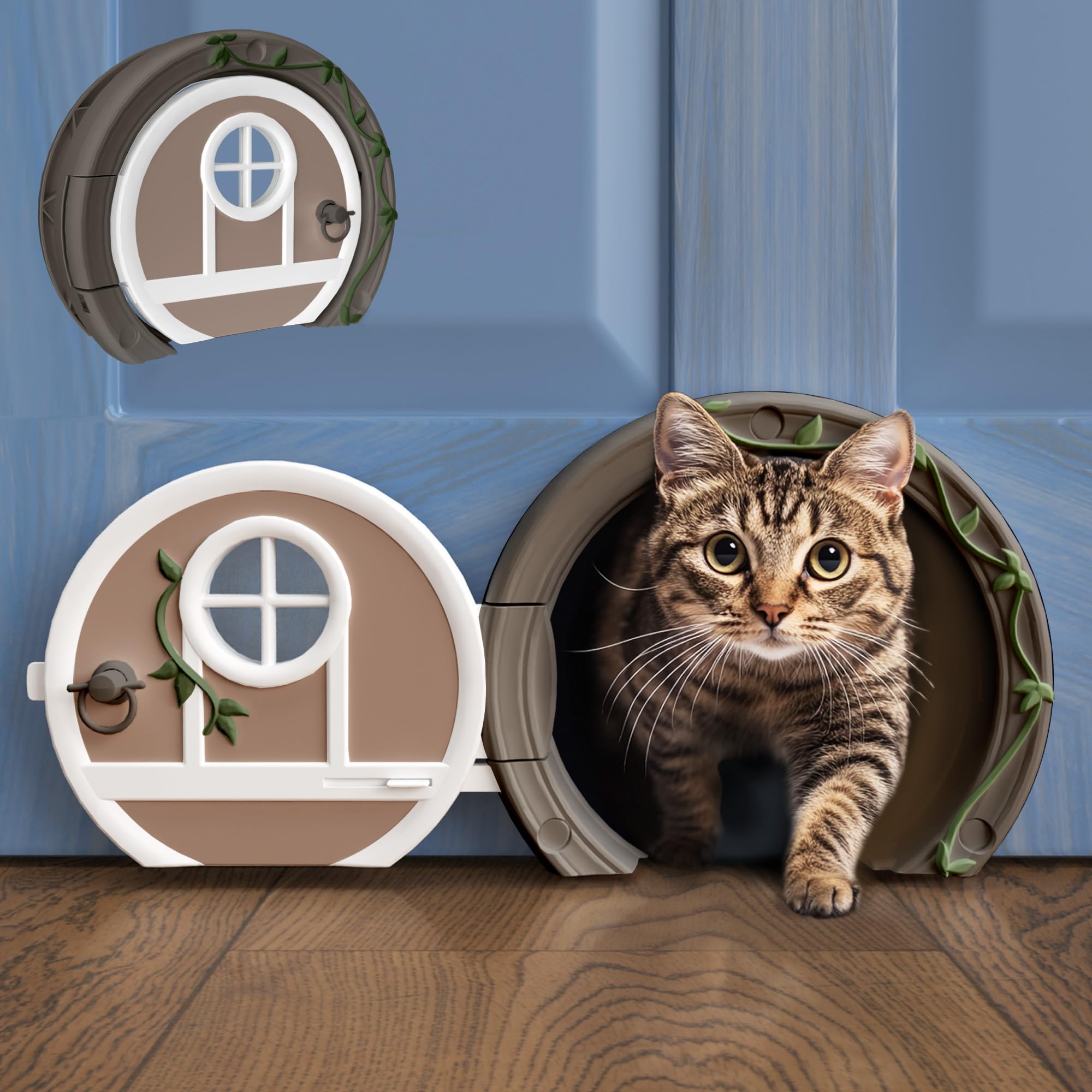
The Gnome Door differentiates itself from the Fairy Door with a wood composite frame instead of all-plastic construction. The brown wood finish gives it a warmer, more furniture-like appearance that integrates better with stained doors and rustic interior styles. The opening measures 8 x 10 inches — slightly smaller than the Fairy Door but still sufficient for most adult cats up to 20 lb.
Like the Fairy Door, this is a no-flap interior pass-through designed for litter box concealment. The lockable sliding panel controls access from one side. The frame material composite is more rigid than standard ABS and resists warping better in humid environments. Installation requires a door thickness between 1.25 and 1.75 inches, which covers most standard hollow and solid core interior doors. The included screws and decorative caps give a finished look without exposed fasteners.
Reviews frequently mention the aesthetic appeal — the gnome motif is subtle enough to look like intentional decor rather than a pet modification. The wooden frame does require more care during cutting since the composite can splinter at the edges if the saw blade isn’t sharp. For homeowners who want their cat passage to look like part of the room rather than an afterthought, this is the strongest contender.
Why we love it
- Wood composite frame blends with stained doors beautifully
- Rigid construction resists warping in humid rooms
- Decorative screw caps create a finished look
Good to know
- Opening is smaller than some alternative interior doors
- Limited to door thicknesses between 1.25-1.75 inches
4. VOSOIR All Aluminum Frame Cat Door
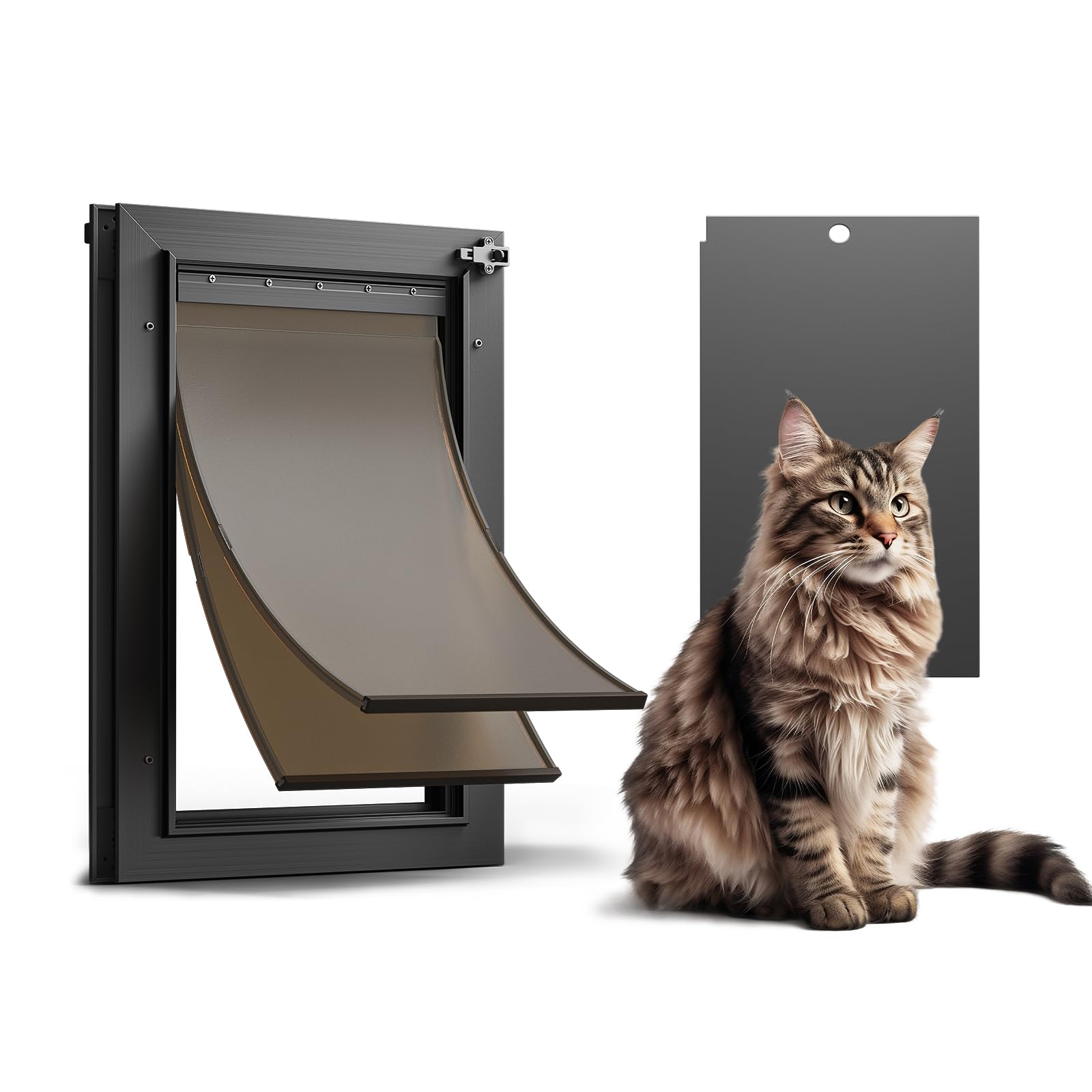
The VOSOIR is the first unit in this lineup built entirely from aluminum alloy — no plastic frame components anywhere. This construction choice delivers superior thermal performance because aluminum conducts heat away from the door surface and resists the expansion and contraction that can break plastic seals over time. The flap opening measures 10.5 x 6.8 inches, suitable for pets up to 22 lb.
Energy efficiency is the primary selling point. The double magnetic flaps are made from a PA material that blocks UV rays and reduces thermal transfer by over 50% compared to standard flaps. High-density dust strips run along the full perimeter to stop insects and drafts. An included closing panel slides into place and can be locked from both sides using the bilateral aluminum locks, maintaining home security even when the door is sealed. Expandable channels let it fit doors between 1.26 and 2.08 inches thick.
Owner feedback emphasizes how much quieter the house feels after installation — less wind noise and fewer drafts near the door. The all-metal frame does make the unit heavier than plastic alternatives, requiring more careful support during installation. Some users note that the flap magnets could be stronger to prevent the flap from bouncing open in high winds. For exterior doors in climates with extreme temperature swings, the VOSOIR’s material choice is a clear advantage.
Why we love it
- Full aluminum alloy frame resists rust and deformation
- Double magnetic flaps with dust strips for superior sealing
- Bilateral locks on the closing panel for added security
Good to know
- Heavier than plastic-framed units, requiring careful installation
- Flap magnets could be stronger for high-wind conditions
5. TBC PET Wall Cat Door

The TBC PET is the first wall-specific door on this list, meaning it installs into drywall, brick, or wood siding rather than a door panel. Its steel frame and telescoping tunnel adjust to walls between 4.13 and 7.87 inches thick, covering standard residential framing. The flap opening is 5.28 x 8.98 inches — designed explicitly for small cats and toy breed dogs under 10 lb.
The double-layer silicone flaps are food-grade and nontoxic, remaining flexible even in subfreezing temperatures. They seal with over 95% gap-free coverage when fully closed, far better than typical vinyl flaps. A built-in safety lock lets you control access from inside the home. Installation is more involved than a door-mounted unit — you must cut through the wall sheathing, which requires verifying there are no studs or wiring in the path. The included template and step-by-step guide walk you through the process.
Owner feedback notes that the silicone flaps remain supple in cold weather where vinyl alternatives stiffen and crack. The weight limit of 10 lb is restrictive — larger cats will not fit comfortably. This door is a specialty solution for tiny pets who need access through a wall where no door exists.
Why we love it
- Steel frame offers maximum durability for wall installation
- Food-grade silicone flaps remain flexible in extreme cold
- Telescoping tunnel adapts to a wide range of wall depths
Good to know
- 10 lb weight limit excludes many average-size cats
- Wall installation requires verifying no studs or wiring in the cut area
6. Decormax Wall Cat Door

The Decormax wall door combines a rust-proof steel frame with a three-mode access system: full open, full lock, and partial open that contains pets while allowing airflow. This flexibility is rare among wall-mounted cat doors and makes it useful for homeowners who want to let their cat access a screened porch during the day but lock it at night. It accommodates walls from 3.9 to 7.87 inches thick.
The double magnetic flaps are designed for extreme weather resistance, sealing against rain, wind, and snow. The 13.9 x 9.4-inch frame supports a 9.25 x 6.5-inch flap opening — large enough for cats and small dogs up to 22 lb. The neutral white finish blends with most walls without requiring paint. Flap replacement is tool-free, which simplifies maintenance as the flaps wear over years of use.
Reviews emphasize the solid build quality and the convenience of the partial-open mode for transitioning a new pet to outdoor access. Some users found the installation template markings slightly off and recommend measuring twice before cutting. The dual sliding lock panels add genuine security since they can be locked from the inside, preventing any outside animal from pushing through.
Why we love it
- Three-mode access system includes a useful partial-open setting
- Tool-free flap replacement simplifies long-term maintenance
- Steel frame resists rust and aggressive scratching
Good to know
- Installation template may require careful measurement verification
- White finish is standard; no color options available
7. ClawJaw Wall Pet Door
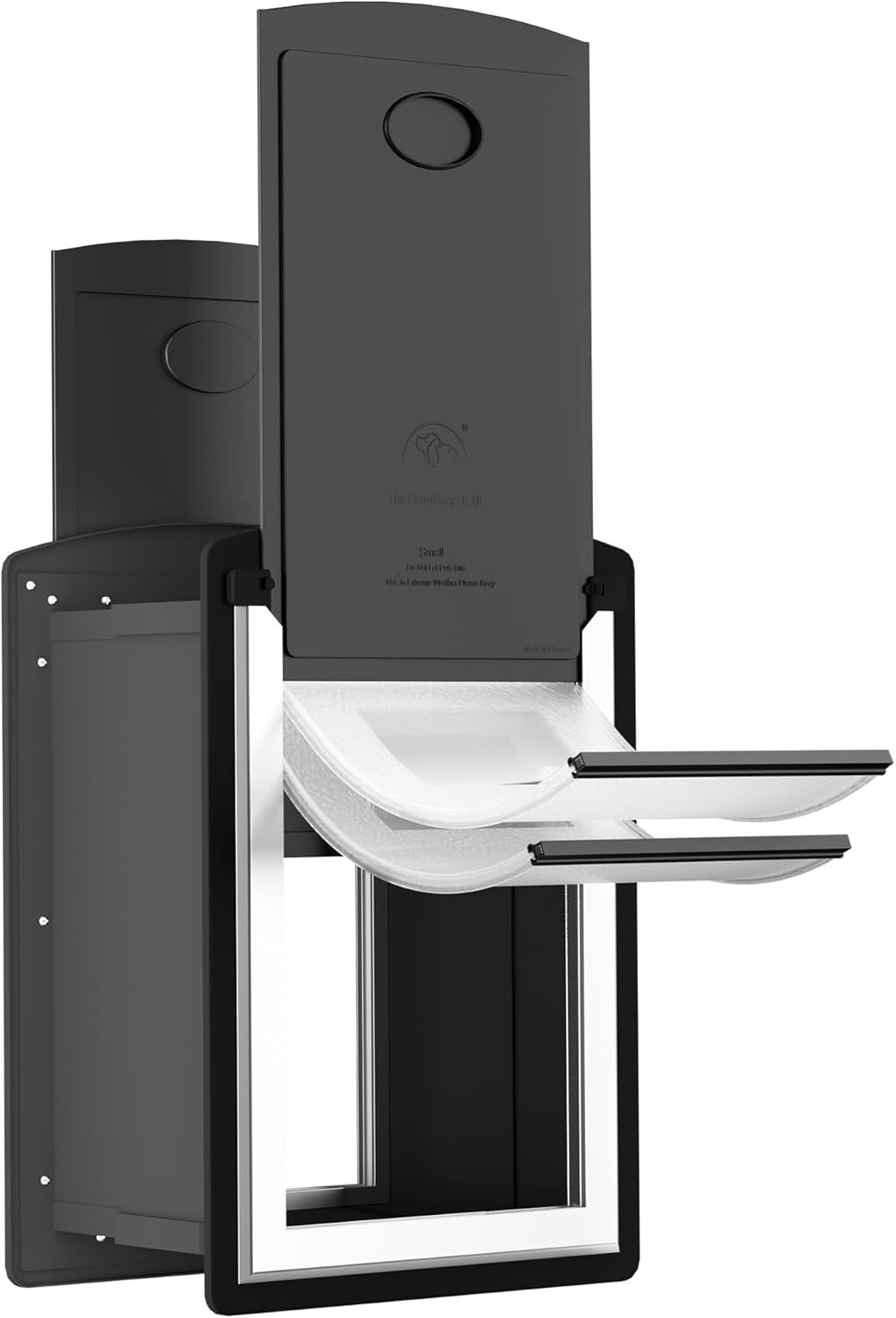
The ClawJaw is the entry-level option for wall installation, offering a metal frame and telescoping tunnel at a more accessible price point than the Decormax or TBC PET. The black finish gives it a discreet appearance on darker siding or painted walls. It fits walls between 3.9 and 7.87 inches thick, with the same 9.25 x 6.5-inch flap opening as the Decormax — suitable for pets up to 22 lb.
Construction uses a metal frame with double flaps and sliding lock panels. The weatherproofing is functional but less refined than premium competitors — the dust strips are thinner and the flap magnets are standard-strength rather than heavy-duty. The sliding panels lock from both sides, maintaining security when the door is sealed. Installation follows the standard cut-and-fit pattern with an included template, though some users report needing to trim the template edges for a precise fit.
Owner feedback generally highlights good value for the price — it performs adequately in mild climates but shows its limitations in extreme weather where draft sealing is critical. The metal frame holds up well to scratching, but the paint finish can chip if the unit is handled roughly during installation. For budget-conscious buyers who need a wall-mounted solution in a moderate climate, the ClawJaw provides the essential function without the premium price tag.
Why we love it
- Metal frame at a budget-friendly price point
- Both-side locking panels maintain home security
- Double flaps provide basic weather protection
Good to know
- Weather sealing is less robust than premium alternatives
- Paint finish may chip during installation
FAQ
Can a cat door be installed in a hollow core interior door?
How do I measure my cat for the correct flap size?
Does a wall-mounted cat door require planning permission?
Final Thoughts: The Verdict
For most households, the best cat door overall is the PetSafe Big Cat Door because it offers the most versatile access control (4-way Push-&-Turn lock) at a reasonable investment while fitting both interior and exterior doors. If you need a draft-free passage to hide a litter box inside the home, the Fairy Door Interior Pet Door eliminates air leakage completely with its no-flap design. And for exterior wall installation where energy efficiency is critical, the VOSOIR All Aluminum Frame Cat Door provides the best thermal performance and structural durability.