
Your air quality is only as good as the last layer of filtration your purifier offers. A standard HEPA catches particulates, but it is the activated carbon bed that locks onto VOCs, cooking fumes, and pet odors — the invisible chemistry that defines truly fresh indoor air. Picking the wrong carbon mass or bypassing it entirely leaves you breathing air that *looks* clean but still carries the load.
I’m Mo Mahin — the founder and writer behind Furric. I’ve spent years cross-referencing CADR scores, carbon density specs, and real-world owner feedback to isolate which units actually handle odor neutralization and chemical adsorption without doubling as a nightstand noise machine.
Whether you are battling smoke, litter box linger, or seasonal VOCs, the right choice boils down to carbon volume and airflow calibration — this guide covers the best air purifier with activated carbon filter across every room size and budget.
How To Choose The Best Air Purifier With Activated Carbon Filter
The filter stack matters more than the fan. A unit loaded with a lightweight carbon pad will saturate in weeks, while a thick carbon pellet matrix lasts months and handles chemical odors far better. Look beyond the “carbon” sticker and compare the actual gram weight or volume of the carbon layer.
Carbon Density vs. Pellet Size
Granular activated carbon (GAC) pellets have more surface area for adsorption than carbon-impregnated foam or cloth. A unit that uses a thick pellet bed will absorb VOCs from paint, cooking, and smoke far longer than one with a thin carbon fiber sheet. If you are sensitive to odors, prioritize models that specify a carbon filter weight or multiple carbon cartridges.
CADR and Room Matching
The Clean Air Delivery Rate tells you how fast the machine pulls smoke, dust, and pollen out of the air. For an activated carbon filter to do its job, the air must pass through the carbon at a speed the carbon can actually capture. Over-speccing a tiny carbon layer with a high CADR motor only pushes odors through before adsorption happens. Match the CADR to your room size — around 4–5 air changes per hour is the sweet spot.
Filter Replacement Cost and Life
Carbon beds eventually saturate and stop adsorbing. Some units combine the carbon and HEPA into one sealed cartridge, forcing a full replacement every 6–12 months. Others offer a separate pre-filter or washable carbon tray that reduces the frequency of full cartridge swaps. Factor the annual filter expense into the total ownership cost before committing to a specific model.
Quick Comparison
On smaller screens, swipe sideways to see the full table.
| Model | Category | Best For | Key Spec | Amazon |
|---|---|---|---|---|
| Winix 5520 | Premium | Large rooms & wildfire smoke | HEPA + Washable Carbon Pellet | Amazon |
| Coway Airmega AP-1512HH | Premium Mid | Wirecutter choice & auto mode | 4‑Stage Filtration | Amazon |
| Coway Airmega 100 | Mid Range | Compact premium build | HEPA + Deodorization Filter | Amazon |
| GermGuardian AC4825E | Mid Range | UV‑C & carbon combo | True HEPA + UV‑C | Amazon |
| LEVOIT Core 300‑P | Budget Mid | All‑around small rooms | 56W Motor, 143 CFM CADR | Amazon |
| LEVOIT Core 200S‑P | Entry Level | Smart control & quiet sleep | 27 dB Sleep Mode | Amazon |
| Amazon Basics AC2224A | Budget | Pet dander & value | 3‑Speed, 32 dB Sleep | Amazon |
In‑Depth Reviews
1. Winix 5520 Air Purifier
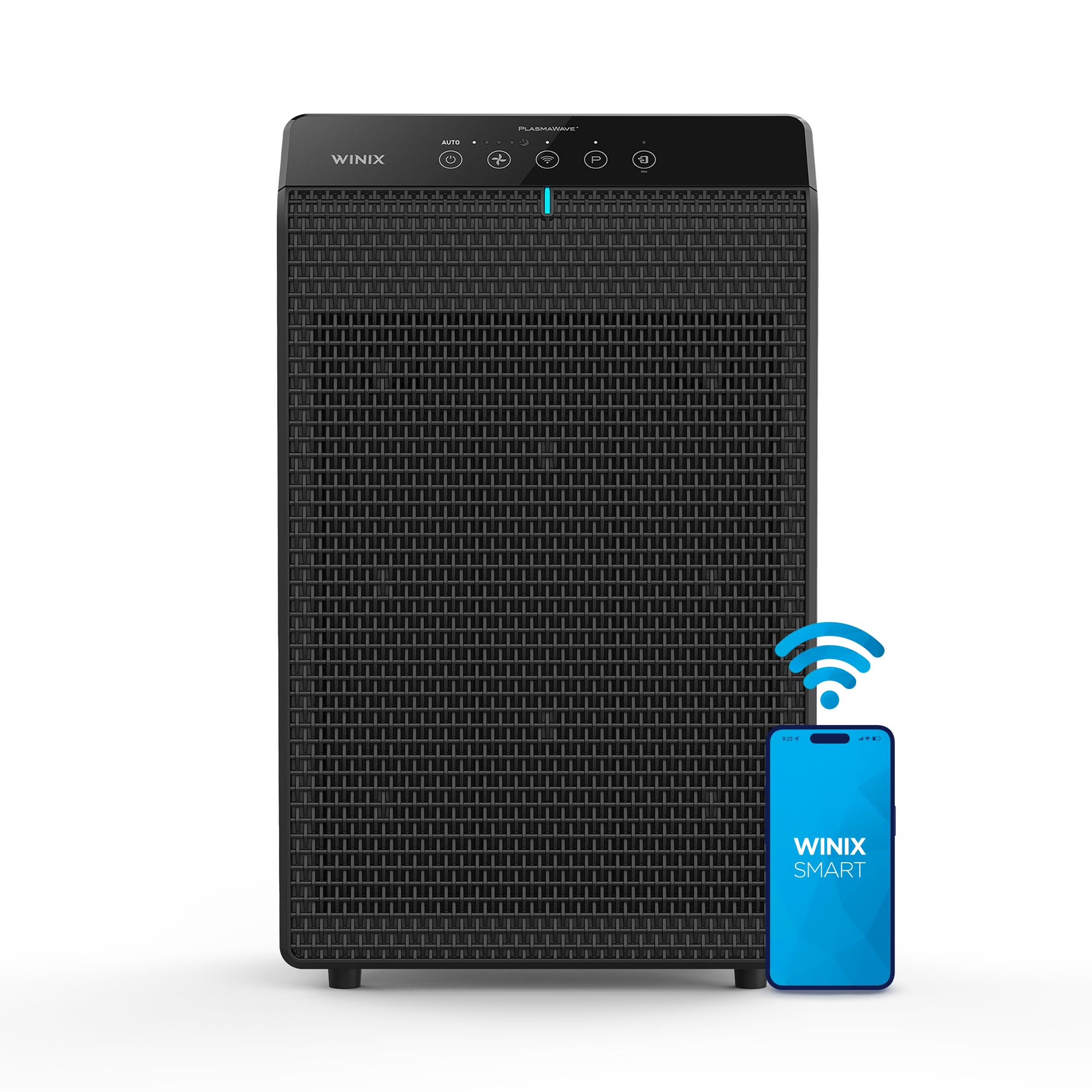
The Winix 5520 uses a four-stage stack — a washable fine-mesh pre-filter, an advanced odor-control carbon pellet filter, a True HEPA that grabs 99.99% of particles down to 0.01 microns, and PlasmaWave for additional pollutant neutralization. The carbon layer is a distinct pellet-based bed, not a bonded sheet, which gives it noticeably longer adsorption life for cooking and pet smells. In real use, the auto mode responds to airborne particles within seconds, ramping the fan based on a color-coded air quality indicator.
Coverage is rated at AHAM Verifide for 392 square feet, but it processes up to 1,882 square feet in one hour on a single pass. Owners consistently report it tames wildfire smoke and litter box odors better than cheaper carbon-pad units. The sleep mode activates automatically in darkness and drops to a near-silent 23.5 dB, which is barely audible in a quiet bedroom.
The washable pre-filter reduces replacement frequency — only the carbon and HEPA cartridges need annual swapping. Some users note that the washable carbon filter is slightly louder on high compared to disposable carbon filters, but the trade-off is lower annual cost. The included remote control and Winix Smart App add convenience without forcing a monthly subscription.
Why we love it
- Pellet-based carbon filter handles VOCs and cooking odors for months without saturation
- Auto-dimming sleep mode at 23.5 dB is genuinely silent for overnight use
- Washable pre-filter extends HEPA life and lowers total ownership cost
Good to know
- Washable carbon filter can produce slightly more airflow noise on speed 3
- Unit is 22.7 inches tall — check clearance if placing on a low shelf
2. Coway Airmega AP-1512HH
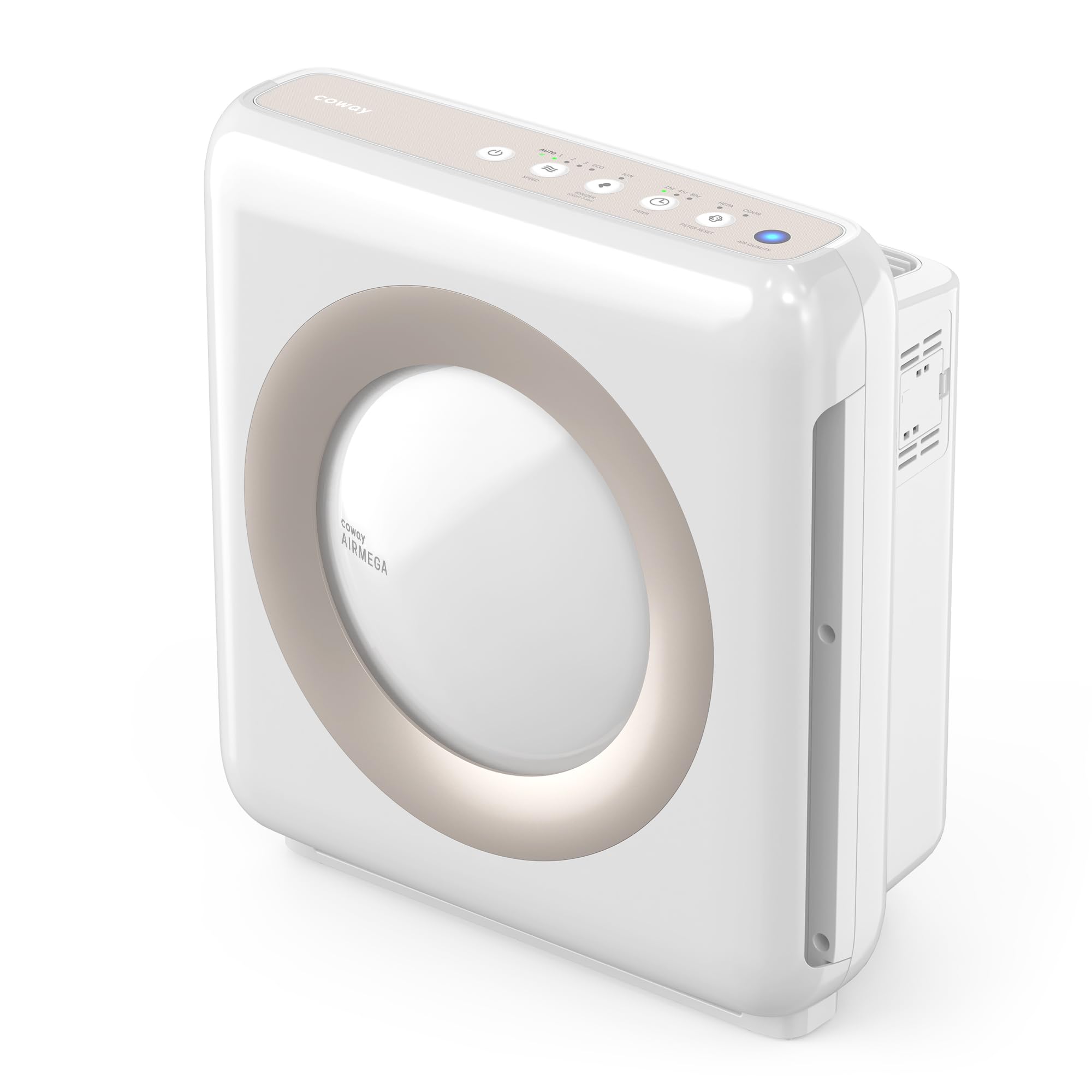
The Coway Mighty (AP-1512HH) earned its Wirecutter “Best Air Purifier” reputation through a combination of a dense deodorization carbon filter and a True HEPA that captures 99.97% of 0.3-micron particles. The four-stage system includes a pre-filter, activated carbon deodorization layer, True HEPA, and Vital Ion — though the ionizer can be turned off if you prefer purely mechanical filtration. The pollution sensor reads air quality in real-time and displays it via a color-coded LED ring.
Rated for rooms up to 361 square feet at a CADR of 246 CFM for dust, 240 for pollen, and 233 for smoke. Owners confirm it clears wildfire smoke in minutes and detects cooking smells before the human nose registers them. The auto mode ramps through three fan speeds based on the sensor reading, then switches to an Eco mode after 30 minutes of clean air, shutting the fan off entirely to save power. Noise ranges from a whisper-quiet 24.4 dB on low to a strong 53.8 dB on turbo — the mid setting is the sweet spot for most living rooms.
Filter replacement is straightforward: the pre-filter is washable, and the carbon + HEPA combo lasts about 12 months. Coway backs the motor and electronic parts with a 3-year warranty. The unit’s upward airflow design pushes clean air toward the ceiling, improving circulation without creating a direct draft on nearby furniture. The only omission is a lack of app control, which some buyers find refreshingly simple.
Why we love it
- Proven real-world performance against wildfire smoke and kitchen odors
- Eco mode shuts off fan after 30 minutes of clean air to save energy
- Washable pre-filter combined with long-life carbon/HEPA cartridge lowers yearly upkeep
Good to know
- No Wi-Fi or app connectivity — manual controls only
- High/turbo setting is loud enough to compete with TV dialogue at close range
3. Coway Airmega 100
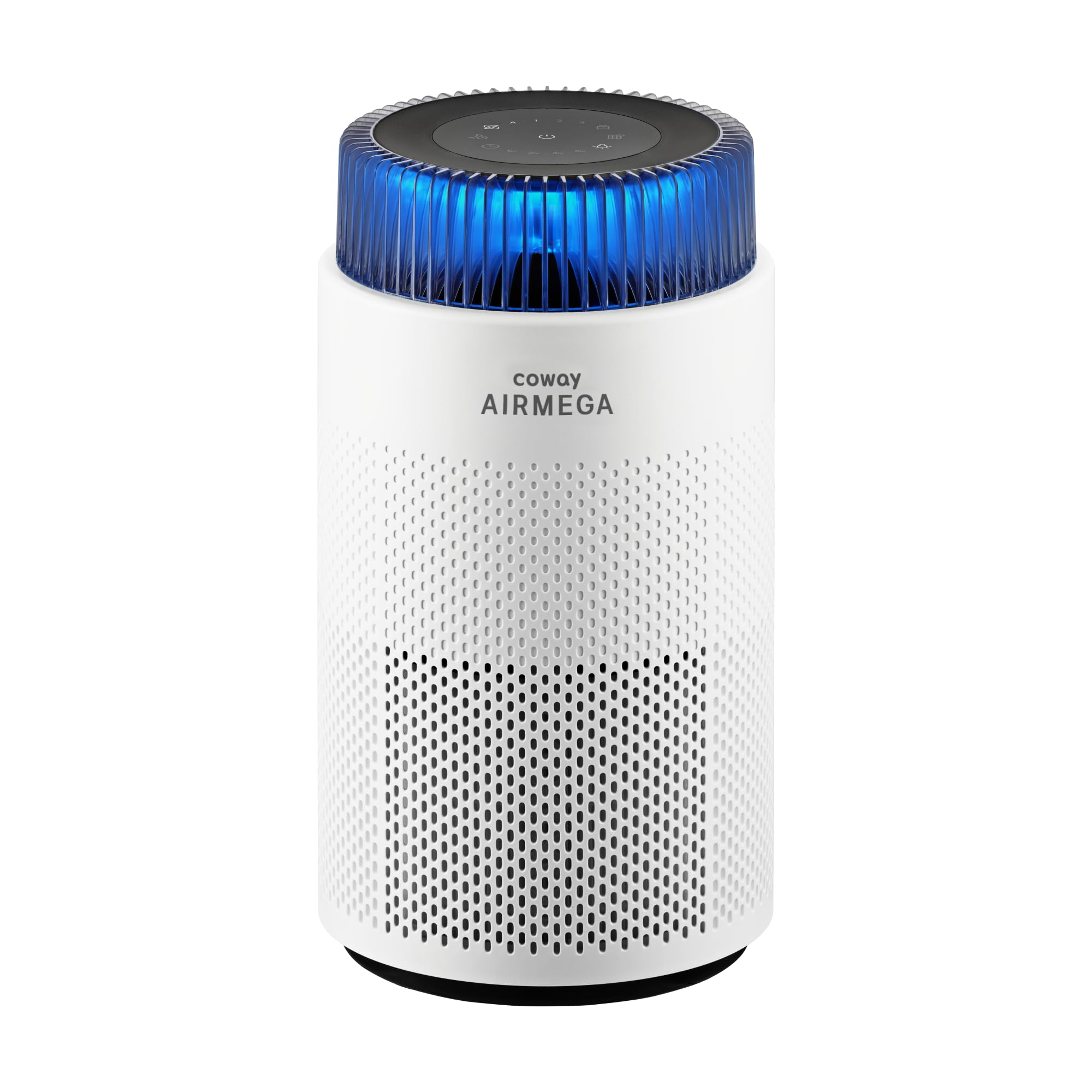
The Coway Airmega 100 packs the brand’s filtration pedigree into a footprint that is just 8.66 inches square and 15.55 inches tall — smaller than the Mighty but still carrying a dedicated deodorization filter alongside the HEPA. The carbon layer uses Coway’s pellet-based deodorization technology, which targets VOCs, smoke, and pet odors without relying on a thin impregnated sheet. The built-in AQI monitor displays real-time air quality and triggers auto mode to adjust the fan speed between low, medium, and high.
Coverage is optimized for 405 square feet in 30 minutes, or up to 810 square feet in 60 minutes on a single pass. The 3-stage manual fan control gives you full override over auto mode, which is useful if the sensor ramps up during cooking and you prefer a consistent low hum. Sleep mode kills the AQI light and touch panel glow, dropping the fan to its lowest setting — quiet enough for a nursery or master bedroom.
Owners highlight the unit’s ability to clear cooking odors within minutes and its durable build that matches Coway’s longer-running models. The filter set (pre-filter, deodorization, HEPA) requires replacement roughly every 12 months, and the pre-filter is vacuum-cleanable between changes. The timer offers 1-, 2-, 4-, and 8-hour options, though some users wish for a 12-hour setting for overnight use. It lacks Wi-Fi or app control, but the touch interface is responsive and intuitive.
Why we love it
- Compact footprint with a dedicated pellet-based deodorization filter, not a bonded carbon pad
- AQI monitor with auto mode responds quickly to cooking fumes and smoke
- Sleep mode completely blacks out all lights for undisturbed rest
Good to know
- No support for timer durations longer than 8 hours
- Lacks remote control or smartphone connectivity
4. GermGuardian AC4825E

The GermGuardian AC4825E stacks a True HEPA, a charcoal carbon filter, and an optional UV-C light into a 22-inch tower that has been a staple in allergy households for years. The carbon element is a bonded charcoal sheet positioned after the pre-filter but before the HEPA — it captures odors from pets and cooking while the UV-C lamp targets airborne bacteria and mold spores. The UV-C can be toggled independently, which is useful if you want mechanical-only filtration during sleep hours.
Coverage is rated at 743 square feet per hour, with the ability to cycle a 153-square-foot room in 12.5 minutes on high speed. The rotary dial control offers three fan speeds and a separate UV button — no auto mode, no air quality sensor. Owners appreciate the simplicity: set the dial to low for white noise overnight or crank it to high for a rapid air scrub after cooking. The low setting is quiet enough for a nursery, while high produces a noticeable airflow sound that some users describe as a gentle white noise machine.
Filter replacement is straightforward: the charcoal pre-filter can be vacuumed monthly, and the True HEPA cartridge lasts 6–8 months depending on usage. UV-C bulbs need replacement roughly every 12 months. The tower design has a small 10.25 by 6.75-inch footprint, making it easy to tuck into a corner. Some owners note that the blue UV glow is bright at night, but the UV button turns it off completely.
Why we love it
- UV-C light provides an extra layer of germicidal protection beyond mechanical filtration
- Simple rotary dial with no auto mode means no unexpected fan speed changes
- Compact tower footprint fits tight spaces between furniture
Good to know
- High speed is loud enough to interfere with conversation in the same room
- Bonded carbon sheet saturates faster than pellet-based carbon filters
5. LEVOIT Core 300-P

The LEVOIT Core 300-P uses a 56-watt high-torque motor to push a CADR of 143 CFM for smoke, 153 for dust, and 167 for pollen — numbers that place it above many similarly sized units. The 3-in-1 filter combines a nylon pre-filter, a high-efficiency activated carbon layer, and a HEPA-grade main filter that captures 99.97% of particles down to 0.3 microns. The carbon layer uses a pleated fabric impregnated with carbon, which handles moderate odor loads well but saturates faster than loose pellet designs.
Coverage extends to 1,073 square feet on a single pass per hour, or it refreshes a 222-square-foot room 4.8 times per hour. The QuietKEAP technology drops noise to 24 dB in Sleep Mode — one of the quietest readings in its class. Owners consistently mention that the low and medium speeds are inaudible at night, while the high speed is audible but not harsh. The touch controls include a display-off button, a timer (2/4/6/8 hours), and a filter replacement indicator.
A major advantage of the Core 300-P ecosystem is the variety of official replacement filters: a Toxin Absorber for VOCs, a Smoke Remover for wildfire smoke, and a Pet Allergy filter for dander and odors. This lets you swap the filtration focus without buying a new machine. The unit is AHAM Verifide, FCC Certified, ETL Listed, and CARB Compliant. The main trade-off is the absence of auto mode and a real-time AQI sensor — the fan runs at whatever speed you set until you change it.
Why we love it
- Interchangeable filter line lets you target VOCs, smoke, or pet allergens with a single unit
- 56W motor delivers strong CADR numbers for the price tier
- Sleep Mode at 24 dB is genuinely silent for light sleepers
Good to know
- No auto mode or air quality sensor — fan speed is fully manual
- Activated carbon layer is a pleated fabric, not loose pellets, so odor capacity is lower
6. LEVOIT Core 200S-P

The Core 200S-P is the smart-enabled sibling of the Core 300, trading some motor power for Wi-Fi and voice control via Alexa or Google Assistant. The 3-in-1 filter uses the same nylon pre-filter, high-efficiency activated carbon layer, and HEPA main filter that removes 99.97% of 0.1–0.3 micron particles. The carbon layer is similarly a bonded fabric impregnated with activated carbon, suitable for light odor control in smaller rooms. The 360-degree air intake pulls from all sides, maximizing surface area usage despite the compact 8.1-inch square footprint.
Coverage is optimized for a 140-square-foot room at 4.8 air changes per hour, or up to 675 square feet on a single pass. The motor is less powerful than the Core 300 (45 watts vs 56 watts), so it is best suited for bedrooms, nurseries, and home offices rather than open-plan living areas. The app allows scheduling, speed adjustment, and filter life monitoring — features missing from the manual-only Core 300. Owners appreciate being able to set a timer or change speeds without getting out of bed.
At 27 dB on Sleep Mode, the unit is barely audible — owners report forgetting it is running. The Display Off button kills all panel lights, making it ideal for nurseries. The filter replacement cycle averages 6–8 months, and Levoit offers the same specialized filter variants (Toxin Absorber, Smoke Remover, Pet Allergy) as the Core 300 line. The main limitation is the smaller room capacity compared to the Core 300 and the bonded carbon filter’s shorter odor-adsorption lifespan relative to pellet-based alternatives.
Why we love it
- Wi-Fi + voice control enables scheduling and speed changes from anywhere
- Compact footprint fits on a nightstand without overhang
- Sleep Mode at 27 dB is near-silent for light sleepers
Good to know
- Smaller motor limits coverage to rooms under 200 square feet for 4.8 ACH
- Bonded carbon fabric saturates faster than pellet-based carbon filters
7. Amazon Basics AC2224A

The Amazon Basics AC2224A brings an auto mode with a built-in PM2.5 sensor and a 3-speed fan at a price point that undercuts most branded competitors. The filter uses a layered HEPA plus activated carbon medium, with the carbon described as sugar-crystal-sized granules embedded in the filter media. The 360-degree intake draws air from all sides, feeding a 31-watt DC motor that is Energy Star certified for low power consumption. The CADR is rated at 238 m³/h (140 CFM), refreshing a 213-square-foot room five times per hour.
The smart sensor displays air quality via LED colors — red for poor, orange for moderate, green for good — and the auto mode adjusts fan speed accordingly. Sleep Mode drops noise to 32 dB, which is quiet enough for a bedroom but slightly more audible than the 24 dB competitors. Owners highlight that the unit detects cooking smoke and incense quickly, ramping up within seconds of a pollutant spike. The compact dimensions (9.6 inches square by 14.3 inches tall) make it easy to reposition between rooms.
The filter is a single sealed cartridge that combines the pre-screen, carbon, and HEPA layers — replacement is a one-piece swap every 6–8 months. Some owners report the filter arrives wrapped in plastic inside the unit, so removing the plastic before use is critical. The timer offers 2/4/8-hour settings, and the filter life indicator flashes when replacement is due. A few users report that the sensor can be overly sensitive to minor dust events, but this is generally preferable to a sensor that under-reacts.
Why we love it
- Built-in PM2.5 sensor with auto mode and real-time color-coded air quality display
- 31W DC motor draws low power while maintaining solid CADR for medium rooms
- Compact 9.6-inch footprint fits easily on desks and side tables
Good to know
- Filter arrives sealed in plastic inside the unit — must be unwrapped before use
- Sleep Mode at 32 dB is slightly louder than premium competitors in the same class
FAQ
How often should I replace the activated carbon filter in my air purifier?
Does a higher CADR always mean better carbon filter performance?
Can I wash the activated carbon filter to extend its life?
What is the difference between bonded carbon and pellet carbon filters for odor control?
Final Thoughts: The Verdict
For most gardeners, the best air purifier with activated carbon filter winner is the Winix 5520 because it pairs a pellet-based carbon bed with a True HEPA that captures 99.99% of 0.01-micron particles, all backed by a washable pre-filter and a silent 23.5 dB sleep mode. If you want a compact unit with premium build and an auto mode that responds instantly to cooking fumes, grab the Coway Airmega 100. And for budget-conscious buyers who still demand a real-time PM2.5 sensor and auto mode, nothing beats the Amazon Basics AC2224A for value per dollar in a mid-sized room.