
A finch feeder that spills more seed than it serves is not a feeder—it’s a mess. Goldfinches are acrobatic, clingy feeders that demand a specific perching geometry and small-port access. A poorly designed tube or mesh body forces these birds to fight for a single spot, lets larger birds bully them off, and dumps expensive nyjer seed onto the ground. Your choice of feeder directly dictates whether your yard fills with flashing yellow or with wasted money.
I’m Mo Mahin — the founder and writer behind Furric. I’ve spent years cross-referencing port diameters, mesh gauge, material corrosion data, and verified owner water-test reports to separate the goldfinch magnets from the seed-wasters.
After analyzing five market-leading designs across die-cast aluminum, alloy steel, polycarbonate, and coated mesh, I landed on a clear ranking. This guide presents the definitive best goldfinch feeder picks for every yard scenario and budget tier.
How To Choose The Best Goldfinch Feeder
Goldfinches are not casual visitors. They feed exclusively on tiny, high-oil seeds like nyjer and require specific landing surfaces. Selecting the wrong feeder often means watching your expensive seed rot on the ground while house sparrows take over the trays. Focus on these four factors before clicking buy.
Port Size & Perch Geometry
Goldfinches have smaller feet and lighter bodies than cardinals or jays. The feeder must have narrow feeding ports—typically in or smaller—and perches that slope or extend just enough for a finch-sized grip. Ports that are too wide allow larger birds and squirrels to feed, while perches that are too thick or horizontal make it hard for finches to cling. Look for designs that restrict access naturally rather than relying on weight-sensitive mechanisms.
Material & Weather Resistance
Nyjer seed spoils quickly when moist. The feeder body must be rust-proof polycarbonate, powder-coated metal, or die-cast aluminum to avoid corrosion that traps moisture. Mesh feeders offer superior airflow to dry seed after rain, while tube feeders with overhanging rain guards keep the seed hopper dry. Plastic feeders without UV stabilizers become brittle and crack within a single season—avoid clear acrylic unless it is labeled UV-resistant.
Seed Conservation Design
The largest hidden cost of a goldfinch feeder is wasted seed. Mesh feeders let finches pick individual seeds without shaking the tube, but they also expose the entire column to wind and rain. Tube feeders with no bottom tray cause all waste to fall on the ground. A bottom tray or catch basin extends the life of each fill, but that same tray must be removable for cleaning to prevent mold growth. Balanced designs minimize spillage while keeping the feeding area dry.
Cleaning & Re-fill Convenience
Goldfinch feeders require cleaning every two to three weeks during peak season to prevent seed rot and disease transmission. The best designs let you remove the lid and base or twist off the tube in seconds without tools. Mesh bodies that are permanently crimped to end caps trap debris and seed hulls inside—avoid those unless you are willing to soak and scrub. A wide-mouth opening also saves minutes per fill when you are topping off several feeders in a single morning.
Quick Comparison
On smaller screens, swipe sideways to see the full table.
| Model | Category | Best For | Key Spec | Amazon |
|---|---|---|---|---|
| Woodlink NAWLNT | Mesh Tube | Ultra-durable mesh with squirrel-proof metal | 13” long, 1 lb capacity, die-cast aluminum | Amazon |
| Stokes Select 38171 | Mesh Screen | Heavy-duty build with high capacity perching | 1.1 lb capacity, cast alloy ends, metal roof | Amazon |
| Stokes Select 38224 | Tube Port | Budget-friendly tube with six dedicated ports | 1.1 qt capacity, polycarbonate, rain hoods | Amazon |
| MIXXIDEA Copper | Tube Port | Budget copper-toned tube for multiple species | 15.5” tall, 8 ports, alloy steel construction | Amazon |
| Kingsyard Mesh | Mesh Tube | Mixed-seed tube for clinging birds (not nyjer) | 2.5 lb capacity, all-metal, 360-degree tray | Amazon |
In‑Depth Reviews
1. Woodlink NAWLNT Audubon Die Cast Aluminum Finch Screen Tube

The Woodlink NAWLNT is a die-cast aluminum tube with a fine mesh screen that lets only finches feed effectively. Doves cannot perch on the narrow mesh, and the 13-inch length holds roughly one pound of nyjer seed—enough for a small flock of goldfinches to empty in three to four days. The sliding lid stays secure even when squirrels jump on the hanging wire, and the entire tube weighs almost nothing at 0.04 pounds, making it easy to hang from thin branches or shepherds hooks.
Customer reports show finches begin feeding within minutes of hanging, and the mesh design prevents large birds from shaking seeds loose. The lack of a bottom tray means all shell waste and occasional spilled seed land directly on the ground, which some users treat as a downside if they prefer a clean patio. Owners recommend buying the optional acrylic tray attachment to catch falling seed and reduce waste by roughly twenty percent.
The rugged build is the standout feature here—reviewers consistently call it the sturdiest thistle feeder they have owned, with no rust or corrosion after multiple seasons of outdoor exposure. The main trade-off is that the mesh hole pattern allows some tiny seeds to fall through if the feeder is bumped, and the smaller 2-inch diameter limits how many birds can feed simultaneously compared to wider tube designs. For a compact, nearly indestructible finch-only feeder, this is the top pick.
Why we love it
- Die-cast aluminum body will not rust or crack in freezing rain
- Narrow mesh excludes all large birds and doves completely
- Sliding lid stays locked and is simple to remove for refilling
Good to know
- No integrated bottom tray—waste seed falls to the ground
- Mesh holes can allow tiny nyjer seeds to spill if feeder is knocked
2. Stokes Select 38171 Finch Screen Feeder with Metal Roof

The Stokes Select 38171 uses a coated wire mesh cylinder with cast alloy end caps and a full metal roof that shields the seed column from rain. The feeder holds 1.1 pounds of nyjer or finch mix, and the wide mesh body allows ten or more finches to cling simultaneously without crowding. The twist-off top mechanism makes disassembly straightforward for cleaning, and the metal roof prevents water from pooling on top of the seed—critical for nyjer, which molds fast when damp.
Owners consistently praise the heavy-duty construction, with one 40-year birding veteran calling it the best feeder he has ever owned. The mesh lets finches pick seeds from any angle, and fresh nyjer draws goldfinches within 24 hours of hanging. However, the mesh body is not waterproof—heavy wind-driven rain can saturate seed near the screen, and the open bottom allows any moisture that enters to drain rather than pool inside. Some users add a foam insert at the base to reduce moisture entry while keeping drainage holes functional.
This is not a squirrel-proof feeder; squirrels that can reach the mesh will hang and feed, and they can damage the coating over time if they persist. The mesh also allows seed to be wasted in high winds by shaking loose dry seeds. Still, for a feeder that prioritizes maximum bird access and weather protection, the Stokes 38171 is the premium option that serious finch enthusiasts choose.
Why we love it
- Cast alloy end caps and metal roof resist all weather damage
- Mesh body allows a full flock of 10+ finches to feed at once
- Twist-off top makes seed refill and brush-cleaning effortless
Good to know
- Open design lets wind shake loose seed and rain saturate outer portion
- Not squirrel-proof—hanging on a pole requires a baffle
3. Stokes Select 38224 Thistle Tube with Six Feeding Ports

The Stokes Select 38224 is a polycarbonate tube feeder with six individual perching portals, each topped with a small rain-shield hood that keeps nyjer seed dry even during sustained showers. The bright yellow body is specifically designed to catch goldfinch attention—users report goldfinches arriving within days, and many suspect the color helps finches spot the feeder from a distance. The 1.1-quart capacity holds roughly the same volume as the larger mesh feeders, but the tube format restricts each feed session to one bird per port, reducing crowding.
Customer feedback consistently highlights the perch-comfort design as a key advantage—finches sit naturally on the small plastic perches without slipping, and the size excludes pigeons and grackles entirely. The bottom of the tube is shaped to reduce seed waste, and the clear tube body lets you see exactly when a refill is needed without tilting the feeder. The main durability concern is that the polycarbonate, while rust-proof and strong, can crack if the feeder is struck by a falling branch or dropped on concrete during cleaning.
Owners note that the base is not removable for deep cleaning unless you disassemble the entire tube, which can be tedious compared to a fully twist-off design. The rain hoods reduce moisture entry but do not seal the portals completely, so seed near the opening can still get damp in heavy sideways rain. For a mid-range tube feeder that balances price with reliable goldfinch attraction, the 38224 is the best value option in this list.
Why we love it
- Bright yellow color is proven to attract goldfinches faster than neutral tones
- Six individual port hoods keep nyjer dry during standard rain
- Port and perch dimensions exclude large birds completely
Good to know
- Polycarbonate can crack if struck or dropped on hard ground
- Base requires full disassembly for thorough cleaning
4. MIXXIDEA Finch Bird Feeder with 8 Feeding Ports

The MIXXIDEA copper-toned tube feeder offers eight feeding ports spaced around a clear polycarbonate tube, with a steel top cap and base that provide weather-rated durability. The 15.5-inch height holds a generous volume of nyjer or thistle seed, and the transparent body lets you monitor seed levels at a glance. The included tray underneath the main tube catches spillage and gives finches an alternative flat-perch feeding surface, which many birds use when the ports are crowded.
Customer feedback is mixed on build quality—while many owners report excellent durability and fast finch attraction, a subset notes that the perches feel lightweight and that the tube can separate from the top cap if not handled gently. The copper finish resists tarnishing but the underlying alloy steel is vulnerable to rust if the powder coating is scratched during cleaning. The eight-port configuration means multiple finches can feed simultaneously, and users have reported seeing seven goldfinches on the feeder at once.
This feeder performs best when mounted on a hook that keeps it stable, as the relatively light construction can swing in high wind and cause seed to spill from the ports. The transferable lifetime of the product depends heavily on how carefully it is cleaned—abrasive scrubbing can damage the powder coating and accelerate corrosion. For a budget-friendly entry point with a sophisticated color that blends into garden decor, the MIXXIDEA delivers solid, if not exceptional, performance.
Why we love it
- Eight feeding ports allow a large flock to feed simultaneously
- Copper-toned finish offers a more decorative look than plain plastic
- Transparent tube lets you see the exact seed level without lifting
Good to know
- Alloy steel base can rust if powder coating is scratched
- Lightweight construction swings in wind and can spill seed
5. Kingsyard Mesh Tube Feeder for Sunflower & Mealworm
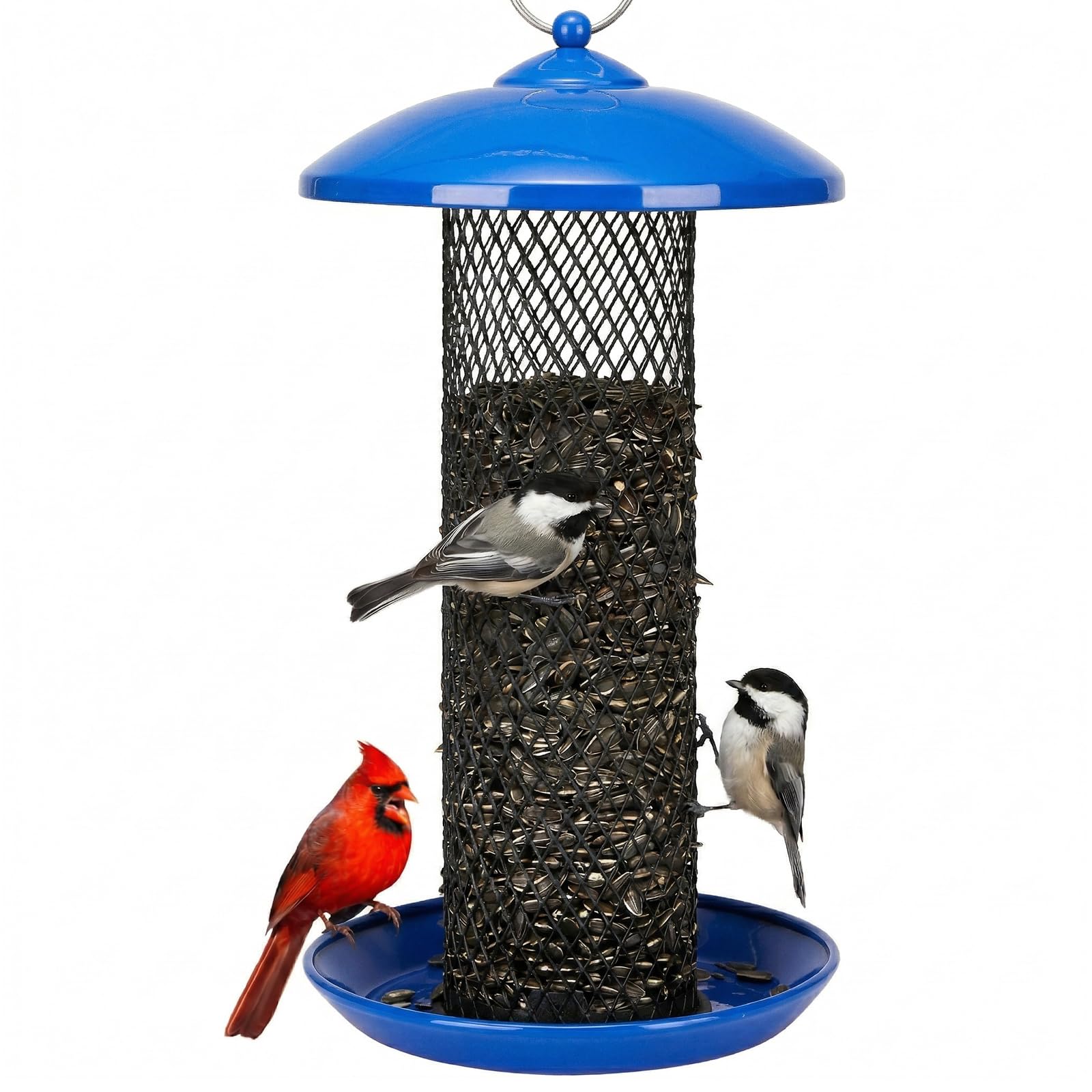
The Kingsyard mesh tube feeder is an all-metal design built for sunflower hearts, suet nuggets, and mealworms—not nyjer or thistle. The powder-coated steel body resists rust and squirrel gnawing, and the 360-degree seed tray at the base provides a flat perching surface that attracts woodpeckers, chickadees, nuthatches, and finches. The 2.5-pound capacity is the largest in this guide, making it ideal for high-traffic yards where the feeder needs refilling only once or twice per week.
Customer reports emphasize the easy disassembly: the top and base both twist off for complete access to the wide-mouth mesh tube. The mesh pattern is designed for clinging birds, and the blue powder coating prevents the rust that plagued earlier all-metal designs. The feeder holds up well against deer bumps and squirrel weight, with owners noting it survives abuse that would crack polycarbonate tubes. The one consistent complaint is that the mesh openings are too small for sunflower seeds in the shell to pass through freely, so this feeder works best with hulled seed or small nuggets.
Because the mesh is not suited for nyjer—the tiny seeds would fall straight through—this feeder is a complementary piece for yards that already have a dedicated finch tube. The large bottom tray collects hulls and dropped seed, keeping the ground below cleaner than a mesh-only feeder would. For birders who want a single durable station for sunflower hearts and mealworms, the Kingsyard is the obvious choice, but it cannot replace a proper thistle feeder for goldfinch-only feeding.
Why we love it
- All-metal construction withstands squirrel, deer, and weather abuse
- Twist-off top and base make full disassembly for cleaning simple
- Large 2.5 lb capacity reduces refill frequency during peak feeding
Good to know
- Mesh is too wide for nyjer—requires sunflower hearts or mealworms
- Small mesh openings can block passage of sunflower seed shells
FAQ
Why do goldfinches ignore my nyjer feeder?
Should I choose a mesh or a tube goldfinch feeder?
Can I use a goldfinch feeder for other types of seed?
How do I keep squirrels off my goldfinch feeder?
How often should I replace my goldfinch feeder?
Final Thoughts: The Verdict
For most gardeners, the best goldfinch feeder winner is the Woodlink NAWLNT because its die-cast aluminum construction and finch-only mesh design deliver years of service without rust or waste. If you want maximum flock capacity and premium materials, grab the Stokes Select 38171. And for budget-conscious buyers who prefer a bright visual attractant with six dedicated perches, nothing beats the Stokes Select 38224.