
Selecting the wrong substrate for a marine aquarium can stall the nitrogen cycle for weeks, trap detritus in sharp grains, or leach unwanted silicates into the water column. Live sand is not just decoration — it functions as the biological engine room of your reef, hosting nitrifying bacteria that convert toxic ammonia into nitrate before your fish ever see the tank.
I’m Mo Mahin — the founder and writer behind Furric. My approach to evaluating live sand focuses on grain size distribution, aragonite purity, bacterial inoculation density, and real-world cycle acceleration data from hundreds of owner reports.
This guide compares seven different substrates side by side, weighing convenience against cost so you can pick the right live sand for saltwater tank without weeks of trial and error.
How To Choose The Best Live Sand For Saltwater Tank
Not all bagged sand behaves the same once submerged. Aragonite-based sand buffers pH naturally, silicate-based sand can fuel nuisance algae, and grain size determines whether your goby can sift or your wrasse can burrow without getting scratched. The three factors below filter out the wrong options quickly.
Aragonite Purity and Buffer Capacity
Aragonite is a calcium carbonate mineral that dissolves slowly in saltwater, helping maintain a stable pH between 8.0 and 8.4. Sand labeled “aragonite reef sand” or “crushed coral” will actively buffer your tank. Inexpensive play sand or pool filter sand lacks this property and will not counteract the natural pH drift that occurs in closed marine systems.
Grain Size and Bed Depth
Fine sand under 1 mm stays suspended too easily in high-flow tanks and can cloud water for days. Coarse sand above 2 mm allows detritus to fall through, where it rots rather than being removed by your clean-up crew. The sweet spot for most reef tanks is 1–2 mm, often called “special grade” or “reef grade.” Shoot for 1 to 1.5 inches of depth — enough for denitrification zones without trapping waste.
Live vs. Dry and the Cycle Jump-Start
True “live sand” is packaged moist and contains millions of nitrifying bacteria that can reduce the initial cycle from weeks to days. Dry sand is cheaper and cleaner but requires seeding from an established tank or bottled bacteria. If you are starting a brand-new system, live sand saves time. If you are replacing substrate in an existing tank, dry sand avoids the risk of importing unwanted organisms.
Quick Comparison
On smaller screens, swipe sideways to see the full table.
| Model | Category | Best For | Key Spec | Amazon |
|---|---|---|---|---|
| Carib Sea Arag-Alive Special Grade Reef Sand | Live Aragonite | Cycle jump-start & reef tanks | 1.0–2.0 mm grain size | Amazon |
| CaribSea Arag-Alive Bimini Pink | Live Aragonite | Reef aesthetics & coral growth | 1.0–2.5 mm grain | Amazon |
| Carib Sea Aragonite Reef Sand | Dry Aragonite | Large tanks & bare-bottom setups | 40 lb bag, 0.5–2.0 mm | Amazon |
| Aqua Natural Sugar White Sand | Dry Silicate | Freshwater & low-budget marine | 0.5–1.0 mm fine grain | Amazon |
| imagitarium White Aquarium Sand | Crushed Coral | Hard water freshwater & budget marine | 0.5–2.0 mm granule | Amazon |
| CLASSIC SAND & PLAY Natural Sand | Pre-washed Dry | Minimal clouding & natural look | 20 lb, 0.3–0.8 mm | Amazon |
| TheFrogHouse Black Sand | Dry Specialty | High-contrast planted tanks | 45 lb, 1.0–2.0 mm | Amazon |
In‑Depth Reviews
1. Carib Sea Arag-Alive Special Grade Reef Sand, 10 lb.

The Arag-Alive line ships moist with millions of live marine bacteria already colonized on the aragonite grains, so you can shorten the initial cycle from three weeks to under seven days in many cases. The special grade grain size — roughly 1 to 2 mm — strikes the balance between staying put under moderate flow and allowing burrowing invertebrates like pistol shrimp to dig without collapsing tunnels.
Multiple owners report that this substrate stabilized their alkalinity and calcium levels within the first two weeks of setup, which reduces the need for frequent dosing adjustments during the break-in period. The wheat-beige color mimics natural reef sand without looking sterile white, and the 10 lb bag covers roughly a 1-inch depth in a 10-gallon tank.
The only real downside is the bag size — 10 lb goes fast if you have a tank larger than 20 gallons, and buying multiple bags adds up. Some users noted slight cloudiness for the first 24 hours, but it clears quickly with mechanical filtration running.
Why we love it
- Live bacteria cuts cycle time dramatically
- Grain size stays put in moderate flow yet allows burrowing
- Buffers pH and stabilizes alkalinity early on
Good to know
- Only 10 lb per bag — larger tanks need multiple bags
- Mild cloudiness for first day or two after adding
2. CaribSea Arag-Alive Bimini Pink Special Grade Reef Sand, 20 lb.
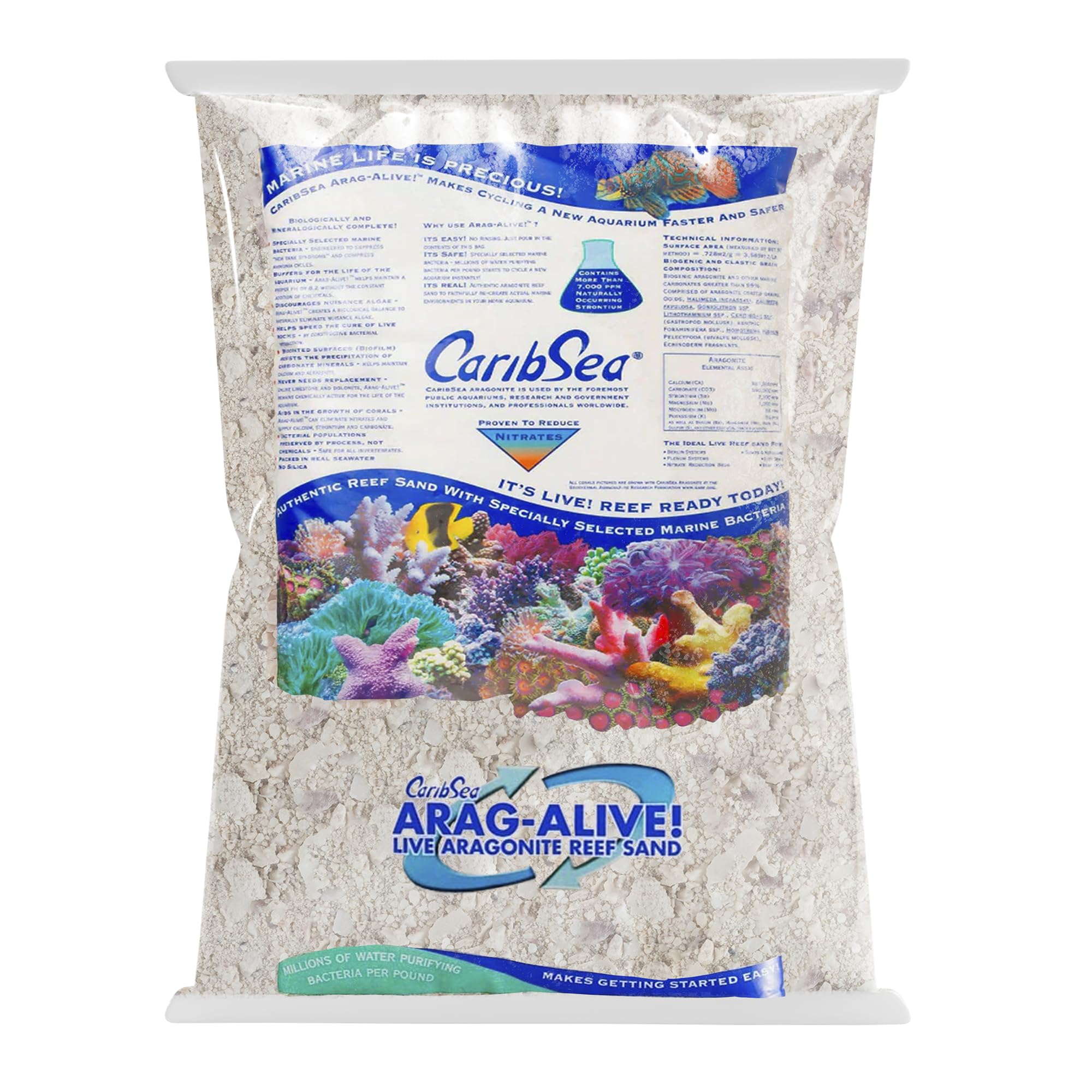
Bimini Pink is the premium aesthetic choice for reef keepers who want a subtle rosy tint under LED lighting without sacrificing biological performance. Like the Special Grade, this sand ships alive with nitrifying bacteria already established, and the aragonite base buffers pH naturally. The grain distribution includes some larger particles up to 2.5 mm, giving the bed more texture and preventing compaction.
Owners frequently mention that this sand does not blow around even in tanks with strong wave makers, which is critical for keeping the bed surface clear for coral placement. One bag provides roughly a 1-inch depth in a 25-gallon tank, and reviewers noted that the included water conditioner helped clear the water within 48 hours. The heavier grains also mean less sand gets sucked into the sump or filter intake during water changes.
The main hesitation is the premium cost per bag compared to standard aragonite sand — if you are building a tank over 50 gallons, the total investment climbs quickly. Also, the pink hue may not appeal to everyone; it looks natural under blue reef lighting but stands out more under white light.
Why we love it
- Stays in place under strong wave pump flow
- Live bacteria accelerates cycle establishment
- Attractive pink tint enhances coral colors
Good to know
- Higher price per pound than dry sand alternatives
- Pink hue may not match every aquascaping plan
3. Carib Sea Aragonite Reef Sand, 40-Pound

This is the dry aragonite version of the Carib Sea product line — same mineral composition, no pre-loaded bacteria, but nearly double the volume for a similar price point. The grain size mixes finer particles (0.5 mm) with coarse pieces up to 2 mm, giving a natural mixed-grade bed that reduces detritus buildup compared to uniform sand. The 40 lb bag covers a 2-inch depth in a 55-gallon tank, making it the most practical option for larger builds.
Reviewers consistently mention that the sand buffered their pH to around 8.2 for African cichlid and marine setups, and while it requires thorough rinsing — some users went through 100 gallons of rinse water — the cloudiness clears within 24 to 48 hours after filling. The bag packaging is tough enough to survive shipping, and the weight per dollar is hard to beat for budget-minded reefers.
The trade-off is that dry sand has no starter bacteria, so you either need to seed it from an established tank or add a bottled bacteria product if you want instant cycle benefits. Some owners also noted that the larger crushed-coral fragments can be uncomfortable for bottom-dwelling fish like stingrays or gobies that sift through the substrate.
Why we love it
- Exceptional value for the volume — covers a 55-gallon tank
- Mixed grain size prevents detritus pockets
- Buffers pH reliably in marine and hard water
Good to know
- Requires extensive rinsing before use
- Dry — no live bacteria; needs seeding for quick cycle
4. Aqua Natural Sugar White Sand, 20lb

Aqua Natural’s Sugar White Sand undergoes triple washing and kiln drying, which means it arrives in the bag with virtually no dust or fines. The 0.5 to 1.0 mm grain size is fine enough to look smooth but coarse enough to avoid blowing around in all but the strongest flow. The color is an off-white that reads as bright white under aquarium lighting without the sterile hospital look.
This is a silicate-based sand, not aragonite, so it does not actively buffer pH or alkalinity — you will need to maintain those parameters through water changes or dosing. That said, the lack of buffering makes it a safer choice for mixed planted marine systems where you want to control alkalinity independently. Owners report needing only two or three rinses before the water runs clear, and many comment that it did not cloud the tank at all after filling.
The biggest limitation for saltwater use is that it lacks the calcium carbonate contribution that reef systems often rely on. If you keep soft corals or fish-only marine tanks, this is fine, but stony coral keepers may prefer a true aragonite sand. Some users also noted that the fine grain can be messy if siphoning aggressively near the bed.
Why we love it
- Exceptionally clean — minimal rinsing needed
- Bright white color looks great under LED lighting
- Fine but dense — does not float or cloud easily
Good to know
- Silicate-based, does not buffer pH or alkalinity
- Not ideal for stony coral reef tanks requiring aragonite
5. imagitarium White Aquarium Sand, 20 lbs

The imagitarium White Sand is essentially a bright white crushed coral/limestone substrate that buffers water and adds calcium hardness. The granule size varies widely — some particles float initially while others sink immediately — giving the bed a textured look rather than uniform sand. It is made from non-toxic materials and is safe for both freshwater and saltwater species.
Owners report that this sand works beautifully in axolotl tanks, African cichlid setups, and marine systems where a high pH is desired. The pearly white color mimics tropical river bottoms and contrasts well with dark driftwood or live plants. Some users caution that the floating dust and clumps settle within a week, and that a deep bed over 0.4 inch can cap underlying substrate if not mixed properly.
The main drawback for saltwater use is that the material is quite light compared to aragonite — a strong pump can push it into bare patches if the flow is directed at the bed. It also requires thorough rinsing to remove dust, and some reviewers noted small debris that needed skimming off the surface after filling.
Why we love it
- Bright white color enhances tank appearance
- Buffers water hardness and pH for hard water species
- Non-toxic and safe for axolotls and sensitive fish
Good to know
- Light particles can float and shift in high flow
- Requires multiple rinses to remove dust
6. CLASSIC SAND & PLAY Natural Aquarium Sand, 20 lb
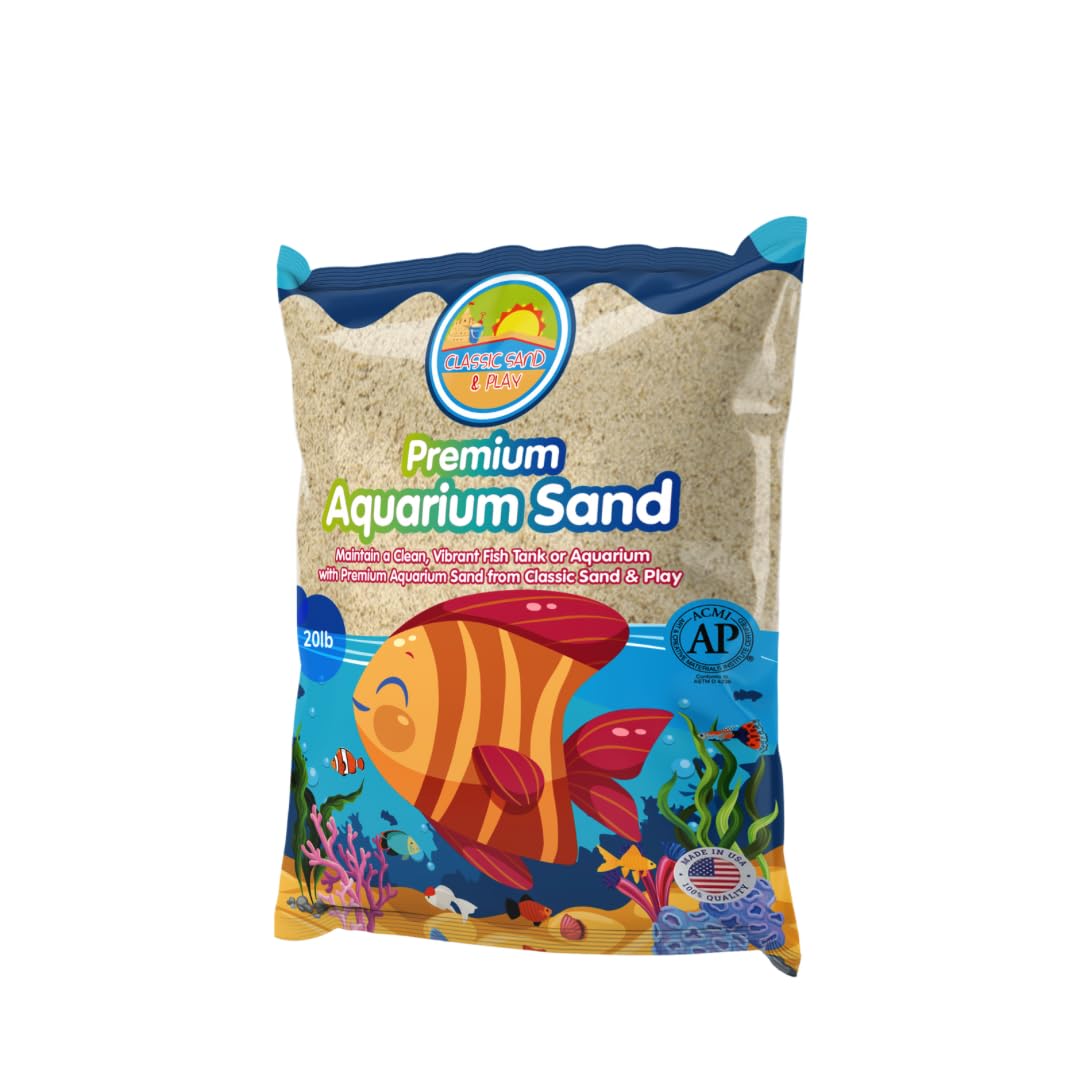
Classic Sand & Play offers a pre-washed, kiln-dried natural sand that prioritizes clarity and ease of setup. The grain size is very fine, around 0.3 to 0.8 mm, which gives the bed a smooth, silky appearance. Reviewers consistently note that this sand produces almost no cloudiness — many added it straight from the bag and saw clear water within hours.
The natural beige color avoids the stark white or pitch black extremes, making it a good middle-ground choice for freshwater planted tanks or marine setups where you want a soft background. Owners appreciate that it does not contain dyes or coatings, and the 20 lb bag provides enough for a shallow bed in a 40-gallon tank. It also works well in vivariums and terrariums due to the fine, dust-free texture.
This sand is not aragonite and does not buffer pH, so it is not suitable as the sole substrate in a reef tank where calcium maintenance is critical. The fine grain can also compact over time, reducing water flow through the bed if you do not have sand-sifting inhabitants.
Why we love it
- Pre-washed — minimal clouding, ready to use
- Natural color blends well with plants and hardscape
- Works for both freshwater and soft coral marine tanks
Good to know
- No aragonite — does not buffer pH or alkalinity
- Fine grain can compact over time without stirrers
7. TheFrogHouse Black Aquarium Sand, 45lbs

TheFrogHouse Black Sand offers a striking dark substrate that makes brightly colored fish and coral pop visually. The grain size sits between 1 and 2 mm, providing good weight for sand-sifting species like loaches, corydoras, and goldfish, while remaining easy to clean with a standard gravel vacuum. The 45 lb bag is a bulk option that covers a 2-inch depth in a 90-gallon tank.
Reviewers note that the sand requires heavy rinsing — best done outside with a hose — to remove the initial dust and any loose dye. After a thorough rinse, the sand settles into a deep black color that maintains its appearance over many months. The sand is heavy enough to stay in place during water changes and does not get sucked into filters easily.
The darker color means less light reflection, which can be a downside if you want a bright, open look. Some users also reported small brown flecks within the black sand, giving a more natural speckled appearance rather than a pure monochrome black. It is not aragonite, so it will not buffer pH, making it better suited for planted freshwater tanks rather than coral reef systems.
Why we love it
- Deep black color creates dramatic contrast
- Heavy grain stays put and vacuums cleanly
- Bulk bag covers large tanks affordably
Good to know
- Needs heavy rinsing to remove dust and debris
- Not aragonite — no pH buffering for reef tanks
FAQ
Can I use play sand or pool filter sand in a saltwater tank?
How much live sand do I need for my tank size?
Will live sand from one brand seed a new tank as fast as advertised?
Can I mix different grain sizes or brands in the same tank?
How do I avoid sand storms when filling the tank?
Final Thoughts: The Verdict
For most gardeners, the live sand for saltwater tank winner is the Carib Sea Arag-Alive Special Grade Reef Sand because it combines live bacteria for fast cycling with an ideal grain size for flow and burrowing. If you want a stunning pink-tinted sand that stays put under high flow, grab the CaribSea Arag-Alive Bimini Pink. And for large tanks on a budget where you are willing to seed the sand yourself, nothing beats the Carib Sea Aragonite Reef Sand 40 lb.