
Managing feline diabetes demands precise blood glucose readings you can trust without forcing your cat through stressful vet visits every time. The wrong meter delivers inconsistent numbers, wastes expensive test strips, and leaves you guessing about insulin doses. Your cat deserves a device calibrated specifically for their unique physiology.
I’m Mo Mahin — the founder and writer behind Furric. I’ve spent months comparing veterinary literature on species-specific glucose metabolism, analyzing test strip enzyme chemistry, and cross-referencing thousands of owner-reported readings against lab reference ranges to identify which meters truly deliver consistent results.
Whether your cat was recently diagnosed or you’re refining an existing management routine, the right glucose meter for cats makes the difference between guessing and knowing your pet’s daily curve.
How To Choose The Best Glucose Meter For Cats
Feline diabetes management hinges on consistent, accurate blood glucose data. A meter designed for humans reads your cat’s blood differently because feline red blood cells have a higher glucose turnover rate and different plasma-to-cell glucose distribution. Choosing wrong means chasing phantom highs or missing dangerous lows.
Species-Specific Calibration Chips
The single most important feature separating a useful feline meter from a guess machine is the calibration chip. Cat blood contains different levels of interfering substances like uric acid and bilirubin compared to dog or human blood. Meters with dedicated cat code chips apply the correct algorithm to your sample. Without it, expect readings that drift 20-40 mg/dL off the true value — dangerous territory when dosing insulin.
Blood Sample Volume Requirement
Cat ear veins are tiny. A meter asking for 1.0 µL or more forces you to squeeze the ear repeatedly, creating bruising and hematomas that make future draws harder. Look for meters requiring 0.6 µL or less. The difference between 0.3 µL and 0.7 µL determines whether you get a clean reading on the first stick or waste three strips wrestling a stressed cat.
Test Strip Cost and Availability
The meter itself is a one-time purchase. The financial trap lives in the test strips. A cat needing twice-daily glucose curves burns through 4-8 strips per curve session. At -1.50 per strip, that adds up to -540 per year just in consumables. A budget-friendly meter with cheap, widely available strips saves real money without sacrificing accuracy.
Reading Range and Display Speed
Feline blood glucose can spike above 500 mg/dL during stress hyperglycemia and drop below 40 mg/dL during insulin overdoses. A meter with an extended range of 20-750 mg/dL catches both extremes without displaying error codes. Reading speed matters too — a 5-second result lets you finish before the cat shakes the ear, while 10-second meters increase the chance of movement artifacts.
Quick Comparison
On smaller screens, swipe sideways to see the full table.
| Model | Category | Best For | Key Spec | Amazon |
|---|---|---|---|---|
| AlphaTrak 3 | Premium | Veterinarian-recommended gold standard | 0.3 µL sample, 20-750 mg/dL range | Amazon |
| Pet Control HQ Monitor + 50 Strips | Premium | Complete starter kit with control solution | 0.6 µL sample, dual code chips | Amazon |
| PawDiag 100 Strips + 100 Lancets | Mid-Range | High-volume testing without refills | 0.8 µL sample, 5-second results | Amazon |
| Pet Control HQ 50 Strips | Mid-Range | Lab accuracy with minimal blood | 0.6 µL sample, no-flop strip design | Amazon |
| PetTest 50 Individually Sealed Strips | Mid-Range | Strip-only refill for existing meter owners | No coding required, foil wrapped | Amazon |
| VQ PET H 100 Strips Kit | Budget-Friendly | High strip count on a tight budget | 100 strips included, lithium battery | Amazon |
| Easy Touch Pet Starter Kit | Budget-Friendly | Lowest entry cost with full accessories | 0.7 µL sample, dual code chip | Amazon |
In‑Depth Reviews
1. AlphaTrak 3, 8-Piece Pet Blood Glucose Monitoring Kit
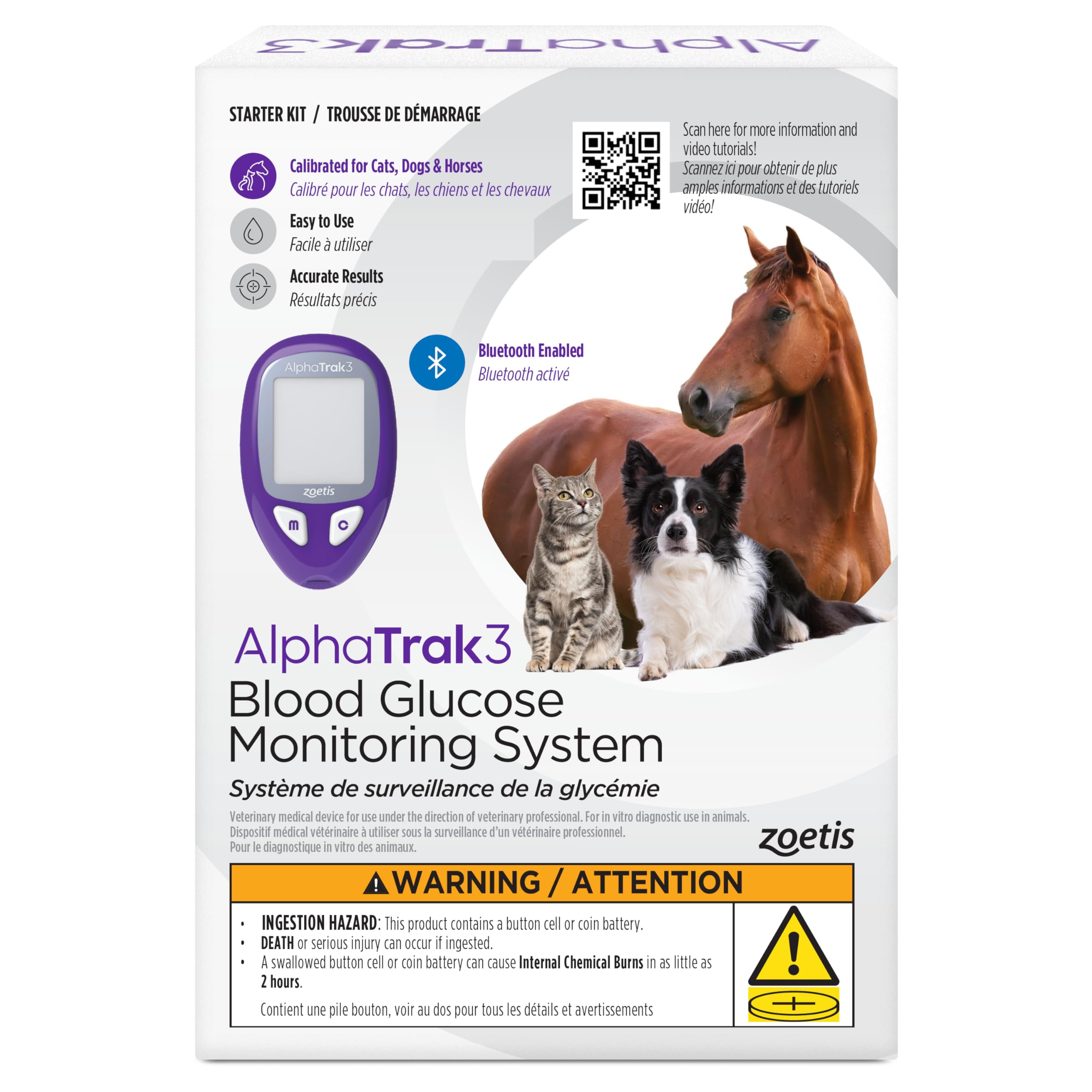
The AlphaTrak 3 commands the top spot for a reason — it’s the #1 veterinarian-recommended pet glucose monitor, and that reputation rests on a feline-specific calibration algorithm backed by Zoetis veterinary research. The 0.3 µL blood sample requirement is the lowest of any meter in this category, making ear-stick testing dramatically easier on cats with small veins. The extended 20-750 mg/dL reading range captures both stress-induced hyperglycemia spikes and dangerous hypoglycemic dips without displaying confusing error codes.
This kit includes the meter, 25 test strips, lancing device with 30 lancets, control solution, batteries, carrying case, and a diabetes diary. The companion AlphaTrak Mobile App lets you graph glucose curves and share them directly with your veterinarian — a feature that turns raw numbers into actionable insulin adjustment data. The two-year manufacturer warranty provides peace of mind that budget-tier meters simply don’t offer.
The trade-offs are real: test strips cost roughly each, making this the most expensive consumable in the category. Some users report initial error codes requiring careful strip insertion technique. The control solution is essential for calibration verification, and Amazon storage conditions have been questioned by buyers who received defective fluid.
Why we love it
- Lowest blood sample requirement (0.3 µL) reduces ear trauma
- Extended 20-750 mg/dL range catches all feline glucose extremes
- Veterinarian-recommended with mobile app for curve tracking
Good to know
- Test strips are the most expensive per unit in this category
- Some buyers report defective control solution from third-party storage
- Initial error codes may require practice to master technique
2. Pet Control HQ Pet Blood Sugar Glucose Monitoring Kit (50 Strips)

The Pet Control HQ complete starter kit delivers everything for about two-thirds the price of the AlphaTrak without sacrificing the critical dual-code-chip technology. One chip calibrates for feline glucose metabolism while the other handles canine values, so multi-pet households get accurate readings across species. The 0.6 µL blood sample sits in the sweet spot — small enough for cat ear draws but forgiving enough for beginners still developing their lancing technique.
Inside the box you get the glucometer, 50 test strips, 50 lancets, lancing device, control solution, carrying case, a logbook, and both quick-reference and full user manuals. The easy-to-read LCD display shows results in 10 seconds, and the audible tone confirms when the strip has drawn enough blood — reducing the frustration of silent error messages. The control solution lets you verify accuracy before relying on readings for insulin dosing decisions.
Several users report that the 10-second read time feels slow when managing a squirmy cat. A few reviewers noted that consistency improved dramatically once they switched to a vacuum-assisted lancing device. Some readings may show a consistent offset compared to AlphaTrak, though curve tracking remains reliable once you establish your baseline.
Why we love it
- Complete starter kit with control solution for calibration verification
- Dual-code-chip technology species-specific for cats and dogs
- Audible tone confirms sufficient blood draw to reduce strip waste
Good to know
- 10-second read time feels long on anxious cats
- Some users require a vacuum lancet for consistent blood draws
- Readings may show a small offset vs. AlphaTrak reference
3. PawDiag Pet Blood Glucose Monitor Kit (100 Strips + 100 Lancets)
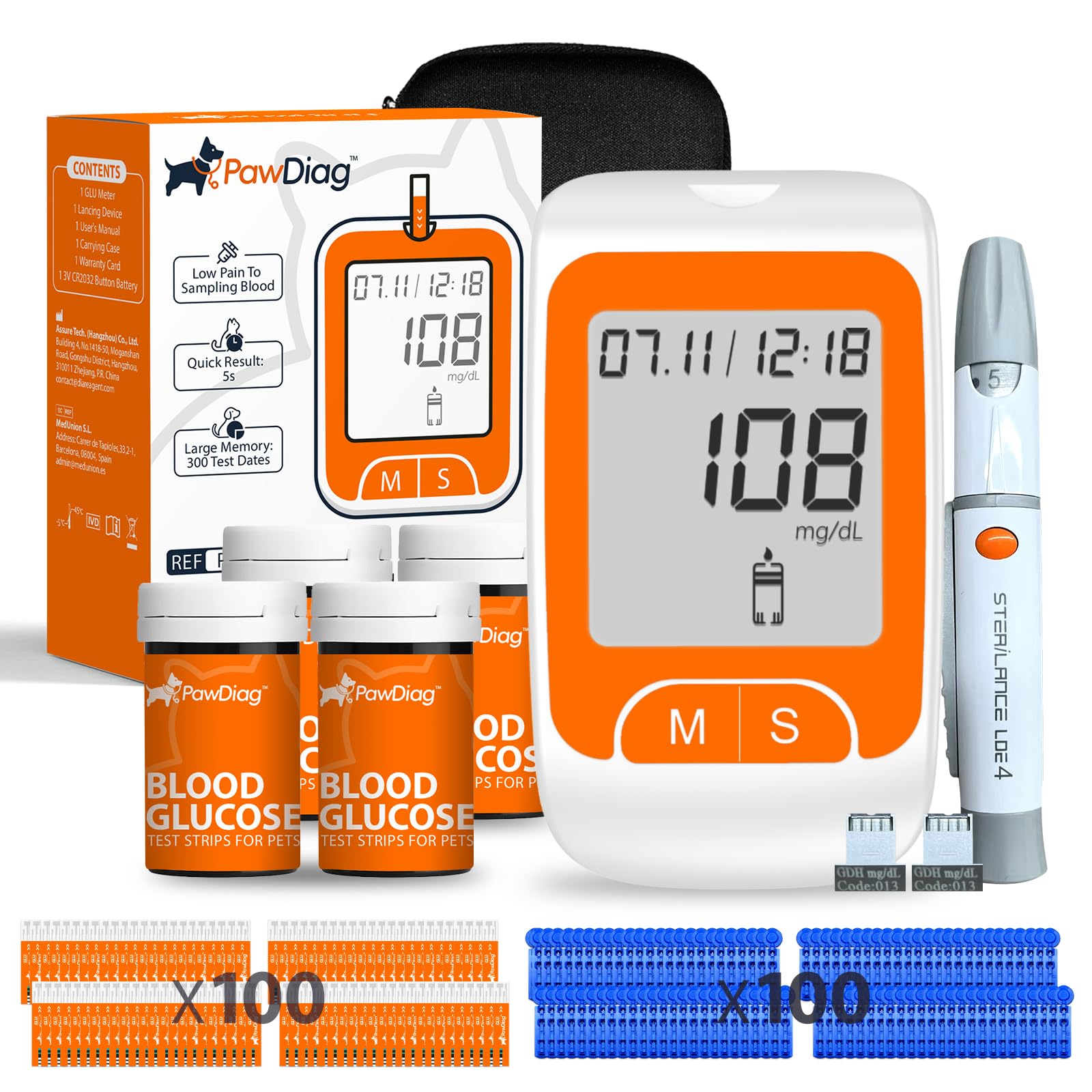
The PawDiag kit solves the problem that frustrates every feline diabetes owner — running out of test strips mid-week and paying express shipping for refills. The 5-second result speed is the fastest in this category, giving you a reading before most cats even register the prick.
The 0.8 µL blood sample is slightly larger than the AlphaTrak’s 0.3 µL, but still manageable for ear draws when using the included adjustable lancing device with five depth settings. Most users find level 3 works best for feline ear margins. The compact zippered carrying case keeps everything organized for travel to the vet or across the house. The one-button operation and clear step-by-step instructions make this accessible even for first-time cat diabetes managers.
The primary downside is the included lancing pen, which some users report lacks the spring force to draw blood reliably on thicker cat ear skin. The instruction manual could be clearer about proper strip-tip-to-blood-contact technique — dropping blood on top of the strip rather than touching the tip to the blood source causes failed readings. No control solution is included for accuracy verification.
Why we love it
- 100 strips + 100 lancets support extended glucose curve sessions
- Fastest read speed at 5 seconds reduces cat movement frustration
- One-button operation with clear instructions for beginners
Good to know
- Lancing pen may lack sufficient force on thick ear skin
- No control solution included for accuracy verification
- Requires tip-to-blood contact technique, not drop-on-top method
4. Pet Control HQ 50 Test Strips for Glucose Monitor

These Pet Control HQ test strips are designed specifically for the Pet Control HQ glucose monitor that uses dual code-chip technology, giving you household-specific calibration for your cat. The 0.6 µL sample requirement places this firmly in the low-volume category, reducing the squeezing trauma on ear tips that often discourages owners from testing as frequently as their vet recommends.
The sturdy single-handed strip design eliminates the bending and flopping common with cheaper test strips — a small detail that matters enormously when you’re holding a cat with one hand and operating the meter with the other. The 2-code-chip system uses separate calibration for feline and canine blood chemistry, addressing the species-specific glucose metabolism differences that make universal meters unreliable. Each strip is individually protected in a temperature-controlled vial to prevent enzyme degradation.
This package includes 50 test strips and 25 lancets, making it a mid-point refill between the starter kit and the bundled supply. Users frequently report that the strips read within a few points of veterinary lab results, giving confidence for at-home insulin adjustments. The main limitation is compatibility — these strips only work with the Pet Control HQ monitor, so switching brands means replacing both meter and strips.
Why we love it
- Low 0.6 µL sample minimizes ear tissue trauma during draws
- Sturdy one-handed strip design prevents flopping during use
- Species-specific dual-chip calibration for accurate feline readings
Good to know
- Only compatible with Pet Control HQ glucose monitor
- Bundled lancet count (25) is lower than the strip count (50)
- Temperature-controlled vial storage required to maintain enzyme integrity
5. PetTest Blood Glucose Test Strips, 50 Pieces

The PetTest strips earned their reputation through word-of-mouth within feline diabetes support communities, where experienced owners consistently recommend them for reliability and ease of use. The no-coding-required design eliminates one of the most common error sources — forgetting to calibrate the meter to the strip batch. Each strip is individually foil-wrapped, protecting the glucose oxidase enzyme from humidity and temperature fluctuations that degrade accuracy in bulk vial storage.
These strips are calibrated specifically for diabetic dogs and cats, though they work best with the Advocate PetTest glucometer. The small sample size requirement competes with the best in this category, making them suitable for ear draws on cats with fragile veins. Owners report remarkably low failure rates — typically one error per 50-strip vial, often attributable to user technique rather than strip defects. The individually wrapped design also means you can carry loose strips in a bag without risking contamination.
The catch is compatibility: these strips only work with PetTest meters, not with human glucometers or other pet brands. Some users find the foil wrapping fiddly under time pressure. The 50-count quantity requires more frequent reordering than the 100-count alternatives, though the per-strip cost remains competitive with mid-range options.
Why we love it
- No coding required eliminates calibration errors between strip batches
- Individual foil wrapping protects enzyme integrity for accurate readings
- Low failure rate with community-vetted reliability for feline curves
Good to know
- Only compatible with PetTest brand glucometers
- Foil wrapping can be fiddly when managing an anxious cat
- 50-count supply requires more frequent reordering than 100-count kits
6. VQ PET H Blood Glucose Monitoring System Starter Kit

The VQ PET H kit delivers 100 test strips in the box — more than double the count of most starter kits at a price that undercuts many 50-strip competitors. For owners managing a recently diagnosed diabetic cat, this supply cushion eliminates the pressure of immediately tracking down refills. The lithium battery composition provides consistent power delivery across temperature fluctuations that might affect alkaline batteries in unheated rooms during nighttime testing.
Accuracy reviews are mixed but generally positive, with several owners reporting readings that track closely with veterinary lab results when proper technique is used. The kit includes the glucose meter and 100 test strips, making it a straightforward purchase without extra accessories you may not need. Replacement strips are reasonably priced compared to premium brands, reducing the long-term financial burden of daily monitoring.
The most common complaint centers on the blood sample size requirement, which several users describe as larger than expected. The strip may require more blood than the 0.6 µL units, leading to failed readings and increased waste. A few reviewers report that switching from this system to another brand with smaller sample requirements dramatically reduced their cat’s stress and improved testing consistency. The lack of a dedicated feline calibration chip means readings may need validation against a vet-grade reference.
Why we love it
- 100 strips included, far more than typical starter kits at this price
- Lithium battery maintains consistent power in varied temperatures
- Low entry price reduces financial barrier to starting home monitoring
Good to know
- Requires a larger blood sample than premium meters
- No dedicated feline calibration chip for species-specific accuracy
- Some users report higher strip waste from insufficient blood draws
7. Easy Touch Pet Glucose Monitoring System Starter Kit
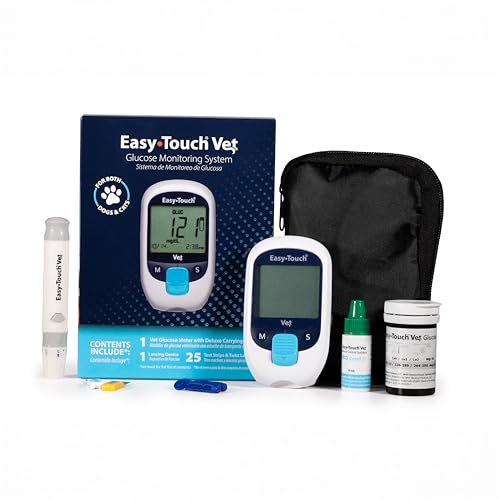
The Easy Touch starter kit packs an impressive accessory bundle — meter, lancing device, 25 test strips, 25 lancets, control solution, carry case, and a CR2032 battery — at the lowest entry point in this category. The dual-code-chip system includes separate calibration for cats and dogs, a feature typically reserved for mid-range and premium kits. The 0.7 µL sample requirement lands close to the best-in-class for sample volume.
Positive user reviews highlight the cost efficiency compared to AlphaTrak 3, with easier setup and readings that match veterinary results when technique is correct. The included control solution lets you validate accuracy before committing to insulin adjustments. The deluxe carrying case stores everything neatly, making this a genuinely all-in-one purchase for owners just starting their feline diabetes journey.
The durability issue is the elephant in the room. Multiple verified purchasers report the meter stopping entirely after a handful of uses, with both Amazon and the manufacturer refusing returns or refunds. Accuracy complaints from other owners describe readings consistently 25 points above the AlphaTrak reference, and the test strip slot width may cause insertion errors. The budget pricing seems directly correlated with quality control risks that could compromise your cat’s diabetes management.
Why we love it
- Most complete starter kit accessories at the lowest entry price
- Dual-code-chip technology for feline-specific calibration
- Control solution included for accuracy verification before use
Good to know
- Multiple reports of meters failing after 3-5 uses with no refund support
- Readings reported 25 points higher than AlphaTrak reference values
- Wide strip slot may contribute to insertion and error rate issues
FAQ
Can I use a human glucose meter on my cat?
Where is the best place to draw blood on a cat?
How often should I test my diabetic cat’s blood glucose?
What does a feline blood glucose reading of 300 mg/dL mean?
Why does my cat’s glucose meter show an error message?
Final Thoughts: The Verdict
For most cat owners, the glucose meter for cats winner is the AlphaTrak 3 because its veterinary-developed calibration algorithm, lowest blood sample requirement, and extended 20-750 mg/dL range provide the most reliable data for safe insulin dosing. If you want a complete starter kit with control solution and dual-code-chip accuracy at a lower consumable cost, grab the Pet Control HQ kit. And for high-volume testing without worrying about strip supply, nothing beats the PawDiag 100-strip kit.