
Choosing a reef light means wrestling with PAR values, spectral spread, and the fine line between coral growth and an algae bloom. A fixture that dazzles your eye with blue might starve your SPS polyps of the 440nm punch they actually need.
I’m Mo Mahin — the founder and writer behind Furric. I’ve spent years tracking the PAR charts, driver-board revisions, and owner-reported longevity data across the reef lighting market to separate fixtures that deliver measurable performance from those that just look pretty in the box.
For the sake of clarity, this guide focuses solely on the technical and practical considerations when selecting reef tank lights, ensuring your next upgrade matches both your coral’s metabolic demands and your maintenance tolerance.
How To Choose The Best Reef Tank Lights
Reef tank lights are not decorative lamps — they are the primary energy source for photosynthetic corals. Selecting the wrong spectrum or insufficient PAR leads to polyp retraction, bleaching, or nuisance algae dominance. Focus on four core parameters.
PAR Output & Coverage Footprint
Photosynthetically Active Radiation (PAR) measured in µmol/m²/s dictates coral health. Soft corals need 50–100 PAR, LPS thrive at 100–200, and SPS demand 250–400+. Check the fixture’s PAR map at your tank’s depth, not just the peak number at center. A wide 90° or 120° lens helps distribute light evenly and avoids hotspots that torch one colony while starving its neighbor.
Spectral Channels & Chromatic Control
Modern reef lights use multiple color channels — cool white, royal blue, 440nm violet, 420nm UV, and occasionally red/green for cosmetic fill. The violet/UV range drives coral fluorescence and pigmentation, while the blue channel powers photosynthesis. Avoid units that dump all power into a single blue channel without independent dimming; you need fine-grained control to tune a specific Kelvin appearance without sacrificing growth.
Control Scheme & Reliability
Three control tiers exist: onboard push-button/timer, IR remote, and full app or external controller. Onboard timers retain settings after power loss — critical for daily cycle stability. App control offers convenience but can fail if WiFi drops or the cloud service shuts down. External controllers (like Neptune Apex) provide hardwired redundancy. Decide which failure mode you can tolerate before buying.
Thermal Management & Form Factor
A reef light running 8–10 hours daily generates substantial heat. Passive cooling (fin-only) works only for sub-60W fixtures. Active cooling (fans) must balance airflow against noise — target <40 dB for living-room placement. Mounting style matters equally: rimmed-tank brackets need vertical clearance, hanging kits work for open tops, and extruded aluminum stands must resist saltwater corrosion over years.
Quick Comparison
On smaller screens, swipe sideways to see the full table.
| Model | Category | Best For | Key Spec | Amazon |
|---|---|---|---|---|
| AquaIllumination AI Prime 16 HD | Premium Compact | SPS/LPS nano to mid-size tanks | 55W, 16 HD LEDs, app control | Amazon |
| SMATFARM G6 140W | Mid-Range | Mixed reef with SPS demand | 140W, 6-channel, OLED touch | Amazon |
| NICREW NavaReef 135 | Mid-Range | Blue-focused LPS growth | 135W, 440-480nm peak, 90° lens | Amazon |
| SMATFARM G5 95W | Entry-Level | Soft corals & beginner setups | 95W, remote/touch, master-slave | Amazon |
| Current USA Orbit Marine IC | Entry-Level | LPS/soft coral display | Dual actinic, weather effects | Amazon |
| NICREW HyperReef 100 Gen 2 | Premium | SPS tanks demanding high PAR | 100W, 120° lens, USB-C ports | Amazon |
| PopBloom RL90 4-Light Kit | Premium Multi-Unit | Large 72–96″ display systems | 400W total, APP cloud control | Amazon |
In‑Depth Reviews
1. AquaIllumination AI Prime 16 HD

The AI Prime 16 HD punches above its 55W rating thanks to HD dynamic power allocation — unused white-channel energy is redistributed to the blue/violet spectrum on demand, effectively boosting PAR where corals actually use it. Owners report running SPS and LPS at 40% intensity on the BRS schedule, with mushroom polyps thriving at 70%, indicating headroom for deeper tanks up to 24 inches.
App control via myAI or Mobius provides granular 24-hour programming with a dedicated moonlight channel that mimics lunar phase intensity. The fixture integrates with Neptune Apex through an MXM module, making it a viable pick for automated dosing and pH-reactive dimming. The 4.8-inch square footprint and aluminum housing run warm but passive — the lack of a fan means zero noise, a real advantage for bedroom or living-room reefs.
The ecosystem lock-in is worth noting: all AI fixtures share the same app, so expanding to a larger system later requires sticking with the same brand for multi-unit groups. The tabletop mount is fine for display-tank placement, but a hanging kit is strongly recommended for rimmed aquariums. One unit lasted over two years in reported owner feedback without driver failure.
Why we love it
- HD power reallocation delivers exceptional per-watt PAR for SPS/LPS
- Silent fanless operation with durable aluminum build
- Full Neptune Apex integration for advanced automation
Good to know
- Limited USB/expansion ports compared to some competitors
- Requires optional mount arm or hanging kit for many tank types
2. SMATFARM G6 140W Reef Light

SMATFARM’s G6 pushes 140W through 52 individual 5W LEDs separated into six independent channels — white, blue, violet, ultraviolet, green, and red — giving you spectral sculpting that most fixtures in this tier reserve for double the cost. The violet and UV channels are the headline; they drive coral fluorescence hard enough that owners with mixed reefs 24 inches deep report strong polyp extension and pigmentation after several weeks.
Control comes via an onboard OLED screen with tactile push buttons and a bundled IR remote, bypassing the WiFi-dropout headaches that plague some app-only units. Master-slave 2.4GHz wireless sync links multiple G6 units across larger tanks without cabling. The internal fan is rated below 40 dB — audible only when the room is silent. The heatsink design increases dissipation area by roughly 300% versus the G5, keeping the housing manageable to the touch after an 8-hour photoperiod.
A noted quirk: the 1% minimum dim step is still bright enough to spook some fish, and the internal clock drifts about 10 minutes over four months, requiring a periodic manual reset. The preprogrammed SPS/LPS/MIX modes are a decent starting point, but you will want to dial in custom ramp times. SMATFARM offers a training group for new users, which is helpful given the six-channel learning curve.
Why we love it
- Six independent channels with 1% dimming precision for spectral tuning
- OLED touch screen plus IR remote — no smartphone dependency
- Master-slave wireless sync for multi-unit deployments
Good to know
- Internal RTC drifts slightly over months
- Minimum 1% brightness may still be harsh for very shy fish
3. NICREW NavaReef 135
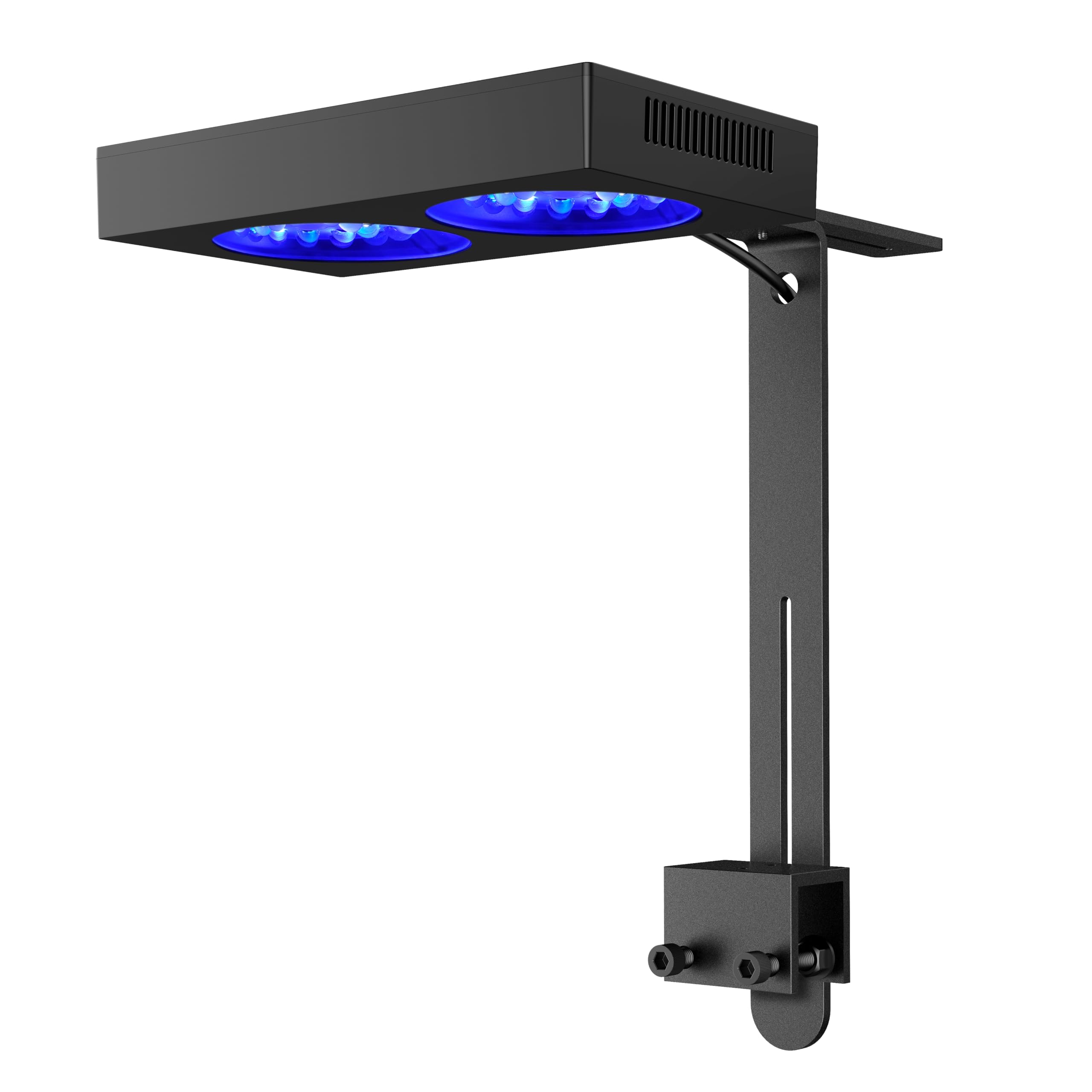
The NavaReef 135 concentrates over 80% of its 135W output into the 440–480nm blue and violet sweet spot, the precise range where chlorophyll a and photosynthetic accessory pigments in Symbiodinium absorb most efficiently. This narrow-band strategy reduces wasted energy that would otherwise fuel nuisance algae, while the 90° optical lens concentrates PAR into a column that penetrates deeper tanks with less scatter than wider-beam alternatives.
Initial user reports note that this fixture is substantially brighter than the HyperReef 100 Gen 1 — some owner-run units at 100% intensity caused early algae outbreaks until blue ratios were dialed back. The built-in preset buttons enable quick switching between soft, LPS, and SPS modes without a phone, but the optional external controller (sold separately) is needed for full 24-hour programmable ramping. Without it, you are limited to onboard timer-only cycles.
The cooling system uses a removable dust-resistant mesh over the fan intake — a thoughtful detail for reef tanks where salt creep and airborne particles accumulate. The fan runs near-silently at all but the highest output levels. The included rimmed/rimless tank mount is functional but protrudes farther back than some owners prefer; a hanging kit provides a cleaner aesthetic for open-top installations.
Why we love it
- Narrow 440-480nm spectral focus maximizes coral photosynthesis per watt
- 90° beam angle provides strong depth penetration for taller tanks
- Removable dust mesh on fan simplifies long-term maintenance
Good to know
- Fully programmable 24-hour schedule requires separate controller purchase
- Mounting arm extends behind tank further than some rimmed setups allow
4. SMATFARM G5 95W Reef Light

The G5 is SMATFARM’s entry-level gateway, packing 24 pieces of 5W SMD LEDs into a 95W package that reliably grows soft corals and lower-light LPS. Experienced reefers running 18-year-old setups have reported measurable PAR at the substrate of a 20-inch-deep tank, with SPS in the upper third maintaining color. The included IR remote supports sunrise/sunset ramping and a moonlight simulation channel — surprising depth of control at this level.
The mounting bracket is full aluminum with oxidation resistance, but the rimmed-tank attachment method received criticism from multiple buyers. The stock plastic mounting base struggles with glass thickness over 0.5 inches, often requiring DIY shims with washers or tape to stabilize. The fan noise is rated below 44.7 dB — slightly more audible than the G6 but still reasonable for a living space. A remote battery is included, but the instructions are minimal enough that YouTube guides become almost mandatory for first-time programming.
After two years of continuous use, owner reviews note that the screen may eventually degrade from saltwater exposure. SMATFARM’s customer service replaced affected units under warranty for several users, suggesting consistent post-sale support. The master-slave group control is present but uses a separate protocol from the G6, so mixing generations in a multi-light array requires keeping all units on the same model line.
Why we love it
- Proven 2+ year reliability on soft coral and LPS tanks
- Full sunrise/sunset/moonlight cycles via included remote
- SMATFARM warranty support widely praised in owner feedback
Good to know
- Rimmed tank bracket needs DIY reinforcement for thicker glass
- Programming instructions are sparse — YouTube recommended
5. Current USA Orbit Marine IC

The Orbit Marine IC focuses on visual spectacle more than raw PAR density, with built-in weather modes that simulate rolling clouds, thunderstorms, and lightning strikes over your tank. The dual actinic 445nm/460nm blue combined with 6700K and 10000K daylight channels produces color rendition that makes corals pop under 90° spherical lenses. For LPS and soft coral display tanks, this is a legitimate aesthetic tool.
The 24-hour biorhythmic cycle — gradual sunrise, full daylight, sunset, and lunar moonlight — is easy to program via the onboard IR remote. Integration with Current USA’s eFlux wavemakers and pumps via a separate hub adds wave synchronization to the weather effects, creating motion that simulates surge. However, the weather features are gimmicky for many keepers; the lightning flicker feels mechanical, and cloud-cover dimming is more of a novelty than a utility.
Build quality concerns surfaced in customer feedback: the screw-type connector between the light bar and controller cable is prone to looseness, and some units arrived with warped housings from shipping. Current USA’s customer service response times varied widely — some received replacements promptly, others reported weeks of silence. The extendable brackets fit 18–24 inch wide tanks cleanly, but timers do not hold without the controller cable staying connected.
Why we love it
- Unique weather simulation and cloud-cover effects for display tanks
- Integrates with Current USA wave pumps for synchronized surge motion
- Easy sunrise/sunset programming with default 24-hour cycle
Good to know
- Connector between light and controller has weak retention reported
- Customer service response is inconsistent based on owner reports
6. NICREW HyperReef 100 Gen 2

The Gen 2 HyperReef addresses the original’s primary weakness — fan noise — with a redesigned heatsink and a new fan assembly, though early batch units still shipped with audible whine that NICREW replaced free of charge with quieter driver boards. The 120° wide-angle optical system spreads PAR evenly across a 24×24 inch footprint, eliminating the hotspot that made the Gen 1 tricky to position over mixed reefs. Verified PAR meter readings showed 100+ µmol/m²/s at the sand bed and 250+ at the top rock zone at only 30% output.
Two USB-C ports connect to an external controller (sold separately) that unlocks full 5-channel programmability. Without the controller, the unit runs only at the last-saved setting and reverts if power is interrupted — a critical limitation that pushes the effective cost higher. The enhanced violet and blue spectrum produces strong coral pop, and owners running SPS-dominant systems report good encrusting growth at 70% channel intensity.
Build quality is noticeably higher than the HyperReef Gen 1 — the aluminum housing and ABS end caps feel solid, and the mounting arm system is widely praised as the best in its segment for rimmed, rimless, and euro-braced tanks. A surviving unit weathered a lightning strike that fried other household electronics, speaking to robust surge protection. The controller must stay plugged in at all times or the unit resets to factory default.
Why we love it
- 120° lens delivers even PAR distribution across 24×24 inch footprint
- Strong violet/blue channels for SPS pigmentation and color pop
- Best-in-class mounting arm accommodates all tank rim styles
Good to know
- External controller required for full programmability and power-loss recovery
- Early batches had noisy fans — verify serial or order from recent stock
7. PopBloom RL90 WiFi 4-Light Kit
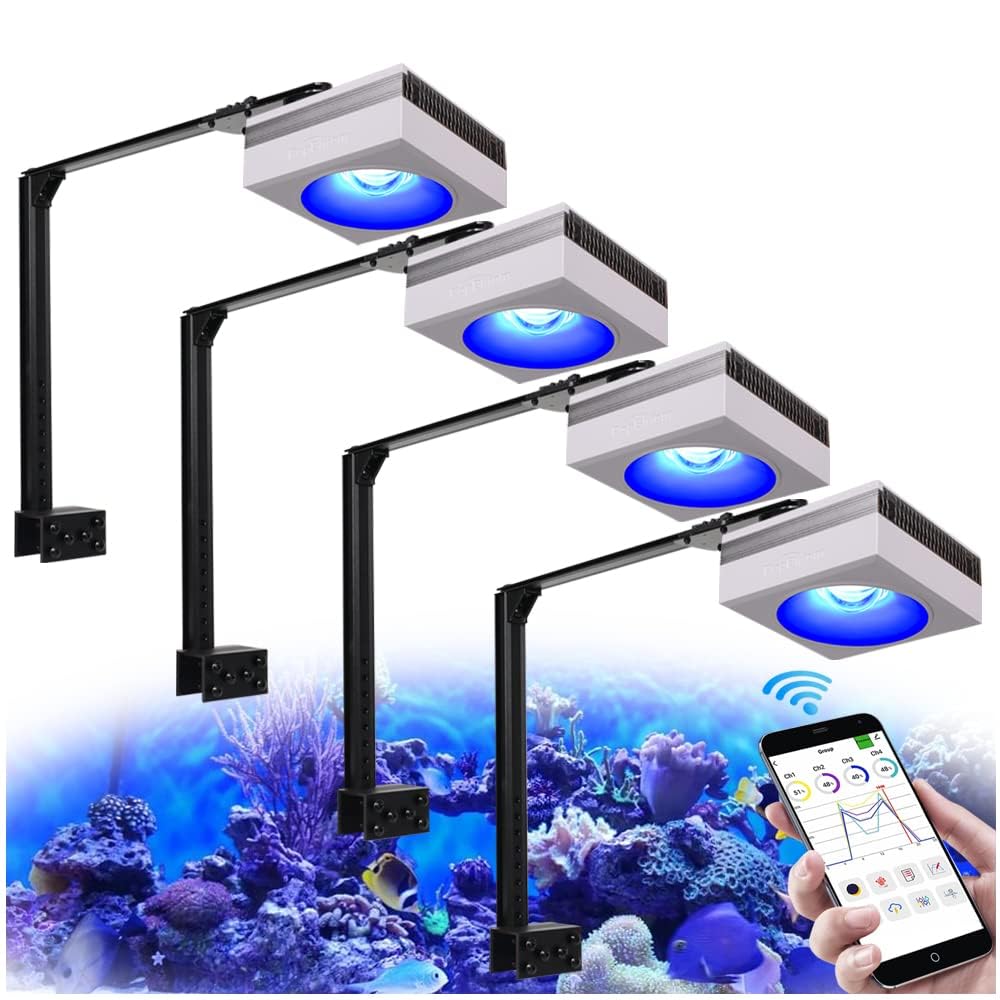
The PopBloom RL90 bundle addresses the fundamental challenge of lighting long aquariums (72–96 inches) with four independently adjustable fixtures linked via WiFi cloud control. Each unit runs a 4-channel dimmable array with 400W total system power, delivering PAR values that satisfied owners with 130-gallon cylinder tanks and 6-foot mixed reefs. The APP supports 24-hour DIY programming, sunrise/sunset, seasonal 4-season simulation, lunar cycles, and lightning effects.
The app runs on a 2.4GHz-only WiFi network, which is a common compatibility hurdle for dual-band routers. Once paired, the cloud-control feature allows adjustments from anywhere, but a critical flaw emerged in long-term use: the lights have no onboard memory. If the app disconnects or the phone is out of range, the fixtures hold their last state but cannot revert to a schedule. A dedicated old phone running the Tuya app acts as a workaround, but this is a kludge.
Quality control appears inconsistent between units — one owner reported a lunar LED channel that flickered each morning and required reconnection. The included mounting kit provides both 2cm and 4cm bases to accommodate rimmed and rimless tanks, plus hanging kit hardware. For the price of a single premium fixture, you get four-unit coverage, but the reliance on cloud-dependent control and the possibility of driver variance between fixtures should be weighed carefully if absolute reliability is your priority.
Why we love it
- Four-fixture bundle covers 6–8 foot tanks at a fraction of competing multi-unit costs
- 24-hour DIY programming with seasonal and lunar simulation
- Cloud-based remote control via smartphone from anywhere
Good to know
- No onboard schedule memory — schedule stops if app disconnects
- Quality control varies; some units have LED flicker or connectivity issues
FAQ
What PAR value do I need for SPS corals at a 24-inch depth?
Should I choose a hanging kit or tank-mounted brackets for a rimmed aquarium?
How do multiple reef lights sync together without cable clutter?
Final Thoughts: The Verdict
For most reef keepers, the reef tank lights winner is the AquaIllumination AI Prime 16 HD because it delivers a proven balance of silent fanless operation, strong per-watt PAR via HD power reallocation, and seamless Neptune Apex integration for the advanced hobbyist. If you want the deepest spectral control with six independent channels, grab the SMATFARM G6 140W. And for large display systems needing uniform coverage without a four-figure budget, the PopBloom RL90 4-Light Kit offers the best square-foot PAR coverage per dollar.