
A planted aquarium isn’t just a fish tank with plants thrown in — it’s a living ecosystem where biological filtration, water flow, and nutrient cycling must work in harmony. Choose a filter that strips too much CO₂ or creates dead zones, and your plants will struggle, your algae will thrive, and your careful aquascaping will slowly degrade.
I’m Mo Mahin — the founder and writer behind Furric. I’ve spent years analyzing water chemistry interactions, flow-path engineering, and real owner feedback across hundreds of filter models to pinpoint which designs actually support plant growth rather than fight against it.
After cross-referencing flow rates, media flexibility, and noise data with long-term user reports, I’ve isolated the specific models that give your plants the stable environment they need. This guide covers the best filter for planted aquarium setups, breaking down what makes each one work and where they fall short.
How To Choose The Best Filter For Planted Aquarium
Planted aquariums place unique demands on filtration. You’re balancing mechanical clarity, biological stability, and chemical purity — all while preserving CO₂ that your plants need to photosynthesize. Ignore these dynamics, and you’ll either gas off your carbon or create dead spots where detritus settles and algae blooms.
Flow Rate vs. CO₂ Retention
High flow rates create gas exchange at the water surface, which drives off dissolved CO₂. For a high-tech planted tank with injected CO₂, you want moderate turnover — roughly 4–6x the tank volume per hour — not the 10x often recommended for fish-only systems. Look for filters with adjustable flow or a spray bar that distributes return water gently without churning the surface.
Media Versatility and Biofiltration Surface Area
Planted tanks can reduce the need for aggressive chemical media like activated carbon, but they thrive on generous biological media. Ceramic rings, sintered glass, or bio-balls provide surface area for nitrifying bacteria that convert fish waste without stripping plant nutrients. A filter that accepts custom media stacks lets you swap in extra bio-media or add phosphate-removing resins when algae pressures rise.
Maintenance Access and Cleanability
You’ll need to clean mechanical media (sponges, floss) frequently to prevent nitrate buildup that feeds algae. Choose a filter where the media chamber is easy to reach without disconnecting plumbing. Hang-on-back models with lift-out media baskets and canisters with quick-release valves save hours over the life of your aquascape.
Quick Comparison
On smaller screens, swipe sideways to see the full table.
| Model | Category | Best For | Key Spec | Amazon |
|---|---|---|---|---|
| hygger HOB 5–30 Gal | Canister HOB | Small planted tanks with CO₂ | 132 GPH / 3-stage media / spray bar | Amazon |
| hygger HOB 210 GPH | HOB | Mid-size planted tanks | 210 GPH / clog light indicator | Amazon |
| Tetra Whisper IQ 45 | HOB | Low-maintenance planted setups | 215 GPH / <40 dB / self-priming | Amazon |
| Marineland Penguin 350 | HOB Bio-Wheel | Heavy bioload + planted | 350 GPH / dual Bio-Wheels / 4 cartridge slots | Amazon |
| COOSPIDER U-V Internal | Internal UV | Green water algae outbreaks | U-V light + 5W motor / 20–75 gal | Amazon |
In‑Depth Reviews
1. hygger Quiet Hang On Back Aquarium Filter 5–30 Gallon

This hygger model stands out for planted tanks because of its integrated spray bar. Instead of a single waterfall that agitates the surface and drives off CO₂, the spray bar distributes return flow horizontally across the water, minimizing gas exchange while still circulating oxygen. The telescopic intake lets you adjust pick-up depth, and the surface skimmer removes oily films that block light from reaching your carpet plants.
The 3-stage media design uses floss pads for mechanical debris, ceramic balls for biological colonization, and a dedicated chamber for optional chemical media like activated carbon or phosphate removers. The fish waste collector — a transparent tube with a stainless steel rotary drum — traps larger particles before they reach the media, cutting down on how often you need to rinse the floss. The drainage outlet allows you to siphon dirty water directly out of the collector during water changes.
At 132 GPH, the flow is appropriate for tanks up to 30 gallons. The 6-watt motor is quiet enough for a bedroom tank, and the adjustable flow control lets you dial back circulation if you’re running injected CO₂. Some owners reported the surface skimmer can occasionally trap small shrimp, and the clear media canister shows debris buildup that some find visually unappealing. Overall, it’s one of the most planted-tank-friendly hang-on-back designs on the market at this price tier.
Why we love it
- Spray bar reduces surface agitation for better CO₂ retention
- Waste collector with separate drainage port speeds up water changes
- Adjustable telescopic intake fits rimless tanks up to 12mm thick
Good to know
- Drainage hose not included — requires 1/2” ID tubing
- Surface skimmer can trap small shrimp if not adjusted properly
- Not suitable for saltwater or rimmed aquariums
2. hygger Aquarium HOB Filter 210 GPH
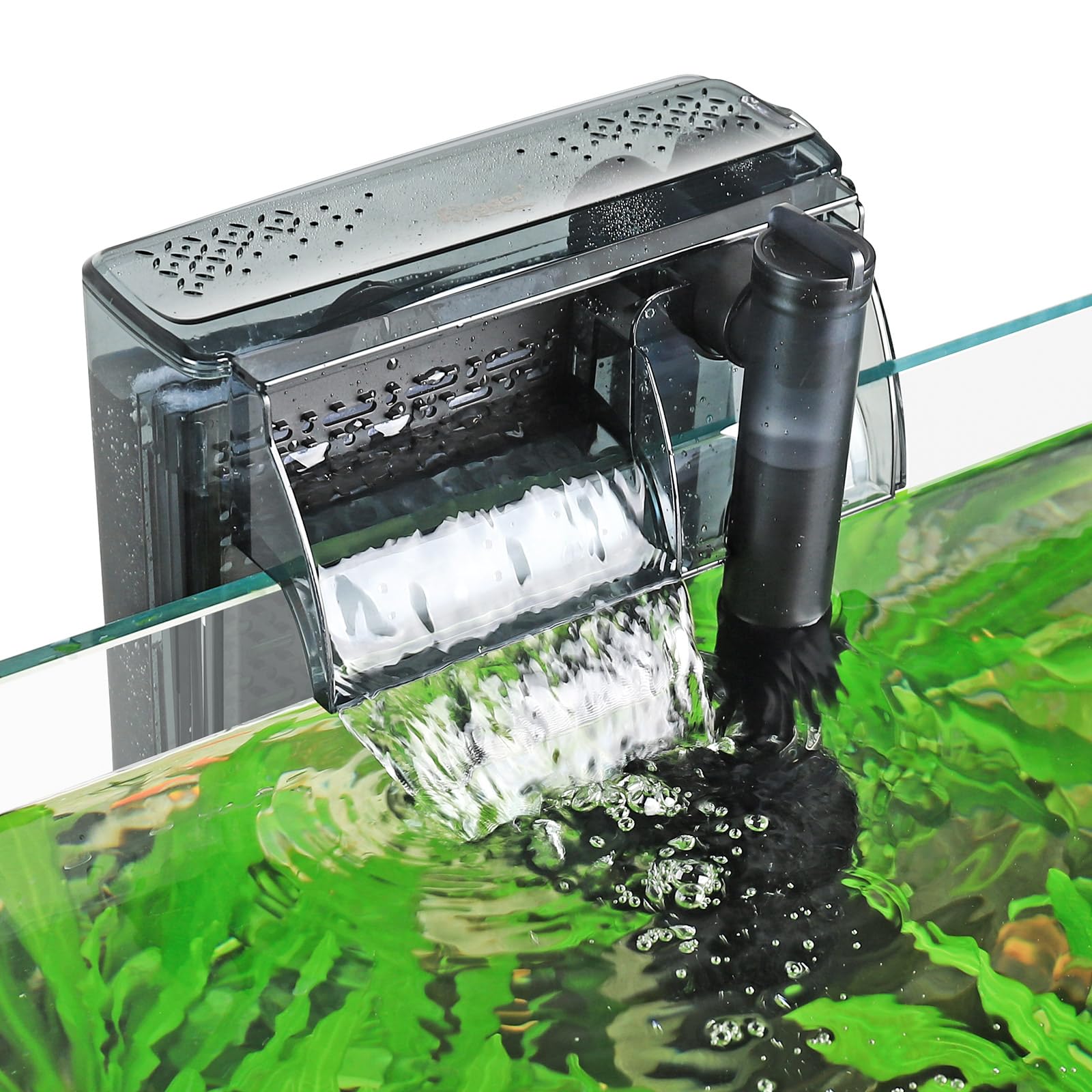
What makes this filter interesting for planted aquariums is the LED indicator light that activates when water begins overflowing around the cartridge due to clogging. In a planted tank with heavy bioload or decomposing plant matter, that visual cue saves you from guessing when mechanical media needs replacement — crucial for preventing debris from breaking down into nitrates that fuel algae.
Flow is adjustable via a top knob, and the intake tube extends to fit various tank depths. The included media pack contains a dual-sided sponge-cotton and activated carbon cartridge plus a bio-filter plate for biological colonization. The mini-waterfall outflow oxygenates the water without blasting your foreground plants, though the sound can be noticeable until you raise the water level to cover the outlet lip.
One trade-off: the media compartment is relatively compact, limiting how much bio-media you can stack. For a heavy planted tank with a large fish load, you may want to supplement with additional biological filtration elsewhere. Still, given the adjustable flow and the clever clog indicator, this is a solid mid-range choice for tanks between 15 and 40 gallons where CO₂ injection is moderate and maintenance regularity is a priority.
Why we love it
- LED indicator warns when filter cartridge is clogged
- Adjustable flow rate via top knob
- Extendable intake tube fits different tank depths
Good to know
- Not self-priming — chamber must be filled before powering on
- Media compartment is small for custom bio-media stacking
- Some users report cloudy water with heavy bioloads
3. Tetra Whisper IQ Power Filter 45 Gallons

Tetra’s Whisper IQ series uses a sound shield that keeps operation below 40 dB, which matters if your planted tank is in a living room or office where pump hum is a nuisance. The submerged motor is self-priming — simply hang it on the tank and plug it in — no manual water filling required, saving time during maintenance or after power outages.
The Stay Clean technology is marketed around pH maintenance, but for a planted tank the real value is that the cartridge-based system provides consistent mechanical and chemical filtration without over-complicating the media load. The 215 GPH flow is appropriate for tanks up to 45 gallons, and adjustable flow control lets you throttle back to reduce surface agitation when CO₂ injection is active.
Owners report strong reliability — several mentioning the same unit lasting a decade on a 55-gallon tank, with the new version improving sound dampening and splash control. The primary limitation for planted enthusiasts is the proprietary Bio-Bag cartridge system, which restricts media choices compared to open-basket designs. If you prefer to customize your filter media stack, the hygger models give you more flexibility, but for a quiet, fuss-free filter that just works, the Whisper IQ is hard to beat.
Why we love it
- Self-priming design — no manual filling needed
- Sound shield keeps noise below 40 dB
- Adjustable flow control for reducing surface agitation
Good to know
- Uses proprietary Bio-Bag cartridges, limiting media customization
- Flow may be too strong for smaller nano planted tanks
- Struggles with taller-than-standard aquarium depths
4. Marineland Penguin Bio-Wheel Power Filter 350

Marineland’s Bio-Wheel technology is one of the most established wet/dry biological filtration systems in the hobby. The rotating wheel exposes beneficial bacteria to air during part of each revolution, boosting nitrification efficiency — a real advantage in a planted tank where ammonia spikes from decaying plant matter can disrupt the system. The PF0350B model offers four cartridge slots and two Bio-Wheels, giving it substantial biofiltration surface area for tanks up to 75 gallons with heavy plant and fish loads.
The multi-stage approach (mechanical cartridge, chemical carbon, biological wheel) is effective, but the cartridge system is proprietary — you’re limited to Marineland Rite-Size cartridges unless you modify the tray. The 350 GPH maximum flow is powerful, but there’s no built-in flow control, so you may need to add a spray bar or ball valve to reduce surface agitation for CO₂ retention. Owners praise its reliability and quiet motor operation, noting that any noise usually comes from trickling water when the reservoir level drops.
For a planted aquarium, this filter works best when you skip the carbon cartridges (which strip micronutrients) and run just the mechanical floss and Bio-Wheels. The four-cartridge design gives you room to add extra bio-media or phosphate-removing pads. Just be aware that the intake knob adjusts surface-to-bottom pull ratios rather than overall flow, and monthly cleaning of the wheel pins and impeller is necessary to maintain smooth rotation.
Why we love it
- Bio-Wheel technology boosts nitrification efficiency through wet/dry cycling
- Four cartridge slots allow custom media stacking (skip carbon, add bio rings)
- Proven reliability — many units run for years with basic maintenance
Good to know
- No built-in flow control — may need external spray bar for CO₂ tanks
- Proprietary cartridges reduce media flexibility
- Requires monthly cleaning of Bio-Wheel pins and impeller to prevent stalling
5. COOSPIDER Aquarium Filter U-V (20–75 Gallon)
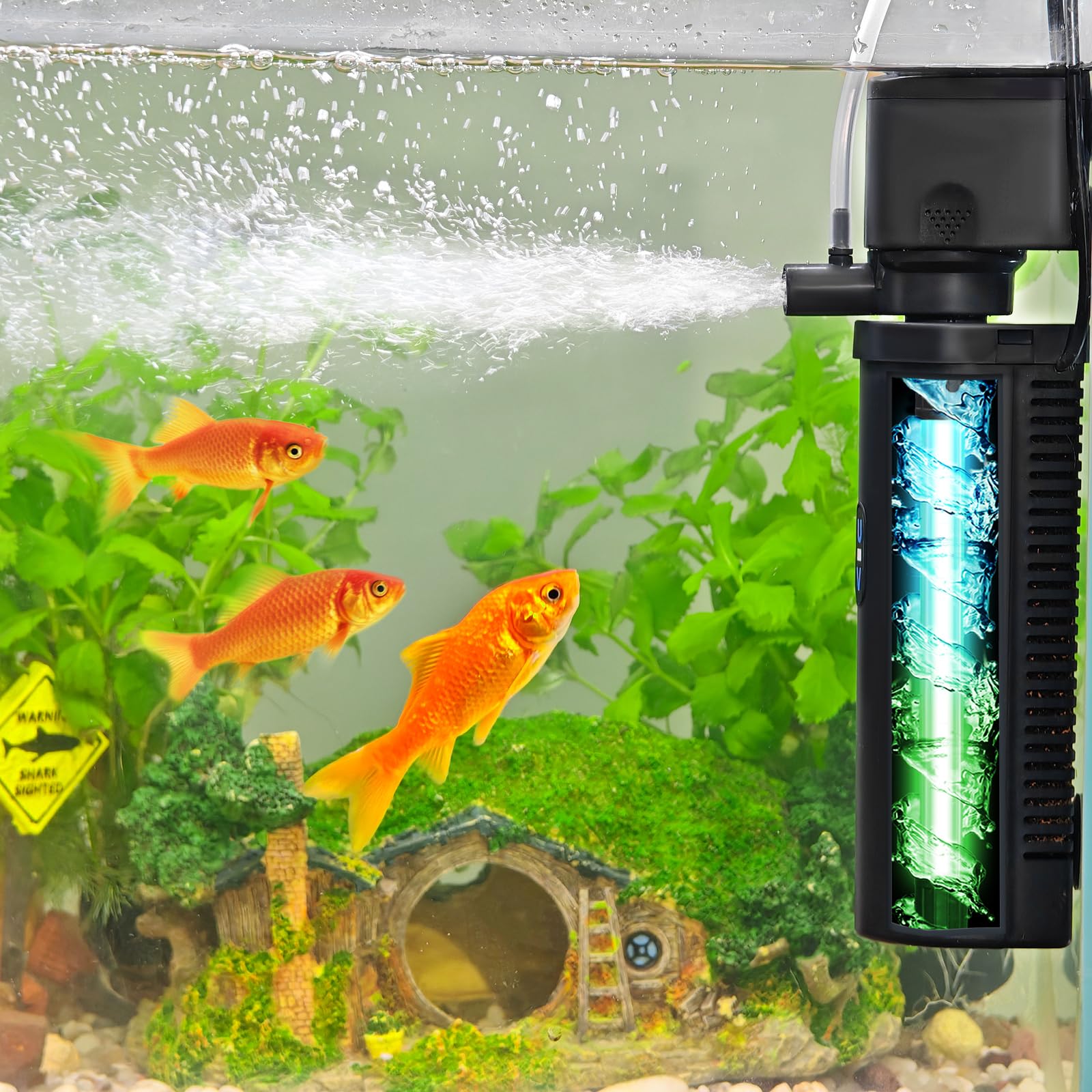
This internal submersible filter integrates a 5-watt U-V light chamber directly into the filtration path. For planted tanks battling green water (free-floating phytoplankton blooms), the U-V light kills algae cells within 1–3 days without harming plants or fish — a targeted solution that mechanical filtration alone can’t provide. The filter body uses a protected sponge compartment for mechanical debris, and the pump is driven by a pure copper motor that the manufacturer has tested for extended dry-run tolerance.
The U-V light and pump have separate power plugs, so you can run the filter continuously and switch the U-V on only during outbreaks. The outflow nozzle can be positioned above the water surface for aeration or submerged for wave motion, giving you some control over CO₂ retention. At roughly 10.3 inches tall, the unit sits unobtrusively in the tank corner, though the black plastic housing is visible — something to consider if you prefer a minimalist aquascape.
Performance feedback is mixed: most owners report dramatic green water clearance within days, but a smaller number experienced rapid clogging of the sponge (requiring cleaning every few days during an active bloom) and, in one case, a motor failure that caused a fish kill. The flow is not adjustable, and some users noted the current was strong for nano fish in smaller tanks. For planted tanks where green water is a recurring problem, this U-V filter is a potent tool — but it works best as a supplementary filter rather than a primary unit, given its single-stage mechanical filtration and lack of biological media.
Why we love it
- Integrated 5W U-V light clears green water in 1–3 days
- Separate plugs for pump and U-V — use U-V only when needed
- Pure copper motor tested for dry-run tolerance
Good to know
- No biological media — must be paired with a bio filter
- Sponge clogs quickly during active algae blooms
- Flow is not adjustable; may be strong for small tanks
FAQ
Can I use a U-V filter in a planted tank without killing the beneficial bacteria?
What flow rate should I target for a planted tank with injected CO₂?
Should I run activated carbon in my planted tank filter?
Final Thoughts: The Verdict
For most planted aquarists, the best filter for planted aquarium winner is the hygger 5–30 Gallon HOB because its spray bar design minimizes CO₂ loss while offering three-stage media flexibility and a waste collector that simplifies maintenance. If you want ultra-quiet operation and self-priming convenience for a mid-size tank, grab the Tetra Whisper IQ 45. And for green water outbreaks that standard filtration can’t touch, nothing beats the COOSPIDER U-V Internal Filter as a supplementary unit on your planted system.