
Picking the wrong filter for your freshwater tank means staring at cloudy water, stressed fish, and a constant battle against nitrates. The internal pump, the media compartment size, and the flow rate in GPH determine everything about your aquarium’s health — not just the brand name on the box.
I’m Mo Mahin — the founder and writer behind Furric. I’ve spent years dissecting aquarium filter specifications, studying fluid dynamics across tank volumes, and cross-referencing hundreds of owner logs to isolate which features actually produce crystal-clear water versus which are marketing noise.
This guide ranks the most reliable options by real-world filtration performance, ease of maintenance, and biological support so you can confidently choose the right freshwater tank filter for your setup without guessing.
How To Choose The Best Freshwater Tank Filter
Selecting a freshwater tank filter means balancing flow rate, media capacity, filter type, and maintenance convenience against your specific tank volume and inhabitants. Here are the three specs that separate effective filtration from constant frustration.
Flow Rate: The GPH-to-Gallon Ratio
Aim for a filter that turns over your tank volume at least 4 to 6 times per hour. For a 20-gallon tank, that means a filter rated at 80 to 120 GPH. Heavily stocked tanks or messy species like goldfish and turtles demand 8 to 10 times turnover. Oversizing slightly is safer than undersizing, but excessive flow can stress slow-moving fish.
Filtration Stages: Mechanical, Chemical, Biological
Mechanical media (sponges, pads) trap solid waste. Chemical media (activated carbon) removes odors and discoloration but must be replaced regularly. Biological media (ceramic rings, bio-balls, Bio-Wheels) houses nitrifying bacteria that break down ammonia and nitrite — this is the most critical stage for long-term water quality. A filter that skips biological support will leave you chasing water parameters.
Filter Type: HOB vs. Canister vs. Internal
Hang-on-back (HOB) filters are the most common option for tanks up to 75 gallons — easy to maintain, no tank clutter, and decent media capacity. Canister filters shine on larger tanks (50+ gallons) with superior media volume and sealed external operation, but they cost more and require periodic hose cleaning. Internal submersible filters save space but reduce display area and are best for small tanks or supplemental polishing.
Quick Comparison
On smaller screens, swipe sideways to see the full table.
| Model | Category | Best For | Key Spec | Amazon |
|---|---|---|---|---|
| Fluval FX2 | Canister | Large tanks up to 100 gal | 475 GPH / 4-stage baskets | Amazon |
| OASE BioMaster 2 Thermo 250 | Canister | Integrated heater + easy pre-filter | 250 GPH / 4-stage + heater | Amazon |
| Sicce Shark PRO 900 | Internal | In-tank flexibility | 240 GPH / 3 filter cartridges | Amazon |
| Aqueon Quietflow Internal | Internal | Silent internal operation | Fully submersible / low noise | Amazon |
| Marineland Penguin Bio-Wheel | HOB | Wet/dry biological filtration | 350 GPH / rotating Bio-Wheel | Amazon |
| hygger HOB Filter | HOB | Space-saving adjustable HOB | 105 GPH / clog indicator light | Amazon |
| TARARIUM Internal Filter | Internal | Low water level / turtle tanks | 290 GPH / ceramic bio-balls | Amazon |
In‑Depth Reviews
1. Fluval FX2 High Performance Canister Filter
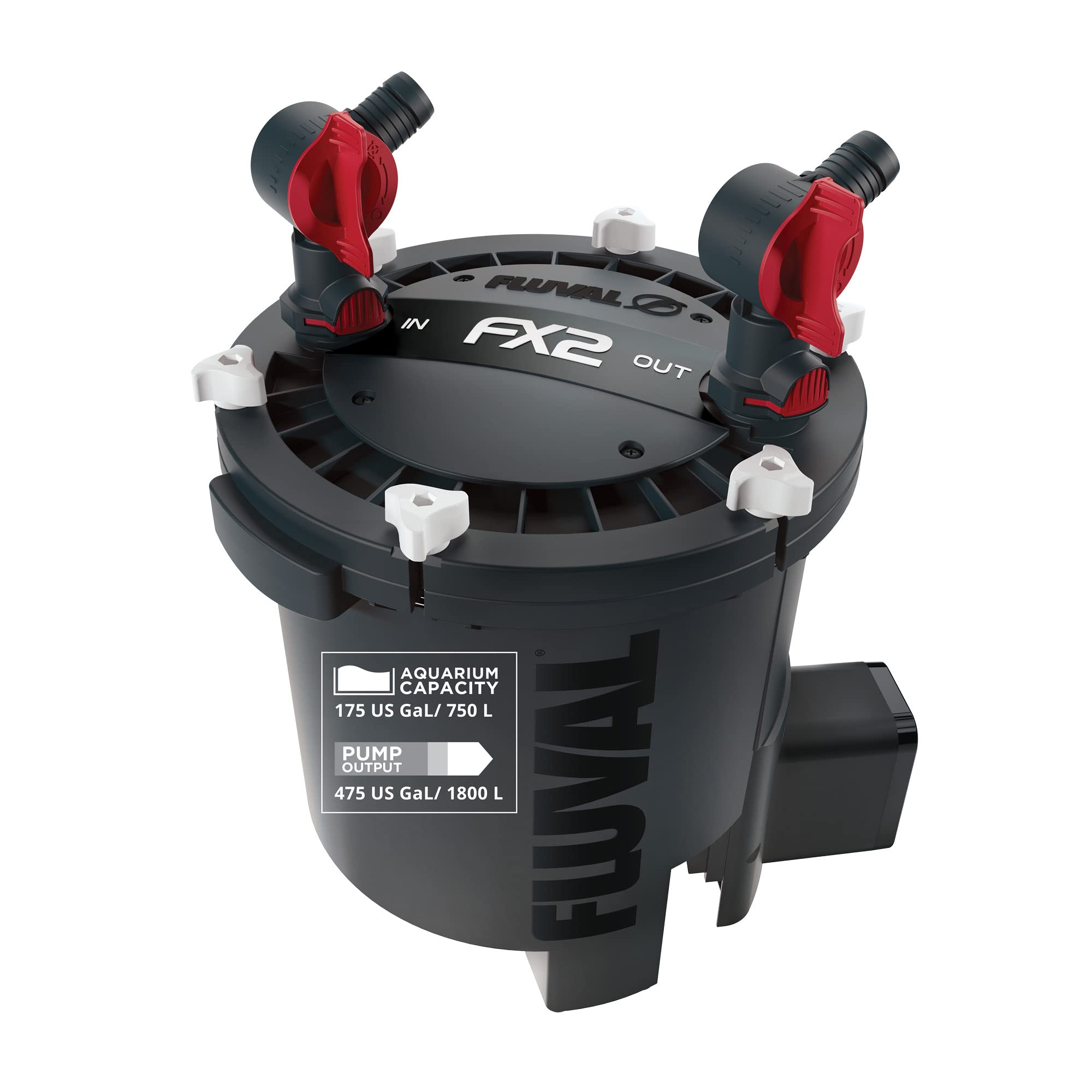
The Fluval FX2 delivers 475 gallons per hour through four removable filter baskets that eliminate water bypass — a critical design detail for consistent mechanical, chemical, and biological filtration. The Smart Pump technology self-starts after maintenance and auto-evacuates trapped air every 12 hours, so you never deal with priming frustration or airlock stalls.
At 16.5 inches tall, this canister fits under most cabinets and runs noticeably quieter than other pumps in its class thanks to the unidirectional impeller. The multi-functional utility valve at the base lets you drain the canister and perform water changes without disconnecting hoses — a time-saver that keeps your hands dry.
Owners running 75-gallon planted and community tanks consistently report crystal clarity and stable parameters even with heavy bioloads. The pump is rated for up to 100-gallon tanks, but the 475 GPH rate makes it a solid match for 60-to-90-gallon setups where you want serious turnover without going to the FX4 or FX6.
Why we love it
- Self-starting Smart Pump eliminates priming guesswork
- Four stacked baskets prevent water bypass and maximize media contact
- Built-in drain valve simplifies water changes
Good to know
- Replacement pump can cost around if the unit fails outside warranty
- Tubing is somewhat rigid; some owners replace it with silicone hose
2. OASE BioMaster 2 Thermo 250 Canister Filter
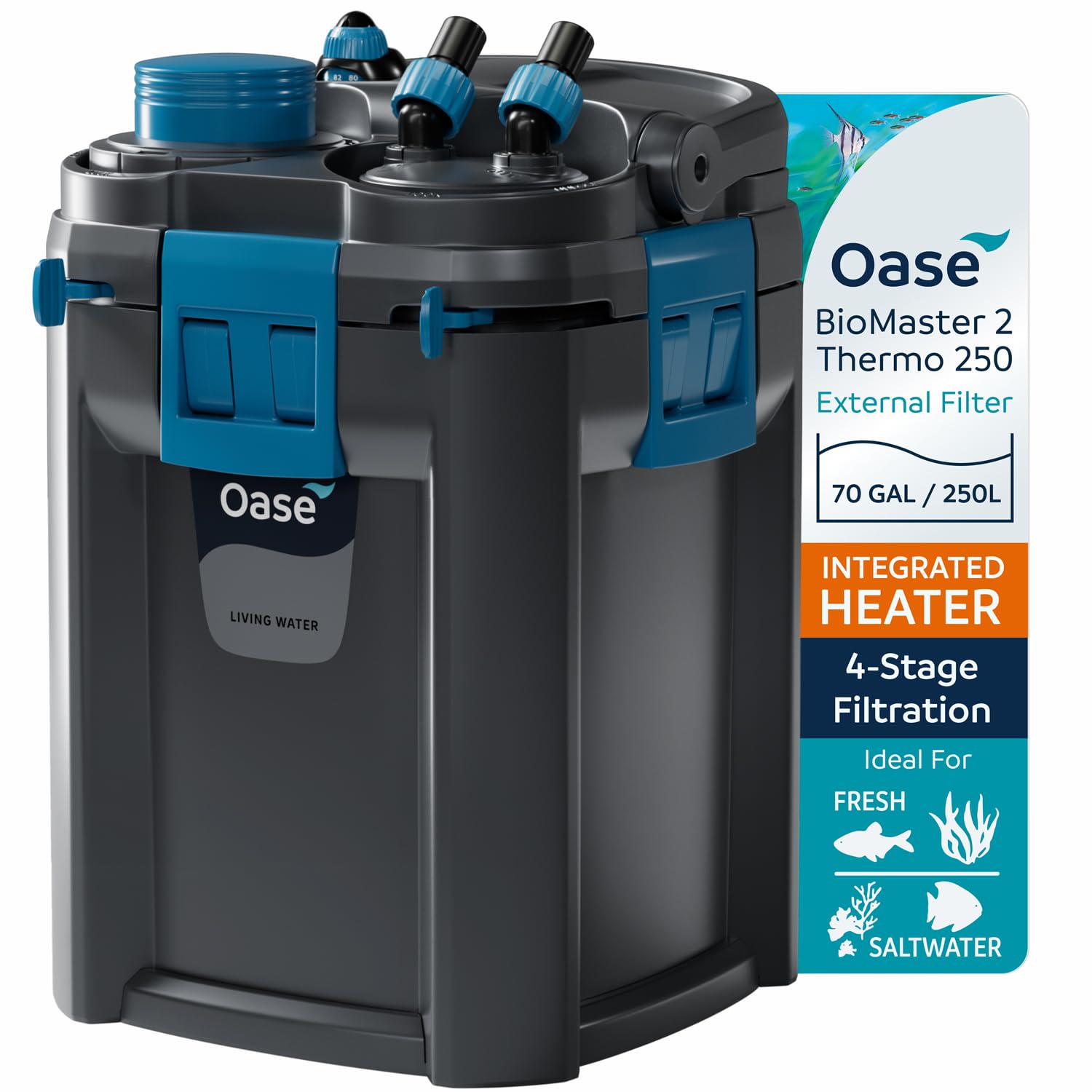
The OASE BioMaster 2 Thermo 250 integrates a 250-watt heater directly into the canister body, removing a bulky piece of equipment from your tank while maintaining precise temperature control via bi-metal technology with thermal shutoff. The sealed 4-stage filtration path uses multi-density foams, Hel-X biomedia, and activated carbon to achieve exceptional clarity in tanks up to 70 gallons.
The standout feature is the EasyClean pre-filter module that detaches separately from the main filter body — you can rinse the coarse sponge without opening the canister or disturbing your bacterial colonies. Safety locks on the handle, pre-filter, and aquastop prevent spills during disconnection, and the detachable aquastop lets you move the filter without disrupting your tubing run.
Owner feedback emphasizes the near-silent operation and extended intervals between deep cleanings. The 4-year warranty (3 plus 1 with online registration) reflects confidence in the German-engineered construction, though the initial investment sits at the higher end of the canister market.
Why we love it
- Integrated heater eliminates in-tank clutter and protects fish from contact
- EasyClean pre-filter rinses without opening the main canister
- 4-stage filtration with Hel-X biomedia supports heavy bioloads
Good to know
- Heavy when filled; ensure your cabinet stand can support over 15 pounds
- Latches can be stiff during initial use
3. Sicce Shark PRO 900 Internal Filter

The Sicce Shark PRO 900 uses a patented magnetic quick-uncoupling system that lets you detach the filter body for cleaning without stopping the pump or pulling the suction cups. Three removable filter cartridges give you 930 cm³ of total media volume — enough for separate mechanical, chemical, and biological stages in an internal footprint.
The adjustable intake diameter protects small fish and shrimp from being pulled against the intake, and the built-in Venturi system injects air for improved oxygenation. The transparent body lets you visually monitor clogging levels so you clean only when needed rather than on a fixed schedule.
Owners running 29-to-70-gallon tanks report the filter polishes water to near-zero turbidity within days. The optional spray bar attachment distributes flow evenly across the tank width, and the magnetic mount holds securely on glass up to about 12mm thick. Some users note the magnets could be stronger for thicker glass applications.
Why we love it
- Magnetic quick-release makes in-tank maintenance fast and mess-free
- Venturi system adds oxygenation without a separate air stone
- Adjustable intake prevents fish from being trapped
Good to know
- Magnetic hold may be weak on glass thicker than 12 mm
- Filter cartridges can pop loose if not fully seated
4. Aqueon Quietflow Internal Power Filter

The Aqueon Quietflow Internal Power Filter is a fully submersible unit designed for whisper-quiet operation — multiple owner logs describe it as nearly inaudible in living room setups. The compact footprint leaves usable tank space while still delivering strong flow for tanks up to 20 gallons, and some owners successfully run it in 29-gallon tanks with moderate bioloads.
Cleaning requires reaching into the tank to access the media sponge, which is slightly more intrusive than an HOB filter but a fair trade-off for the noise reduction. The outlet nozzle can be rotated to direct water flow toward the surface for oxygenation or toward the substrate for circulation.
Long-term reliability is a split story: many owners report years of silent, trouble-free performance, while a minority describe increased vibration and humming after three months. The design lacks an adjustable flow control, but the directional output gives some flexibility. Best suited for small-to-medium community tanks where noise is the primary concern.
Why we love it
- Near-silent operation ideal for bedrooms or quiet living spaces
- Small internal footprint leaves more room for aquascaping
- Directional output nozzle lets you target surface agitation
Good to know
- No built-in flow rate adjustment knob
- Some units develop vibration noise after a few months
5. Marineland Penguin Bio-Wheel Power Filter

The Marineland Penguin Bio-Wheel is a workhorse HOB that uses patented rotating Bio-Wheel technology for continuous wet/dry biological filtration — the wheel exposes bacterial colonies to air as it turns, boosting nitrification efficiency. Available in sizes from 75 to 350 GPH, the largest model handles tanks up to 100 gallons with room for up to four Rite-Size filter cartridges.
Setup takes about five minutes: attach the intake tube, hang the filter body, fill the reservoir, and plug it in. Priming requires manually filling the reservoir with tank water to prevent the motor from running dry. The water flow creates strong surface agitation for gas exchange, which helps stabilize oxygen levels in stocked tanks.
Owners running the 350 GPH version on 75- and 100-gallon tanks report exceptional clarity and stable ammonia readings. The filter’s main drawback is the lack of a flow control valve — you get full pump output or nothing. Monthly cleaning of the Bio-Wheel pins and impeller prevents noise buildup, and cartridges should be rinsed in tank water, not tap water, to protect the bacteria colony.
Why we love it
- Patented Bio-Wheel provides excellent wet/dry biological filtration
- Multiple cartridge slots allow customized media stacking
- Easy to prime and maintain without shutting down the tank
Good to know
- No adjustable flow control valve
- Requires manual reservoir filling to prime
6. hygger Aquarium HOB Filter 105 GPH
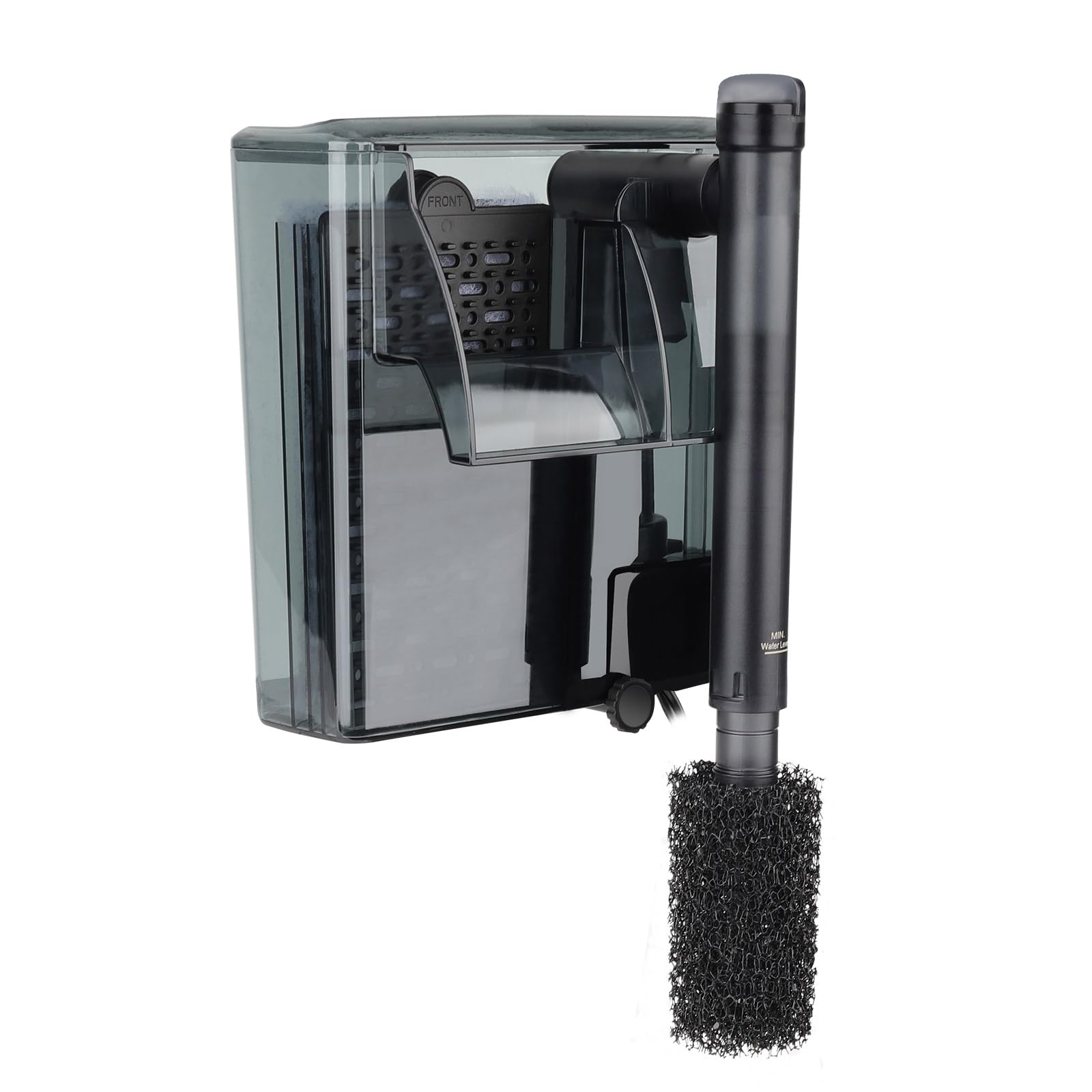
The hygger HOB Filter packs a practical innovation — an LED indicator light that turns on when the filter cartridge becomes clogged, signaling when it’s time for a swap. The 105 GPH flow rate suits tanks from 10 to 20 gallons, and the adjustable top knob lets you dial the flow down for slower-moving fish or increase it for surface agitation.
The extendable intake tube fits varying tank depths, and the intake sponge prevents small fish or shrimp from getting sucked into the impeller. The included filter cartridge uses dual-sided sponge cotton and ultra-activated carbon, while the bio-filter plate provides surface area for nitrifying bacteria. Both media types can be swapped independently.
Owners consistently note how quiet the unit runs — significantly quieter than many similarly priced HOB filters. The mini-waterfall outflow creates a gentle trickle sound that some find pleasant, though the noise can be reduced by raising the water level closer to the outflow. The media compartment is on the smaller side, so this filter works best for lightly stocked tanks where bio-load is low.
Why we love it
- LED clog indicator removes guesswork from media replacement
- Adjustable flow rate and extendable intake tube
- Very quiet operation for an entry-level HOB
Good to know
- Small media compartment limits biological capacity
- Not self-priming — must fill reservoir manually
7. TARARIUM Internal Filter 290 GPH

The TARARIUM Internal Filter delivers 290 GPH from a submersible unit that operates at water levels as low as 2.6 inches — a critical spec for turtle tanks, reptile enclosures, and shallow aquariums where HOB filters can’t draw water. The three-stage filtration uses a double-sided mesh sponge for mechanical debris capture and ceramic bio-balls for biological breakdown of waste and odor.
The top-lid canister design makes media access straightforward: lift the lid, remove the sponge and bio-media, rinse, and reassemble. The adjustable water flow dial lets you reduce output for smaller tanks or crank it up for larger volumes. The waterfall-style return aerates the water surface, improving oxygen exchange without a separate air stone.
Owners running 50-to-60-gallon goldfish and turtle tanks report the filter handles heavy waste loads effectively, with some going over a month without a water change. The unit is noticeably quiet for an internal pump of this capacity. However, some keepers note that the sponge clogs quickly with very messy species, requiring cleaning every two to three days rather than weekly.
Why we love it
- Operates at only 2.6 inches of water — ideal for turtles and paludariums
- 290 GPH flow handles heavy bioloads from messy species
- Adjustable flow and easy-access top canister design
Good to know
- Sponge may need frequent cleaning with heavy waste producers
- Some units don’t achieve full advertised water clarity without additional polishing media
FAQ
What GPH rating do I need for a 20-gallon freshwater tank?
Can I run a canister filter on a 10-gallon tank?
How often should I clean my HOB filter impeller?
Final Thoughts: The Verdict
For most freshwater tanks, the freshwater tank filter winner is the Fluval FX2 because it combines self-starting convenience, 475 GPH turnover, and four-stage basket filtration in a quiet canister package that handles tanks up to 90 gallons with ease. If you want a built-in heater and the easiest pre-filter maintenance in the category, grab the OASE BioMaster 2 Thermo 250. And for a silent internal unit that disappears into your aquascape, nothing beats the Aqueon Quietflow Internal.