
The right substrate does more than weigh down your driftwood — it drives your cycle, buffers your water, and determines whether your corydoras wear out their barbels by month two. Colored gravel from big-box stores often leaches, fades, or traps detritus in ways that crash nitrates. The best options are either chemically inert river stones or biologically active sands that kickstart the nitrogen cycle before your ammonia spike arrives.
I’m Mo Mahin — the founder and writer behind Furric. I’ve spent hundreds of hours comparing grain-size distribution curves, analyzing customer photos of cloudy-start vs. crystal-clear setups, and cross-referencing substrate composition claims with independent water-parameter tests across this niche.
Swipe through my shortlist of the best gravel for freshwater aquarium and you’ll walk away knowing exactly which grain profile belongs in your tank.
How To Choose The Best Gravel For Freshwater Aquarium
Substrate choice directly impacts biofiltration surface area, root anchorage for stem plants, and the physical comfort of bottom-dwellers. Prioritize these specs when comparing bags.
Grain size distribution matters more than brand name
Sand under 1 mm packs tightly, reducing oxygen exchange and creating anaerobic pockets that release hydrogen sulfide. Gravel over 5 mm leaves large gaps where uneaten food sinks deep and rots. The sweet spot for most freshwater community tanks — especially those with corydoras, khulis, or shrimp — is 1–4 mm. This range allows flow-through without trapping debris, and mimics the natural creek beds many species evolved in.
Inert vs. active: know your water chemistry
Inert substrates (natural river gravel, silica sand, most quartz-based options) do not alter pH, GH, or KH — essential if you keep soft-water species like discus or apistogramma. Active substrates (bio-seeded sands, laterite blends, clay balls) buffer pH downward and release nutrients for plant roots. Mixing a small layer of active sand beneath inert gravel gives you the best of both: rooted plant nutrition plus easy cleaning of the top layer.
Pre-rinse protocol changes by type
Bio-active substrates that contain live nitrifying bacteria must NOT be rinsed — you wash away the very colony that speeds your cycle. Natural river gravel and standard aquarium sand require aggressive rinsing in a bucket until runoff runs clear (sometimes 10–15 cycles). Fine sands like Carib Sea Sunset Gold often need 20+ minutes of stirring to release trapped dust that would otherwise turn your tank milky for 48 hours.
Quick Comparison
On smaller screens, swipe sideways to see the full table.
| Model | Category | Best For | Key Spec | Amazon |
|---|---|---|---|---|
| Aqua Natural Galaxy Sand 20lb (Black) | Premium Sand | Dramatic aquascapes / planted tanks | 20 lb bag / fine 0.5–1 mm grains | Amazon |
| Carib Sea Super Natural Sunset Gold Sand | Premium Sand | Soft-bellied fish / natural biotopes | 5 lb bag / pH-neutral / ultra-fine | Amazon |
| Aqua Natural Sugar White Sand Bio-Substrate 5lb | Bio-Active Sand | Instant cycle / planted nano tanks | 5 lb bag / seeded with live bacteria | Amazon |
| YISZM 1/8″ (2–4mm) Natural River Rocks | Mid-Range Gravel | Small freshwater community tanks | 5 lb bag / 2–4 mm / earthy tones | Amazon |
| YISZM 1/4″ (6mm) Natural River Rocks | Budget Gravel | Succulent toppers / turtle tanks | 5 lb bag / 6 mm / multicolor pebbles | Amazon |
In‑Depth Reviews
1. Aqua Natural Galaxy Sand 20lb (Black)

This 20-pound bag delivers a fine, sparkling black sand that makes plant greens and fish colors pop with contrast. The grain consistency is uniform at roughly 0.5–1 mm — soft enough for corydoras to sift through without barbel abrasion, yet dense enough to stay in place during filter flow. Owners consistently report that the sand arrives cleaner than competing blacks, requiring just a few rinses before the water runs clear.
The depth of color is genuine: no paint or dye, just ethically sourced natural black sand. A single bag provides a 2-inch base in a 20-gallon long, or a 1.5-inch layer in a 29-gallon. The weight and grain size also make it excellent for slope-building in aquascapes — it holds a contour without sliding flat overnight.
For larger tanks or those stocking heavy burrowers, the minimal dust cloud clears within 24–48 hours post-fill. Reviewers note that after the initial rinse, water changes rarely stir up any residue. This is the go-to choice for aquascapers who want a dramatic, light-absorbing background that highlights hardscape.
Why we love it
- Deep, natural black that doesn’t fade or leach
- Soft grain geometry safe for burrowing fish
- Large bag size gives best coverage per dollar
Good to know
- Must rinse thoroughly despite pre-washed appearance
- Fine grains can cloud water if poured too aggressively
2. Carib Sea Super Natural Sunset Gold Sand

Carib Sea’s Sunset Gold is a staple among biotope specialists because the warm golden hue matches the soft, sandy bottoms of Southeast Asian blackwater streams. The grains are extremely fine — closer to a silica play sand than typical aquarium gravel — so it is ideal for puffers, rays, and any fish that enjoys burying itself. The manufacturer confirms it is pH neutral, stringently free of dyes or paints, and made in the USA.
This sand demands patience during setup. Multiple owner accounts confirm that 15 to 20 minutes of aggressive bucket-rinsing is necessary to remove the fine dust that clings to the grains. Skip this step and the tank turns opaque for two days. Once settled, however, the sand remains stable: water changes and corydoras stirring rarely lift any cloudiness.
The 5-pound bag covers roughly a 10-gallon footprint at 1-inch depth. For larger biotopes, plan on two or three bags. The soft texture is a non-negotiable selling point for anyone keeping scaleless or soft-bellied species that would abrade on sharper gravel.
Why we love it
- Ultra-soft grains safe for bottom-dwellers and stingrays
- Natural golden color mimics wild riverbeds
- Absolutely no pH or hardness swing
Good to know
- Extremely dusty; requires many rinse cycles
- Small bag size limits large-tank coverage
3. Aqua Natural Sugar White Sand Bio-Substrate 5lb

This is the only substrate on this list that arrives pre-seeded with live nitrifying bacteria — you do NOT rinse it at all. The instructions call for a 1:4 mix ratio (1 part live bio-substrate to 4 parts dry sand), effectively jump-starting the nitrogen cycle so you can add fish within days instead of waiting weeks. Each 5-pound bag ships pre-moistened to keep the bacterial colony alive.
The off-white color is softer than pure white, giving a natural sugar-sand appearance that brightens the tank without looking sterile. Grain size sits around 1–2 mm, making it a true sand rather than gravel — ideal for shrimp, small tetras, and nano-planted setups. Owners report that water clears within 24 hours when poured slowly over a plate, and that dust is near-zero because of the pre-moistened form.
The major tradeoff is bag size: 5 pounds covers only a 5-gallon footprint at 1-inch depth. A 10-gallon tank needs three bags, and the cost adds up. Reserve this for nano-tanks or as a 1-inch top-layer cap over inert substrate in larger aquariums to get the bacterial benefit without breaking the budget.
Why we love it
- Contains active nitrifying bacteria for rapid cycling
- Zero rinsing required — use straight from bag
- Soft natural color brightens planted nano tanks
Good to know
- Small bag means lower value for larger aquariums
- Can’t rinse; must pour carefully to avoid cloud
4. YISZM 1/8″ (2–4mm) Natural River Rocks
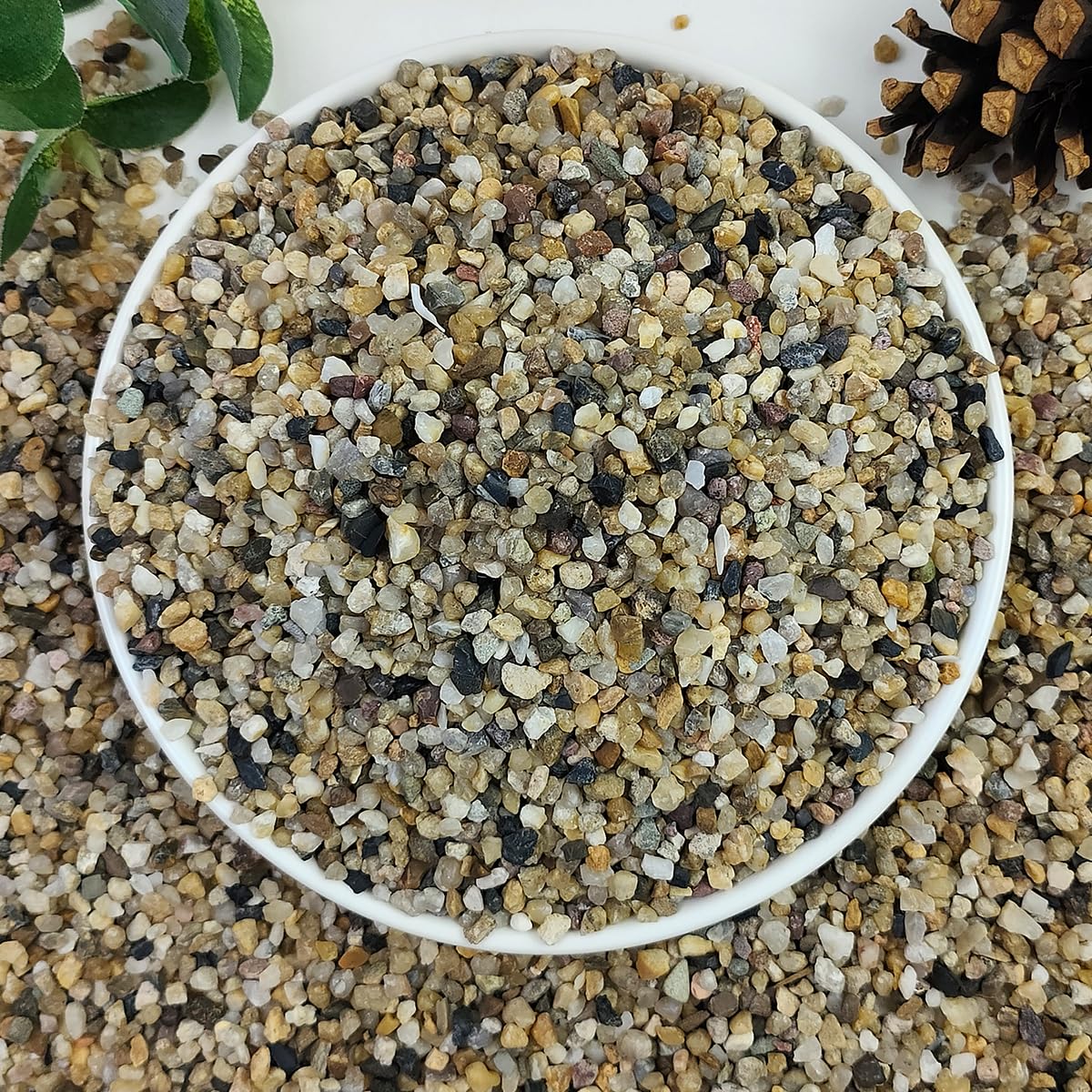
This 5-pound bag of 2–4 mm river gravel hits the sweet spot between sand fineness and the pebble size that traps food. The grain diameter is uniform enough to allow decent water flow-through while keeping the surface relatively smooth for bottom-feeders. The earthy tones — tans, grays, soft browns — look natural under both 6500K plant lights and standard LED hoods, with no painted colors that might peel over time.
Owners successfully use it in freshwater community tanks with small cichlids, tetras, and livebearers. The polished round shape means fish can shuffle the pebbles without injury — several reviewers note their corydoras actively move the stones around during foraging. The bag covers about a 5.5-gallon footprint at 1-inch depth, so expect to buy multiple bags for standard 20-gallon longs.
The main knock is that the stone mix contains slightly more variance in color than depicted in listing photos — some bags lean warmer, some cooler. For pure aesthetics this is minor; for biotope purists it may matter. The gravel is chemically inert, confirmed by water-parameter tests across multiple owner reports.
Why we love it
- Optimal 2–4 mm size balances cleaning and flow
- Natural no-dye stones safe for all freshwater fish
- Polished round edges prevent barbel damage
Good to know
- Color variation between batches can be noticeable
- Small bag size increases per-gallon cost for big tanks
5. YISZM 1/4″ (6mm) Natural River Rocks

At 6 mm diameter, this gravel occupies the larger end of the substrate spectrum — better suited for turtle tanks, cichlid aquariums, or as a decorative topper for potted plants than for a standard community fish tank. The multicolor mix includes tans, whites, grays, and occasional reddish tones that give a natural river-bottom appearance. The pebbles are polished smooth with no sharp edges, so they won’t scratch glass or injure larger fish.
For serious aquarium use, the larger gaps between pebbles create a downside: uneaten food sinks into the gaps and decomposes, requiring more aggressive gravel-vacuuming during water changes. It is best mixed with a finer sand layer underneath if you intend to keep bottom-feeding fish. Owners of large cichlids appreciate the weight — these stones don’t shift easily when fish dig.
The 5-pound bag feels dense but covers roughly 4–5 gallons of footprint at 1-inch depth. The price per pound makes it one of the most entry-level options here. If your primary goal is a turtle tank or a hardscape accent layer over a sand base, this fits the bill. For a standard planted community tank, the finer 2–4 mm sibling is a better match.
Why we love it
- Polished, smooth pebbles safe for turtles and cichlids
- Natural multicolor mix looks attractive without dye
- Heavy stones resist digging and displacement
Good to know
- Large gaps trap debris; needs frequent vacuuming
- Too rough for soft-bellied fish or small shrimp
FAQ
Can I reuse this gravel after tearing down a tank?
How deep should I layer gravel in a freshwater aquarium?
What grain size prevents corydoras barbel erosion?
Final Thoughts: The Verdict
For most gardeners, the best gravel for freshwater aquarium winner is the Aqua Natural Galaxy Sand 20lb (Black) because it pairs a deep, dramatic color with safe grain geometry and generous per-bag coverage. If you want a biotope-safe, pH-neutral sand for soft-bellied species, grab the Carib Sea Super Natural Sunset Gold Sand. And for instant-cycle nano tanks where convenience outweighs bag size, nothing beats the Aqua Natural Sugar White Sand Bio-Substrate.