
A harness built for running isn’t a walking harness with a sporty color. The difference lies in how the load transfers across the dog’s body, how the chest and shoulders articulate during a full stride, and whether the attachment point lets you run hands-free without torque. Choosing the wrong rig means a chafed dog, a pulled shoulder, or a runner fighting constant side-pull. The right harness makes the miles disappear for both of you.
I’m Mo Mahin — the founder and writer behind Furric. I’ve spent years cross-referencing biomechanics data, tensile-strength specs on webbing and buckles, and real-world owner reports from distance runners to pinpoint which harness designs actually deliver stable, chafe-free performance at speed.
The goal is simple: find a setup that stays locked on the dog’s body, allows full shoulder extension, and transfers pulling force cleanly to your waist or hand. That’s what defines a true harness for running with dog versus a standard pet store vest that shifts, rubs, and slows you down.
How To Choose The Best Harness For Running With Dog
A running harness must do three things that a standard walking harness does not: allow unrestricted shoulder movement, stay locked in place during a full sprint, and transfer pull force without choking or chafing. Before you buy, lock in these five criteria.
Attachment Point Location
Back-clip attachments are fine for a casual jog where the dog stays beside you. If your dog actually pulls into the harness during a run — which is the goal in canicross or bikejoring — you need a side-clip or a dedicated pulling loop low on the dog’s back. This keeps the line straight and prevents the harness from twisting sideways. Front-clip rings are useful for training, but they interfere with natural gait at speed.
Neck and Shoulder Cut (Y-Shape vs. H-Shape)
A Y-shaped neck cut sits behind the dog’s collarbone, leaving the shoulder blades free to extend fully. An H-shape or vest-style that wraps across the front of the chest restricts stride length, especially for breeds with deep chests like pointers or shepherds. Look for a yoke or gusset that angles away from the point of shoulder.
Padding and Chafe Prevention
Running generates friction at the armpits, the sternum, and the inside of the hind legs. Fleece lining or closed-cell foam padding in those high-friction zones — especially under the straps and buckles — is non-negotiable for any run over two miles. A harness that lacks padding will cause bald spots and sore spots within a single long session.
Reflective Visibility
Most runs happen at dawn, dusk, or on trail shoulders where car traffic is a real risk. The harness should carry 3M reflective piping, not just a single small logo patch. A light loop for attaching a small LED beacon adds a layer of safety that matters when you’re in the dark on a dirt road.
Escape-Proof Adjustment Points
A running dog that backs out of its harness mid-sprint is a disaster waiting to happen. The harness needs a secondary belly strap or a third adjustment point at the girth that prevents the vest from rotating. Hard plastic buckles with locking mechanisms — not sliding clips — are the benchmark for escape-proof retention.
Quick Comparison
On smaller screens, swipe sideways to see the full table.
| Model | Category | Best For | Key Spec | Amazon |
|---|---|---|---|---|
| Alpine Outfitters Urban Trail | Premium | Multi-sport (bikejoring, runs) | 4 welded D-rings; fleece padding | Amazon |
| Non-stop dogwear Freemotion 5.0 | Premium | Canicross & skijoring | Y-shaped neck; reflective loop | Amazon |
| Ruffwear Trail Runner Vest | Premium | Long trail runs with hydration | Includes 2 soft flasks; light loop | Amazon |
| Neewa Running & Hiking Harness | Mid-Range | Pulling-focused H-style runs | 4 adjustment points; padded chest | Amazon |
| ShawnCo Essential Dog Harness | Mid-Range | Jogging & training combo | 3 leash attachment rings; mesh belly | Amazon |
| PUPTECK Escape Proof Harness | Mid-Range | Escape-prone active dogs | 6 adjustment points; oxford fabric | Amazon |
| BARKBAY No Pull Harness | Entry-Level | Daily walks & light jogging | 4-point adjustment; no-rip nylon | Amazon |
In‑Depth Reviews
1. Alpine Outfitters Urban Trail

The Urban Trail is the most versatile multi-activity harness in this comparison. It carries four welded D-rings — one front, one center back, and two side rings — which makes it usable for canicross, bikejoring, scootering, and standard walks. The side rings are particularly valuable because they prevent the pulling line from sliding sideways across the dog’s back, a common failure point on single-back-ring designs.
Polartec fleece padding runs under the entire strap assembly, including under the buckles, which eliminates the hot spots and chafing that plague less-padded designs. Multiple owners report using this harness for 5+ mile runs with zero armpit rubbing on breeds like Labs and GSPs. The Y-shaped neck cut allows full shoulder extension, and the military-grade buckles hold securely even with a 100-pound dog at full sprint.
The main trade-off is the fitting process: your dog must step through the neck opening, which can be awkward with a wiggly or anxious dog. Some runners found the side D-rings slightly noisier than webbing loops. But for anyone running a multi-sport schedule that includes biking, running, and hiking, this harness eliminates the need for three separate rigs.
Why we love it
- Four attachment points for every activity from walks to bikejoring
- Full Polartec fleece under buckles prevents chafing
- Y-neck cut allows unrestricted shoulder extension
Good to know
- Fitting requires dog to step through the neck opening
- Side D-rings can create slight noise during movement
2. Non-stop dogwear Freemotion Harness 5.0

The Freemotion 5.0 is built by a Norwegian company that designs harnesses specifically for canine pulling sports — canicross, bikejoring, and skijoring. The Y-shaped neck yoke sits behind the collarbone, giving the shoulders full freedom of movement, a design proven in competition. The pull force is transferred from two side points, evenly distributing the load across the entire harness structure rather than concentrating it on the neck or throat.
Every hard edge is padded or turned away from the dog’s body. The inner lining is gentle on the coat, and owners of deep-chested breeds like German Shorthaired Pointers report zero armpit chafing even on technical trails. The 3M reflective piping covers the full perimeter, and a reflective loop lets you see the dog’s movement pattern in low light. Non-stop offers a two-year warranty, which reflects the build quality of the nylon and the high-tensile webbing.
The sizing can be tricky. Despite a detailed measuring guide, a few owners had to return and exchange for a different size. This is not a grab-and-go harness — you need to measure the dog’s neck and girth precisely. However, once dialed in, the Freemotion stays locked and will not rotate, even when the dog hits a full sprint. It is the lightest dedicated pulling harness here.
Why we love it
- Developed by world-leading canicross athletes
- Y-shaped neck eliminates breathing constraints at speed
- Two-year warranty reflects high build quality
Good to know
- Sizing requires precise measurements; plan for potential exchange
- Price point is higher than many all-purpose harnesses
3. Ruffwear Trail Runner Running Vest

The Trail Runner is not a pulling harness — it is a hydration vest for high-mileage runs where your dog needs to carry its own water, treats, and waste bags. It comes with two Ruffwear soft flasks that ride securely on each side, balanced to prevent sway. The vest-style cut wraps the body with adjustable chest and belly straps, creating a zero-bounce fit that owners describe as a second skin.
The key spec here is the bluesign-approved, lightweight mesh. This is the lightest pack Ruffwear makes, and the breathability matters when your dog is working hard on a warm day. The reflective trim wraps the entire perimeter, and a dedicated light loop accepts Ruffwear’s Beacon light for dawn or dusk runs. The YKK zippers and reinforced leash loop have held up through hundreds of miles on rocky trails, based on owner reports.
The limitation is clear: this is not a line-attachment harness for pulling. If your goal is canicross or bikejoring, you want a dedicated pulling harness like the Non-stop or Alpine. But if you run long distances in remote areas and need your dog to hydrate without stopping, the Trail Runner is the only option here that solves that problem. A few owners report the main leash hook failing after months of frequent use, so inspect the hardware.
Why we love it
- Integrated soft flasks for true hands-free hydration
- Zero-bounce vest fit for high mileage runs
- Lightest Ruffwear running pack with breathable mesh
Good to know
- Not designed for heavy pulling or line attachment
- Main leash hook durability varies over months of use
4. Neewa Running & Hiking Harness

The Neewa uses an H-style design with a padded chest plate that distributes load across the sternum rather than the neck. Four adjustment points — two at the neck, two at the girth — allow a tailored fit for deep-chested breeds like pit bulls and huskies, which are the target audience for this harness. The chest padding is dense enough to prevent rubbing even when the dog pulls consistently.
Owners of sighthounds and broad-chested breeds report that this harness provides control without restricting movement during nose work and agility. The polypropylene webbing is quick-drying and non-allergenic, and the pink and blue color options make it easy to spot on the trail. The metal D-ring for pulling attachment sits low on the back, keeping the line in line with the dog’s center of gravity.
A few owners found the adjustment straps prone to slipping through the bracket buckles under load. For dogs that pull very aggressively, this could require periodic re-tightening mid-run. The sizing chart runs slightly small, so measure girth carefully before ordering. For moderate to heavy pulling on paved trails or dirt paths, the Neewa offers strong value at its price tier.
Why we love it
- Padded chest plate prevents rubbing on pulling dogs
- Four adjustment points for a custom fit
- Quick-dry, non-allergenic materials
Good to know
- Straps can slip through bracket on high-power pullers
- Sizing runs slightly small; measure girth carefully
5. ShawnCo Essential Dog Harness
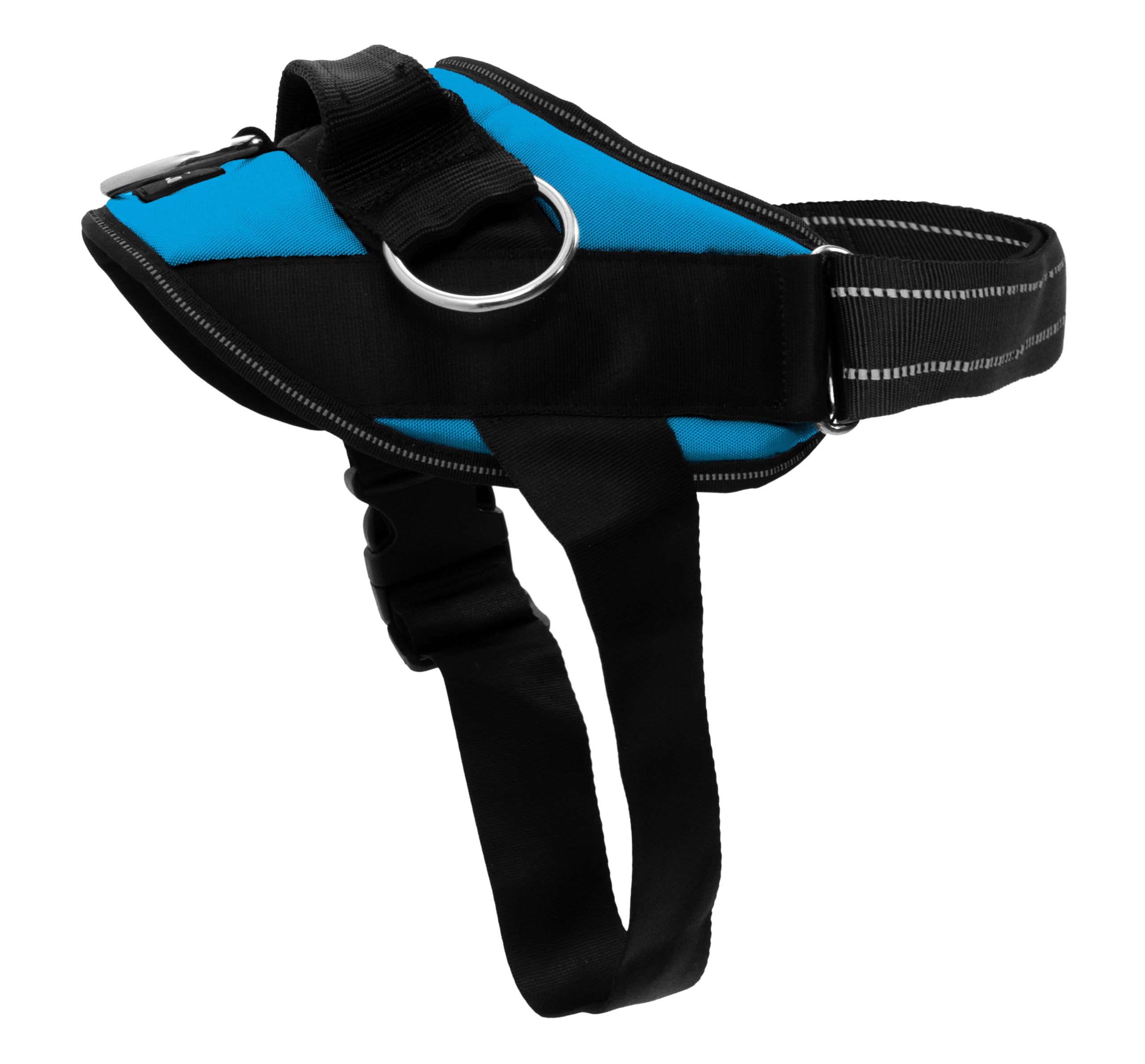
The ShawnCo Essential harness features three reinforced steel rings — one front, one back, and one chest — that give the runner options for how to position the leash. For a calm jog where the dog runs beside you, clip to the back ring. For training or to discourage pulling, use the front chest ring. This flexibility makes it a good bridge harness for owners transitioning from walking to running.
The mesh underside runs the full length of the belly, providing ventilation that matters when the dog is working. The chest strap and belly strap are fully adjustable, and the reflective chest plate and trim lining make the dog visible from all angles at night. Owners of small breeds with neck issues specifically praise the no-choke design, which directs all pressure to the chest plate.
This harness does have limits at higher speeds. The three-ring setup works well for a steady jog, but the back ring is centered on the spine rather than low on the back, which can cause the harness to shift sideways if the dog pulls at a full sprint. For occasional 3-5 mile jogs where the dog stays beside you, this is a comfortable, well-priced option that goes on in seconds.
Why we love it
- Three leash ring positions for flexible training and jogging
- Full mesh underside for ventilation during runs
- Goes on in under three seconds with one snap
Good to know
- Back ring centered on spine can shift at full sprint
- Not designed for heavy pulling or canicross use
6. PUPTECK Escape Proof Dog Harness

The PUPTECK harness solves the problem of dogs that can back out of standard vests. It adds webbing across the belly that runs between the front legs, creating a third retention point that prevents the harness from rotating and sliding over the dog’s head. Six adjustment points across the neck, chest, and belly allow you to tighten every dimension independently for a truly locked-in fit.
The outer shell is scratch-resistant oxford fabric, which holds up well against brush and undergrowth on trail runs. The inner lining is a breathable mesh with neoprene padding in the straps to minimize friction on the fur. Two D-rings — front for training, back for casual running — give flexibility, and the padded top handle is useful for lifting the dog over obstacles or through crowded areas.
Owners report that the straps can loosen during a run and require re-tightening. The three-release-buckle system makes it fast to put on, but the extra webbing can be slightly bulkier than a dedicated running harness. For runners with a known escape artist — particularly dogs with narrow heads and broad chests — this harness provides peace of mind that a standard vest cannot match.
Why we love it
- Extra belly webbing prevents back-out escapes
- Six adjustment points for a fully customized fit
- Scratch-resistant oxford fabric for trail durability
Good to know
- Straps may loosen during extended runs
- Slightly bulkier than slim pull-style harnesses
7. BARKBAY No Pull Dog Harness

The BARKBAY harness is the entry-level option that over-delivers on construction quality for its tier. The no-rip nylon webbing and zinc alloy clips are more durable than many harnesses at twice the price. Four points of adjustment — two on the chest, two on the belly — allow a near-custom fit, and the anti-chafe padding is strategically placed at the sternum and under the front legs.
Two metal leash attachment points (back and chest) give the runner options for casual jogging versus training corrections. The ultra-reflective strips wrap the entire chest and sides, making the dog visible from a quarter mile with even a small light source. Owners report that the harness holds up well to daily use, with the only caveat being that the size runs slightly tight over the head for deep-chested dogs.
This is not a high-performance running harness for sprinting or canicross. The back clip is centered and will not handle aggressive pulling without shifting. But for owners who run short distances — 1 to 3 miles — at a moderate pace with a dog that stays beside them, the BARKBAY offers build quality and visibility that punches well above its price tier. It is the most reviewed harness here by a wide margin for good reason.
Why we love it
- Exceptional build quality for the price tier
- Ultra-reflective strips for night visibility
- Four-point adjustment for a near-custom fit
Good to know
- Back clip shifts at full sprint or heavy pull
- Size runs slightly tight over the head for deep chests
FAQ
Can I use a standard walking harness for running?
Where should the leash attach for a running harness?
How do I measure my dog for a running harness?
Why does my dog chafe even with a padded harness?
Final Thoughts: The Verdict
For most active runners, the harness for running with dog winner is the Alpine Outfitters Urban Trail because its four welded D-rings and Polartec fleece padding make it the only harness here that transitions cleanly between canicross, bikejoring, and daily walks without sacrificing comfort. If your primary sport is competitive canicross, grab the Non-stop dogwear Freemotion 5.0 for its competition-proven Y-cut and two-year warranty. And for long trail runs where hydration matters, nothing beats the Ruffwear Trail Runner Vest — it keeps your dog fueled and balanced for double-digit distances.