
You’re searing a steak, and within 30 seconds the smoke detector screams. This is the daily reality of a kitchen that lacks proper air management. Between lingering grease, volatile organic compounds from cooking, and airborne pet dander that settles on every surface, the air in your cooking space demands a solution that matches the intensity of the work being done.
I’m Mo Mahin — the founder and writer behind Furric. I’ve analyzed hundreds of hours of owner feedback on kitchen air purifiers, studied the real-world CADR and decibel data across price brackets, and compared filtration technologies to separate effective units from marketing-driven shelf fillers.
Whether you need a countertop exhaust fan that tackles smoke in real time or a HEPA unit that scrubs lingering odors between meals, this guide will help you find the best kitchen air purifier for your specific cooking setup and living situation.
How To Choose The Best Kitchen Air Purifier
Choosing the right kitchen air purifier means understanding that your cooking environment creates a different pollutant profile than a bedroom or living room. High-heat cooking produces grease aerosols, smoke particles typically 0.1–1.0 microns, and odorous VOCs from oils and spices. A unit designed for dust and pollen may fail you here.
Filtration Type — HEPA vs. Multi-Layer vs. Ionic
True HEPA filters capture 99.97% of particles down to 0.3 microns, making them ideal for fine smoke particles and allergens. Units with multi-layer filtration — aluminum cores, polymer layers, and activated carbon — excel at trapping grease and absorbing odors. Ionic purifiers are silent and filter-free, but they cannot capture heavy grease or large smoke clouds in real time, making them a supplementary choice rather than a primary smoke solution.
Airflow Rate and Coverage
Smoke is a high-concentration event that demands high air changes per hour (ACH). For a standard kitchen of 150–200 sq ft, look for a unit that can cycle the room air at least 4 times per hour. Countertop range hoods with an airflow of 95 CFM or more can capture smoke at the source if placed within 4 inches of the cooking surface. Larger HEPA units covering 500+ sq ft are better for zone purification between cooking sessions.
Quick Comparison
On smaller screens, swipe sideways to see the full table.
| Model | Category | Best For | Key Spec | Amazon |
|---|---|---|---|---|
| AirHood Wired Range Hood | Portable Range Hood | Direct smoke capture | 5000 RPM / 3 speeds | Amazon |
| Cuisinart CAP-500 | H13 HEPA Purifier | Whole-room particle removal | 500 sq ft / 250 CADR | Amazon |
| Honeywell HPA125B | Compact HEPA | Odor & allergen control | 530 sq ft / 20.81 dB sleep | Amazon |
| TUCO Portable Range Hood | Countertop Exhaust | Small-space smoke reduction | 5-layer / 65 dB max | Amazon |
| BREETEE Portable Range Hood | Countertop Exhaust | Budget smoke management | 5-layer / 95 CFM | Amazon |
| Dyson Hushjet Compact Purifier | Smart HEPA | Quiet whole-room purification | 24 dB sleep / 5-yr filter | Amazon |
| LabCharge Ionic 5-Pack | Ionic Purifier | Filter-free background purification | No filter / 0.3 lb each | Amazon |
In‑Depth Reviews
1. AirHood Wired Range Hood

The AirHood Wired tackles the single biggest pain point of kitchen air quality: direct smoke capture at the source. Its dual-filter system combines a dishwasher-safe 3-ply stainless steel oil filter with activated charcoal cartridges rated for 500 hours of odor absorption. At 5000 RPM on the highest of three speeds, this portable range hood pulls smoke away from the cooktop before it can disperse into the room.
Real-world owner reports confirm it eliminates smoke during high-heat searing, preventing smoke detector activation. The plug-and-play ductless design means you can place it on any countertop or induction range without installation. At 3.92 pounds, it’s genuinely portable for RV or dorm use. Noise registers at 70 dB on max speed, which is noticeable but acceptable during active cooking — quieter than a full-size range hood.
The main limitation is height. Some users report the splatter guard interferes with suction, and the height booster — sold separately — improves capture efficiency for taller cookware. Odor removal for strong smells like fish or garlic is less complete than smoke capture, so pairing it with a secondary HEPA unit for post-cooking air scrubbing is a smart move.
Why we love it
- Powerful 5000 RPM motor catches smoke before it spreads
- Dishwasher-safe stainless steel oil filter reduces maintenance
- Truly portable with no ductwork required
Good to know
- Noisy at max speed — 70 dB makes conversation difficult
- Height booster is an additional purchase to optimize capture
- Charcoal filters need replacement after ~500 hours of use
2. Dyson Hushjet Compact Purifier
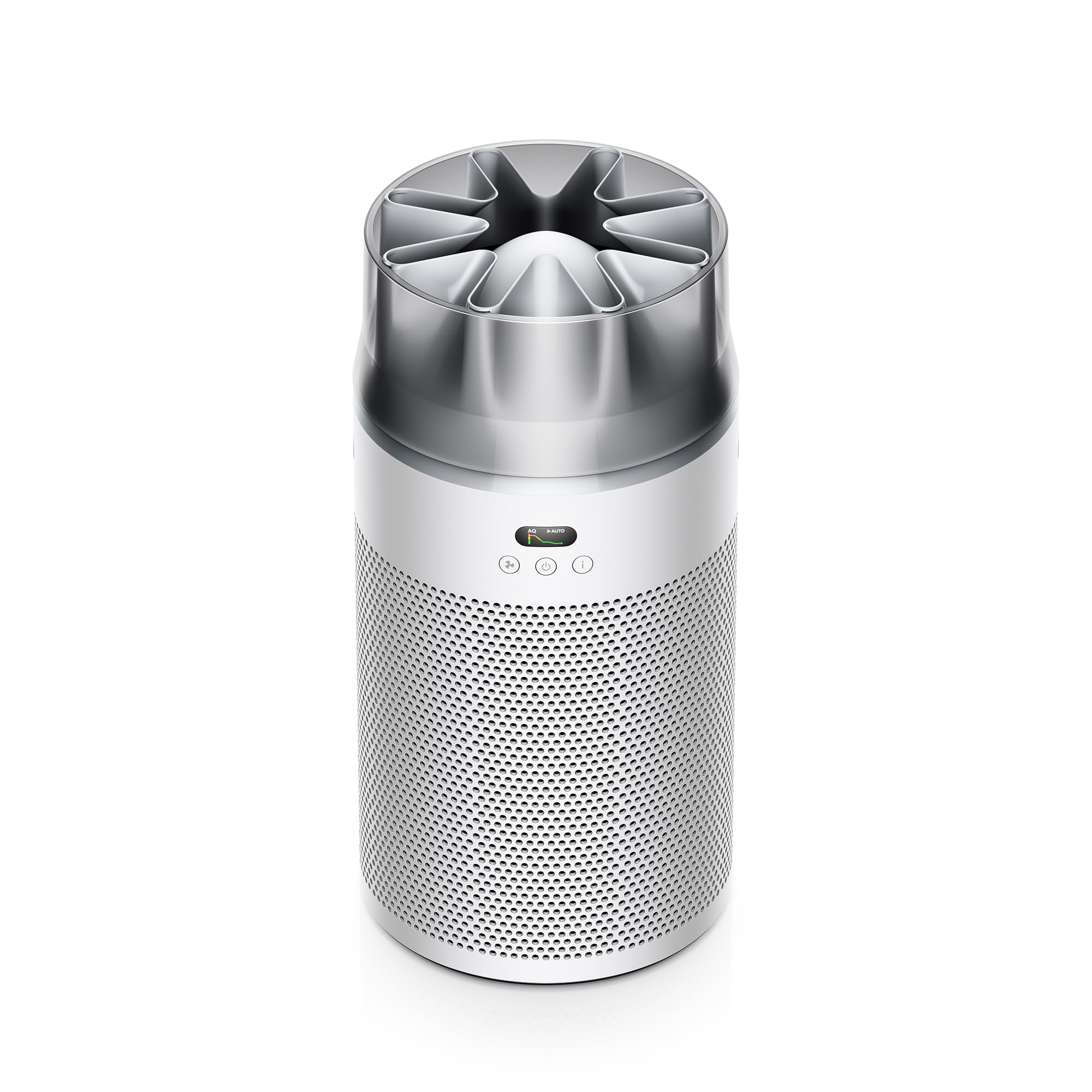
The Dyson Hushjet redefines quiet operation for kitchen use. Its proprietary star-shaped nozzle reduces turbulence, delivering whole-room purification at just 24 dB in Sleep mode — quieter than a library. The fully-sealed 360-degree electrostatic filter captures 99.97% of particles down to 0.3 microns, while the activated carbon layer absorbs cooking odors and gases like NO₂ from gas stoves.
Auto mode is where this unit shines in a kitchen. The real-time air quality sensor detects a drop in air quality — from a searing session or even someone walking through with strong perfume — and automatically ramps up fan speed. You can monitor everything through the MyDyson app, set schedules, and receive air quality reports. The filter is rated for up to five years, dramatically reducing long-term cost.
The trade-off is coverage. At 203 sq ft, this is suited for a compact kitchen or a kitchen-dining nook, not a large open-concept space. Owners report it performs excellently in bedrooms with litter boxes and acts as white noise on higher speeds. Unlike the AirHood, this unit recirculates room air rather than capturing smoke at the stove, so you’ll need to run it for 10–15 minutes after cooking to fully clear the air.
Why we love it
- Near-silent 24 dB operation in Sleep mode won’t disturb conversation
- Five-year filter lifespan minimizes replacement hassle
- Auto mode with real-time air quality sensing adjusts on the fly
Good to know
- Coverage limited to ~200 sq ft — not for large open kitchens
- Post-cooking odor removal requires running the unit for several minutes
- No remote control included, app-only control may feel limiting
3. Cuisinart Air Purifier CAP-500
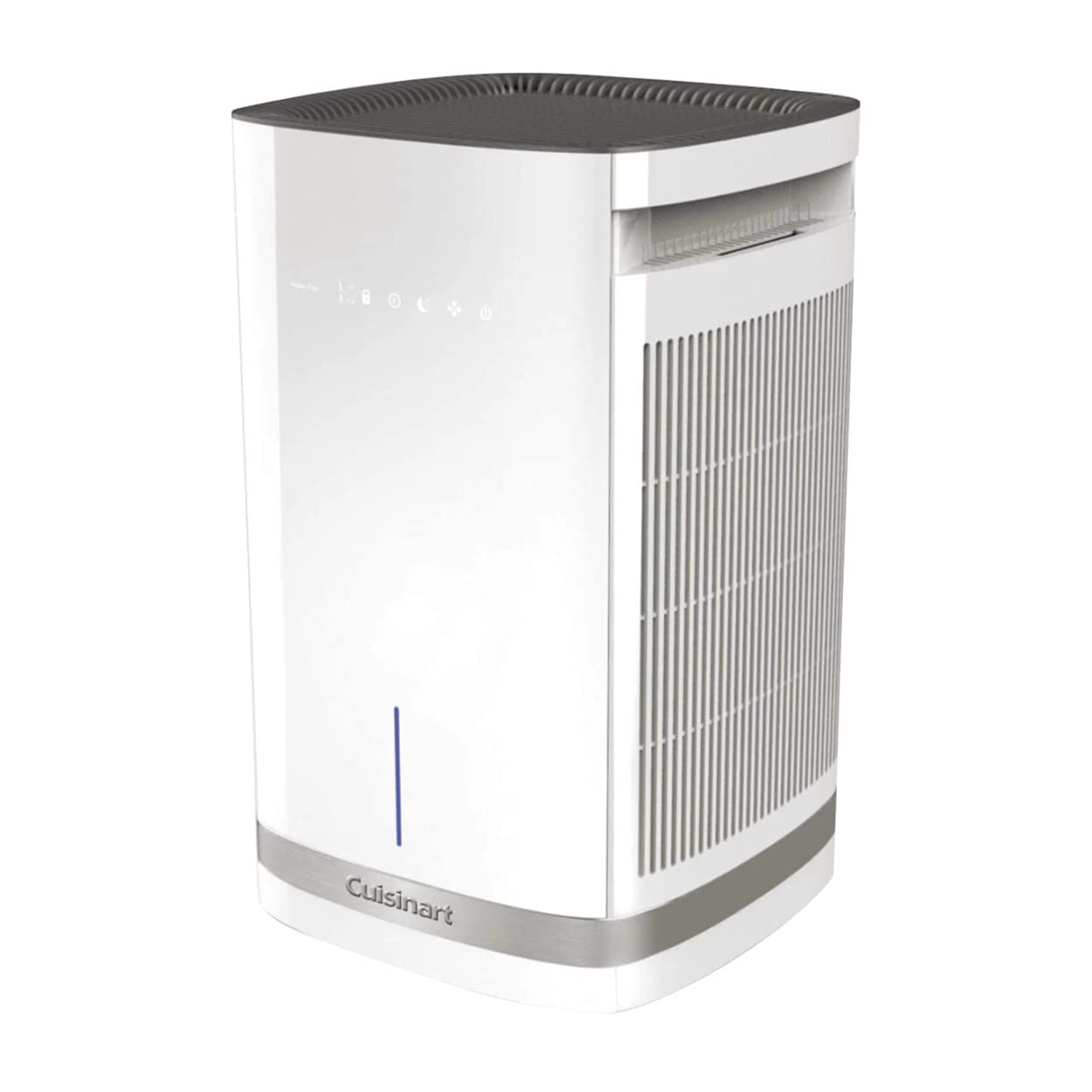
Cuisinart brings its kitchen appliance expertise to air purification with the CAP-500, a serious H13 HEPA unit that captures 99.9% of particles as small as 0.1 microns. With a 250 CADR rating and coverage up to 500 sq ft, this unit can cycle a medium-sized kitchen four times per hour. Owners report it clears cooking odors faster than pricier brands and reduces congestion during allergy season.
The filtration stack is thorough: two H13 HEPA filters, two active carbon filters, and two washable metal pre-filters. The 2,500-hour runtime rating means you get roughly a year of continuous use before needing replacements. Illuminated touch controls, a filter replacement indicator, and a child safety lock add real convenience. At 40 watts, it’s also energy-efficient for a unit of this capacity.
The CAP-500 lacks auto air quality adjustment — you select the fan speed manually. On high, it is audible, though owners describe it as acceptable for a bedroom or kitchen. The dual-side air intake is effective but means the unit needs at least 6 inches of clearance on both sides. It is heavier at 8 pounds, which gives it stability but reduces portability compared to countertop range hoods.
Why we love it
- H13 HEPA captures 99.9% of particles down to 0.1 microns
- 500 sq ft coverage with 4x ACH for medium kitchens
- 2,500-hour filter life and low 40W power draw
Good to know
- No auto mode — speed adjustment is manual only
- Audible on high speed, less suited for open-plan living
- Requires side clearance for dual air intake
4. Honeywell Allergen Plus HPA125B
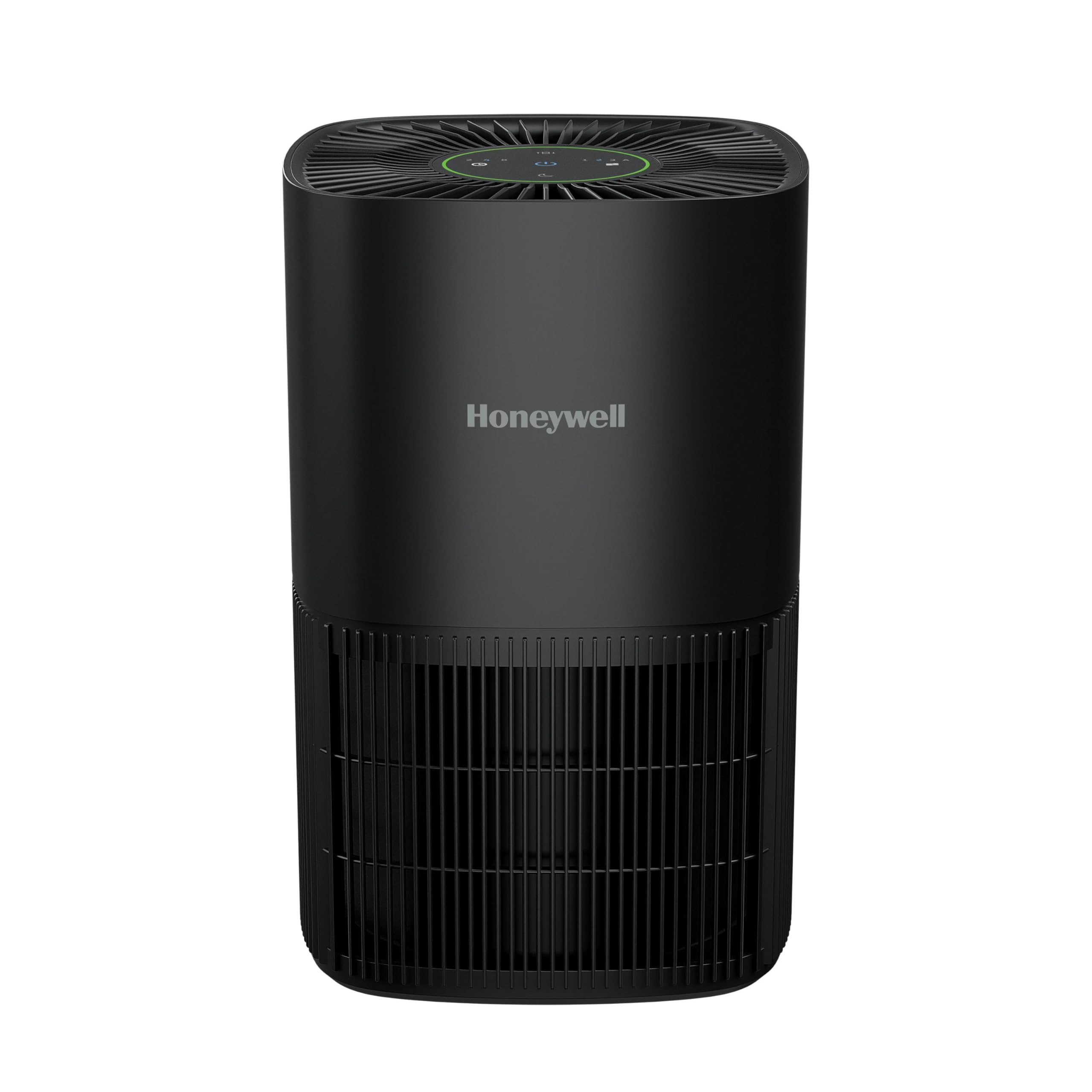
The Honeywell HPA125B proves that good air quality doesn’t require a large footprint. At just 7 inches square and 2.08 pounds, this compact HEPA purifier fits on a countertop corner or shelf without dominating the space. Its standout feature is the AQSense Auto Mode with a color-coded air quality sensor — green, yellow, and red indicators let you see real-time changes as you cook.
The 3-in-1 filtration system uses a HEPA filter for 99.97% particle capture, an activated carbon layer for odors and VOCs, and a pre-filter for pet hair and visible dust. Sleep mode drops noise to an astonishing 20.81 dB — among the quietest in this roundup — with dimmable lights. In a 110 sq ft room, it achieves 4.8 air changes per hour, making it ideal for a galley kitchen or kitchenette.
Owner feedback is overwhelmingly positive for odor removal and quiet operation. The 360-degree intake with top exhaust is well-suited for bedside use, which means it doubles as a bedroom purifier when the kitchen is not in use. The only common complaint involves the bright blue light on higher fan speeds — it cannot be turned off while maintaining speed, so some users place a manual cover over the display at night.
Why we love it
- Ultra-quiet 20.81 dB sleep mode for 24/7 use
- AQSense auto mode with real-time air quality color display
- Compact 7×7 inch footprint fits tight spaces
Good to know
- Best for rooms up to 110 sq ft — not for large open kitchens
- Bright light on higher speeds cannot be dimmed independently
- Filter replacements required every 6–12 months
5. TUCO Portable Range Hood
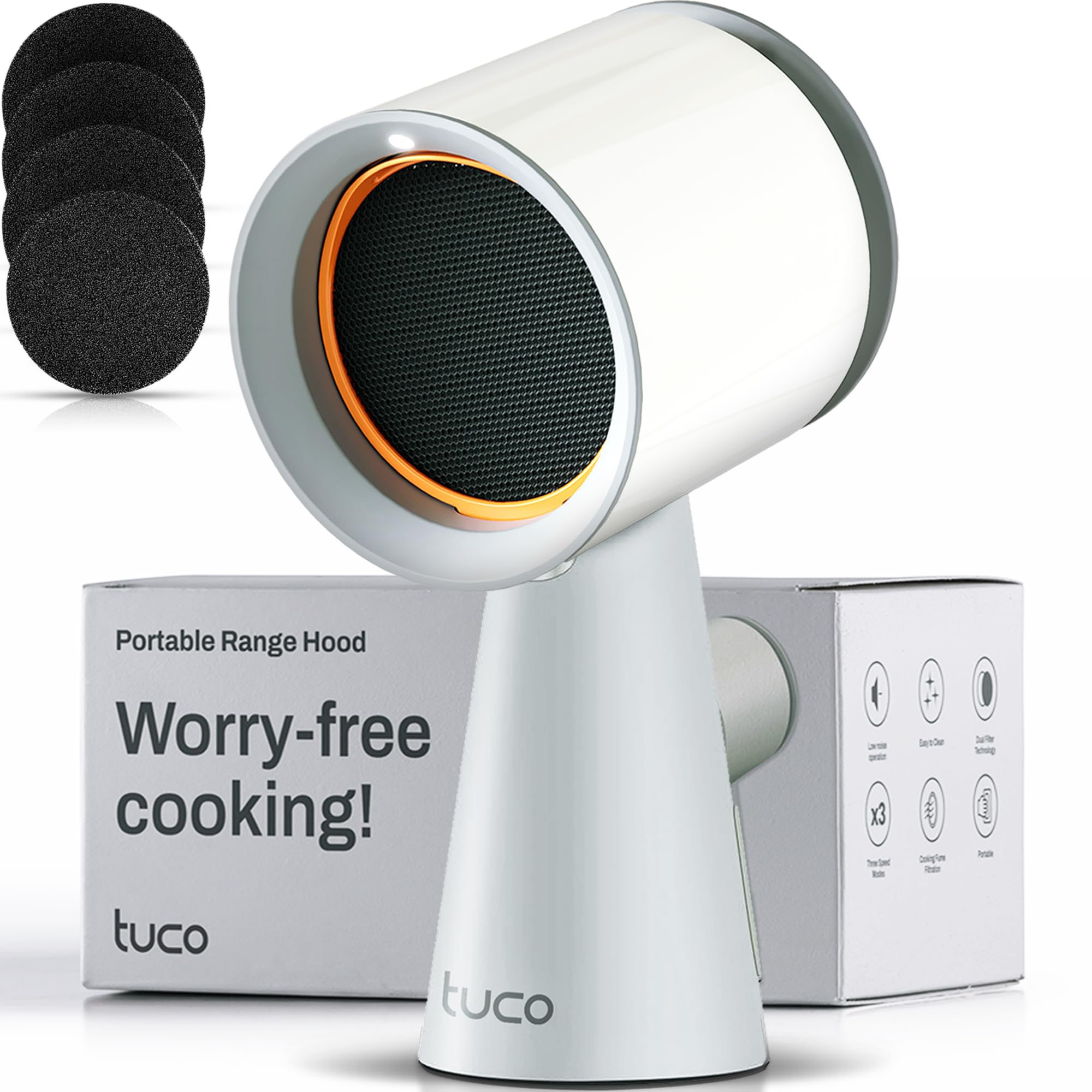
The TUCO Portable Range Hood delivers a strong balance of smoke capture and affordability for renters, dorm residents, and apartment dwellers. Its 5-layer filtration system combines an aluminum quad-core filter, a polymer layer, and an activated carbon filter to trap grease and reduce cooking odors. The 70-inch power cord gives flexible placement options on any countertop.
With three speed settings and a noise range of 50–65 dB, it runs quieter than a full-size range hood while still being effective. Owners report capturing roughly 90% of smoke during searing sessions, with the remaining odor dispersing into the room. The built-in LED light illuminates the cooktop, and the matte grey finish resists fingerprints and grease stains visibly.
The key limitation is that, like all countertop range hoods, performance drops significantly if the unit is placed more than 5–6 inches from the cooking surface. It is not a substitute for a permanently installed vent hood in a large kitchen, and some owners find the push-button controls feel less premium than touch-sensitive alternatives. Replacement filters are readily available and easy to swap.
Why we love it
- 5-layer filtration effectively captures grease and smoke at the source
- Compact 5 x 7 x 14.5 inch footprint fits small countertops
- Low 50 dB on lowest speed suits continuous use
Good to know
- Requires 4–5 inch proximity to stovetop for best performance
- Push-button controls less refined than touch models
- Not designed to replace a full-size ducted range hood
6. BREETEE Portable Range Hood
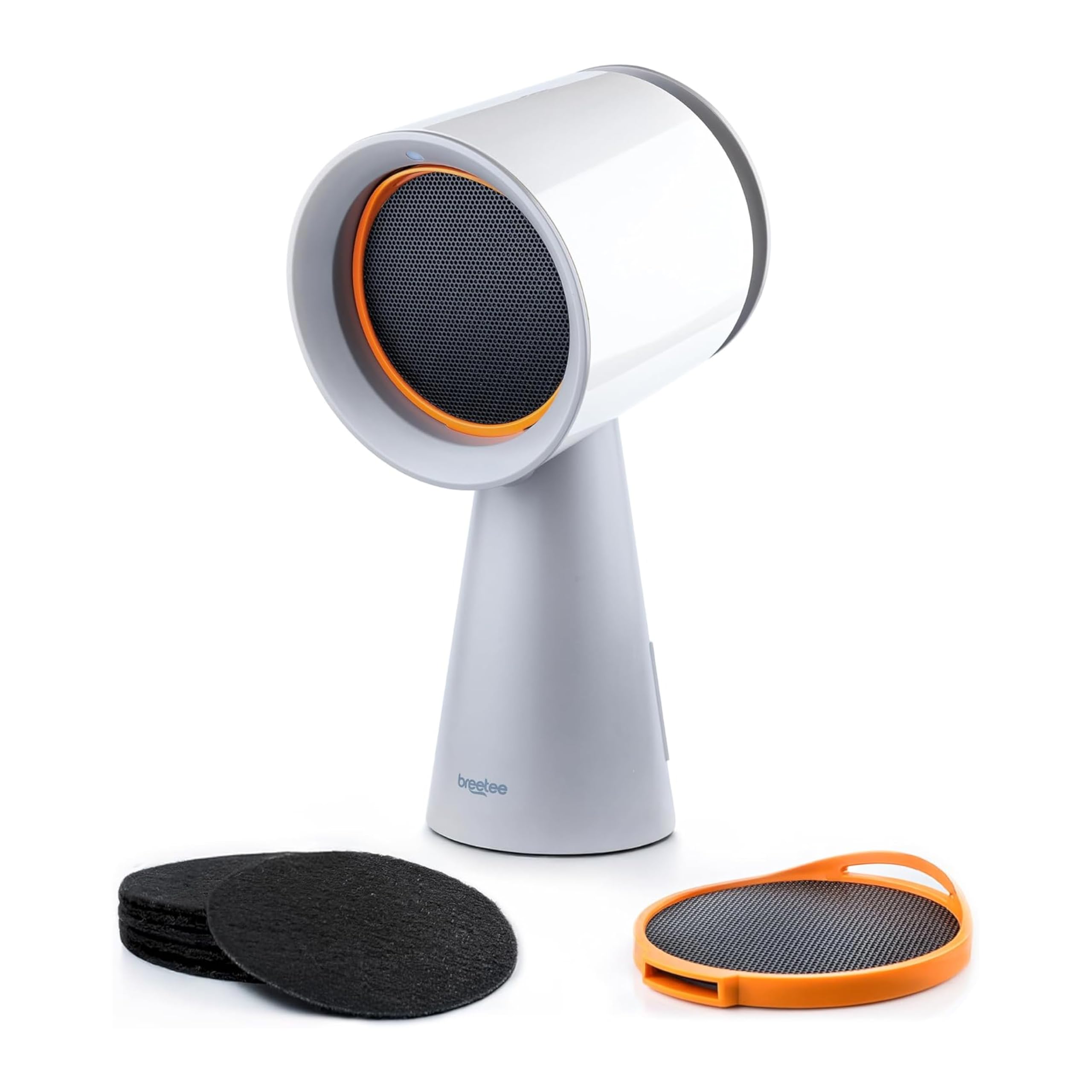
The BREETEE Portable Range Hood takes a pragmatic approach to kitchen air management at a very accessible price point. Its 5-layer aluminum and activated carbon filter captures grease and smoke during cooking, with a rated airflow of 95 CFM. The 70-inch power cord and plug-and-play design mean you can place it exactly where you need it — on a kitchen island, RV counter, or dorm table.
Real-world feedback is split in a revealing way. Users who place the unit close to the cooking surface — within 4 inches — report it effectively prevents smoke detector activation and eliminates visible smoke during high-heat cooking. Those who expected it to handle heavy smoke from a gas range without positioning care report disappointment. The noise level of 50–65 dB is acceptable for active cooking.
The off-white finish is a design choice that may show grease more readily than darker units, and the push-button controls are functional but basic. The included oil cup is a practical touch, collecting grease drips that might otherwise land on the counter. This unit is best viewed as a smoke-management accessory for small spaces rather than a comprehensive whole-room air purification solution.
Why we love it
- 95 CFM airflow captures smoke effectively at close range
- 70-inch power cord offers flexible placement across kitchen layouts
- 5-layer filter and oil cup reduce grease buildup
Good to know
- Performance drops steeply beyond 4–5 inches from cooking surface
- Not designed to replace a full-size vent hood in large kitchens
- Off-white finish shows grease and requires frequent wiping
7. LabCharge Small Ionic Air Purifier 5-Pack
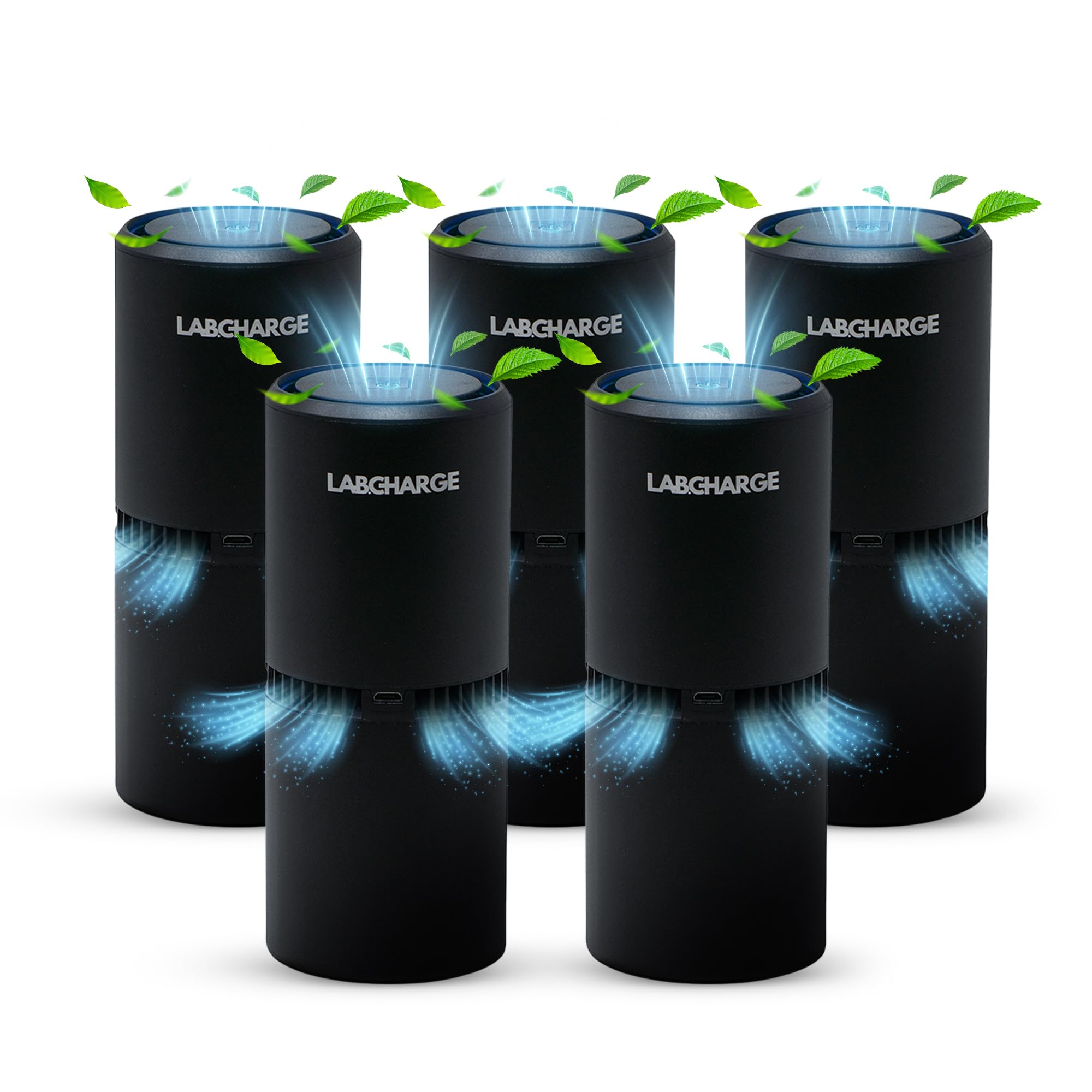
The LabCharge ionic purifier 5-pack takes a fundamentally different approach. Instead of pulling air through a filter, it emits high-density ions that attach to airborne particles, causing them to clump and fall out of the breathing zone. Each unit is just 3.5 inches tall and 0.3 pounds — smaller than a smartphone — with zero filter replacements, zero installation, and zero ongoing costs.
Owner testimony is compelling for certain use cases. Users with severe allergies report symptom relief within hours, and those with two cats note a significant reduction in pet dander. The whisper-quiet operation — no fan, just a faint electrical hum — makes it unobtrusive anywhere. The 5-pack lets you place one in the kitchen, bedroom, office, living room, and entryway simultaneously, which is unique among products in this roundup.
However, ionic purifiers have inherent limitations in a kitchen environment. They cannot capture grease aerosol or heavy smoke in real time — the mechanism requires particles to drift into the ionization field. For immediate smoke management during searing or frying, this unit is inadequate. The LED light on top is also bright enough to be disruptive in a dark bedroom. It is best used as a complementary background purifier, not a primary kitchen smoke solution.
Why we love it
- Zero filter replacement costs over the lifetime of the unit
- 5-pack covers multiple rooms for consistent background purification
- Completely silent operation and takes up no counter space
Good to know
- Cannot capture grease or heavy smoke — only fine particles and odors
- Bright top LED may be disruptive in dark bedrooms
- Individual units are small with limited coverage per unit
FAQ
Can a regular HEPA air purifier handle kitchen smoke?
How often should I replace filters in a kitchen purifier?
Are ionic purifiers effective for kitchen use?
What is the ideal noise level for a kitchen air purifier?
Do I need a countertop range hood or a HEPA purifier?
Final Thoughts: The Verdict
For most gardeners, the kitchen air purifier winner is the AirHood Wired Range Hood because it directly attacks the biggest kitchen air problem — visible smoke at the stove — with a powerful 5000 RPM motor and durable dual-filter design. If you prioritize whisper-quiet whole-room purification and smart-home integration, grab the Dyson Hushjet. And for coverage of larger kitchen spaces with H13 HEPA efficiency, nothing beats the Cuisinart CAP-500.