
A reef aquarium demands stability above all else. A temperature swing of just a few degrees can stress LPS corals, trigger rapid tissue necrosis in SPS, or send your prized anemone into a spiral. The heater inside your sump is the single piece of equipment most likely to fail silently, and when it does, the financial and emotional cost is brutal. Choosing the right one is not a luxury; it is a biological necessity for your closed-loop ecosystem.
I’m Mo Mahin — the founder and writer behind Furric. I have spent countless hours cross-referencing technical specifications from manufacturer datasheets with aggregated owner feedback across reefing forums to isolate which aquarium heaters actually hold their set point under real-world bioload and ambient temperature conditions.
This guide breaks down the essential construction materials, controller accuracy ratings, and safety redundancies you need to know before buying a reef aquarium heater that protects your investment from both thermal shock and catastrophic failure.
How To Choose The Best Reef Aquarium Heater
Selecting a heater for a reef tank is fundamentally different from choosing one for a freshwater community aquarium. The corrosive chemistry of saltwater, the tight temperature tolerance of corals, and the high cost of livestock demand materials and precision that entry-level heaters cannot provide. Focus on these four areas before you click “buy”.
Titanium vs. Quartz Glass Construction
Quartz glass heaters heat up and cool down rapidly, making them responsive but brittle. A crack in a glass heater inside a reef tank releases stray electrical current and can crash the system’s salinity gradient. Titanium heaters are shatterproof, do not corrode in saltwater, and resist thermal shock when removed for cleaning. For any reef aquarium over 20 gallons, titanium is the default safer material.
Controller Type and Accuracy
Internal bimetal thermostats are inexpensive but drift significantly over time. An external IC (integrated circuit) controller with a separate probe provides a hysteresis of +/- 0.5°C to 1.0°F, which is tight enough to avoid stressing corals. Look for a controller that displays both the set temperature and the current tank temperature simultaneously, so you can spot drift at a glance without touching the water.
Safety Features: Over-Temperature Protection and Dry-Fire Prevention
A reef heater should have an automatic shut-off that triggers if the unit is exposed to air during a water change (dry-fire prevention) and another that cuts power when the tank temperature exceeds a safe threshold, typically around 97°F to 100°F. These features prevent melted wiring and fish kills if the controller fails or the water level drops unexpectedly.
Wattage Selection Based on Biotope
The standard rule of thumb is 4 to 5 watts per gallon of water for a reef tank, but ambient room temperature plays a larger role in practice. If your aquarium sits in a cold basement or near an exterior wall in winter, size up by one tier. A single heater should never be oversized beyond about 6 watts per gallon, however, because large heaters can overshoot on small water volumes. Two medium heaters are safer than one giant unit that fails stuck-on.
Quick Comparison
On smaller screens, swipe sideways to see the full table.
| Model | Category | Best For | Key Spec | Amazon |
|---|---|---|---|---|
| hygger Pinpoint Titanium 200W | Premium | SPS/Dominant Reef Tanks | Titanium tube, +/- 0.5°C accuracy | Amazon |
| Aqueon Pro 300 | Premium | Large Reef Tanks & Turtles | Shatterproof alloy-steel body, 300W | Amazon |
| hygger Intelligent 200W | Mid-Range | Mixed LPS/Soft Coral Tanks | Quartz glass, APS anti-boiling system | Amazon |
| Marineland Precision 250W | Mid-Range | Freshwater/Saltwater Hybrid Setups | Mica core, dial click adjustment | Amazon |
| ZazaFi 300W | Budget | Entry-Level Reef Kits | Quartz glass, external LED controller | Amazon |
In‑Depth Reviews
1. hygger Pinpoint Saltwater Aquarium Heater 200W Titanium

This is the unit every reef keeper with a 20-to-45-gallon system should consider first. The tube is pure titanium — zero glass, zero risk of shattering from thermal shock or clumsy handling. At 10.7 inches, it fits vertically in most sump chambers or horizontally in the display tank without disrupting aquascaping. The external IC controller provides a control accuracy of +/- 0.5°C, which is tight enough for sensitive Acropora and Montipora colonies.
Owner reports consistently confirm that it heats a 36-gallon tank from 71°F to 79°F in roughly three hours and holds temperature with about 1°F of hysteresis. The dual LCD display shows both the set point and the current aquarium temperature simultaneously, allowing you to verify performance at a glance without a separate thermometer. A few users experienced failure after several months, but the manufacturer provided replacements promptly — a sign that customer support is responsive for a category where failure means livestock loss.
For a reef tank demanding pinpoint stability and absolute material safety, this hygger Pinpoint is the strongest option in the mid-to-high tier. The purely mechanical risk of a shattered heater is eliminated entirely, and the controller accuracy rivals units costing twice as much. It is not rated for tanks above 45 gallons, so size up to the 300W variant if your display is larger.
Why we love it
- Shatterproof titanium construction eliminates glass-breakage risk in saltwater
- External controller with dual LCD display and +/- 0.5°C accuracy
- Auto shut-off system prevents overheating and dry-fire accidents
Good to know
- Suction cups can lose grip over time; monitor mounting periodically
- Some users report 1°F hysteresis rather than the advertised 0.5°C
2. Aqueon Pro 300 Submersible Heater 300W

The Aqueon Pro line has been a staple in the aquarium industry for years because it balances rugged construction with a limited lifetime warranty. The 300W model is rated for tanks up to 100 gallons, making it a candidate for larger reef systems or frag tanks that need reliable heat without breaking the bank. Its body is made of alloy steel and shatterproof plastic — not glass and not pure titanium, but far tougher than standard quartz tubes.
The electronic thermostat is accurate to +/- 1°F, which is adequate for mixed reefs with LPS and soft corals but slightly looser than the hygger Pinpoint for SPS-dominated systems. Owners report these units lasting six years or more without drift, and the manufacturer honors the lifetime warranty when failures occur, replacing units with minimal hassle. One frequent note is that the heater can feel cool to the touch even when it is maintaining 80°F, simply because it cycles efficiently.
If you run a larger display tank (75 to 100 gallons) and want a single, durable heater with a safety net, the Aqueon Pro 300 is a solid investment. It does not offer the sub-0.5°C precision of dedicated titanium units, but its warranty and build quality give it a long-term value edge over disposable glass models.
Why we love it
- Limited lifetime warranty provides excellent long-term coverage
- Shatterproof alloy-steel body is nearly indestructible
- Suitable for larger systems up to 100 gallons
Good to know
- Accuracy is +/- 1°F; not ideal for SPS coral tanks
- LED indicator lights are bright in a dark sump area
3. hygger Intelligent 200W Submersible Heater
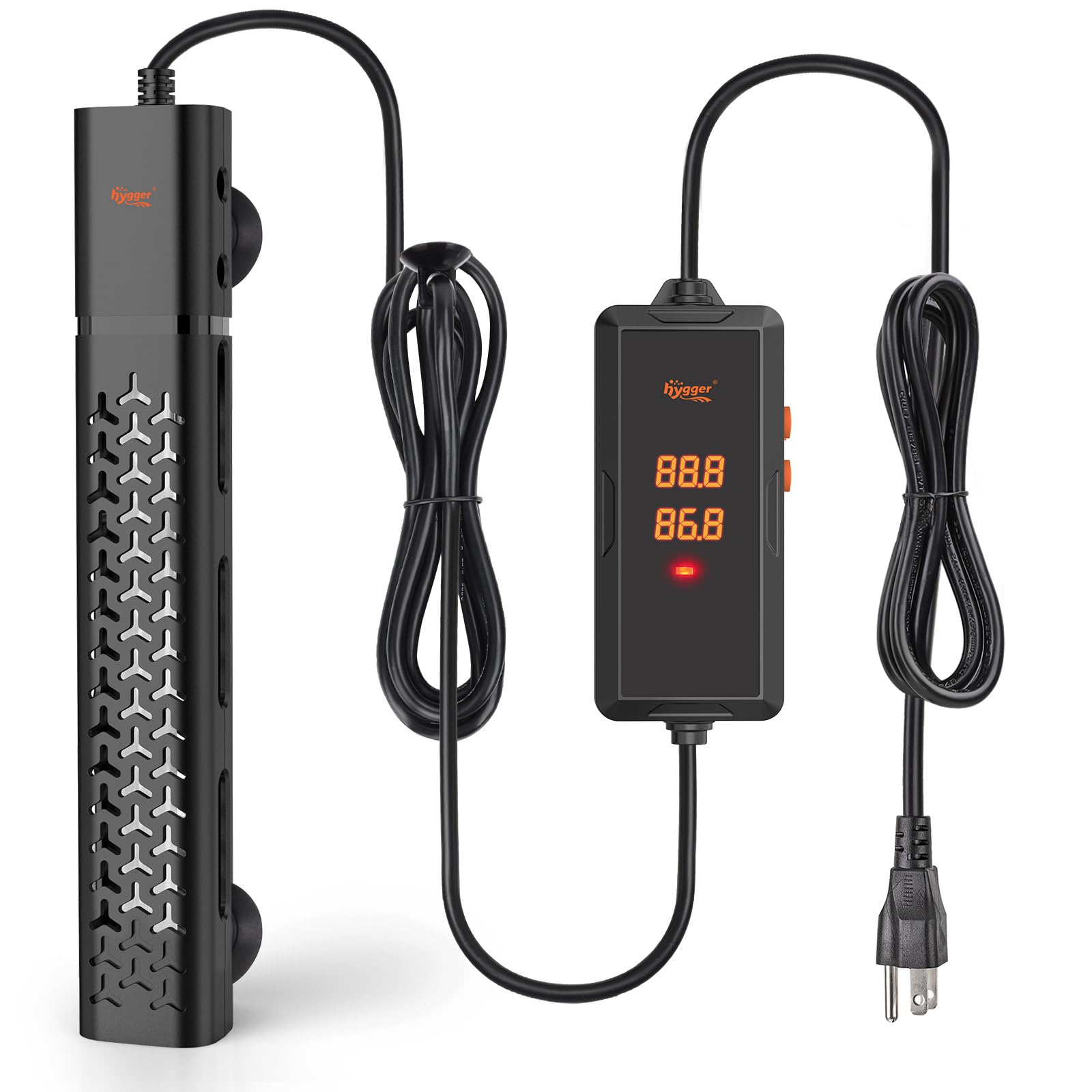
hygger continues to deliver well-featured heaters at accessible price points. This 200W model is designed for 20-to-40-gallon tanks and packs multiple safety layers rarely seen at this level: over-temperature protection that triggers an audible alarm if the water exceeds 97.7°F, a water-sensor that shuts off the unit when it lifts above the surface, and the APS (Anti-Boiling System) that cuts power within 10 seconds if the heater runs out of control.
The quartz glass construction with silicon carbide thermal conductivity heats water faster than standard glass, and the automatic frequency power-saving feature drops the heating output to 10-30% as the set temperature approaches, reducing thermal overshoot. The external controller adjusts temperature in 0.5°F increments up to 93°F, giving you granular control for specialized tanks like frag systems or invert-only setups. Owners report stable temperature maintenance even in rooms that drop to 65°F at night.
For a reef tank on a mid-range budget, this hygger offers safety redundancies that many competitors reserve for their premium lines. The safety features alone make it a strong choice for a beginner who may still be learning water-change protocols.
Why we love it
- APS anti-boiling system and dry-fire protection included at this price tier
- 0.5°F adjustment increments for precise temperature targeting
- 24-month manufacturer warranty adds confidence
Good to know
- Quartz glass can crack if handled roughly during cleaning
- LED controller is not backlit, making it hard to read in dim sumps
4. Marineland Precision Submersible Heater 250W
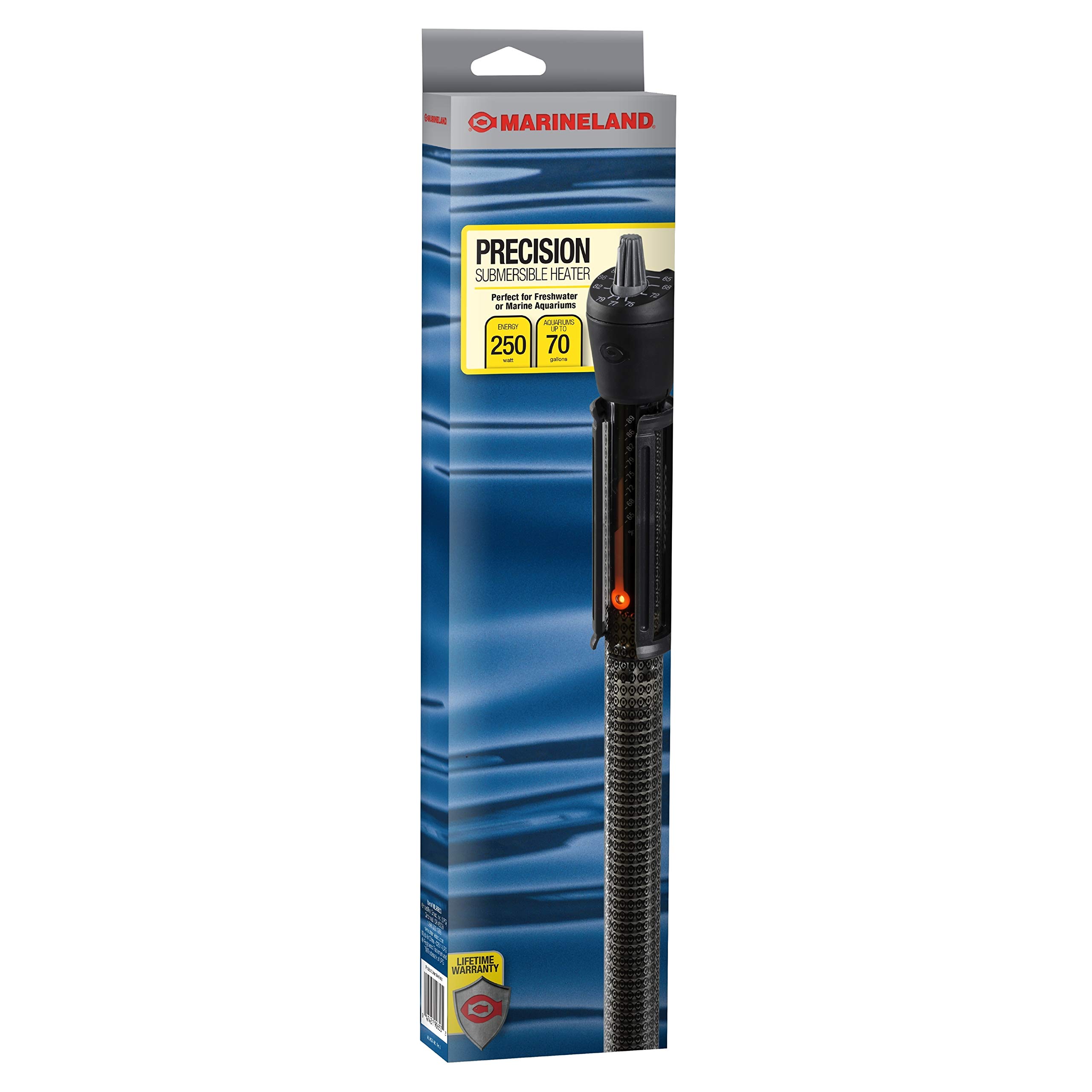
Marineland has been manufacturing aquarium equipment for decades, and the Precision heater line reflects that legacy. The 250W model uses a mica core surrounded by a mesh heating element, which distributes heat more evenly than simple coiled wire and extends the heater’s lifespan. The adjustable temperature dial clicks through one-degree increments, giving tactile feedback as you set the target. Three viewing windows in the mounting bracket let you read the sliding scale from different angles.
Owners who bought this heater years ago consistently mention durability lasting 10 to 20 years across multiple tank setups. That said, recent batches have drawn mixed reviews: some units stopped heating within a month, and a small number of buyers reported the unit smoking or overheating due to a faulty internal thermal switch. The suction cups have also been criticized for losing grip, which can cause the heater to shift against the glass and potentially crack it if the heater is quartz-based.
For a backup heater, a quarantine tank, or a low-bioland environment where you can monitor the unit daily, the Marineland Precision remains a functional choice. But for a primary reef aquarium heater running 24/7 without supervision, the reliability variance makes it a secondary option rather than a top-tier pick.
Why we love it
- Mica core mesh element provides even heat transfer and long service life
- Click-dial adjustment with sliding temperature scale is intuitive
- Eight sizes available for matching any tank volume
Good to know
- Mixed reliability reports; some units fail or overheat within weeks
- Suction cups are notoriously weak and may not hold on textured glass
5. ZazaFi 300W Aquarium Heater with External Controller
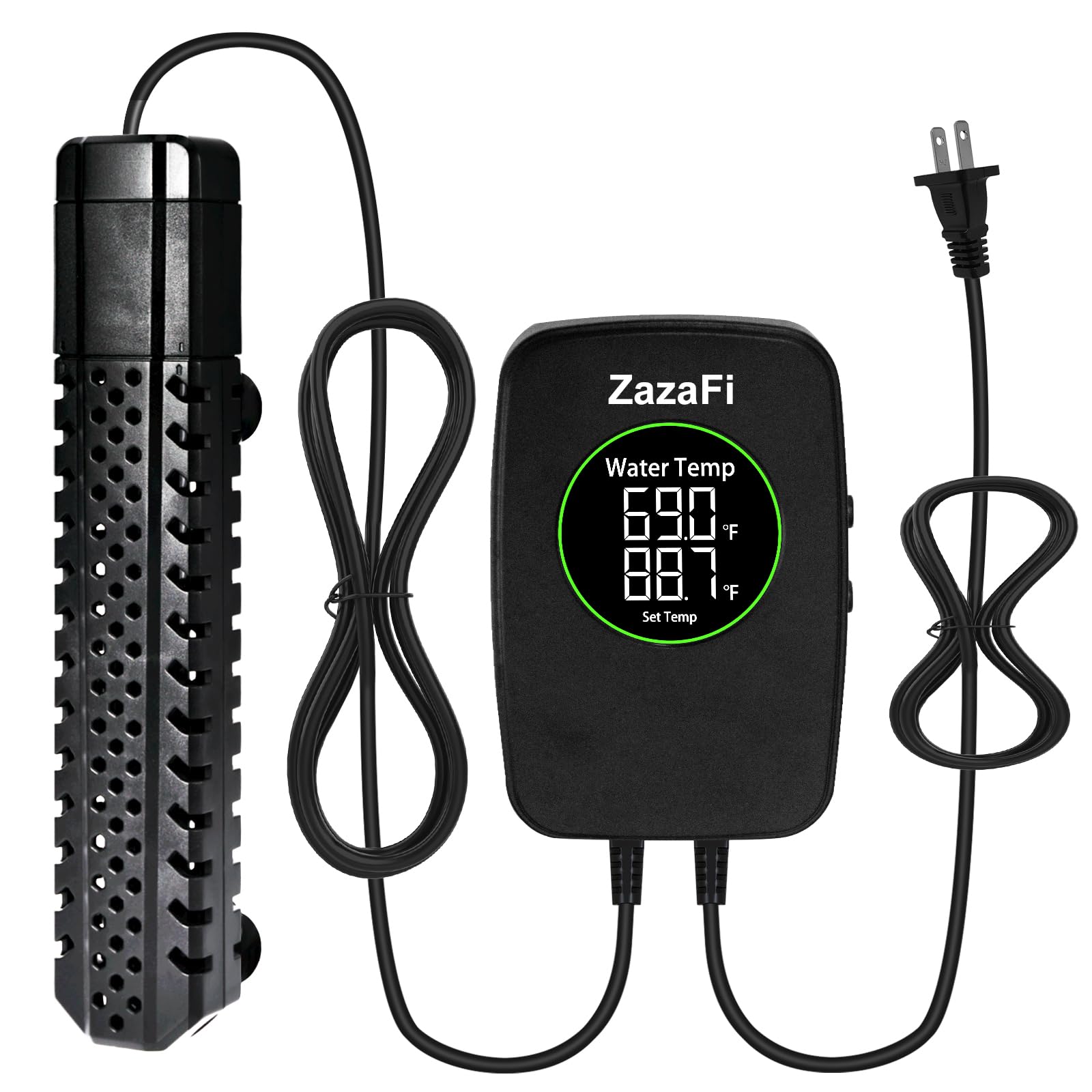
ZazaFi enters the reef heater space with an aggressive price point and a feature list that includes an external IC controller, dual temperature scale (Fahrenheit/Celsius), and an intelligent water sensor that cuts power when the heater lifts out of the water. The 300W version is rated for 40-to-75-gallon tanks and uses nickel-chromium wire inside explosion-proof quartz glass with a black ABS shell to prevent burns on fish and invertebrates.
Early buyer feedback is overwhelmingly positive — the heater holds temperature within one degree of the set point, and the external controller buttons are responsive. For the price, the build quality and control accuracy outperform many glass heaters in the same bracket. The main tradeoff is the quartz glass body: it heats quickly but remains brittle. One drop or thermal shock from a cold water change could shatter it, which is a non-negotiable risk in a reef system where stray voltage can kill livestock.
If you are setting up a budget reef tank, a coral quarantine tank, or a soft coral system where livestock value is lower, the ZazaFi 300W delivers reliable performance for very little money. Just pair it with a separate temperature controller as a safety fallback, because the quartz glass does not forgive accidents.
Why we love it
- External IC controller with clear two-digit LED temperature display
- Water sensor automatically stops heating if exposed to air
- Strong suction cups for secure mounting on aquarium glass
Good to know
- Quartz glass body is fragile; handle carefully during cleaning
- Not designed for titanium-level corrosion resistance in long-term saltwater use
FAQ
Can I use a freshwater heater in a reef aquarium?
What wattage do I need for a 75-gallon reef tank?
How often should I replace my reef aquarium heater?
Final Thoughts: The Verdict
For most gardeners, the reef aquarium heater winner is the hygger Pinpoint 200W Titanium because it eliminates glass shatter risk and delivers +/- 0.5°C accuracy that SPS corals demand. If you want a shatterproof body with a lifetime warranty for a larger tank, grab the Aqueon Pro 300. And for a budget-friendly entry into reefing with reliable safety features, nothing beats the ZazaFi 300W when paired with a separate external controller.