
A fence that a dog can climb, dig under, or simply bolt past leaves you with two choices: a constant watch or a risky gamble. A Dog Collar Fence shifts that balance by placing the boundary on the animal, not the landscape — a receiver collar that responds with escalating tones, vibrations, or static whenever a paw crosses an invisible line you define. The technology range is wide, from buried-wire loops that have anchored yards for decades to satellite-based GPS collars that follow you to a campsite or a second home.
I’m Mo Mahin — the founder and writer behind Furric. I’ve spent the last several years comparing containment specs, studying GPS drift tolerances and static correction levels, and analyzing aggregated owner feedback from thousands of verified purchasers to identify which collar-fence systems actually deliver consistent, reliable boundaries day after day.
This guide breaks down the seven most capable options on Amazon, from entry-level GPS units to premium wired systems with training remotes, so you can match the right containment approach to your property size and your dog’s determination. Use this analysis to find the best dog collar fence for your specific yard, dog breed, and budget.
How To Choose The Best Dog Collar Fence
A dog collar fence is only as effective as the match between its technology and your property’s physical reality. The first fork in the road is wired versus wireless: in-ground systems loop a signal-emitting wire around the perimeter you dig into the soil, creating a precise boundary that works regardless of tree cover or building interference. GPS wireless collars, by contrast, use satellites to define a circular or custom-shaped zone — no digging required, but they can lose lock under dense canopy or in narrow side yards where signal multipath confuses the receiver.
Wired vs. GPS foundation. In-ground fences (the PetSafe and SportDOG models on this list) trade installation labor for reliability. Once the wire is buried and spliced, the boundary is rock-solid; GPS drift of a foot or two is irrelevant. Wireless systems (FOCUSER, VERSMELO, Halo) sacrifice some positional precision for portability and zero-dig setup. If your property has a clear sky view and you want to take the fence to a vacation cabin, GPS wins. If you have a heavily wooded lot or a narrow corridor along a house wall, a wired loop gives fewer false corrections.
Correction type and escalation. Every system here uses a graduated approach: a warning tone, then vibration, then static stimulation. The key differentiator is the number of static levels and whether the collar auto-shuts off to prevent overstimulation. For a sensitive 20-pound terrier, you want 4–5 gentle levels topping out at a mild tickle. For a 100-pound livestock guardian dog that ignores first warnings, you need higher intensity and a run-through prevention feature that escalates correction if the dog keeps charging the boundary.
Boundary shape and coverage area. Circular GPS fences (typical in budget wireless models) force your property into a round zone, which wastes space on irregular lots. More advanced GPS collars like the Halo let you draw custom polygons around your house, driveway, and garden beds. Wired fences follow any path you lay. Coverage range matters too: a GPS model with a 990-meter radius covers over 750 acres, but the collar battery must survive that full-day patrol. In-ground transmitters for wired systems typically handle 1–10 acres with standard wire, expandable to 100 acres with heavier gauge and a loop extension kit.
Collar fit and battery logistics. Neck sizes from 6 inches (small puppies) to 30 inches (giant breeds) are accommodated across this list, but not every collar fits the full spectrum. Check the stated neck range. Battery type is equally practical: rechargeable lithium-ion collars (common in GPS units and newer PetSafe models) save on battery cost but require nightly charging and eventually hold less charge after 12–18 months. Traditional 9V battery collars (older PetSafe, SportDOG) give months of run time but demand a small screwdriver and fresh batteries — a pain point long-time users regularly mention.
Quick Comparison
On smaller screens, swipe sideways to see the full table.
| Model | Category | Best For | Key Spec | Amazon |
|---|---|---|---|---|
| Halo Collar 5 | GPS Wireless | Custom-shaped boundaries & real-time tracking | Dual-frequency GPS (L1+L5), 2-ft accuracy | Amazon |
| SportDOG Contain + Train | In-Ground Wired | Hybrid fence + remote training for large yards | Expands to 100 acres, 7 static levels | Amazon |
| PetSafe Stubborn Dog | In-Ground Wired | High-drive, stubborn breeds that ignore mild correction | 5 static levels + run-through prevention | Amazon |
| FOCUSER Wireless (2-Dog Kit) | Wireless Boundary | Multi-dog households with a circular yard layout | Radius 25–300m, includes 2 collars | Amazon |
| VERSMELO TZ-726 | GPS Wireless | Large rural properties (0.7–2593 acres) | Max radius 1999 yards, AI boundary recognition | Amazon |
| FOCUSER GPS Wireless | GPS Wireless | Mid-sized yards, no-dig setup with training flags | Radius 10–990 meters, 99 correction levels | Amazon |
| PetSafe Rechargeable Collar | Add-On Receiver | Adding a rechargeable collar to an existing PetSafe in-ground system | 4 static levels + tone, 2-month battery | Amazon |
In‑Depth Reviews
1. Halo Collar 5
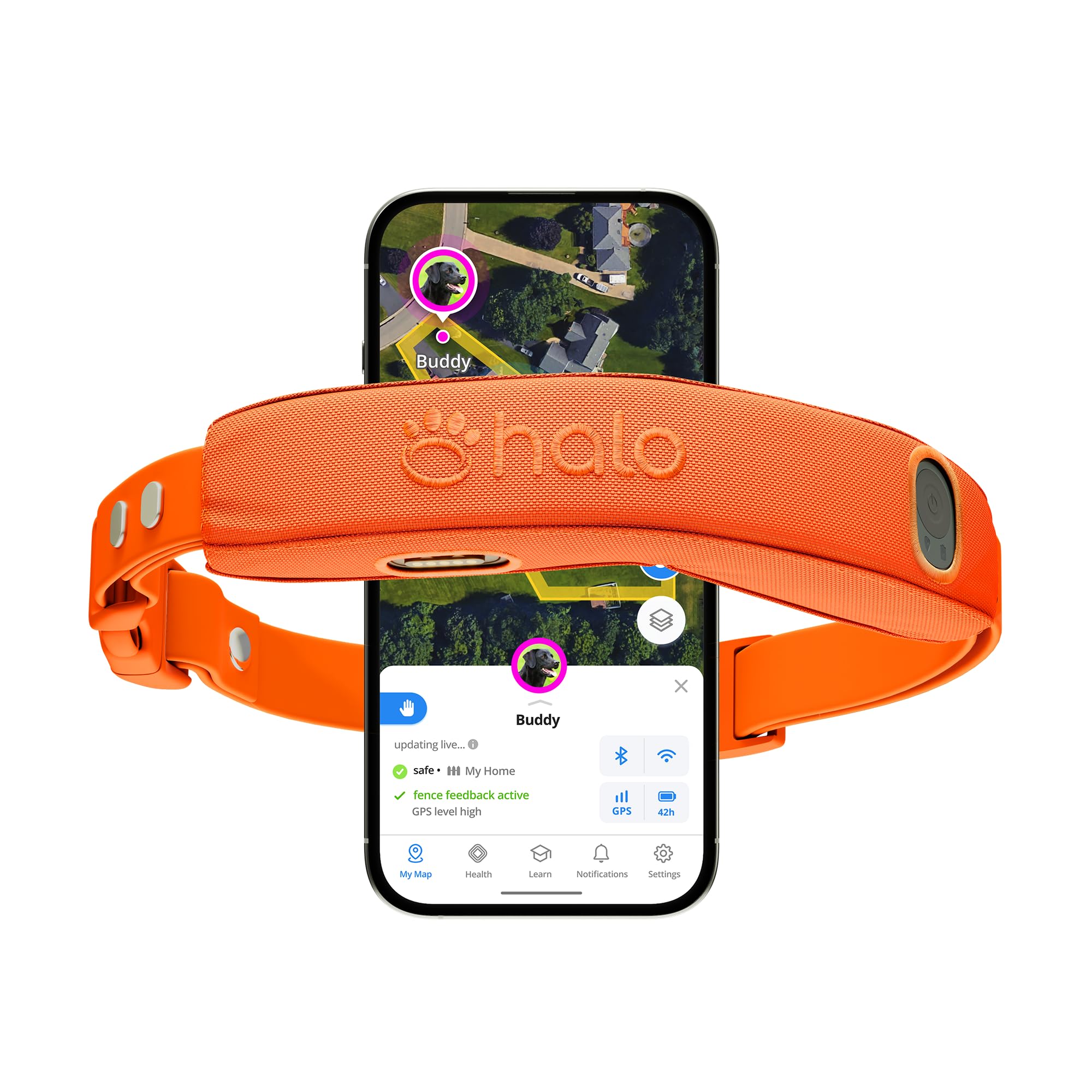
The Halo Collar 5 is the most technologically advanced unit on this list, using dual-frequency L1 and L5 satellite reception plus real-time ground-station corrections to hold GPS accuracy to roughly two feet. That precision allows you to draw custom-shaped fences on your phone — wrapping around your house, driveway, and garden — instead of being stuck with a circle that wastes half your yard. The collar updates your dog’s location twenty times per second and sends instant alerts if a boundary is approached or crossed.
Battery life covers a full day of activity, and the magnetic charger refills it in about an hour — but you must charge nightly, and there is no way to disable the collar overnight without turning it off entirely. The included training program by Cesar Millan walks you through the sound-vibration-static escalation sequence, and the static correction is optional if you prefer to rely on tone and vibration only. Most verified owners report that dogs with high prey drive learn the boundary within three weeks.
The biggest consideration is the ongoing subscription: GPS tracking, fence creation, and activity reports require an annual plan. A small number of users report GPS drift that triggers false corrections indoors, although the dual-frequency antenna array is designed to reject that kind of multipath error. For rural properties up to 1,200 square miles and owners who want app-based boundary control without burying wire, the Halo Collar 5 sets a new ceiling for what a wireless containment system can do.
Why we love it
- Dual-frequency GPS delivers sub-2-foot boundary accuracy
- Custom-shaped fences drawn on smartphone, no circular radius limit
- AlwaysOn GPS tracking works 24/7 with instant escape alerts
Good to know
- Requires a paid subscription (annual fee) for full GPS and fence functionality
- Requires nightly charging; cannot be left on overnight without dock
2. SportDOG Brand Contain + Train System
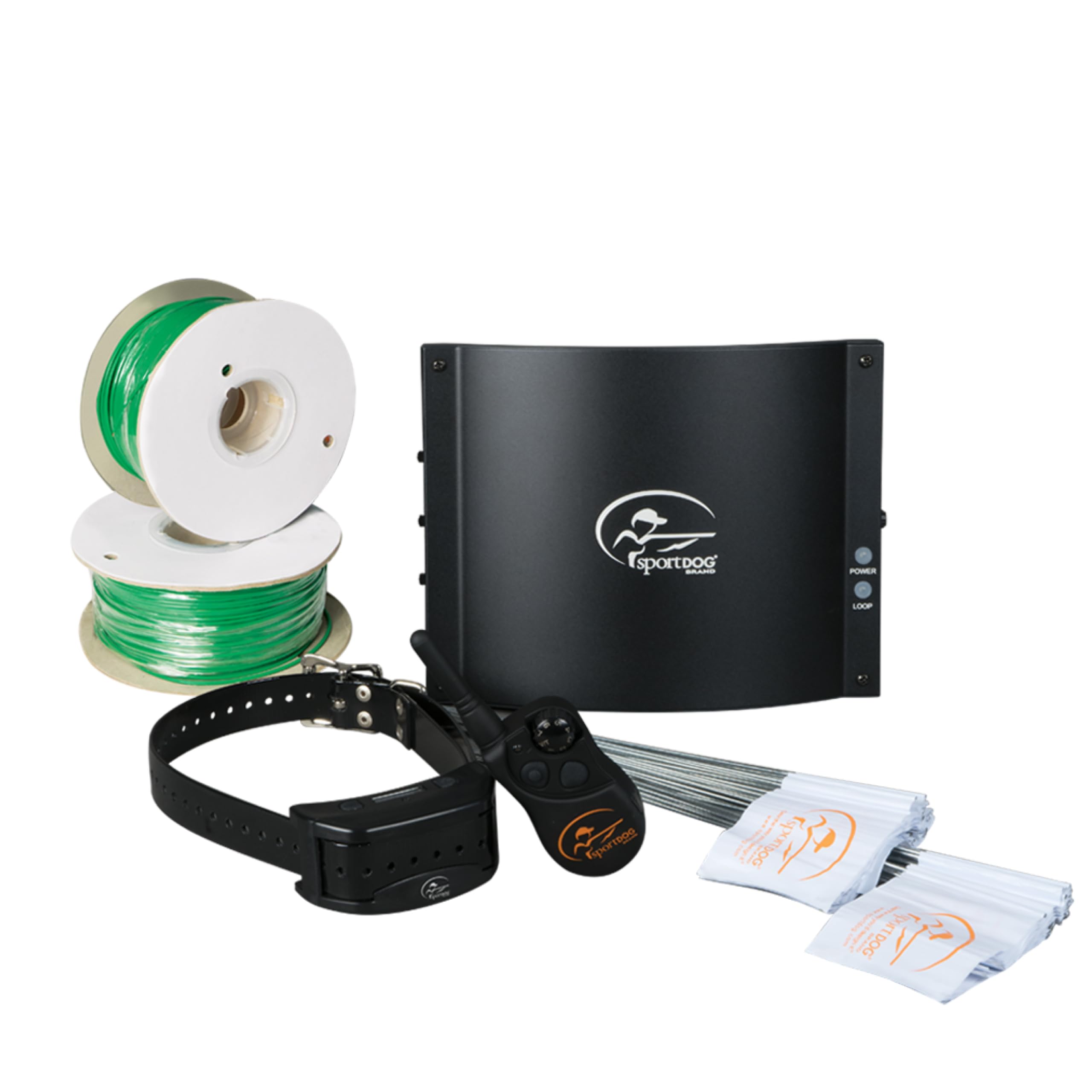
The SportDOG Contain + Train system is a hybrid that marries an in-ground wired fence with a handheld remote trainer in a single collar receiver. You can use the fence boundary normally, then switch the remote to deliver tone, vibration, or one of seven static levels for obedience corrections — a capability that makes it uniquely valuable for off-leash training beyond the yard. The transmitter includes a wire-break alarm and a built-in lightning protector, two features that prevent the common frustration of a dead fence after a storm.
The kit covers 1.3 acres with the included 1,000 feet of 20-gauge wire, and you can expand coverage up to 100 acres by adding more wire and flags. The collar module runs on a rechargeable battery (the newer version moves away from the older 9V design), but owners note the battery life is closer to two weeks than the two months advertised on some competitor collars. The receiver is waterproof and fits neck sizes from roughly 6 to 28 inches, though the module itself is bulky — owners of very small breeds suggest the collar can feel heavy on a dog under 15 pounds.
Verified reviews highlight the ease of installation and the excellent U.S.-based customer support, which has replaced chewed antennas and provided troubleshooting for wire breaks. A few long-term owners report that the terminal connectors for the boundary wire feel flimsy, especially when using 14-gauge wire for a larger loop. If you need a single collar that handles both containment and remote training across a very large property, the SportDOG Contain + Train offers a combination that no other system on this list matches.
Why we love it
- Combines in-ground fence and handheld remote trainer in one collar
- Expands up to 100 acres with additional wire
- Wire-break alarm and built-in lightning protector add long-term reliability
Good to know
- Collar battery life is about two weeks, shorter than some competitors
- Bulkier collar module may be heavy for dogs under 15 pounds
3. PetSafe Stubborn Dog In-Ground Pet Fence

The PetSafe Stubborn Dog system is purpose-built for the kind of dog that treats a standard fence as a suggestion — the escape artist that climbs chain-link, digs under panels, or runs through a mild correction without flinching. Its transmitter delivers the highest static intensity in PetSafe’s lineup, with five correction levels plus a tone+vibration mode that works well for hearing-impaired dogs. The run-through prevention feature ramps up the correction if the dog keeps charging the boundary, and an automatic safety shut-off stops stimulation after 30 continuous seconds.
Boundary wire is sold separately, which lets you choose between 20-gauge standard wire and 16-gauge heavy-duty wire for rocky soil or long loops. The kit includes 100 feet of pre-twisted boundary wire for the initial layout, 4 interchangeable FlexContact points, training flags, a surge protector, waterproof splice capsules, and a 9V battery for the collar. Owners consistently report that the system stops even large, determined breeds — a 140-pound St. Bernard learned its boundary in days, and a Maremma that had climbed a 5-foot fence stopped escaping after two months.
The most common frustration is the tiny Phillips screw that secures the collar battery compartment; several verified reviews describe a 45-minute ordeal to replace the battery without stripping the head. PetSafe does not include a micro screwdriver in the kit. For owners of stubborn, high-drive dogs who need the strongest available correction and don’t mind the occasional battery-change hassle, this wired system has a two-decade reputation for effectiveness that budget wireless units cannot claim.
Why we love it
- Highest static correction intensity in PetSafe’s range, designed for stubborn escape artists
- Run-through prevention escalates correction if dog charges the boundary
- FlexContact points accommodate both short and long-haired breeds
Good to know
- Boundary wire sold separately; you must purchase the correct gauge
- Tiny Phillips screw on battery compartment is notoriously difficult to remove
4. FOCUSER Wireless Dog Fence System (2-Dog Kit)

The FOCUSER Wireless 2-Dog Kit is the only system on this list that ships with two receiver collars in the box, making it the logical choice for multi-dog households that want to contain every pet from day one without buying separate add-on collars. The system uses a plug-in transmitter to create a circular wireless boundary adjustable from 25 to 300 meters in radius, with 16 correction levels that let you dial in a mild setting for a small dog and a firmer one for a large breed simultaneously. The collars are rated IP67, meaning they survive rain, sprinkler runs, and shallow puddle play without damage.
Each collar runs on a rechargeable lithium-ion battery, and the transmitter includes a backup battery that maintains the boundary during brief power outages — a thoughtful safety net that cheaper wireless units omit. The included collars fit neck sizes from 8 to 21 inches and accommodate dogs from 10 to 110 pounds. Owners report that the system works well for climbers and bolters: a family whose lab mix puppies kept scaling a chain-link fence found that the wireless boundary stopped the escapes after the first few corrections.
Installation requires careful placement of the transmitter away from other wireless devices — several reviewers warn that interference from Wi-Fi routers or baby monitors caused false boundary readings until the transmitter was relocated. The setup time runs about three hours for the initial flag placement and pairing process. For a two-dog home with a circular yard layout, this kit delivers complete containment at a cost that undercuts buying two separate collars for any other system on the list.
Why we love it
- Includes two receiver collars in the box, perfect for multi-dog households
- Transmitter has a backup battery to maintain boundary during power outages
- IP67 waterproof rating handles rain, sprinklers, and puddles
Good to know
- Circular boundary only; not suitable for irregularly shaped lots
- Transmitter placement must avoid interference from Wi-Fi and other wireless devices
5. VERSMELO TZ-726 GPS Wireless Dog Fence
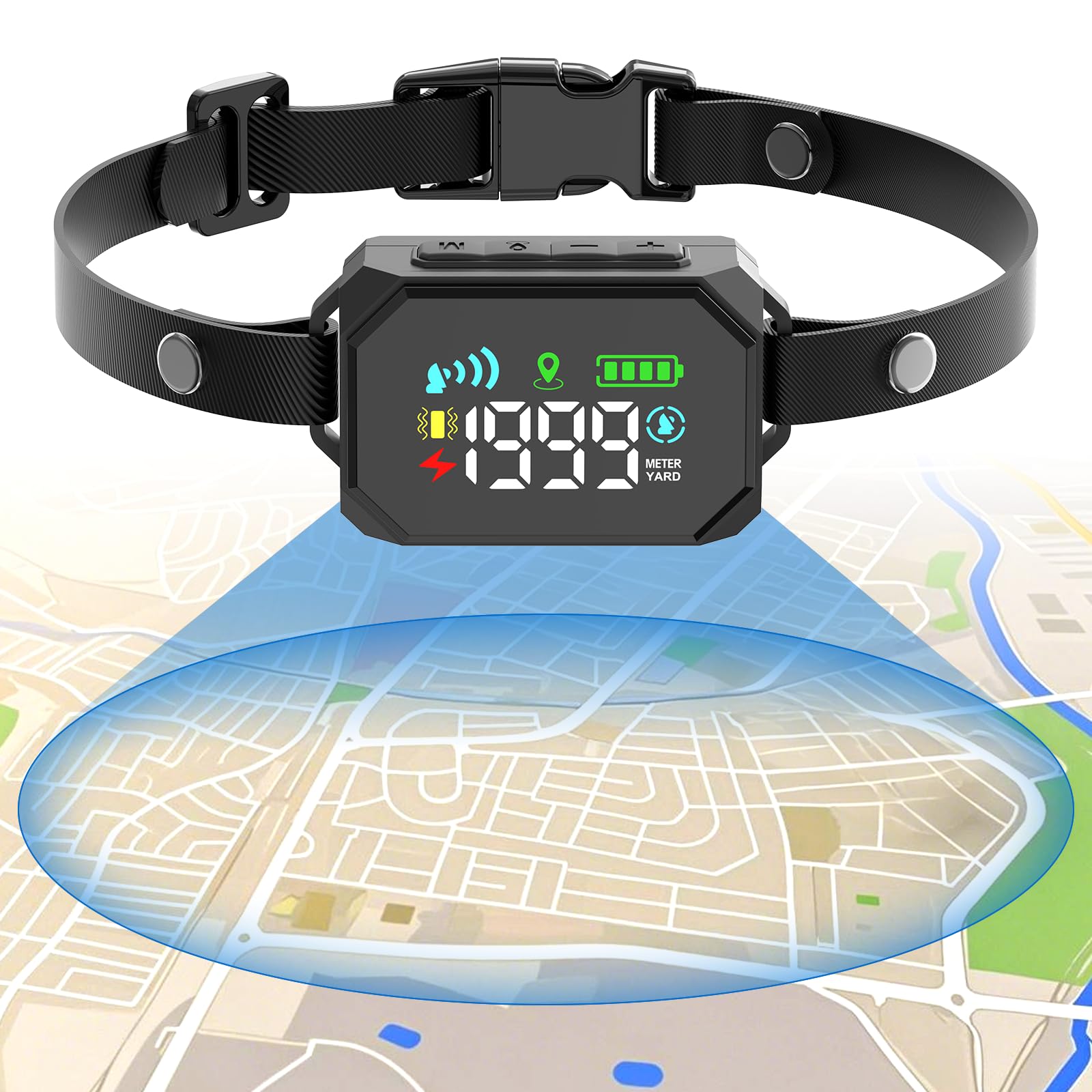
The VERSMELO TZ-726 uses a U.S.-made GPS chip paired with an AI algorithm that intelligently recognizes your dog’s real-time location relative to the boundary, adjusting the correction zone dynamically rather than relying on a simple radius. The range is enormous — a circular boundary from 33 yards to 1,999 yards in radius, covering up to 2,593 acres — making it a strong candidate for farms, ranches, and rural properties where other GPS collars lose signal. The system requires no base station or transmitter; the collar operates independently using satellite connectivity alone.
The collar itself is IPX7 waterproof and runs 24 to 36 hours per charge, which means you will be charging it every day if your dog spends full days roaming. A memory function retains your boundary settings even when the collar is powered off, saving you the re-setup step that plagues some budget GPS collars. The correction system offers six static levels plus progressive sound and vibration warnings, with a protection mode that automatically stops correction after two cycles if the dog remains beyond the boundary — preventing overstimulation during exploratory escapes.
Verified owners on large properties (10–20 acres) report that dogs learned the boundary in one day, and the collar’s self-correction behavior (the dog returns when it beeps) worked reliably for most breeds. However, several reviewers note that dense tree cover causes GPS signal loss, allowing boundary escape without correction, and the collar may then deliver a correction when the dog returns to the approved zone — a behavior that requires supervised training. A small number of units reportedly failed after the return window closed, with poor battery life and no direct website support, so testing immediately on arrival is strongly recommended.
Why we love it
- Massive coverage range up to 2,593 acres for rural and farm use
- AI boundary recognition improves GPS accuracy over basic radius fences
- No base station or transmitter; fully self-contained collar
Good to know
- GPS signal degrades significantly under dense tree canopy
- 24–36 hour battery life requires nightly charging
6. FOCUSER GPS Wireless Dog Fence System

The FOCUSER GPS Wireless system is the entry-level GPS fence on this list, offering a compelling cost-to-feature ratio for owners who want a wire-free setup without a subscription. The boundary radius adjusts from 10 meters to 990 meters, covering roughly 750 acres at maximum, and the collar receiver supports 99 correction levels — an unusually granular adjustment range that lets you fine-tune the static intensity to a degree most competitors do not match. The system supports up to 10 dogs with additional collars, and it includes 20 training flags, a base station, and a USB cable in the box.
The collar is IP67 waterproof and runs on a rechargeable battery, eliminating the ongoing expense of replacement batteries. It fits neck sizes from 7 to 26.5 inches, accommodating most breeds from small to extra-large. The static correction operates at 3.7V, which owners describe as comparable to a carpet-static snap — mild enough that a stubborn husky trained within three days, yet sufficient to stop a 140-pound livestock guardian dog from roaming. Setup takes about 45 minutes with the included flags, and the system requires no internet connection, SIM card, or monthly fee once purchased.
GPS reliability is generally strong in open yards, and verified owners note that the boundary holds even when the collar passes through the walls of an old historic home, a scenario where signal dropout often occurs with less sensitive GPS modules. The two-way alarm that alerts the owner when the dog crosses the boundary adds a useful layer of awareness. The primary limitation is the circular boundary shape — you cannot carve out specific areas like a driveway or garden. For straightforward yard containment at a one-time purchase price with no ongoing charges, this system delivers excellent value.
Why we love it
- 99 correction levels allow precise static intensity tuning
- No monthly fees or subscription; one-time purchase
- Supports up to 10 dogs with additional collars
Good to know
- Circular boundary only; cannot create custom-shaped zones
- GPS signal may drift near dense buildings or metal structures
7. PetSafe Rechargeable In-Ground Pet Fence Receiver Collar
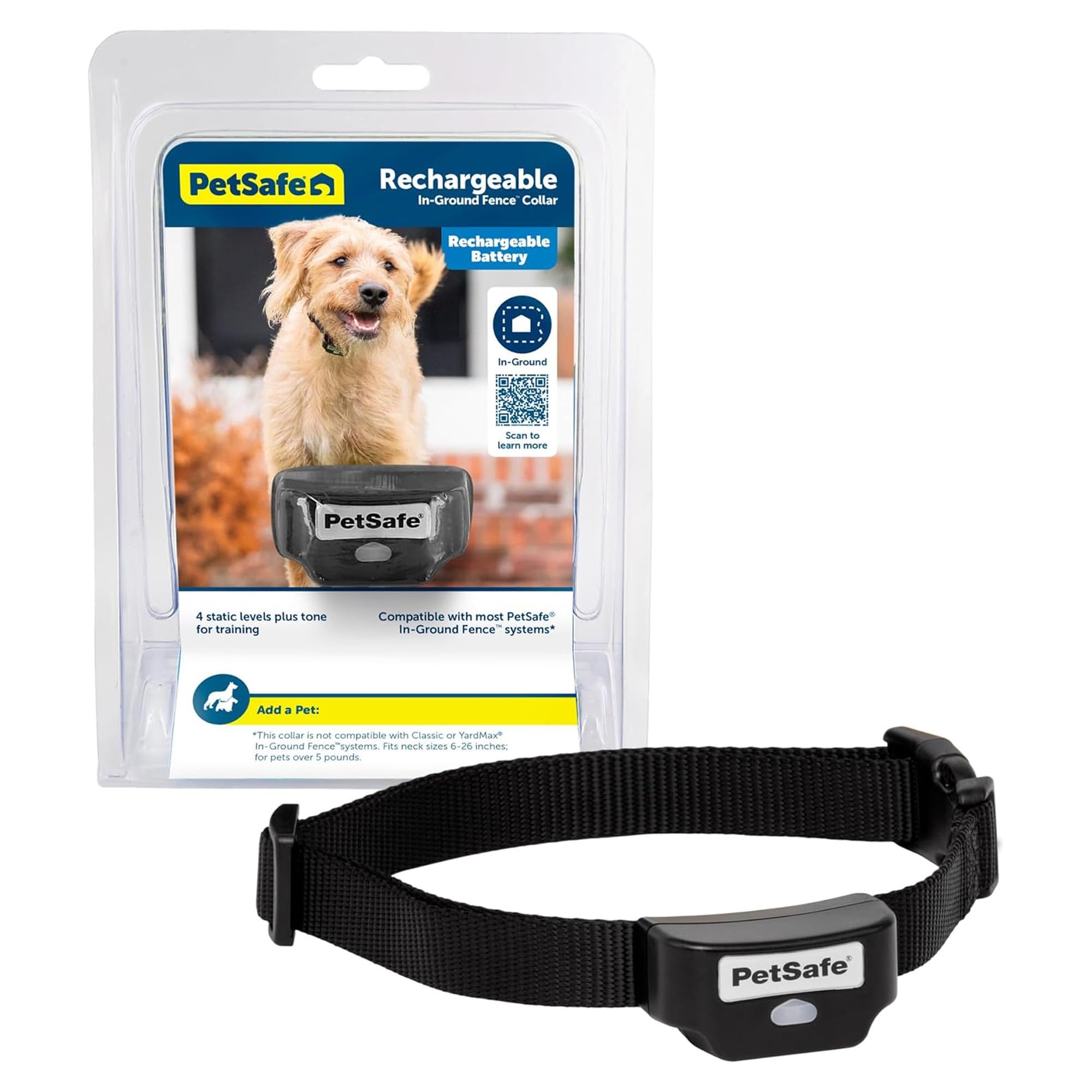
The PetSafe Rechargeable Receiver Collar is not a standalone fence system — it is an add-on collar designed to work with existing PetSafe in-ground systems (excluding YardMax and UltraSmart models). Its value proposition is straightforward: replace a battery-hungry 9V collar with a rechargeable unit that charges in 2–3 hours and runs for up to two months on a single charge, eliminating the monthly expense and hassle of battery swaps. The collar offers four static correction levels plus a tone-only mode, and it fits pets 5 pounds and up with neck sizes from 6 to 26 inches.
The collar is fully waterproof, submersible for shallow water play, and includes a low-battery indicator that alerts you before the charge runs out. The charger uses a single-plug design — you can only charge one collar at a time, which is a mild inconvenience for multi-dog households. Like all PetSafe collars, it is compatible with the parent company of the Invisible Fence brand, and U.S.-based customer care is available by phone, email, or chat. Verified owners confirm it pairs seamlessly with existing wired systems and that the rechargeable battery is a significant upgrade over disposable cells.
Some long-term users report that the overall battery life declines after about a year of regular use, and a small number of units have failed within six months and been replaced under warranty. The contact prongs can loosen over time and require tightening before each charge cycle. If you already own a PetSafe in-ground fence and want to convert your collars to rechargeable operation — or if you need an additional collar for a second dog — this is the only direct replacement that preserves compatibility with your existing transmitter and boundary wire.
Why we love it
- Rechargeable battery eliminates ongoing 9V battery costs
- Up to two months of run time per charge
- Directly compatible with most PetSafe in-ground systems
Good to know
- Not a standalone system; requires an existing PetSafe in-ground transmitter
- Single-plug charger can only charge one collar at a time
FAQ
How long does it take to train a dog to respect a collar fence boundary?
Can a dog collar fence work on a property with irregular or non-circular shapes?
What is the difference between static correction and a shock collar?
Why does my GPS collar sometimes give a correction when my dog is inside the house?
Can I use a collar fence on a puppy or a dog under 8 pounds?
Final Thoughts: The Verdict
For most gardeners, the best dog collar fence winner is the Halo Collar 5 because it combines dual-frequency GPS accuracy with app-controlled custom boundaries and real-time tracking, all without burying a single wire. If you want a wired system with the strongest correction available for determined escape artists, grab the PetSafe Stubborn Dog In-Ground Fence. And for a no-subscription GPS unit that covers hundreds of acres for a fraction of the price, nothing beats the FOCUSER GPS Wireless Dog Fence.