
The look of hand-scraped oak underfoot—without the subfloor prep, without the sanding dust, and without the contractor markup—is the promise premium laminate owners chase. That visual payoff depends entirely on a chain of decisions: the wear-layer thickness measured in mils, the locking-mechanism geometry that fights gapping, and the underlayment that kills hollow echoes. Each link in that chain either delivers a floor that fools the eye for a decade or one that starts cupping within two seasons.
I’m Mo Mahin — the founder and writer behind Furric. My research focuses on comparing wear-layer durability, locking-system failure rates, and sound-transmission data across the most contested price tiers in floating-floor installation, giving buyers a spec-driven edge before they unroll the first plank.
Whether you are installing a great room or a half-bath, the right core thickness and moisture barrier determine your floor’s lifespan — here is your data-backed guide to the best luxury laminate flooring choices on the market today.
How To Choose The Best Luxury Laminate Flooring
Premium laminate is a material stack: a printed design layer under a clear wear layer, bonded to a high-density fiberboard core, backed by a stabilizing layer. The quality of each layer determines your floor’s scratch resistance, water tolerance, and dimensional stability. Below are the specific specs to compare before you buy.
Wear Layer Thickness (Mils)
The wear layer is the transparent aluminum-oxide or urethane coating that protects the printed design. Entry-level planks often carry a 4-mil wear layer—adequate for low-traffic bedrooms but prone to scuffing in hallways. Mid-range options step up to 6 or 7 mils, which handle moderate foot traffic and pet claws. Premium builds hit 12 to 20 mils, often with ceramic bead reinforcement or double UV coating. Each additional mil adds measurable resistance, but the law of diminishing returns kicks in past 12 mils for residential use unless you have heavy rolling loads.
Core Type and Thickness
Standard laminate uses a High-Density Fiberboard (HDF) core. HDF offers good impact resistance but swells when exposed to standing water. Rigid-core laminates—sometimes called stone-plastic composite (SPC) or wood-plastic composite (WPC)—use limestone or polymer blends that resist moisture migration into the core. Core thickness typically ranges from 6 mm to 12 mm. Thicker cores (10 mm or above) dampen footfall noise, feel more solid underfoot, and bridge minor subfloor imperfections better than thin cores.
Locking Mechanism
Angled-tap locking systems (most common in European imports) require you to angle the tongue into the groove and drop the plank flat. They create strong seams that resist separating over time. Drop-lock systems let you connect planks by pressing vertically into place—convenient for solo installers but historically more prone to gapping after seasonal humidity changes. Luxury planks in the mid-range and above almost exclusively use angled-tap or enhanced drop-lock designs with reinforced aluminum-oxide coatings on the tongue.
Underlayment Integration
Floating laminate floors require a separate underlayment layer that provides sound dampening, vapor protection, and minor subfloor leveling. Some premium planks ship with pre-attached underlayment pads, which simplifies installation but limits your choice of moisture barrier type. For concrete subfloors in basements or slab-on-grade construction, a separate underlayment with a 6-mil or thicker polyethylene vapor barrier is essential. Acoustic ratings (IIC and STC) matter if you share walls with neighbors—look for IIC ratings above 50 for noise-sensitive installations.
Quick Comparison
On smaller screens, swipe sideways to see the full table.
| Model | Category | Best For | Key Spec | Amazon |
|---|---|---|---|---|
| MaxCore Pro Lucida Surfaces | Click Lock | Whole-home waterproof installation | 20 mil wear layer, 5mm thick | Amazon |
| GoldMax Premium Floor Underlayment | Underlayment | Dampening hollow sound under planks | 200 sq ft roll, 3mm thick | Amazon |
| Drydiet Uncoupling Membrane | Crack Prevention | Tile and stone subfloor protection | 3mm thick, 54 sq ft roll | Amazon |
| MULGREAT Peel and Stick (Blayney Oak) | Peel and Stick | Renter-friendly temporary floors | 1.5mm thick, 54 sq ft per box | Amazon |
| MULGREAT Peel and Stick (Honey Oak) | Peel and Stick | Quick DIY bathroom floor makeover | 1.5mm thick, 54 sq ft per box | Amazon |
| LUCiDA SURFACES Peel and Stick (Barn) | Peel and Stick | Entry-level luxury look on a budget | 12 mil wear layer, 2mm thick | Amazon |
| NAACOO Floor Installation Kit | Install Kit | DIY precision for click-lock planks | HDPE tapping block, 2.7 lbs | Amazon |
In‑Depth Reviews
1. MaxCore Pro Lucida Surfaces Click Lock Planks

This MaxCore Pro line is the apex of this roundup, delivering a 20 mil wear layer—double what most mid-range planks offer—coated with 4X UV urethane and ceramic bead for commercial-grade scratch resistance. The 5 mm rigid-core construction resists moisture migration far better than standard HDF laminates, and the IXPE sound reduction underlayment bonded to the back eliminates the hollow echo that plagues thinner floating floors. The plank dimensions (7 5/16 inch width by 48 inch length) create a more expansive, less busy visual field than narrow strips, and the micro-beveled edges with matte finish fool the eye at standing height.
Installation is a true angled-tap click-lock system, and the locking edges engaged with a clean audible seat rather than the mushy feel of budget drop-lock mechanisms. At 24.5 square feet per box, you will need to order enough to cover your room plus 10 percent for waste and damaged corner pieces—several buyers noted that shipping can shear corners, but customer service replaced damaged boxes promptly. The matte surface shows fewer fingerprints and smudges than glossy options, and the 10-year warranty (5-year commercial) backs the investment.
Where this plank truly earns the premium spot is in dimensional stability. In a 160-square-foot installation over a concrete slab, the boards did not cup or gap across a winter humidity swing even without separate vapor barrier—the integrated IXPE underlayment doubles as a moisture block. The only downside is the added cost per square foot compared to thinner peel-and-stick alternatives, but for a permanent floor that must resist kids, pets, and kitchen spills, the price scales with durability.
Why we love it
- 20 mil wear layer with ceramic bead coating
- Integrated IXPE sound-reduction underlayment
- Angled-tap click lock with strong seam retention
Good to know
- Shipping may cause corner breakage on some boxes
- Requires careful subfloor prep for even locking
- Not suitable for commercial heavy rolling loads
2. GoldMax Premium Floor Underlayment
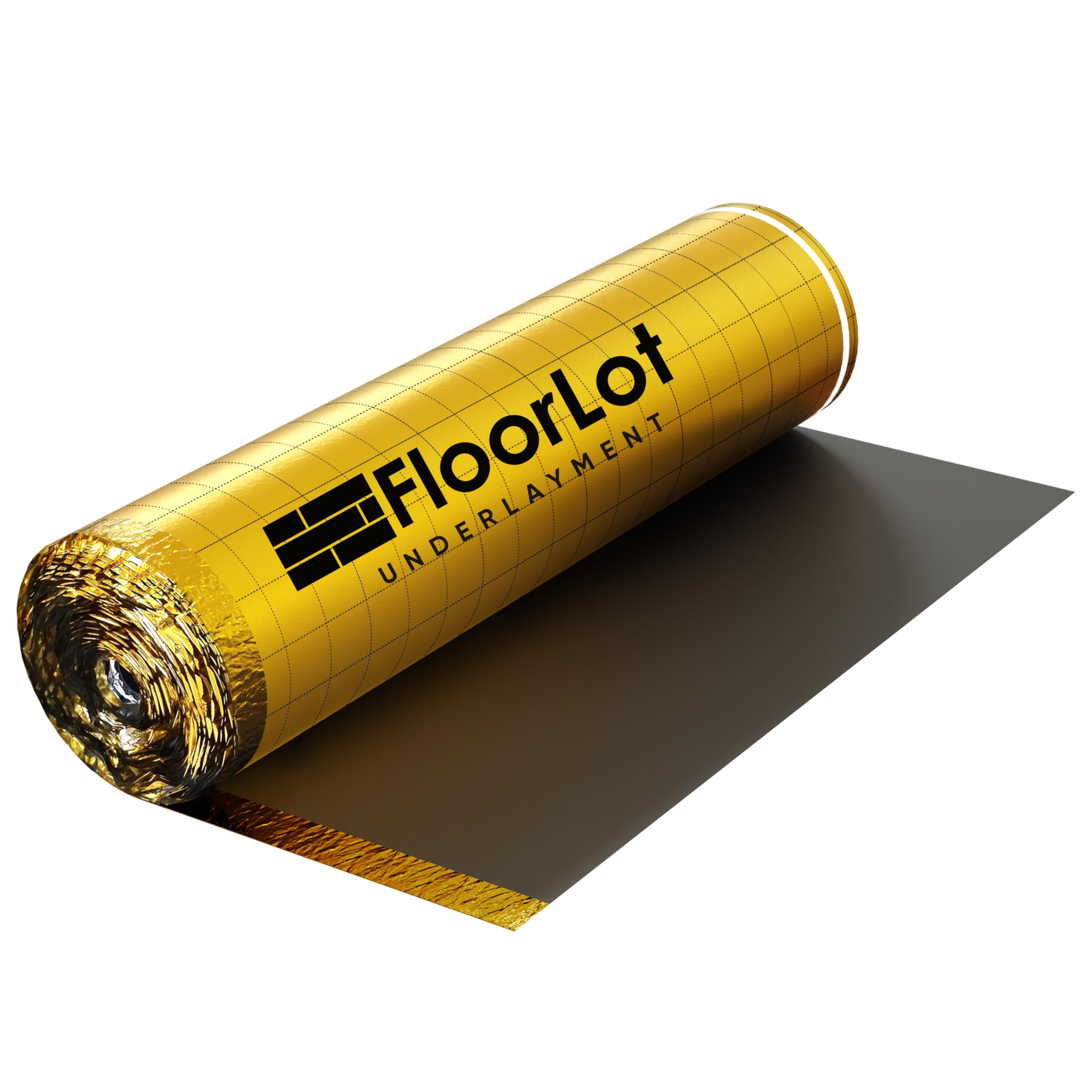
No floating floor performs well without the right underlayment, and the GoldMax Premium roll is engineered specifically for laminate, engineered wood, and solid hardwood floating systems. Each roll covers 200 square feet—enough for an average bedroom-plus-hallway layout—with a 3 mm thick IXPE foam layer that dampens vertical footfall vibration better than the thinner 2 mm pads sold at big-box retailers. The integrated moisture barrier film eliminates the need to double-layer with separate polyethylene sheeting, saving one full step during install.
The printed grid lines across the foam mat cut down measuring guesswork: you align the grid against the wall, slice with a utility knife, and the seams join using the included tape—no adhesive spray or staples required. IIC and STC acoustic ratings are specified, which matters for condominium or townhouse floors where downstairs neighbors can hear every step. Several buyers used this underlayment under engineered bamboo and reported a noticeable reduction in hollow sound compared to their previous unbuffered installation.
One critical detail: this is a foam-based underlayment, not a rigid decoupling mat. It smooths minor subfloor deviations up to roughly 1/8 inch but will not fix larger dips or slopes—those require self-leveling compound before rolling. The moisture barrier is adequate for above-grade and on-grade concrete slabs, but true below-grade basement installations on damp slabs may still require a separate 6-mil vapor retarder beneath the underlayment. For the vast majority of residential floating floor projects, this roll balances coverage, thickness, and vapor protection at a very efficient per-square-foot cost.
Why we love it
- Integrated moisture barrier eliminates extra vapor film
- Grid lines speed up measuring and cutting
- Acoustic rated for multi-unit noise reduction
Good to know
- Not suitable for below-grade installations with standing moisture
- Won’t level subfloor dips larger than 1/8 inch
- Included tape length may be tight for large rooms
3. Drydiet Uncoupling Membrane

When your subfloor cracks, traditional laminate and tile floors transmit that stress upward, producing hairline fractures or popping planks. The Drydiet Uncoupling Membrane sits between substrate and tile to absorb that movement—a critical layer for bathrooms, kitchens, and basements where concrete slabs shrink and expand with seasonal moisture shifts. At 3mm thick, this mat provides the separation distance necessary to decouple the finished floor from the structural substrate.
The orange mat uses a dual-layer grid structure: the top layer bonds with modified thin-set mortar while the bottom layer incorporates anchoring cotton that grips the substrate. This mechanical bond prevents lateral movement from migrating into the tile field. Buyers who replaced premium German-brand membranes noted that the Drydiet mat performs identically at a significantly lower per-square-foot cost, and the 54-square-foot roll covers a typical full bathroom floor or a small kitchen layout without requiring multiple rolls. No mortar curing time is needed before installing the waterproof membrane—you can apply thin-set directly and tile immediately.
One caveat: this is specifically a tile membrane, not a universal laminate underlayment. It belongs under ceramic, porcelain, or stone tiles, not under floating LVP or laminate planks. For laminate buyers who also plan a tile backsplash or shower floor, this membrane bridges the gap between floor types. The stiffness that makes it effective for tile also means it lies flat without curling—uncommon for budget-oriented membranes. Shipping delays were noted by a few customers, but the product itself earned high marks for quality consistency.
Why we love it
- Absorbs substrate movement to prevent tile cracks
- Compatible with standard modified thin-set mortars
- 2X2 anchor grid system holds mortar securely
Good to know
- Only for tile, not for floating laminate floors
- Limited to 54 sq ft per roll
- Occasional shipping delays reported
4. MULGREAT Peel and Stick (Blayney Oak)
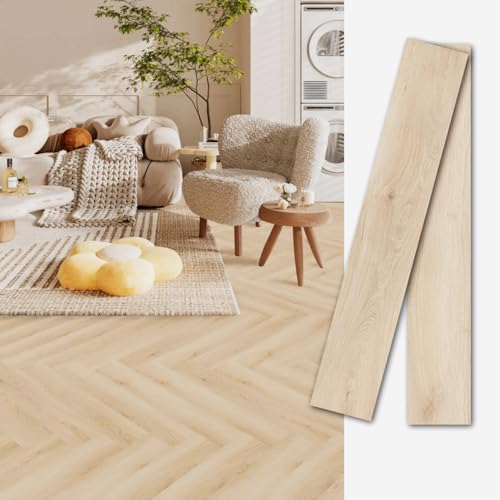
For renters and homeowners who want the look of wood without committing to a click-lock permanent floor, the MULGREAT peel-and-stick tiles in Blayney Oak deliver a realistic deep-embossed wood grain surface at 1.5mm thickness. The 6-inch by 36-inch plank dimensions mimic standard hardwood strip proportions, and the low-gloss printing film avoids the artificial shine that cheap peel-and-stick often betrays. The adhesive backing mates firmly to clean, dry, and level subfloors—multiple buyers reported successful adhesion on rough concrete after a thorough clean.
Installation involves peeling the backing film and pressing the plank into place with weight across the entire surface. Unlike thicker click-lock planks, these can be trimmed with scissors or a utility knife and a straightedge, making them accessible to a single DIYer who lacks a flooring saw. The 0.06-inch thickness is thin enough to avoid a pronounced step transition between rooms but thick enough to resist heel dents and furniture indent marks. Owners reported that the surface showed no visible wear after 8 months in a laundry room with daily foot traffic.
Two limitations define where this product fits: the adhesive is not repositionable, so alignment must be correct on the first press, and the thin core does not mask subfloor imperfections as well as thicker rigid-core planks. Subfloor prep is non-negotiable—every bump or gouge telegraphs through the plank surface. For bathrooms or kitchens, the waterproof claim holds as long as standing water is wiped promptly; extended submersion can wick through seams. Buyers who supplemented with spray adhesive on high-traffic areas reported better long-term adhesion.
Why we love it
- Realistic deep-embossed wood grain texture
- Can be cut with household scissors
- Water-resistant for bathrooms and kitchens
Good to know
- Adhesive is not repositionable—first press matters
- Thin core telegraphs subfloor imperfections
- Not recommended for areas with standing water
5. MULGREAT Peel and Stick (Honey Oak)
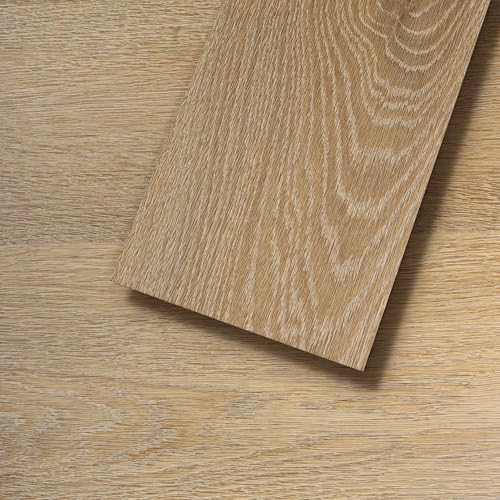
The Honey Oak variant of the MULGREAT peel-and-stick line brings a warmer, more honeyed wood tone compared to the cooler Blayney Oak, offering an alternative palette for homeowners who want a classic maple or oak aesthetic without the gray undertones. The same 1.5mm thickness, the same 6×36-inch plank format, and the same deep embossed surface texture apply—but the color profile changes the room’s feel dramatically. Honey Oak reads as traditional and cozy, making it a natural fit for kitchen floors, breakfast nooks, and main floor hallways.
The rigid-core composition of the PVC-vinyl composite provides dimensional stability that prevents curling at the edges over time, even in rooms that see temperature swings. The scratch-resistant wear layer held up well under chair casters and pet claws in several owner reports, with the deep emboss registering only minor surface marks rather than cuts through the film. The matte finish hides day-to-day dust and foot traffic smudges better than smooth gloss floors, reducing visible maintenance between deep cleanings.
Installation mirrors the Blayney Oak process: clean subfloor, peel, stick, and press. The adhesive strength on smooth subfloors is reliable, but some buyers on rough concrete found that edges lifted after a few weeks and required corner adhesive reinforcement with Gorilla glue. Floor preparation is again the decisive variable—the product is forgiving in design but not in application. The self-adhesive backing will not bond well to painted surfaces, old linoleum residue, or heavily textured concrete. For DIYers who prep properly, this represents the most cost-effective per-square-foot path to a luxury-adjacent look that passes the visual test.
Why we love it
- Warm honey oak tone that blends with traditional decor
- Embossed surface feels like real wood grain underfoot
- Scratch-resistant wear layer for moderate traffic
Good to know
- Adhesive can lift on rough or unsealed concrete
- 1.5mm thickness does not bridge subfloor gaps
- Edge lifting may require supplemental adhesive
6. LUCiDA SURFACES Luxury Vinyl Peel and Stick (Barn)
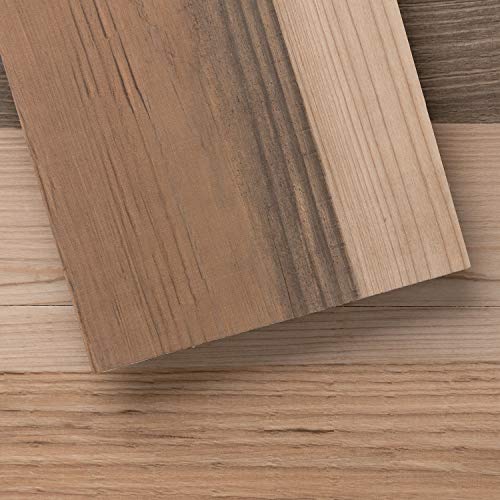
The LUCiDA SURFACES BaseCore collection sits at the intersection of peel-and-stick convenience and respectable durability, with a 12 mil wear layer that outperforms most budget vinyl stickers while maintaining a 2mm overall thickness that keeps transitions flush with adjacent flooring. The Barn colorway carries a weathered, reclaimed-wood look with micro-bevel edges that create realistic board separation lines, and the HD film printing reproduces wood grain detail—including knot patterns—with convincing depth. The surface is finished with a 2X UV-cured urethane blended with ceramic beads for enhanced abrasion resistance.
Each box covers 54 square feet with 36 planks, and the peel-and-stick installation method means no wet adhesives, no curing time, and no special tools beyond a utility knife. The planks are 100% waterproof, making them suitable for bathrooms and kitchens where spills happen—but long-term moisture exposure at the seams can still compromise adhesion if not addressed promptly. Several owners used with liquid nails or spray adhesive on the backing for extra peace of mind in high-traffic areas, and the material cuts easily with a sharp blade or heavy-duty scissors.
The 5-year limited residential warranty covers manufacturing defects, but warranty does not extend to improper installation or subfloor moisture issues. The core is ethylene vinyl acetate rather than a rigid SPC or WPC, so it feels softer underfoot than thicker click-lock luxury vinyl planks—you get some cushioning but less impact resistance against heavy furniture. Texture reproduction is good but not as deep as the embossed MULGREAT planks. This is a solid entry-level choice for someone testing the luxury flooring waters without committing to a click-lock install.
Why we love it
- 12 mil wear layer for enhanced residential durability
- Micro-bevel edges for authentic board separation
- Waterproof core for wet-area installations
Good to know
- EVA core is softer than rigid SPC or WPC
- 5-year warranty is shorter than premium offers
- Adhesion on unsealed concrete may need reinforcement
7. NAACOO 6-in-1 Floor Installation Kit

No matter how good your planks are, poor installation tools will sabotage the result. The NAACOO 6-in-1 kit is built around a 2.7-pound HDPE tapping block that lets you tap tongue-and-groove joints together without needing a separate mallet—each strike transfers force directly into the seam rather than into an impact surface that can shatter. This design eliminates the risk of smashing fingers, a common frustration with traditional tapping block and hammer combos. The heavy-duty pull bar is crafted from 3/8-inch carbon plate steel with a beveled T-shaped head that fits into tight spaces near walls and cabinets, pulling planks together without damaging the tongue.
The kit includes 40 flooring spacers with serrated edges that lock into position when a plank is placed against them, maintaining consistent expansion gaps between the floor and wall. The 10-inch contour gauge features a locking mechanism that holds the profile shape after duplicating odd-shaped obstacles—door jambs, pipes, and irregular corners—so you transfer that contour directly onto the plank for a clean cut. The knee pads use a non-slip TPE outer shell with adjustable elastic straps and ventilated heavy-duty fabric that prevents sweat buildup during extended work sessions.
Buyers noted that the mallet included in the kit is lightweight—adequate for light tapping but not a substitute for a real carpenter’s hammer when you need serious persuasion on a stubborn plank. The spacers can tilt if not placed carefully, and the included cut-out tool is minimally useful. But the core items—the tapping block, pull bar, and contour gauge—perform as well as premium-name-brand equivalents at a fraction of the investment. For a first-time laminate installer, this kit provides the three essential tools plus three extras that reduce frustration and improve joint alignment.
Why we love it
- 2.7 lb HDPE tapping block eliminates mallet use
- 3/8-inch carbon steel pull bar resists bending
- Locking contour gauge for odd-shaped obstacles
Good to know
- Included mallet is too light for tough seams
- Spacers can tip over if not aligned carefully
- Cut-out tool has limited utility
FAQ
What wear layer thickness do I need for a high-traffic hallway?
Can I install luxury laminate over existing tile or hardwood?
Does peel-and-stick flooring damage the subfloor when removed?
What is the difference between AC rating and wear layer thickness?
Final Thoughts: The Verdict
For most homeowners seeking a permanent floor that resists moisture, scratches, and hollow sound, the winner is the MaxCore Pro Lucida Surfaces Click Lock Planks because its 20 mil wear layer, integrated sound-reduction underlayment, and rigid-core stability outperform every other plank in this comparison. If you want a peel-and-stick solution that balances cost with respectable visual appeal, grab the MULGREAT Honey Oak for small rooms and rental-friendly projects. And for ensuring your subfloor protects the investment, nothing beats the GoldMax Premium Underlayment for moisture management and footfall dampening at scale.