
When your cat is diagnosed with chronic kidney disease (CKD), the most critical change is diet — but the challenge is that many prescription renal foods are so unappetizing that cats simply stop eating, which accelerates muscle wasting and worsens their condition. Owners face a painful choice between managing phosphorus levels and keeping their cat nourished.
I’m Mo Mahin — the founder and writer behind Furric. Over the last 15 years, I’ve analyzed hundreds of veterinary diet formulations, studied the clinical data on phosphorus restriction versus protein sufficiency in feline CKD, and cross-referenced thousands of owner-reported outcomes to identify which kidney-support diets actually work without triggering a hunger strike.
After comparing clinical specs, ingredient profiles, and real-world palatability data, this guide isolates the top contenders for a kidney diet for cats that balances renal protection with the taste profile felines actually accept.
How To Choose The Best Kidney Diet For Cats
Selecting a renal-support diet isn’t about picking the most expensive bag or the one with the flashiest “kidney” label. Feline CKD management hinges on three measurable nutritional levers: phosphorus concentration, protein bioavailability, and moisture content. Below are the critical specs to evaluate before buying.
Phosphorus Restriction: The Primary Therapeutic Target
The single most important number on any renal diet label is the phosphorus percentage on a dry-matter basis. Ideally, a kidney diet for cats should contain 0.5% phosphorus or less — some premium wet foods achieve as low as 0.3%. Higher phosphorus accelerates the progression of CKD by worsening hyperphosphatemia, which directly damages remaining nephrons. Always check the guaranteed analysis; avoid foods that list phosphorus content above 0.8% unless your cat is in IRIS Stage 1 and your vet approves a more moderate restriction.
Protein Quality Over Quantity
Many budget renal foods slash protein indiscriminately, which forces the body to break down muscle tissue for energy — a dangerous spiral for an already wasting CKD cat. What matters is highly bioavailable protein (real chicken, fish, or meat) that provides essential amino acids without creating excess nitrogenous waste. Look for named meat sources (not “meat meal”) and formulations that use egg whites or gelatin as protein stabilizers. A quality kidney diet for cats preserves muscle mass by delivering digestible protein even at reduced total protein percentages.
Moisture Content & Palatability Engineering
CKD cats are chronically dehydrated because damaged kidneys lose concentrating ability. Wet food (78-85% moisture) is vastly superior to dry kibble (6-10% moisture) for maintaining hydration without forcing additional water intake. Additionally, many prescription renal foods use “Enhanced Appetite Trigger” (E.A.T.) technology or flavor coatings to overcome the taste rejection that commonly plagues low-phosphorus diets. If your cat rejects a particular texture — pate, stew, or shredded — the best kidney diet is the one they’ll actually consume consistently.
Quick Comparison
On smaller screens, swipe sideways to see the full table.
| Model | Category | Best For | Key Spec | Amazon |
|---|---|---|---|---|
| Hill’s Prescription Diet k/d Kidney Care Wet | Veterinary Prescription | Clinically proven kidney protection | 0.25% phosphorus (as fed) | Amazon |
| Hill’s Prescription Diet k/d Dry (Ocean Fish) | Veterinary Prescription | Dry food convenience with E.A.T. technology | ActivBiome+ Kidney Defense | Amazon |
| Blue Buffalo K+M Kidney + Mobility Dry | Veterinary Prescription | Kidney + joint support combo | Glucosamine & chondroitin added | Amazon |
| Weruva Wx Phos Focused 20-Count Variety | OTC Low Phosphorus | Picky cats that reject prescription diets | Up to 50% less phosphorus than AAFCO | Amazon |
| Weruva Wx Phos Focused 12-Count Variety | OTC Low Phosphorus | Budget-friendly OTC kidney support | All-natural, no phosphorus binders needed | Amazon |
| Blue Buffalo True Solutions Urinary Care Wet | OTC Urinary Support | Early-stage kidney/urinary prevention | Promotes healthy urine mineral content | Amazon |
| Hill’s Science Diet Senior 11+ Healthy Cuisine | OTC Senior Maintenance | General senior kidney maintenance (non-CKD) | Clinically proven antioxidants + Vitamin C/E | Amazon |
In‑Depth Reviews
1. Hill’s Prescription Diet k/d Kidney Care Wet Cat Food

Hill’s Prescription Diet k/d is the clinical gold standard for feline CKD management, backed by multiple peer-reviewed studies showing it can extend life expectancy and improve quality of life. The Chicken & Vegetable Stew formulation delivers precisely controlled low phosphorus (0.25% as fed) and reduced sodium levels, which directly supports nephron preservation. The proprietary ActivBiome+ Kidney Defense prebiotic blend targets the gut-kidney axis, a newer science-backed approach to slowing CKD progression by modulating intestinal nitrogenous waste absorption.
Palatability is notably stronger than earlier k/d versions — owners report that cats who previously refused renal food now clean their bowls, with one reviewer noting an 18-year-old stage 2 CKD cat eating it exclusively. The stew format (bite-sized chunks in gravy, 2.9 oz cans) offers good moisture content for hydration. Some cats remain picky, but the consistency is far more appetizing than standard renal pates, and the small can size prevents waste during multi-meal feeding schedules.
The primary trade-off is that it requires a veterinarian’s prescription, and the price point sits above OTC options. However, for confirmed CKD cats in IRIS stages 2 through 4, the clinical evidence supporting k/d is unmatched — owners who stick with it consistently report stabilized bloodwork and reduced flare-ups. The 24-pack format via Subscribe & Save provides better reliability than sourcing through vet offices.
Why we love it
- Clinically proven to extend life in feline CKD patients
- ActivBiome+ prebiotics directly support kidney function through gut microbiome
- Reduced phosphorus and sodium levels meet strict IRIS guidelines
- Tasty stew texture with gravy encourages hydration and acceptance
Good to know
- Requires veterinarian prescription to purchase
- Higher cost per ounce compared to OTC alternatives
- Not all cats accept the flavor; some still refuse stew texture
2. Hill’s Prescription Diet k/d Kidney Care Dry Cat Food (Ocean Fish)

This dry kibble version of Hill’s k/d is engineered with Enhanced Appetite Trigger (E.A.T.) technology — a clinically tested coating that stimulates food intake in cats with CKD-associated anorexia, a common complication where reduced kidney function causes nausea and smell aversion. The Ocean Fish formula provides a distinct seafood aroma that many cats find irresistible, and the small, soft pellet size (approximately 8-9 mm diameter) makes chewing manageable for cats with dental sensitivity or mouth ulcers that sometimes accompany late-stage kidney disease.
Like its canned counterpart, this dry food contains ActivBiome+ Kidney Defense prebiotics and the same reduced phosphorus/sodium profile (0.52% phosphorus on a dry matter basis). Owners of picky CKD cats — including a stage 4 patient — report that the Ocean Fish flavor outperforms the chicken version in acceptance, with one reviewer noting the cat “loved this food” and ate full servings in one sitting. The 8.5 lb bag offers a better cost-per-feeding ratio than wet food, though moisture content remains at the typical 6-10% range, so supplemental hydration via wet food or water mixing is still necessary.
The main drawback: because this is a prescription dry food, a veterinarian’s authorization is required. Additionally, some cats initially accept it but develop flavor fatigue over weeks — a known risk with dry renal diets compared to wet formats. But for owners who need the convenience of dry food or a cost-effective base diet that their cat will actually eat, the Ocean Fish E.A.T. formula is the strongest dry option in the renal category.
Why we love it
- E.A.T. coating clinically shown to stimulate appetite in CKD cats
- Small, soft kibble suitable for cats with dental or mouth pain
- Ocean Fish flavor outperforms chicken variants in palatability
- ActivBiome+ prebiotics support kidney-gut axis
Good to know
- Low moisture content requires extra water intake
- Some cats develop taste fatigue after weeks of exclusive feeding
- Requires veterinarian prescription for purchase
3. Blue Buffalo Natural Veterinary Diet K+M Kidney + Mobility Support Dry
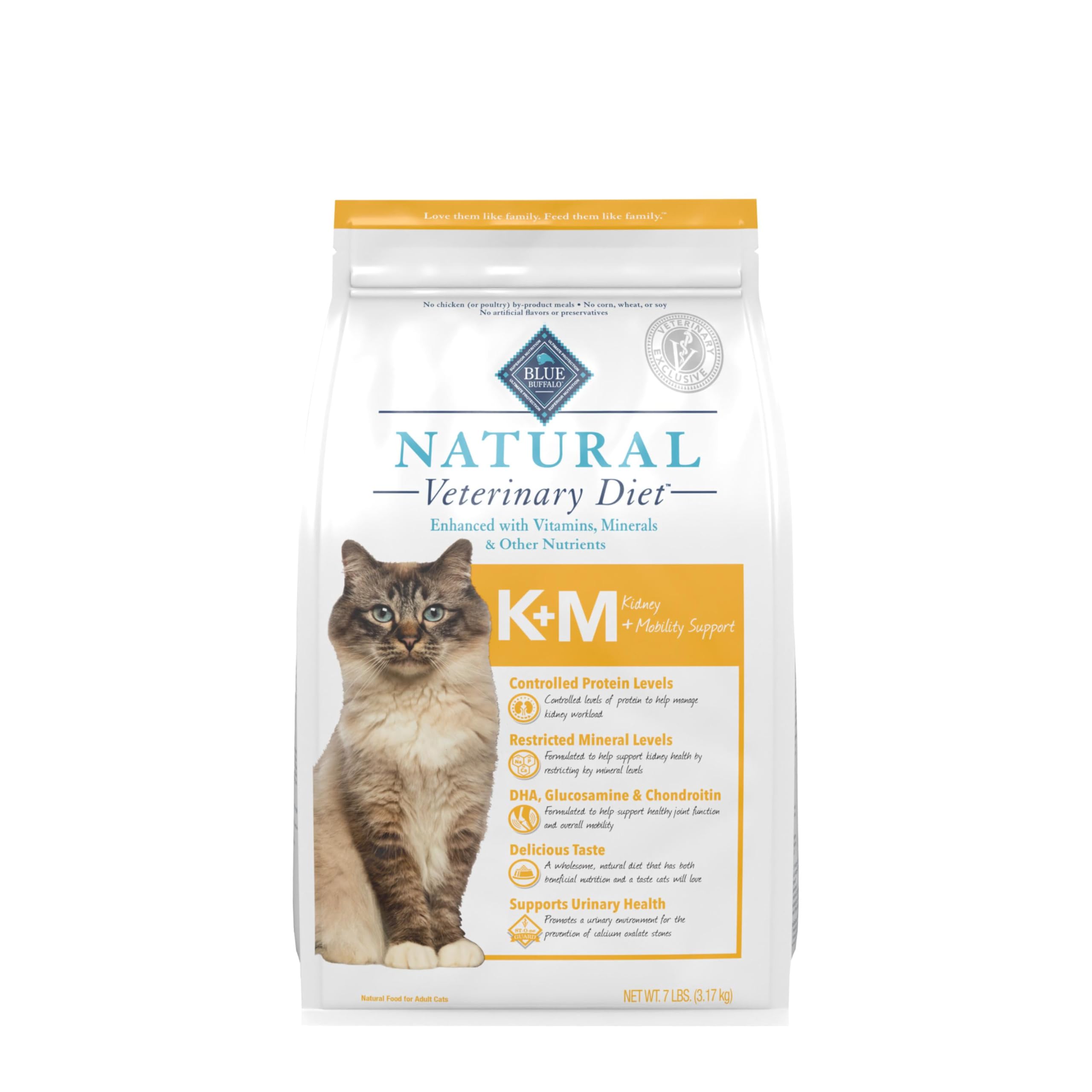
Blue Buffalo’s K+M formulation is unique because it addresses two concurrent chronic issues in senior cats: kidney function decline and osteoarthritis. The controlled protein levels (moderately reduced, not severely restricted) help manage kidney workload, while the added glucosamine and chondroitin (250 mg/kg and 200 mg/kg, respectively) directly support joint cartilage and mobility. This dual-target approach is especially valuable for cats over 12 where CKD and arthritis frequently co-occur.
Real chicken is the first ingredient, delivering highly bioavailable animal protein that helps maintain lean muscle mass — a critical advantage over some lower-quality renal diets that use plant-based protein concentrates. The kibble size is notably small (approximately 8-9 mm), and owners of picky CKD cats consistently report that even cats who rejected Hill’s or Royal Canin prescription diets will eat this Blue Buffalo formula eagerly. Multiple verified reviewers note their cats “surpassed life expectancy” while on this diet, suggesting the nutritional balance supports longevity.
The catch: this is a veterinary prescription diet requiring a veterinarian’s authorization, and as a dry food, its moisture content is low (around 6-10%). Owners must either mix it with canned food or add water to prevent dehydration. The 7 lb bag is smaller than some value-size alternatives, and the cost per pound is at the premium end of the prescription category. However, for CKD cats that also have mobility issues, the combined kidney-joint support eliminates the need for separate supplements.
Why we love it
- Dual kidney plus joint support eliminates need for separate supplements
- Real chicken first ingredient with high bioavailability
- Small kibble size works for cats with dental sensitivity
- High palatability — many picky cats accept it
Good to know
- Requires veterinarian prescription for purchase
- Low moisture content; must be paired with wet food or water
- Phosphorus restriction is moderate, not as tight as Hill’s k/d
4. Weruva Wx Phos Focused Variety Pack (20 Count)

Weruva’s Wx Phos Focused line occupies a unique space: it is an over-the-counter (OTC) low-phosphorus formula that does not require a prescription, yet it achieves phosphorus levels comparable to some veterinary renal diets. The formulation contains up to 50% less phosphorus than the AAFCO minimum, putting the pate around 0.3-0.4% phosphorus on a dry matter basis — within the therapeutic range for early to moderate CKD. The protein sources are clean, bone-free chicken and tuna, which provide highly digestible amino acids without the organ-meat phosphorus load typical of standard wet foods.
The 20-count variety pack includes five flavors (chicken, tuna, and three other pate variants), which is a real advantage for CKD cats that develop flavor fatigue quickly. Owners consistently report that cats who flatly refused prescription brands like k/d or Royal Canin Renal will eat this Weruva line — one reviewer’s 19-year-old stage 2 CKD cat regained appetite after losing weight on prescription food, putting on 1.3 pounds in two months. The pate texture is smooth and hydrating, delivering approximately 78-82% moisture per can.
The downsides are real: the cans are notoriously difficult to open — several reviewers with arthritis or CTS noted this as a significant daily frustration. Additionally, the packaging is visually confusing, making it hard to distinguish flavors when grabbing from the fridge. A small percentage of cats reject one or more of the five flavors, and the 3 oz size may be insufficient for larger cats without using two cans per meal, which drives up feeding cost.
Why we love it
- OTC formula — no prescription needed, accessible pricing
- Up to 50% less phosphorus than AAFCO minimum
- Five-flavor variety prevents taste fatigue in picky CKD cats
- High moisture pate supports feline hydration needs
Good to know
- Cans are very difficult to open, especially for arthritis sufferers
- Not all cats accept every flavor in the variety pack
- 3 oz cans may require two per meal for larger cats
5. Weruva Wx Phos Focused Variety Pack (12 Count)
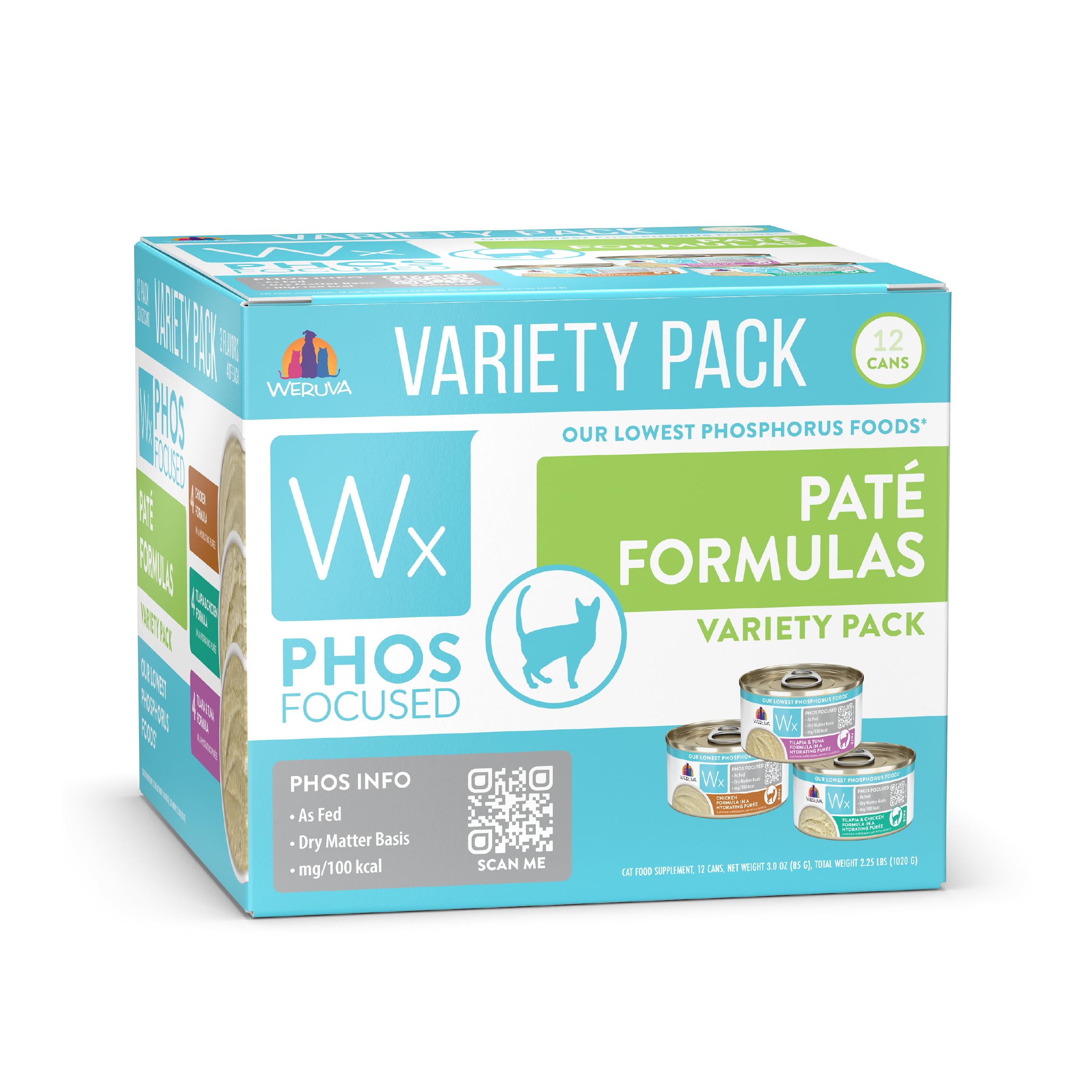
This 12-count variant of the Weruva Wx Phos Focused line offers the same low-phosphorus pate formulation as the 20-count pack but at a lower entry cost, making it a practical starting point for owners whose cats have recently been diagnosed with CKD and haven’t yet committed to a full prescription diet. The phosphorus level (up to 50% below AAFCO minimum) remains consistent across all cans, and the all-natural ingredient list contains no powdered cellulose, fillers, or carbohydrate-based phosphorus diluters — a sign of honest formulation rather than nutritional watering-down.
Owner feedback mirrors the larger pack: cats that reject prescription diets often accept this food readily, with multiple reviewers noting that their previously anorexic CKD patients began eating consistently and even gained weight. One 19-year-old stage 2 CKD cat went from 7.9 lbs to 9.2 lbs over two months on this diet alone, with the owner adding a phosphate binder for additional control. The pate texture is smooth, making it suitable for syringe-feeding if the cat is too weak to eat independently.
The 12-pack is a better value proposition for small cats or for owners who want to mix it with prescription food to improve overall palatability. However, the same can-opening difficulty applies, and the 3 oz size means multi-can feedings for bigger cats. For IRIS stage 3-4 CKD, this should be used only with veterinary guidance and possibly supplemental phosphate binders.
Why we love it
- Lowest phosphorus OTC wet food — therapeutic for early to moderate CKD
- All-natural, no fillers or carbohydrate diluters
- Excellent for transitioning cats off higher-phosphorus diets
- Proven to restore appetite in anorexic CKD cats
Good to know
- Cans very difficult to open manually
- 3 oz portions may be insufficient for larger cats
- Not a substitute for prescription renal diet in advanced CKD without vet approval
6. Blue Buffalo True Solutions Urinary Care Wet Cat Food
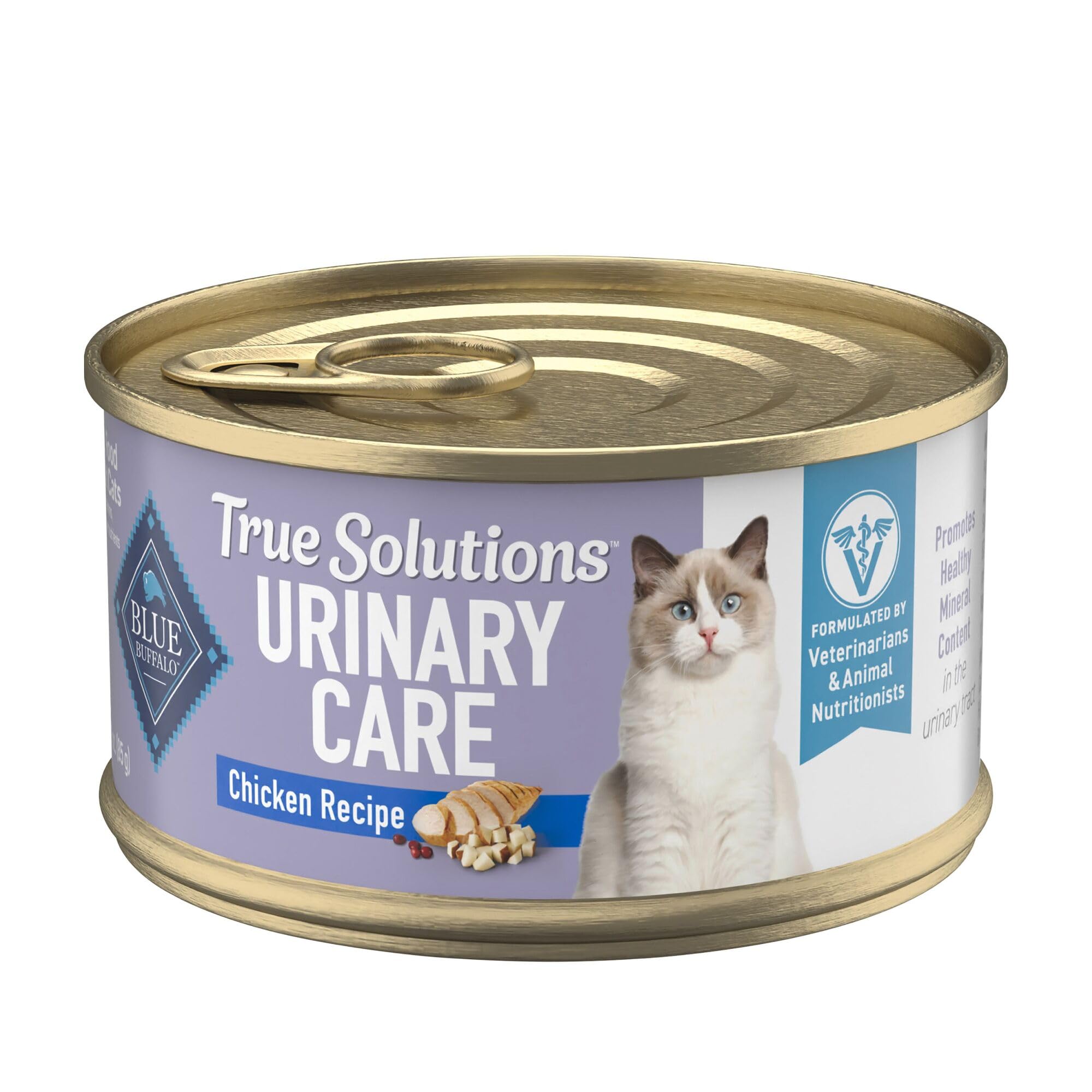
Blue Buffalo’s True Solutions Urinary Care is formulated for cats at risk of urinary tract issues, including urate crystals and bladder inflammation — conditions that can co-exist with or precede kidney disease. The formulation uses controlled mineral content to promote healthy urine pH and reduce crystal formation, which indirectly supports kidney function by preventing secondary urinary obstruction that can worsen renal stress. Real chicken is the first ingredient, and the pate contains no wheat, corn, soy, or poultry by-product meals.
While this is not a prescription renal diet and does not achieve the same tight phosphorus restriction as Hill’s k/d or Weruva Wx, it serves an important role for cats in early CKD (IRIS stage 1) or for owners seeking a preventative OTC option. Multiple verified buyers report that the prescription diet their vet recommended was unnecessary — this Blue Buffalo formula resolved urine crystals effectively at a lower cost. The 24-count case provides good per-can value, and the pate texture (without strong odor) is well-tolerated by most cats, including those with picky tendencies.
The key limitations: this is not a standalone renal diet for cats with diagnosed CKD. The phosphorus content is higher than therapeutic renal levels, and it does not contain the prebiotics or sodium restriction found in prescription kidney formulas. For cats with confirmed kidney disease, use this only as a supplement to a low-phosphorus primary diet, or as a rotation option to add variety. The packaging also received minor complaints about inconsistent labeling across print runs.
Why we love it
- Clinically proven to dissolve and prevent urine crystals
- No wheat thickener — avoids common feline allergens
- Cost-effective prevention for neutered males and crystal-prone cats
- Mild odor and smooth pate texture appeal to picky eaters
Good to know
- Phosphorus levels not restricted enough for therapeutic CKD diet
- Not a substitute for prescription renal food in stage 2+ CKD
- Some packaging label inconsistencies between print runs
7. Hill’s Science Diet Senior 11+ Healthy Cuisine Wet Cat Food

This is not a kidney disease diet — it is Hill’s OTC senior maintenance formula for cats age 11 and older. However, it earns a position in this guide because many owners of cats in early-stage CKD (before formal diagnosis or in IRIS stage 1) use it as a proactive supportive diet. The formulation includes clinically proven antioxidants (Vitamin C+E) that support immune function and cellular health, and the precise balance of nutrients is designed to sustain kidney and vital organ function in aging cats without being as restrictive as a prescription renal diet.
The Seared Tuna & Carrot Stew texture is notably different from most renal foods — it contains visible chunks of real tuna and tiny carrot pieces in a light gravy, which some cats find far more appealing than homogenized pates. Owners report that even 13- and 16-year-old cats who reject all prescription kidney diets will eat this enthusiastically. The 2.8 oz can size is convenient for single-meal feeding without leftovers, and the mild tuna smell is less offensive to owners than some renal stews.
The critical caveat: for cats with confirmed CKD beyond IRIS stage 1, this diet does not provide sufficient phosphorus restriction. The phosphorus content is typical of standard senior wet food (approximately 0.15% as fed, but with higher absolute phosphorus than prescription renal diets). Use this only as a rotation option alongside a true low-phosphorus diet, not as a sole kidney management solution. It also contains tuna, which some cats develop allergies to over extended feeding periods.
Why we love it
- Chunky stew texture appeals to cats that reject pate
- Clinically proven antioxidants support immune function in seniors
- Small 2.8 oz can size prevents waste during multi-meal feeding
- Veterinarian-recommended for general senior health maintenance
Good to know
- Phosphorus content is not restricted enough for therapeutic CKD
- Not a substitute for prescription renal diet in stage 2+ CKD
- Contains tuna — potential allergen for some cats
FAQ
Can OTC low-phosphorus cat food replace a prescription kidney diet?
How much phosphorus is too much for a cat with kidney disease?
Why do some cats refuse to eat prescription kidney diets?
How do I know if my cat’s kidney diet is working?
Final Thoughts: The Verdict
For most owners managing confirmed feline CKD, the kidney diet for cats winner is the Hill’s Prescription Diet k/d Kidney Care Wet Cat Food because it combines clinically validated phosphorus restriction, ActivBiome+ prebiotic gut-kidney support, and improved palatability that outperforms earlier generation renal diets. If your cat rejects all wet prescription foods, the Hill’s Prescription Diet k/d Dry in Ocean Fish with Enhanced Appetite Trigger is the best fallback — the E.A.T. coating solves the anorexia problem that plagues so many CKD cats. And for owners who cannot afford or access prescription diets but need a low-phosphorus OTC option that cats actually eat, the Weruva Wx Phos Focused Variety Pack delivers therapeutic phosphorus levels (up to 50% below AAFCO minimums) with the all-natural, filler-free ingredient profile that CKD cats need.