
A bioactive terrarium is a self-sustaining ecosystem, but without a proper foundation, that ecosystem turns into a swamp. The single most common mistake newcomers make is skipping or skimping on the drainage layer, leading to anaerobic soil, foul odors, and plant roots drowning before they ever establish. The material you choose for that layer dictates humidity control, odor management, and the long-term health of your microfauna.
I’m Mo Mahin — the founder and writer behind Furric. I spend my time cross-referencing substrate material density, particle size distribution, and pH neutrality against thousands of owner accounts to determine which products actually perform in a closed-loop vivarium.
Whether you keep dart frogs, crested geckos, or rare isopod cultures, selecting the right drainage layer for bioactive terrarium is the difference between a lush planted vivarium and a stagnant, smelly failure.
How To Choose The Best Drainage Layer For Bioactive Terrarium
A drainage layer acts as a false bottom, separating your substrate from standing water that collects at the base. The material you pick determines how well excess moisture is wicked away from the root zone and how long the water table remains oxygenated. Three specs rule the decision: particle porosity, surface area, and chemical inertness.
Particle Porosity and Water-Holding Capacity
Porous materials like lava rock and LECA expanded clay store water within their internal structure and release it slowly as humidity, which stabilizes the vivarium’s microclimate. Dense river pebbles do not hold moisture and create a sharp, purely gravitational water table with less buffering. For obligate high-humidity setups, a porous drainage layer reduces the frequency of misting cycles.
Size and Shape Consistency
Uniform particles between 8 and 20 mm produce consistent air gaps that prevent fine substrate from sinking into the water table. Irregular or crushed material can pack tightly, reducing airflow and creating dead zones where anaerobic bacteria thrive. Sizing also affects the depth of the false bottom — larger particles require a thicker layer to establish the same water-holding volume.
Chemical Neutrality and Dust Content
Any drainage material must be pH-neutral or slightly acidic to avoid shocking the soil biology and your inhabitant’s skin. LECA fired clay is naturally inert, while raw volcanic rock can sometimes contain soluble minerals that raise pH. Pre-rinsing is non-negotiable: excess dust clogs the air pockets and introduces fines that settle into the water table, reducing drainage speed over time.
Quick Comparison
On smaller screens, swipe sideways to see the full table.
| Model | Category | Best For | Key Spec | Amazon |
|---|---|---|---|---|
| Exo Terra Sub Stratum | Volcanic Soil | Nutrient-rich planted vivariums | 4.4 lb bag, andisol volcanic soil | Amazon |
| Josh’s Frogs Coco Cradle Brick (3 Pack) | Coir Brick | High-humidity, lightweight setups | Expands 4-6x, EC below 1.0 | Amazon |
| CJGQ Mix Lava Rocks | Volcanic Rock | Aesthetic top dressing & drainage | 7 lb, ~1/5 inch particle size | Amazon |
| Josh’s Frogs Drainage Layer | LECA Mix | Dedicated false bottom drainage | 4 quart, lightweight fired clay | Amazon |
| Legigo LECA Balls (10 lbs) | Expanded Clay | Large enclosures & hydroponics | 10 lbs, 4-16 mm, pH-neutral | Amazon |
In‑Depth Reviews
1. Exo Terra Sub Stratum, Bioactive Volcanic Substrate

The Exo Terra Sub Stratum is a natural andisol volcanic soil that pulls double duty as a drainage medium and a nutrient reservoir. Unlike inert rock, this material actively binds ammonia and odors while maintaining a moisture level that supports both plant roots and microfauna populations. The 4.4-pound bag covers a 20-gallon vivarium floor with roughly two inches of depth.
Users consistently report that cuttings root faster in this substrate compared to plain gravel, and isopod cultures show higher reproduction rates when the Sub Stratum forms the drainage layer. The light, porous texture makes it easy to shape around hardscape elements without compacting into a dense pan.
It is slightly more expensive per volume than generic lava rock, but the biological activity it supports — especially ammonia conversion — reduces the need for supplemental activated charcoal in closed terrariums. One bag goes further than expected because the volcanic structure does not settle flat.
Why we love it
- Eliminates ammonia and odor directly at the drainage layer
- Porous structure retains moisture without waterlogging substrate
- Supports faster rooting and isopod reproduction
Good to know
- Not pH-neutral — slightly acidic, may not suit alkaline-preferring inhabitants
- One bag may be insufficient for enclosures over 36 inches in length
2. Legigo 10 lbs LECA Balls
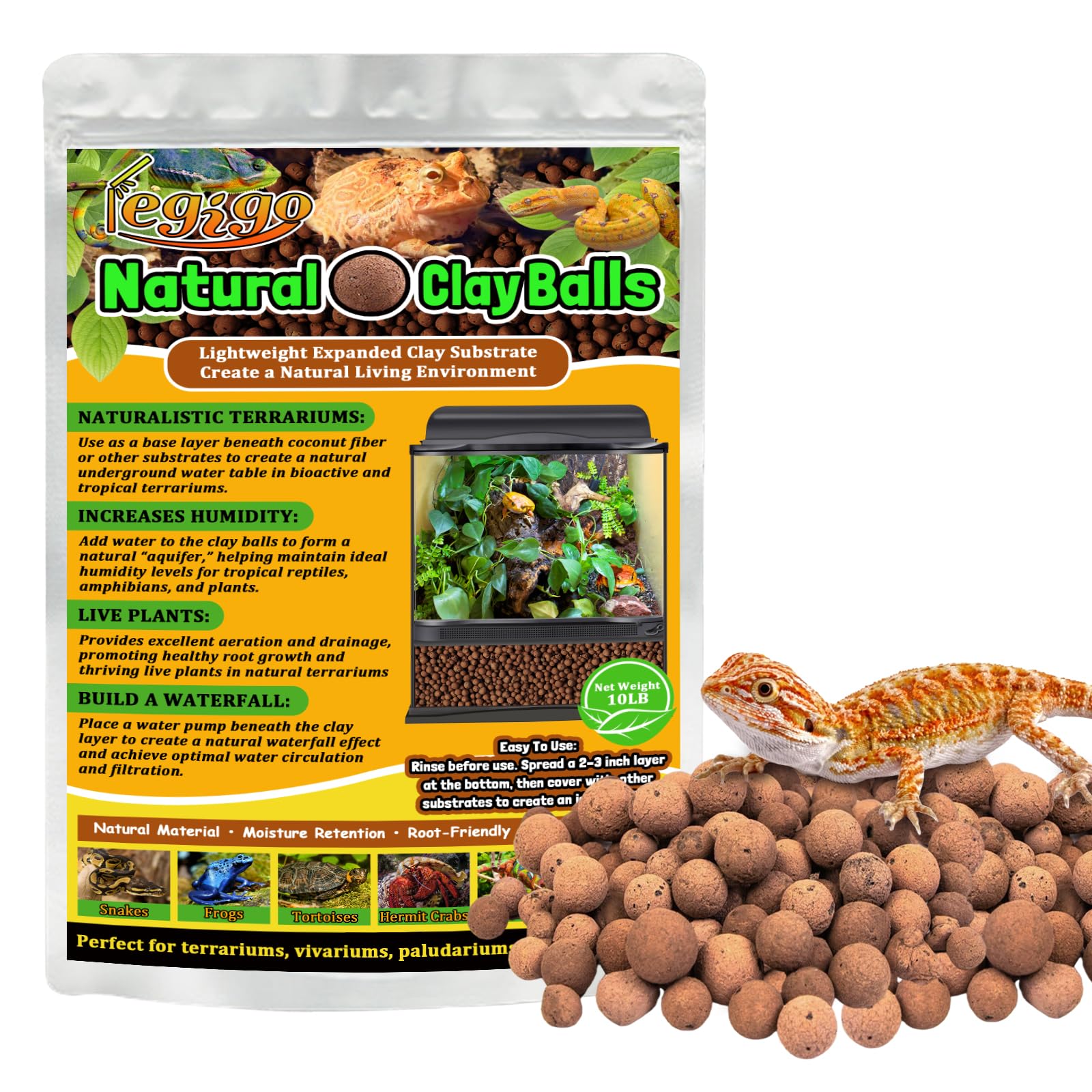
The Legigo LECA balls deliver exactly what an engineered drainage layer should: consistent 4-16 mm expanded clay granules that are lightweight, pH-neutral, and structurally stable when wet. At 10 pounds, this bag provides generous coverage — enough for a 40-gallon breeder tank with a 2- to 3-inch false bottom. The clay is fired at high temperature, which makes each pellet resistant to crumbling even after repeated wet-dry cycles.
Owners specifically mention the balls maintain their shape during reuse, which is unusual for budget LECA alternatives that degrade into dust after a single enclosure breakdown. The porous interior slowly releases moisture back into the air, stabilizing humidity between mistings without keeping the soil layer wet.
The 4-16 mm size range sits in the sweet spot for most bioactive builds — fine enough to create a level water table but coarse enough to prevent substrate fines from migrating downward. Rinsing twice before use eliminates the surface dust that can cloud the water reservoir.
Why we love it
- Reusable after washing and drying — sustainable long term
- Uniform pellet size prevents substrate sinkage
- pH-neutral, safe for sensitive amphibians and reptiles
Good to know
- Balls can float if the water table rises too high
- Requires a substrate barrier mesh to separate from soil
3. Josh’s Frogs Drainage Layer (4 Quart)
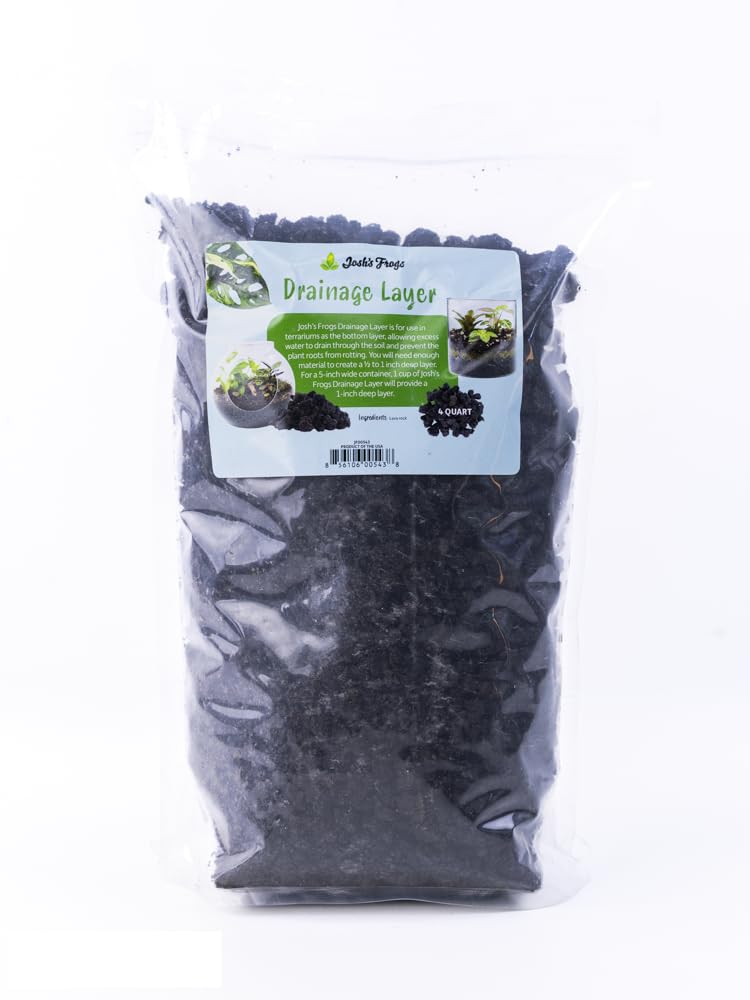
Josh’s Frogs designed this drainage layer specifically for the first step in a planted terrarium build — it sits directly on the glass, under the substrate barrier, and above the water reservoir. The fired clay granules are noticeably lighter than standard pea gravel, which matters when you build a false bottom in a large enclosure on a glass shelf. The rough, irregular surface provides excellent wicking action, pulling water away from the substrate barrier and into the air voids.
Buyers note that the product arrives with minimal dust compared to generic LECA, and the 4-quart size maps perfectly to standard 18x18x24 Exo Terra and Zoo Med enclosures. Some shipments have contained a mix of particle shapes rather than perfectly round balls, but this actually improves drainage by preventing the layer from settling into a solid mass.
The bag weight of 7.3 pounds is heavier than it looks because fired clay is dense, so expect a true 2-inch layer from one bag in a 20-gallon high tank. Pair it with Josh’s Frogs ABG mix for a seamless bioactive system from bottom to top.
Why we love it
- Engineered specifically as a false bottom drainage layer
- Very low dust content — minimal rinsing required
- Irregular shapes improve air gap retention
Good to know
- Some batches may contain darker crushed lava particles instead of white clay
- Not the cheapest per volume compared to bulk LECA options
4. Josh’s Frogs Coco Cradle Brick (3 Pack)

The Josh’s Frogs Coco Cradle Brick isn’t a drainage layer in the traditional rock sense — it’s a compressed coir block that, when expanded, functions as a moisture-wicking base layer that also supports burrowing microfauna. Each brick expands to roughly 4 to 6 times its dry volume, producing a fluffy, fibrous mat that holds water without becoming waterlogged. The electrical conductivity (EC) is below 1.0 ms/ds, meaning the salt content is low enough to avoid shocking sensitive plants or invertebrates.
Users who combine this with a thin gravel false bottom report that the coir acts as a capillary bridge, drawing water up from the reservoir and distributing it laterally beneath the soil layer. This prevents dry pockets from forming at the edges of the enclosure. The material is also 100% biodegradable, so it can be composted after a vivarium teardown.
One brick fills roughly 8 quarts of loose volume, making the 3-pack sufficient for a 30-gallon bioactive setup when used as a middle wicking layer. The main caution is that compressed bricks require thorough hydration before use — skipping the soak leaves dry patches that won’t expand evenly.
Why we love it
- Creates a capillary mat that distributes moisture evenly
- EC below 1.0 — safe for sensitive plants and inverts
- 100% biodegradable and compostable after use
Good to know
- Not a standalone drainage layer — needs gravel or LECA below
- Bag packaging can tear during shipping, creating a mess
5. CJGQ 7 lb Mix Lava Rocks

The CJGQ lava rock mix provides an entry-level drainage solution at a very accessible price point. This 7-pound bag contains a blend of black and red volcanic gravel with particle sizes averaging around 1/5 inch — fine enough to use as top dressing but small enough to function as a bottom drainage layer when layered at least 2 inches deep. The porous surface absorbs excess water and slowly releases it, which prevents root rot in succulent plants and terrarium species.
Reviewers consistently use this as a soil topper for cacti and bonsai, but it also works as a budget drainage medium when paired with a substrate barrier. The main drawback reported is inconsistent sizing — some bags contain an excess of fine dust and occasional foreign debris like plastic shreds. Pre-rinsing through a mesh strainer is essential to remove the sediment that would otherwise clog the water table.
The volume (7 liters) looks generous in the bag but compresses significantly during shipping, so expect roughly 5–6 liters of usable rock. For small enclosures under 20 gallons, this is a cost-effective way to establish drainage without investing in specialty terrarium products.
Why we love it
- Very low cost per pound for a porous drainage medium
- Dual use as top dressing and drainage layer
- Porous structure buffers humidity in small enclosures
Good to know
- Fines and dust require thorough rinsing before use
- Contamination with foreign debris reported in some batches
FAQ
How deep should my drainage layer be in a bioactive terrarium?
Can I use regular aquarium gravel for a drainage layer?
Do I need activated charcoal above the drainage layer?
What is the best material for a false bottom with springtails or isopods?
Final Thoughts: The Verdict
For most gardeners, the drainage layer for bioactive terrarium winner is the Exo Terra Sub Stratum because it combines drainage capability with active biological support — ammonia elimination and nutrient delivery — in a single bag. If you want reusable, pH-neutral clay pellets that scale to larger tanks, grab the Legigo 10 lbs LECA Balls. And for a budget option that handles small enclosures and doubles as top dressing, nothing beats the CJGQ Lava Rock Mix.