
A fever in your dog is rarely a straightforward event. Unlike humans who can describe a headache or a chill, your pup relies entirely on you to detect a rising body temperature before an infection runs unchecked. The challenge is that the most reliable way to measure a dog’s core temperature — the rectal route — is stressful for both of you, often causing the reading to spike from the struggle alone. An ear thermometer designed for the deeper, curved ear canal of a dog solves this problem, offering a fast, less invasive alternative that gets you the answer without the wrestling match.
I’m Mo Mahin — the founder and writer behind Furric. My approach here is rooted in cross-referencing veterinary standards for canine fever detection with the actual mechanical limits of infrared sensors, probe lengths, and memory retention features available in the home market, filtering out the units that simply repackage human tech without adjusting for a dog’s anatomy.
This guide isolates the models that hit the right balance of accuracy, build quality, and ease of use so you can feel confident managing your pet’s health at home, focusing specifically on what makes a good ear thermometer for dogs different from a general-purpose device.
How To Choose The Best Ear Thermometer For Dogs
Not every infrared ear thermometer is built for a canine ear. The human ear canal is relatively straight and short, while a dog’s ear canal takes an L-shaped turn and runs deeper. Buying a thermometer designed for people will likely give you readings that reflect the temperature of the outer ear wall rather than the tympanic membrane, which is where the accurate core temperature lives. You need to look for three specific variables to ensure you are measuring the dog, not the room.
Probe Length and Angle
The single most critical spec is the probe length. A standard human ear thermometer has a short, bulbous tip that barely enters the ear opening. A dedicated pet thermometer, like the MINDPET-MED, extends the probe significantly — around 7 inches — to navigate past the outer ear hair and reach the correct spot near the eardrum. Without this extra length, you are simply measuring the ambient temperature of the ear flap, which will read lower than the true core temperature.
Age Precision and Memory Settings
Dogs have a normal temperature range of 101°F to 102.5°F, notably different from a human’s 98.6°F baseline. A thermometer with a dedicated pet mode or an adjustable age precision setting helps calibrate the fever alarm thresholds so you aren’t falsely alarmed by a reading that is perfectly healthy for a canine. Memory storage (typically 10 to 30 readings) is equally important because a single point of temperature data is less helpful than a trend — tracking a dog’s temperature over several hours tells you whether the fever is rising, falling, or stable.
Speed vs. Consistency
Many units advertise a 1-second reading, but speed must be weighed against the number of readings you actually get. A thermometer that returns a fast but wildly inconsistent number every time you pull the trigger is useless. Look for features like ExacTemp technology from Braun or the pre-warmed tip on the Berrcom — these systems confirm that the probe is correctly positioned and that the ear canal hasn’t been cooled by the insertion of a cold tip, which is a major source of false low readings.
Quick Comparison
On smaller screens, swipe sideways to see the full table.
| Model | Category | Best For | Key Spec | Amazon |
|---|---|---|---|---|
| MINDPET-MED Pet Thermometer | Pet-Specific | Deep ear canal access | 7-inch probe length | Amazon |
| Braun ThermoScan 7 | Premium | Consistent positioning | ExacTemp confirmation | Amazon |
| PetMedics by iHome | Dual Mode | Non-contact belly scan | No-contact belly mode | Amazon |
| Berrcom ET102 | Human/Pet | Babies with heated tip | Pre-warmed probe tip | Amazon |
| iProven DT-K117 | Rectal Alt. | Waterproof flexible tip | Flexible waterproof tip | Amazon |
| Pure Enrichment PureBaby | Child-Friendly | Low-stress design | Penguin-shaped design | Amazon |
| femometer DET-1015 | Entry Level | Basic family monitoring | 30 memory recalls | Amazon |
In‑Depth Reviews
1. MINDPET-MED Pet Ear Thermometer

This is the only unit in this lineup explicitly built for animals rather than adapted from a human design. The standout feature is the long probe — 7 inches in length — which is engineered to reach past the heavy fur and the L-shaped ear canal that defines most dog breeds. You do not have to angle the device awkwardly or guess whether you are pointing at the eardrum; the extra length physically places the sensor where it needs to be.
The reading time is 1 second, and the accuracy margin is cited at 0.4°F, which is in line with what a veterinary clinic expects from a tympanic thermometer. It comes with 20 disposable pet swabs specifically for removing ear wax before measurement, a detail that acknowledges that ear wax is the number one cause of false readings in canines. The dedicated button for sound on/off is also a thoughtful touch for noise-sensitive dogs who flinch at the beep.
Some users reported inconsistent readings, but this almost always stemmed from not cleaning the ear canal first or not inserting the probe deep enough. If you follow the ear-cleaning step and push the probe fully into the horizontal ear canal, the consistency improves dramatically. The storage case keeps everything together, and the included batteries mean it works out of the box.
Why we love it
- 7-inch probe reaches the tympanic membrane in deep-ear breeds
- Includes 20 ear-cleaning swabs to improve reading accuracy
- One-touch mute button suitable for noise-sensitive dogs
Good to know
- Requires ear cleaning before each use for best results
- Hard probe tip may feel less comfortable than flexible alternatives
2. Braun ThermoScan 7 Black Edition

Braun is the gold standard in human ear thermometry, and the ThermoScan 7 brings the same engineering rigor to the table, even if it was not designed exclusively for dogs. The feature that makes it relevant for canine use is the ExacTemp technology — a patented system that confirms the probe is correctly positioned in the ear canal before it takes the reading. This matters enormously for dogs because the sensor will refuse to record a number if the probe is misaligned, eliminating false low readings from bad placement.
The Age Precision pre-sets allow you to select an age bracket (0-3 months, 3-36 months, over 36 months) which adjusts the fever alarm threshold. While these ranges are calibrated for humans, the “over 36 months” setting sets the fever alarm high enough that a normal dog temperature of 102°F does not trigger a false positive. The memory stores the last 9 measurements, which is slightly less than some competitors but adequate for tracking a single fever episode.
The biggest compromise is the probe tip: it is short and designed for the human ear. On a large breed with a deep, hairy ear canal, you will not get the probe deep enough to reach the tympanic membrane, and the reading will reflect the cooler outer ear temperature. This unit works best on small, short-haired breeds like French Bulldogs, Chihuahuas, or short-haired terriers where the ear canal is more accessible.
Why we love it
- ExacTemp technology prevents inaccurate readings from poor positioning
- Age Precision avoids false fever alarms at dog-normal temperatures
- Night light makes middle-of-the-night checks easy
Good to know
- Short human-probe cannot reach deep into large-breed ear canals
- Requires 21 disposable lens filters, adding ongoing cost
3. PetMedics by iHome Pet Thermometer
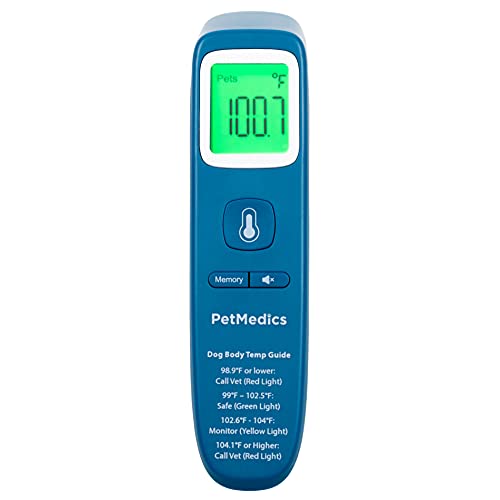
This thermometer offers a unique hybrid approach: it works as a standard ear thermometer but also functions as a non-contact scanner for a dog’s belly or inner thigh. The non-contact mode is a genuine differentiator for dogs that will not tolerate anything entering their ear — you simply point the sensor at the least hairy area of the belly from a few inches away and pull the trigger. It is not as accurate as a direct ear reading (the margin widens by about 0.5°F), but it gives you a usable trend line without any stress.
The large LCD display is easy to read even when you are squinting in a dimly lit room at 3 AM, and it ships with a reference card that shows the normal, elevated, and high temperature zones for dogs and cats. The included carry pouch is practical for keeping the unit clean between uses. It runs on two AAA batteries that are included, so you can start using it immediately.
The downsides are real: several users reported that the non-contact mode is inconsistent, giving readings that swing by 5°F depending on distance and angle. The ear mode is more reliable, but the probe itself is short and better suited for surface-level ear readings rather than deep tympanic measurement. It is a great option for quick triage but should not be your sole diagnostic instrument if accuracy is critical.
Why we love it
- Non-contact belly scan mode for stress-sensitive dogs
- Includes a reference card with normal pet temperature ranges
- Clear LCD display with backlight for low-light use
Good to know
- Non-contact mode can produce inconsistent readings
- Short probe not ideal for deep canine ear canals
4. Berrcom Ear Thermometer ET102
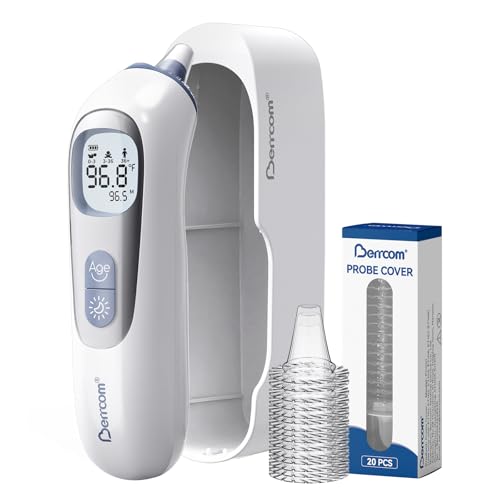
The Berrcom ET102 introduces a pre-warmed probe tip — a feature that addresses a subtle but significant source of error. When a cold plastic probe is inserted into a warm ear canal, the skin near the sensor cools slightly, and the infrared reading can drop by as much as 1°F. The pre-warmed tip eliminates this effect, making the first reading as reliable as the tenth. This is highly relevant for dogs, where a single dependable reading often matters more than averaging multiple stressed-out attempts.
The device stores up to 32 memory recalls, which is more than enough to track a fever through a 24-hour cycle. The 360-degree floating probe tip adapts to the natural angle of the ear, which helps position the sensor correctly without forcing the dog’s head into an unnatural position. The night light is useful for checking temperatures without turning on bright overhead lights that can wake a sleeping pet.
Keep in mind that this is a human-grade thermometer at its core. The age modes are calibrated for human age brackets (infant, toddler, adult), not for species. You will need to manually interpret the reading against the canine 101°F-102.5°F baseline. The probe length is adequate for small and medium dogs but will not reach deep enough for a Labrador or a Golden Retriever without assistance from the 360-degree tip positioning.
Why we love it
- Pre-warmed tip gives accurate first readings without averaging
- 32 memory points track temperature trends over a full day
- 360-degree floating tip adapts to ear angles
Good to know
- Age modes are for human babies, not canine calibration
- Probe depth insufficient for large, deep-eared breeds
5. iProven Pet Thermometer DT-K117
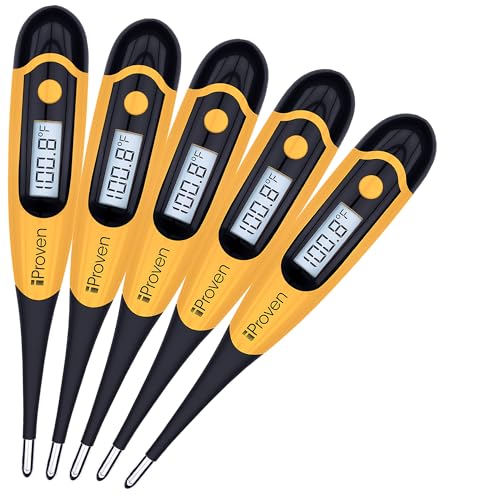
The iProven DT-K117 takes a different approach: it is a flexible-tip digital thermometer designed for rectal use but marketed as a pet thermometer. The advantage here is the flexible tip — it is made of a soft, pliable material that causes minimal discomfort during insertion, which is critical because a rigid tip against a struggling dog can cause injury. The flexible tip bends with the dog’s movement, reducing the risk of a sudden flinch causing trauma.
The device is fully waterproof, which makes post-use cleaning simple. You can rinse it under running water and wipe it dry without worrying about damaging the electronics. The reading time is 20 seconds — slower than infrared options but sufficient if your dog is calm. The memory stores the last reading only, which is a limitation, but the auto-off function preserves battery life between uses.
This is not an ear thermometer in the traditional infrared sense; it is a rectal thermometer that is easier to use than a standard glass or rigid digital version. If your goal is strictly an ear-based reading, this is not the right tool. However, if you want the most accurate possible core temperature and are willing to manage the rectal process with lubricant and a gentle hand, the DT-K117 delivers the best accuracy of any unit here — rectal temperature is the gold standard.
Why we love it
- Flexible, soft tip minimizes discomfort compared to rigid probes
- Fully waterproof design allows thorough cleaning under running water
- Rectal readings provide the highest possible accuracy
Good to know
- 20-second reading time is slower than infrared ear thermometers
- Not an ear thermometer — requires rectal insertion for best results
6. Pure Enrichment PureBaby Penguin Ear Thermometer

The PureBaby Penguin thermometer is undeniably cute, and that matters when you are dealing with a family dog who is already nervous about medical procedures. The penguin-shaped design is not just cosmetic — the ergonomics are structured so that the device fits comfortably in an adult hand, with the button placement encouraging a natural grip that aligns the probe properly. The “InstaRead” technology returns a result in 1 second, which is fast enough to get the reading before the dog pulls away.
The LCD backlit display shows temperature in both Celsius and Fahrenheit simultaneously, and the 10-memory recall allows you to track readings across a short illness. The device is marketed as a child-safe tool, so the materials are BPA-free and the tip is designed to be gentle on sensitive skin — this translates well to a dog’s ear canal, which has delicate tissue that can be irritated by harsh plastic. The protective cap keeps the sensor clean in the drawer between uses.
The probe length is standard — short and designed for human ears. It works well on short-haired breeds and puppies, but you will struggle to get a reliable reading on a thick-coated breed like a Husky or a Golden Retriever. Some users noted inconsistent readings between the left and right ears, which is often a sign of shallow insertion rather than a sensor defect. The 5-year warranty from Pure Enrichment is a solid safety net that beats most competitors.
Why we love it
- Cute ergonomic design reduces stress for anxious pets
- BPA-free materials safe for sensitive ear tissue
- Backlit display shows both Celsius and Fahrenheit simultaneously
Good to know
- Short probe limits accuracy on thick-coated and deep-ear breeds
- Inconsistent results between ears require multiple readings
7. femometer Infrared Ear Thermometer DET-1015

The femometer DET-1015 is positioned as a multi-purpose infrared ear thermometer for the whole family — and it works reasonably well as a budget-conscious option for dog owners who need a tool for occasional checks rather than daily monitoring. The standout spec here is the 30-memory recall, which is generous for the entry-level price point and allows you to track a fever across several days without having to write anything down manually.
The three-color fever alarm system is intuitive: green for normal (below 99.5°F in human mode), orange for elevated, and red for high. You will need to recalibrate your interpretation for canine temperatures — a green light on the display at 101°F does not mean your dog is fever-free, but the quick visual cue at least alerts you that something is happening. The one-button silent function is useful for nighttime checks on a sleeping dog, as the muted operation will not startle them awake.
The probe length is short and standard, identical to most human ear thermometers. It includes 21 disposable probe covers, which are non-negotiable for maintaining hygiene if you are using the same thermometer for humans and dogs. Some users reported that the included covers are thin and require careful fitting to avoid tearing. For the price, this is a capable secondary tool, but if your primary need is accurate canine temperature tracking, the MINDPET-MED or the Braun ThermoScan 7 are better investments.
Why we love it
- 30-memory recall provides extensive fever tracking capability
- Color-coded fever alarm gives quick visual temperature status
- One-touch silent mode for nighttime use
Good to know
- Standard short probe not designed for deep canine ear canals
- Included probe covers are thin and may tear during installation
FAQ
Can I use a human ear thermometer on my dog?
What is a normal ear temperature range for dogs?
How do I clean my dog’s ear before taking a temperature?
Why do I get different readings in each ear?
Final Thoughts: The Verdict
For most dog owners, the ear thermometer for dogs winner is the MINDPET-MED Pet Ear Thermometer because its 7-inch probe is the only design that acknowledges the anatomical reality of a dog’s deep, L-shaped ear canal and comes with the cleaning swabs you need for consistent accuracy. If you prefer a premium human-grade device that ensures correct positioning above all else, grab the Braun ThermoScan 7 — but pair it with a deep-ear technique for larger breeds. And for a budget-friendly backup that offers generous memory and silent operation, the femometer DET-1015 serves as a capable secondary screening tool for quick at-a-glance checks.