
A robot vacuum that bumps into furniture, misses corners, and wraps pet hair around its brush is not a time-saver—it’s a daily frustration. The narrow difference between a helpful cleaner and a frustrating gadget comes down to three specs: navigation intelligence, suction power measured in Pascals, and the self-emptying system’s capacity. Every model below was selected because it addresses these pain points with measurable, category-specific performance.
I’m Mo Mahin — the founder and writer behind Furric. My recommendations are grounded in deep market research comparing LiDAR accuracy, dust-bag capacities, and owner feedback across hundreds of usage reports to identify which models deliver on their mapping and suction claims.
Whether you prioritize deep carpet cleaning, tangle-free pet hair pickup, or a fully automated mopping cycle, this guide breaks down the key specs that separate a smart purchase from a regret. You’ll find the best selling robot vacuum that fits your specific floor plan and cleaning habits.
How To Choose The Best Selling Robot Vacuum
The robot vacuum market is crowded with models that look similar but perform wildly differently. Three technical specifications define the real-world cleaning experience more than anything else: navigation type, suction strength, and the self-emptying system. Understanding these will save you from buying a model that leaves half the room uncleaned or requires daily maintenance.
LiDAR vs. Gyroscopic vs. Random Navigation
LiDAR-based robots use a spinning laser to build a real-time map of your home, enabling row-by-row cleaning, room selection, and precise no-go zones. Gyroscopic or camera-based navigation relies on sensors that track movement but often produce overlapping or missed passes. Random navigation models bounce off walls and cover the same spots repeatedly while ignoring others—these are best avoided unless your home is very small and open.
Suction Power Measured in Pascals (Pa)
A robot vacuum’s suction strength is measured in Pascals. For hard floors, anything above 2,500 Pa is generally sufficient to pick up dust and crumbs. For low-pile carpets, you’ll need at least 5,000 Pa to pull embedded dirt and pet hair from the fibers. High-pile or thick carpets require 8,000 Pa or more. The figures below 2,000 Pa are typically found on entry-level models that struggle on anything but bare floors.
Self-Emptying Capacity and Dust Bag Size
The convenience of a self-emptying base hinges on its dust bag capacity. A 2.5-liter bag might last 30 days for a small apartment, while a 3.5-liter bag can go up to 90 days for a typical home. Some models use bagless cyclonic bins that require washing, while sealed dust bags are better for allergy sufferers because they trap fine particles when the robot empties itself. Ignore the “days” marketing and look at the actual liter measurement—it’s the only consistent spec.
Mopping Systems: Passive Wipe vs. Active Scrub
Not all mopping is equal. Many robot vacuums drag a damp cloth across the floor—this swipes surface dust but does nothing for dried stains. Active mopping systems use a spinning or oscillating pad with downward pressure, sometimes with self-cleaning and hot-air drying stations. If you have tile or hardwood floors that need more than a gentle wipe, prioritize a model with a rotating mop pad and an onboard water tank that can be adjusted for flow rate.
Quick Comparison
On smaller screens, swipe sideways to see the full table.
| Model | Category | Best For | Key Spec | Amazon |
|---|---|---|---|---|
| eufy C28 | Premium | Pet owners wanting auto mop washing | 15,000 Pa suction, HydroJet roller mop | Amazon |
| DREAME L50 Ultra | Premium | Homes with transitions over 6cm thresholds | 19,500 Pa suction, ProLeap system | Amazon |
| DREAME X50 Ultra | Premium | Low-furniture clearance and deep carpets | 20,000 Pa suction, retractable legs | Amazon |
| roborock Qrevo Edge 2 | Premium | Maximum edge cleaning and AI avoidance | 25,000 Pa suction, FlexiArm brush | Amazon |
| roborock Q7 M5+ | Mid-Range | Budget-minded buyers wanting 10,000 Pa | 10,000 Pa suction, 7-week self-empty | Amazon |
| Shark Navigator RV2120AE | Mid-Range | Bagless self-empty with 60-day capacity | LiDAR navigation, bagless bin | Amazon |
| Shark Navigator AV2110S | Mid-Range | Pet owners wanting anti-hair wrap brushroll | LiDAR navigation, 30-day self-empty | Amazon |
| Tikom L8000 Plus | Budget | Entry-level LiDAR with 90-day self-empty | 6,000 Pa suction, 3L dust bag | Amazon |
| uninell Robot Vacuum | Budget | Quiet cleaning with 180-minute runtime | 7,000 Pa suction, 3.5L dust bag | Amazon |
In‑Depth Reviews
1. eufy C28

The eufy C28 redefines mopping in the robot vacuum class by using a 28cm HydroJet roller that spins at 270 RPM with 24 water ports. This is not a passive damp cloth—it actively scrubs, and a built-in scraper constantly removes dirty water into a separate tank, keeping the roller clean throughout the cycle. Combined with 15,000 Pa of suction, this model tackles both embedded carpet debris and dried-on kitchen messes without leaving wet residue.
The all-in-one station handles dust auto-emptying into a 3L bag, hot-air mop drying at 50°C to prevent mold, and wastewater collection for up to 75 days of hands-off maintenance. We found the LiDAR navigation reliably avoids obstacles as small as 3×3×3 cm—shoes, pet bowls, and small toys—without needing a camera, which preserves privacy. The mop lifts 10.8 mm automatically on carpets, preventing the carpet fringe from getting soaked.
Owner feedback consistently praises the zero-tangle DuoSpiral brush on long hair up to 30 cm, a significant time-saver for multi-pet households. The trade-off is that the mopping cycle takes longer to complete because the roller rotates slowly for scrubbing, but the result is a floor that genuinely looks wet-washed rather than streaked. For anyone who needs true floor washing instead of a quick wipe, this is the strongest choice.
Why we love it
- Active roller mop scrubs stains, not just surface dust
- Self-cleaning mop with hot-air drying prevents odor and mold
- Privacy-safe LiDAR avoids cameras while navigating precisely
Good to know
- Mopping cycle is slower than passive pad models
- Some users report initial mapping glitches that require re-mapping
2. DREAME L50 Ultra
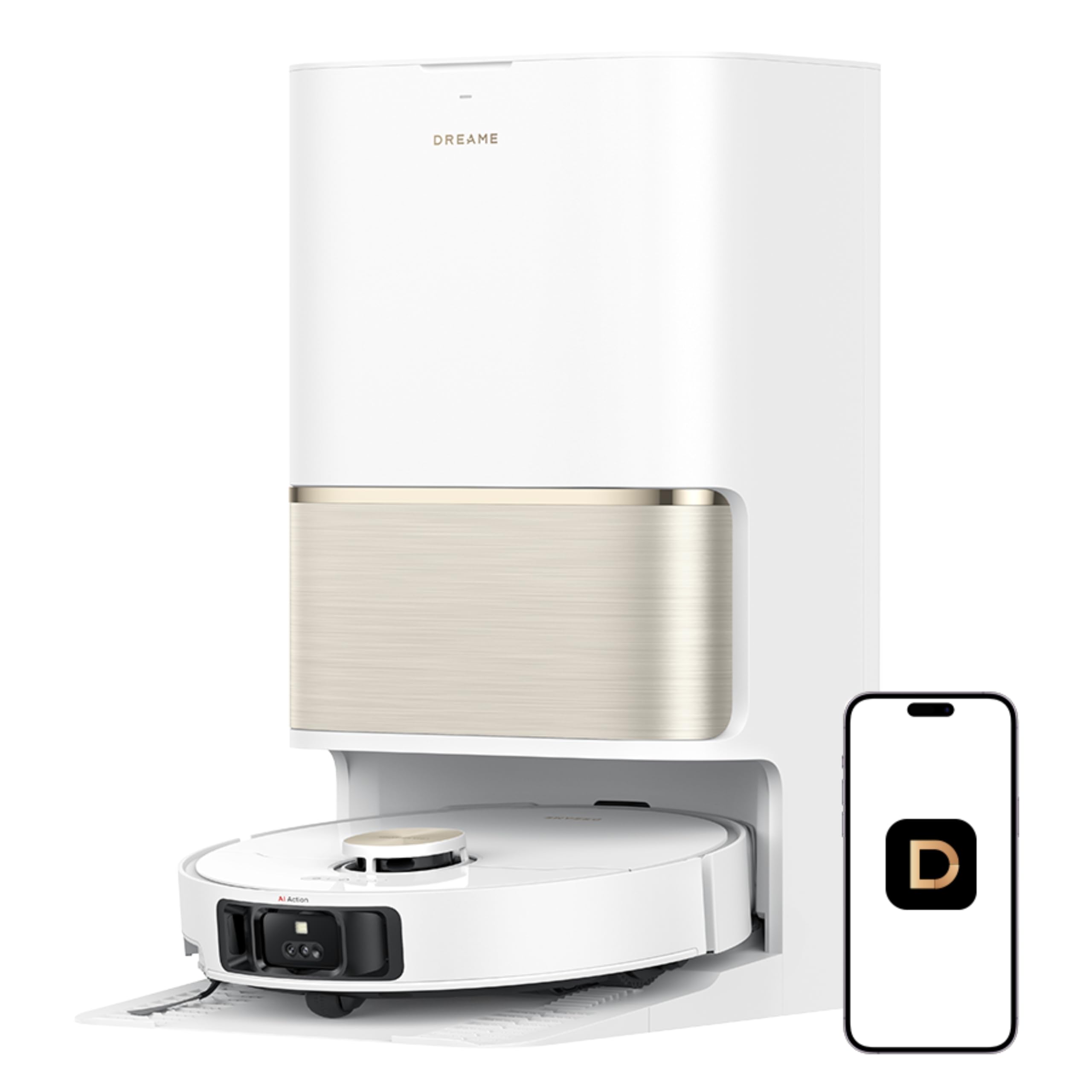
The DREAME L50 Ultra solves a problem many robot vacuums face: getting stuck on door tracks or room-to-room thresholds. Its ProLeap system uses retractable legs that literally lift the robot up to 6 cm, allowing it to traverse obstacles that stop most competitors. This feature is especially useful in homes with transition strips, raised door sills, or thick area rugs with high edges.
Its 19,500 Pa suction power is paired with the HyperStream Detangling DuoBrush—one bristled brush and one TPU rubber brush—that collects hair without wrapping around the axle. The AI-powered 3D structured light obstacle avoidance detects over 180 types of objects, including power cables, which is the number-one reason robot vacuums get stuck. Owners report the docking station handles dust up to 100 days and uses hot water to rinse the mop pads, then dries them automatically.
One of the standout features is the Dual Flex Arm technology: the side brush and the mop extend simultaneously to reach corners and along baseboards, reducing the line of missed dust along walls. The app provides five carpet care strategies, including full carpet avoidance and suction boost, so the robot adjusts its behavior depending on whether it hits a low-pile rug or a high-pile carpet. The only common criticism is the large base station footprint—at 17×16×27 inches, it requires dedicated floor space.
Why we love it
- ProLeap system climbs thresholds up to 6cm high
- Dual Flex Arm extends both brush and mop into corners
- 100-day self-emptying with hot-water mop washing
Good to know
- Base station is large and needs dedicated floor space
- Obstacle avoidance may still catch on very thin cables
3. DREAME X50 Ultra
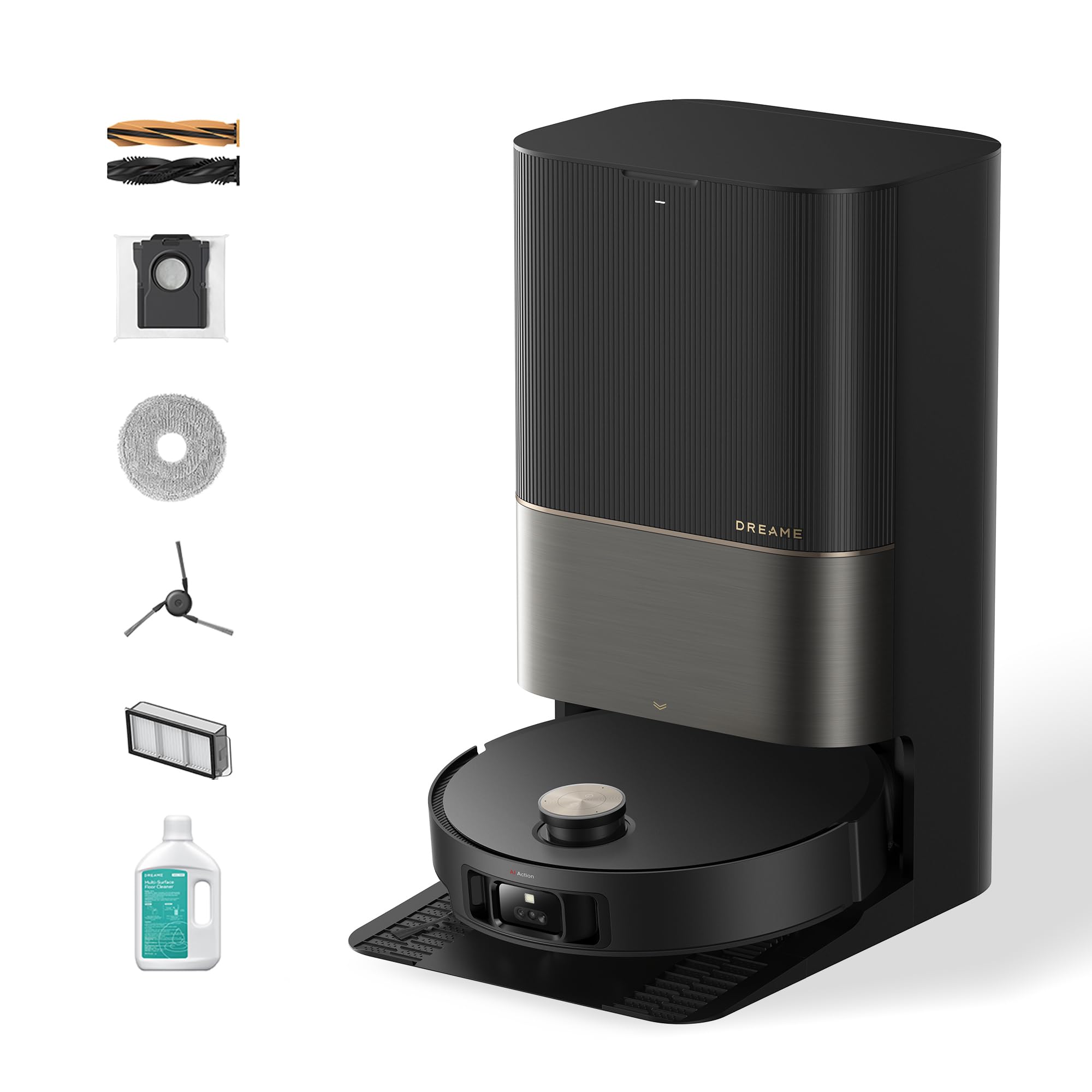
The DREAME X50 Ultra solves the low-clearance problem that plagues many robot vacuums with top-mounted LiDAR towers. Its VersaLift Navigation lowers the entire LDS unit when the robot detects a low gap—like under a sofa or bed frame—dropping the height to just 3.5 inches so it can clean thoroughly in spaces most robots cannot access. This is a genuine breakthrough for homes with furniture that sits close to the floor.
With 20,000 Pa of Vormax suction and a sixth-generation TurboForce motor, the X50 Ultra pulls large debris like cat litter and cereal flakes on the first pass. The DuoBrush system handles hair up to 11.8 inches without tangling, and the AI camera with LED guidance allows precise navigation even in dark spaces under furniture. The base station includes a self-cleaning mop board that washes with hot water and collects wastewater, plus a 5-bag dust system that reduces bag swaps for months.
The five carpet modes—remove mops, avoid carpets, boost suction—give complete control over how the robot interacts with different floor textures. Owners with multiple dog breeds report the X50 Ultra removes 95% of visible pet hair after the first full run, and the self-emptying base means they rarely touch a dust bin. The main trade-off is the learning curve with the app, which some users find less intuitive than Roborock’s interface, but the mechanical performance is hard to fault.
Why we love it
- Retractable LDS tower allows cleaning under 3.5-inch gaps
- 20,000 Pa suction handles heavy debris on carpets
- Self-cleaning mop board with hot-water cycle
Good to know
- App interface is less polished than some competitors
- Base station footprint is comparable to a small trash can
4. roborock Qrevo Edge 2
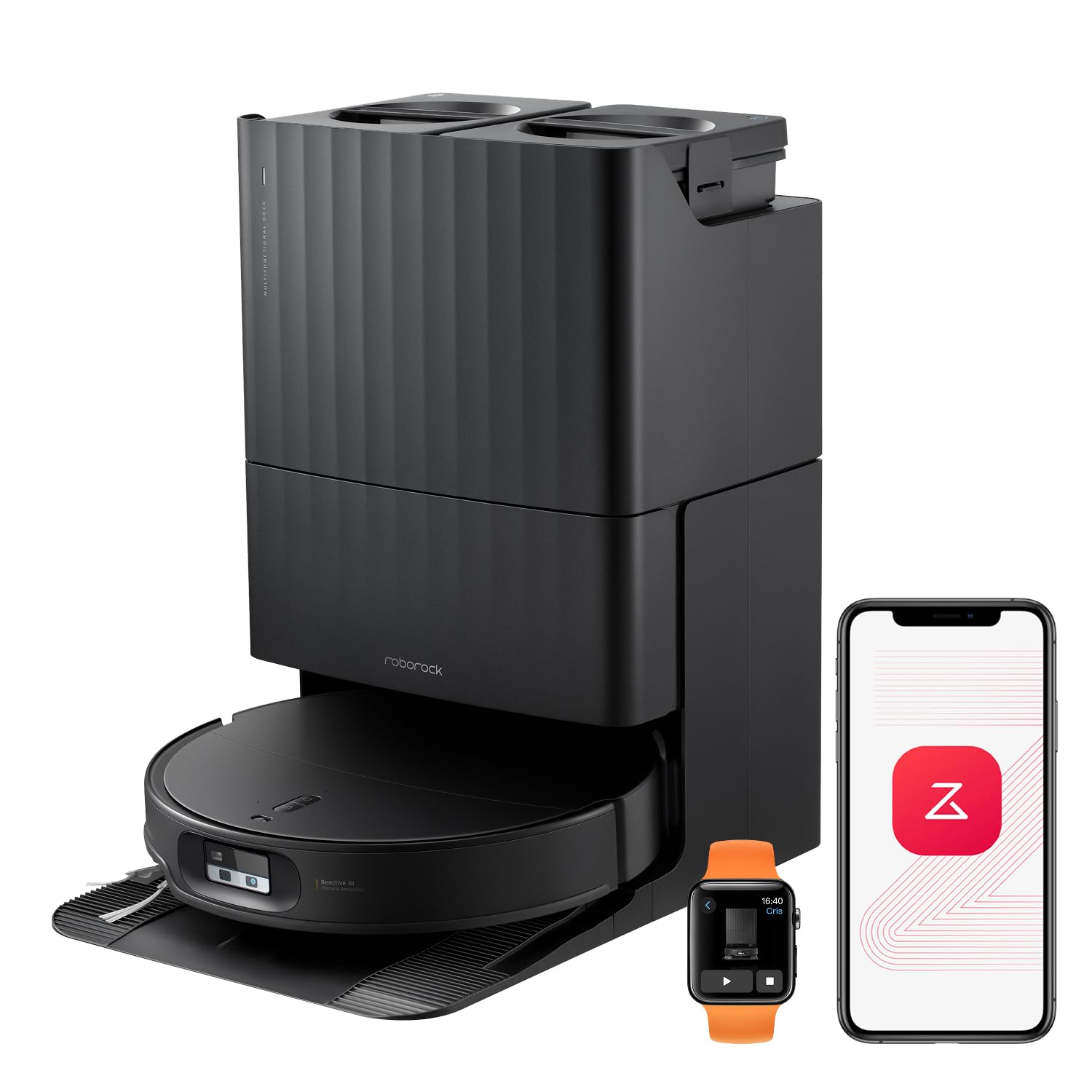
The roborock Qrevo Edge 2 takes raw suction power further than almost any other consumer robot vacuum, delivering 25,000 Pa of HyperSuction. This is not just a marketing figure—it translates into measurable differences on high-pile carpets where lower-suction robots leave visible dirt tracks. The FlexiArm Arc Side Brush extends beyond the robot’s chassis to sweep debris from walls and toe-kick areas down to 0.98 inches, addressing the edge gap that standard side brushes miss.
At just 3.14 inches thin, the Qrevo Edge 2 is among the slimmest premium models, and its RetractSense Navigation uses an upward dToF range finder to detect overhead clearance and retract the LDS tower before entering low furniture. The Reactive AI Obstacle Recognition system identifies over 280 object types, including power cables, pet toys, and socks, using an RGB camera with an LED light. The dock washes mops with 176°F hot water, then dries them with 131°F warm air, and self-empties dust for up to 65 days.
We especially like the SmartPlan 3.0 feature, which automatically recognizes room types and adjusts cleaning strategy—for example, boosting suction in high-traffic entryways and re-washing mops after the kitchen is cleaned. Owner feedback is overwhelmingly positive about the 188-minute runtime, which comfortably covers a 1,300-square-foot single-floor home. The main downsides are the high entry price and the fact that the robot sometimes misses very tight corners despite the FlexiArm brush, but overall this is the most powerful and intelligent cleaner on this list.
Why we love it
- Highest suction at 25,000 Pa for deep carpet cleaning
- Ultra-slim 3.14-inch height fits under most furniture
- FlexiArm brush reaches 0.98-inch gaps along walls
Good to know
- Premium cost places it at the top of the price range
- May still miss extremely tight corner angles
5. roborock Q7 M5+

The roborock Q7 M5+ brings the brand’s proven PreciSense LiDAR navigation and 10,000 Pa suction to a mid-range price point. While 10,000 Pa is below the flagship models, it still delivers enough power for low-to-medium-pile carpets and excels on hard floors. The JawScrapers main brush and a zero-hair-tangling side brush are effective at resisting pet hair wrap, making this a solid pick for households with long-haired dogs or cats.
The 2.7-liter sealed dust bag in the RockDock Plus base provides up to seven weeks of hands-free emptying, and the vacuum-and-mop combination allows three adjustable water flow settings for mopping on tile or hardwood. The app is where Roborock shines: users can schedule cleanings, set no-go zones, and monitor cleaning progress. The rectangular form factor with a 12.8-inch cleaning path width means it covers ground efficiently without leaving stripes of missed debris.
Owner reviews highlight the methodical laser mapping that accurately identifies individual chair legs and other small obstacles, resulting in a cleaning pattern that rarely overlaps unnecessarily. The battery life of 150 minutes is sufficient for most single-floor homes up to 1,800 square feet. The main compromise is the mopping system—it uses a passive vibration pad rather than a rotating scrubber, so it handles surface dust better than dried-on stains. For buyers who prioritize mapping and vacuum performance over advanced mopping, this is a compelling middle-ground option.
Why we love it
- Proven Roborock LiDAR mapping and app experience
- 10,000 Pa suction is strong for carpets and hard floors
- Zero-tangle brushes reduce maintenance frequency
Good to know
- Mopping is passive pad, not active scrubbing
- Dust bag capacity (2.7L) is smaller than some competitors
6. Shark Navigator RV2120AE

The Shark Navigator RV2120AE stands out because its self-emptying base uses a bagless cyclonic bin with a 60-day capacity—no replacement bags to buy, no ongoing cost. This is a major differentiator for buyers who want the convenience of a self-emptying station without recurring expenses. The SmartPath LiDAR navigation enables row-by-row cleaning with 1.5 times more coverage than Shark’s earlier ION-series models.
The self-cleaning brushroll with anti-hair wrap digs into both carpets and hard floors, and Shark claims up to 50% more suction versus competing robot vacuums in a similar price tier. The robot detects and avoids objects in its path, so you don’t need to pick up shoes or small toys before starting a cleaning cycle. The SharkClean app provides schedule setting, room selection, no-go zones, and suction control, with voice compatibility for Alexa and Google Assistant.
Owner reports consistently note that the Navigator avoids getting stuck, unlike earlier Roomba models they replaced, and the bagless bin eliminates the need to buy proprietary dust bags. The 120-minute battery life covers average-sized homes, and the recharge-and-resume feature ensures cleaning completes if the battery runs low. The most common trade-off is weaker carpet performance compared to the top-tier 25,000 Pa models—this Shark is better on hard floors and low-pile carpets than on thick shag or high-pile carpets.
Why we love it
- Bagless self-emptying base saves on ongoing bag costs
- 60-day dirt capacity means infrequent emptying
- Anti-hair wrap brushroll works well on pet hair
Good to know
- Struggles on high-pile or thick shag carpets
- Replacement parts like side brushes are hard to find
7. Shark Navigator AV2110S
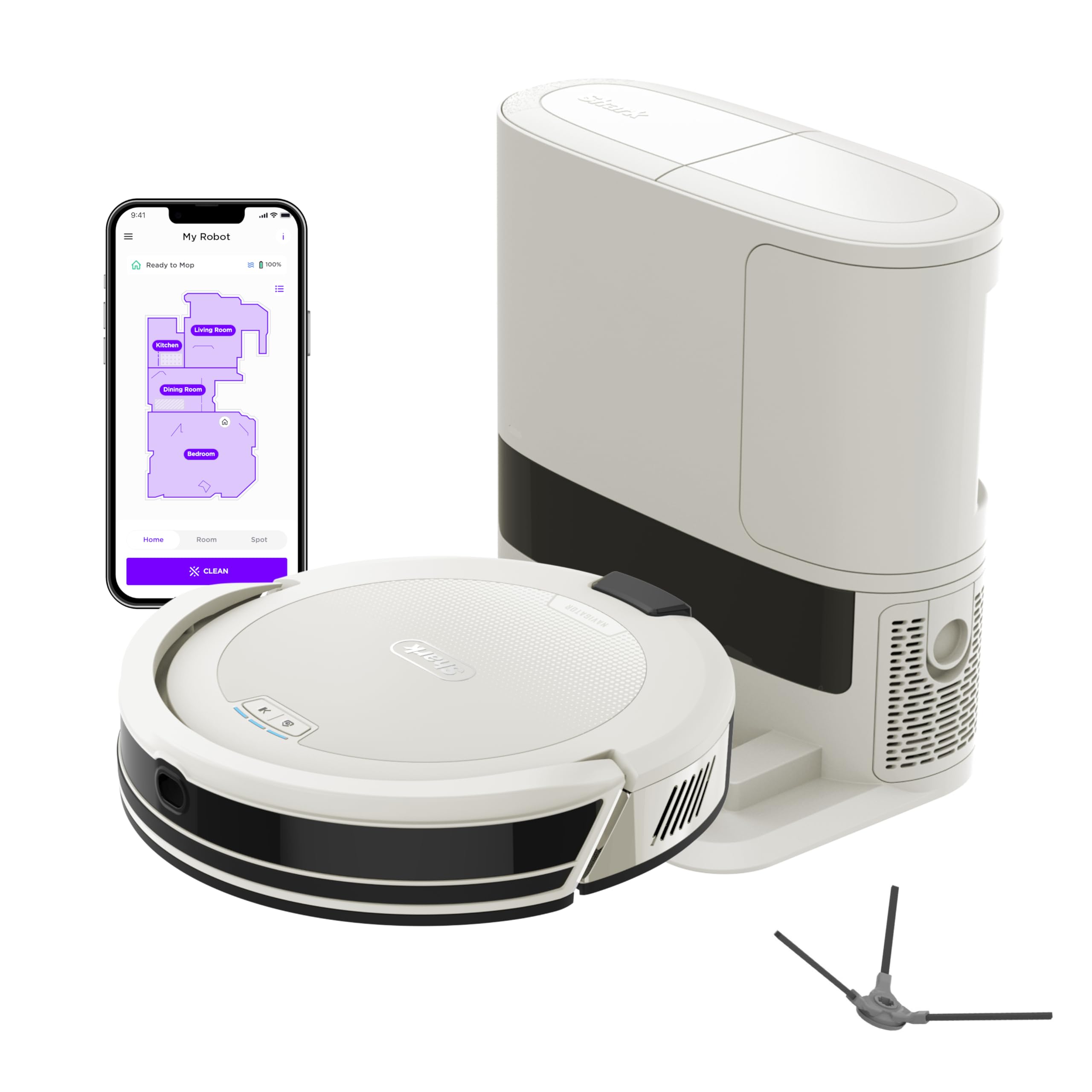
The Shark Navigator AV2110S delivers the same SmartPath LiDAR navigation and self-cleaning brushroll as the RV2120AE but in a package designed specifically for pet homes. Its anti-hair wrap brushroll captures long pet hair and human hair while preventing tangles, which reduces the frequency of manual brush cleaning. The 30-day self-emptying bagless base is smaller than the 60-day version but still eliminates daily emptying.
On hard floors, the AV2110S is remarkably effective—owners report it picks up not just surface dust but also fine particles that settle into grout lines. The object-detection sensors allow the robot to clean around pet bowls and furniture without bumping. The recharge-and-resume function means it can pause, recharge at the dock, and return to the exact spot it left off, which is crucial for large floor plans where a single battery charge isn’t enough.
Owner feedback is overwhelmingly positive on hard floors but consistently notes weaker performance on all carpet types, from low-pile to shag. The robot also does not include a mopping function, so if you need wet cleaning, this model is vacuum-only. For buyers whose homes are predominantly tile, hardwood, or laminate and who need aggressive pet-hair pickup without dust-bag expenses, this Shark is a reliable choice.
Why we love it
- Anti-hair wrap brushroll is effective on long pet hair
- Bagless self-empty base saves on recurring bag costs
- LiDAR navigation avoids obstacles and maps accurately
Good to know
- Weak on all carpet types, especially high-pile
- No mopping function
8. Tikom L8000 Plus
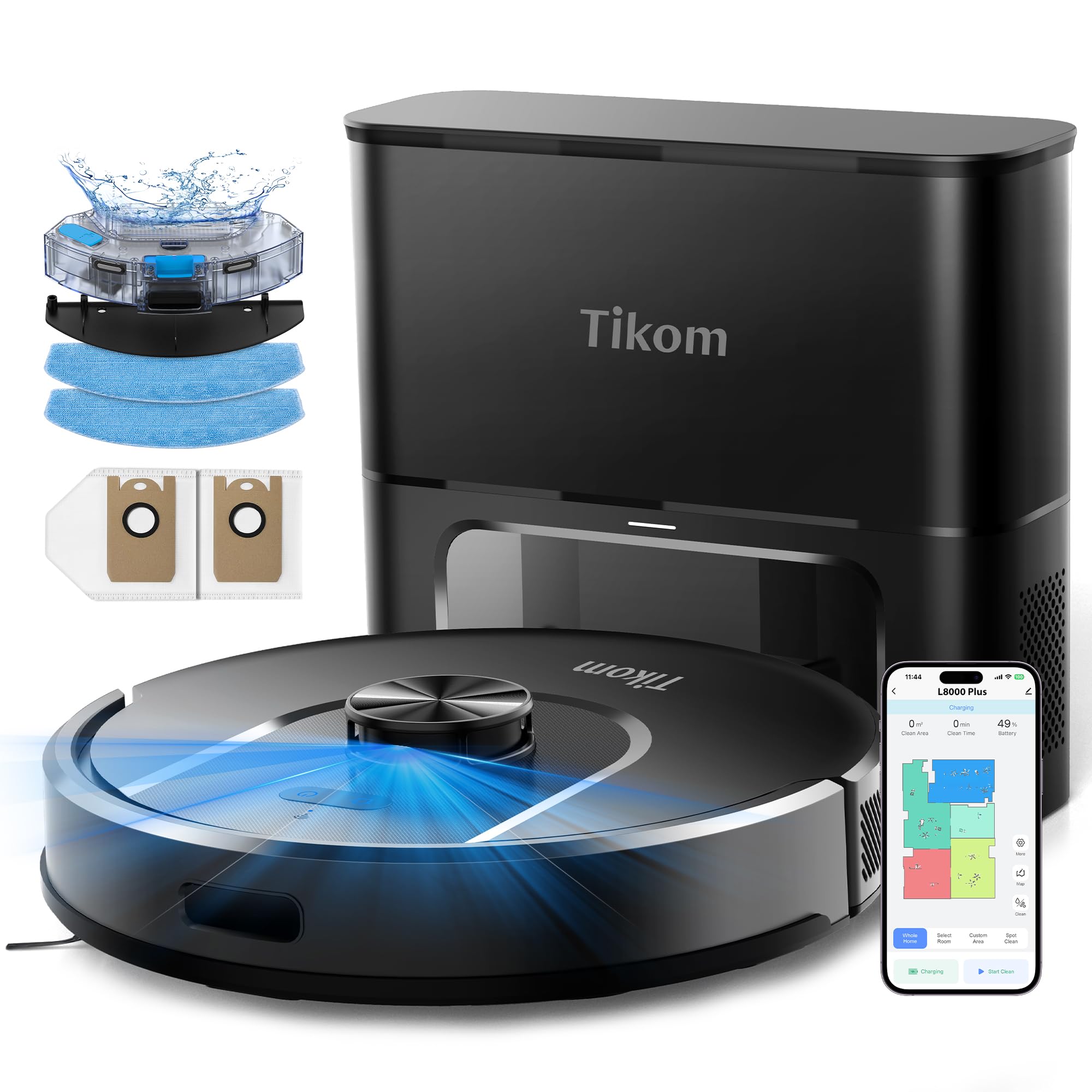
The Tikom L8000 Plus proves that LiDAR navigation and a self-emptying base are no longer exclusive to premium price brackets. For an entry-level cost, it includes a 360° LiDAR scanner that maps your home and allows multi-floor mapping for up to five different maps, along with virtual no-go zones. The 3-liter self-emptying dust bag holds up to 90 days of debris, dramatically reducing manual emptying frequency compared to similar-priced robots that lack auto-empty docks.
Its 6,000 Pa suction is adequate for hard floors and low-pile carpets, automatically boosting to maximum power when it detects carpet. The 2-in-1 sweeping and mopping system offers three suction levels and three water flow settings, though the mopping is a passive pad that handles surface dust better than dried stains. The 150-minute runtime in gentle suction mode covers most single-level homes, and the auto-recharge-resume function ensures full cleaning cycles without interruption.
Owner reviews highlight the quiet operation, accurate cliff sensors for stair avoidance, and remarkably low price for the feature set. The app allows room selection, schedule setting, and custom water and suction levels per room. The primary compromises are the smaller dust bag (3 liters versus 3.5 liters on some competitors) and the fact that the mop holder must be removed or a no-go zone set to prevent it from wetting carpets. For budget-conscious buyers who still want smart mapping, this is the strongest value pick.
Why we love it
- LiDAR mapping and self-emptying at a low entry cost
- 90-day dust bag capacity reduces maintenance
- Adjustable suction and water flow for different floors
Good to know
- 6,000 Pa suction is less effective on medium to high-pile carpets
- Passive mopping pad does not scrub stains
9. uninell Robot Vacuum
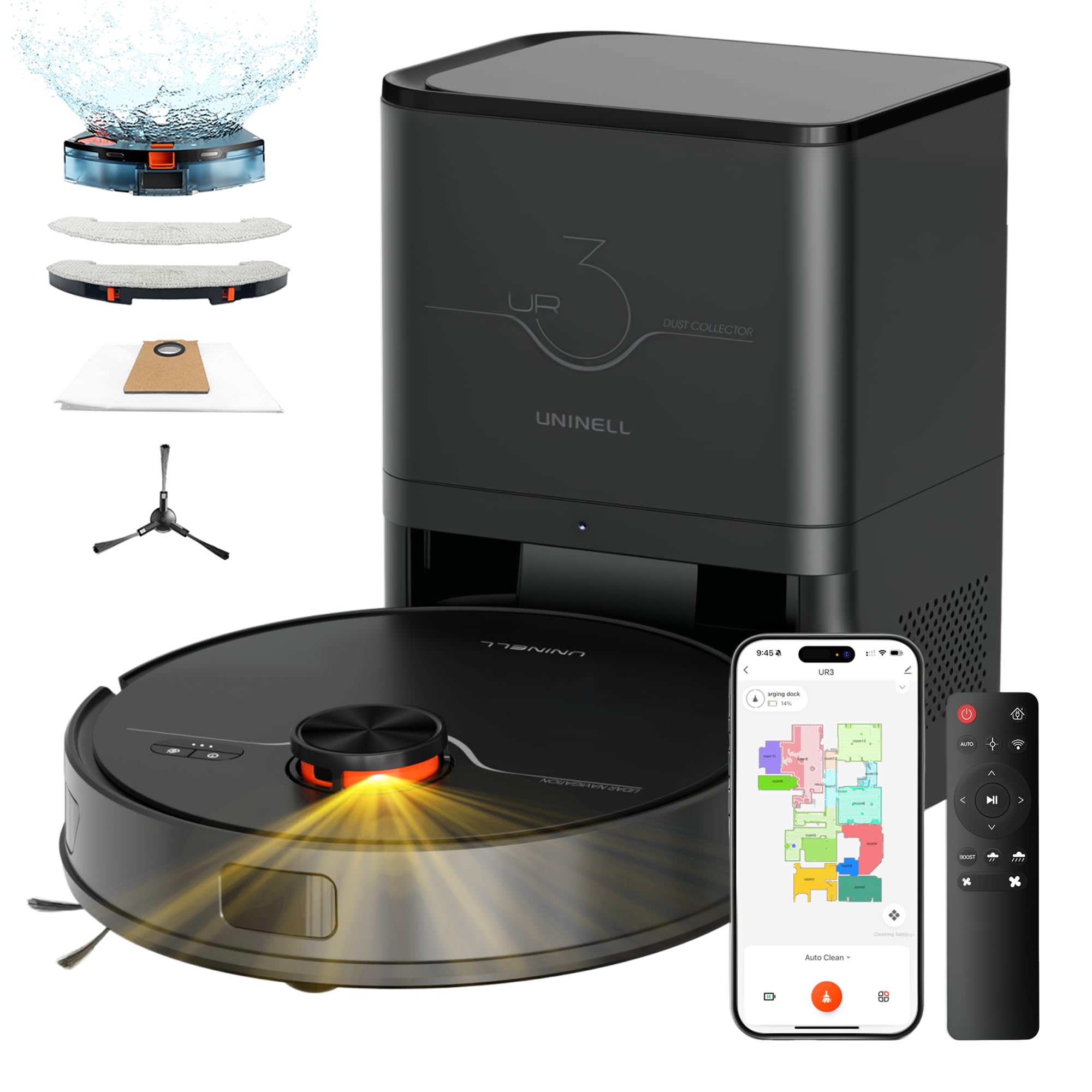
The uninell Robot Vacuum distinguishes itself with a 180-minute battery runtime, the longest in this list. This covers up to 2,000 square feet on a single charge, making it ideal for larger single-floor homes where a 120-minute robot would need to recharge and resume. The 3.5-liter self-emptying base holds up to 90 days of debris and features a tangle-free design that actively prevents hair from wrapping around the brush—a common issue in homes with dogs or cats.
With 7,000 Pa of cyclone suction and automatic carpet boost, it handles pet hair and crumbs on both hard floors and low-pile rugs. The 360° LiDAR laser mapping scans the home with laser precision, and the app allows you to set no-go zones, schedule cleanings, and customize suction and water flow for each room. The included remote control is useful for older users or guests who prefer simple push-button operation without using a smartphone.
Owner feedback highlights how quiet the unit operates—comparable to a refrigerator—and the obstacle avoidance reliably steers around furniture legs and stair edges. The 2-year warranty and lifetime technical support provide strong after-sales assurance. The mopping system is a basic stationary pad that wets the floor for dust pickup but does not scrub, and the self-emptying base is loud when it activates. For buyers who prioritize battery life and quiet operation over advanced mopping, this uninell is a strong budget-friendly contender.
Why we love it
- 180-minute runtime covers up to 2,000 sq ft
- 3.5L self-emptying bag with 90-day capacity
- Quiet operation and carpet boost detection
Good to know
- Mopping is stationary pad, not active scrubbing
- Self-emptying cycle is noticeably loud
FAQ
Does higher suction in Pascals always mean better cleaning on carpets?
How does LiDAR navigation differ from camera-based navigation for avoiding pet toys?
Is a self-emptying base worth the extra cost for an apartment?
Can a robot vacuum with passive mopping handle dried kitchen stains?
Final Thoughts: The Verdict
For most homes, the best selling robot vacuum winner is the eufy C28 because it combines active roller mopping, 15,000 Pa suction, and a privacy-safe LiDAR system at a mid-range price. If you need extreme suction power and edge-cleaning reach, grab the roborock Qrevo Edge 2. And for homes with multiple thresholds or low furniture, the DREAME L50 Ultra or the DREAME X50 Ultra deliver unique mechanical solutions that no other model matches.