
Choosing an air cleaner for asthma is not about picking the most popular brand, the first result on Amazon, or a machine with the most fan speeds. It is about matching a specific particle removal capability — measured in CADR and filter efficiency — to the actual volume of your bedroom, living room, or open floor plan. A machine that looks perfect for a dorm room will do next to nothing for someone with asthma sleeping in a 300-square-foot master bedroom.
I’m Mo Mahin — the founder and writer behind Furric. I spent months cross-referencing AHAM VERIFIDE certificates, comparing CADR ratings for smoke, dust, and pollen against real-world owner feedback from hundreds of asthma households to understand which machines actually reduce nighttime cough frequency and morning congestion.
Whether you need a compact unit for a nursery or a heavy-duty machine for an open-concept home, this guide to the best air cleaner for asthma narrows the field to nine models that share one non-negotiable trait — independently verified filtration that removes the particles most likely to trigger an attack.
How To Choose The Best Air Cleaner For Asthma
Asthma triggers are not limited to pollen and dust mites. Volatile organic compounds from cooking, pet dander, smoke particles, and even ozone produced by some purifiers themselves can provoke an attack. The best unit for your home balances three variables: particle filtration efficiency, clean air delivery rate relative to your room size, and the absence of byproducts like ozone. Below are the four specifications that separate a genuinely asthma-safe machine from a noisy fan in a plastic box.
CADR and Room Size Matching
Clean Air Delivery Rate is the metric that tells you how many cubic feet of particle-free air the machine produces per minute for smoke, dust, and pollen. A unit with a smoke CADR of 143 CFM will handle a 222-square-foot room at 4.8 air changes per hour. If your room is 400 square feet, that same CADR drops to fewer than 3 ACH — insufficient for asthma management. Always multiply your room’s square footage by the ceiling height, divide by 60, then multiply by your desired ACH (4.8 is the minimum for allergy/asthma) to find the minimum CADR you need.
HEPA Grade vs. Particle Size
True HEPA captures 99.97% of particles at 0.3 microns. H13 HEPA catches 99.95% at 0.3 microns with higher efficiency at smaller sizes. UltraHEPA and HyperHEPA filters claim capture rates of 99.99% at 0.003 microns — 100 times smaller than the HEPA standard. For asthma, the difference between 0.3 and 0.003 microns matters less than you think: most common triggers (dust mite feces, mold spores, pet dander, pollen) are between 1 and 30 microns. Fine smoke particles from wildfires or cooking oil can dip to 0.1 microns, which standard True HEPA still catches at high efficiency. The larger concern is whether the filter is pleated paper (replacement-heavy) or washable (higher upfront cost, lower long-term expense).
Filter Replacement Cost and Washability
Asthma air cleaners run 24/7 in many homes. Paper HEPA filters typically need replacement every 6 to 12 months at to per filter. Over five years, replacement costs can exceed the purchase price of a budget unit. Washable pre-filters extend the life of the main HEPA by trapping large particles first. A few models now offer fully washable multi-stage systems that eliminate replacement costs entirely — a significant factor for households managing asthma on a tight budget.
Ozone Safety and Certification
Any air cleaner that uses ionizers, electrostatic precipitators, or UV-C light has the potential to produce ozone — a known lung irritant that can worsen asthma symptoms. CARB (California Air Resources Board) certification ensures the unit produces less than 50 ppb of ozone. Zero Ozone certification means the unit has been independently verified to produce no detectable ozone. For asthma households, a unit without CARB certification or Zero Ozone verification should be avoided even if the CADR numbers look impressive. Stick to mechanical filtration (HEPA + carbon) as the primary cleaning method.
Quick Comparison
On smaller screens, swipe sideways to see the full table.
| Model | Category | Best For | Key Spec | Amazon |
|---|---|---|---|---|
| Coway Airmega AP-1512HH | Mid-Range | All-around asthma household with real-time monitoring | CADR Smoke 233 / Pollen 240 CFM | Amazon |
| CleanForce CP-Rainbow | Premium | Large open floor plans needing 550 CFM CADR | CADR 550 CFM; H13 HEPA | Amazon |
| Blueair Blue Signature 225 | Premium | Living space with design-forward aesthetic | HEPASilent; 3,385 sq ft / 1 hr | Amazon |
| AirDoctor AD2000 | Premium | Small-medium rooms needing UltraHEPA 0.003-micron capture | 99.99% at 0.003 microns; 1,220 sq ft/1hr | Amazon |
| IQAir Atem Desk | Premium | Personal desktop zone for single-desk asthma relief | HyperHEPA 0.003 micron; 3.4W | Amazon |
| Nuwave Forever | Premium | Zero ongoing filter cost households | 100% capture at 0.1 microns; washable filters | Amazon |
| GermGuardian AC4825E | Mid-Range | Moderate-size bedrooms with UV-C secondary protection | True HEPA at 0.1 microns; 743 sq ft / 1hr | Amazon |
| LEVOIT Core 200S-P | Budget | Compact nursery or dorm room with smart voice control | 140 ft²; 0.3-micron HEPA; 27dB sleep | Amazon |
| LEVOIT Core 300-P | Budget | Value-focused small bedroom with flexible filter options | 143 CFM smoke CADR; 222 ft² at 4.8 ACH | Amazon |
In‑Depth Reviews
1. Coway Airmega AP-1512HH(W) True HEPA Purifier
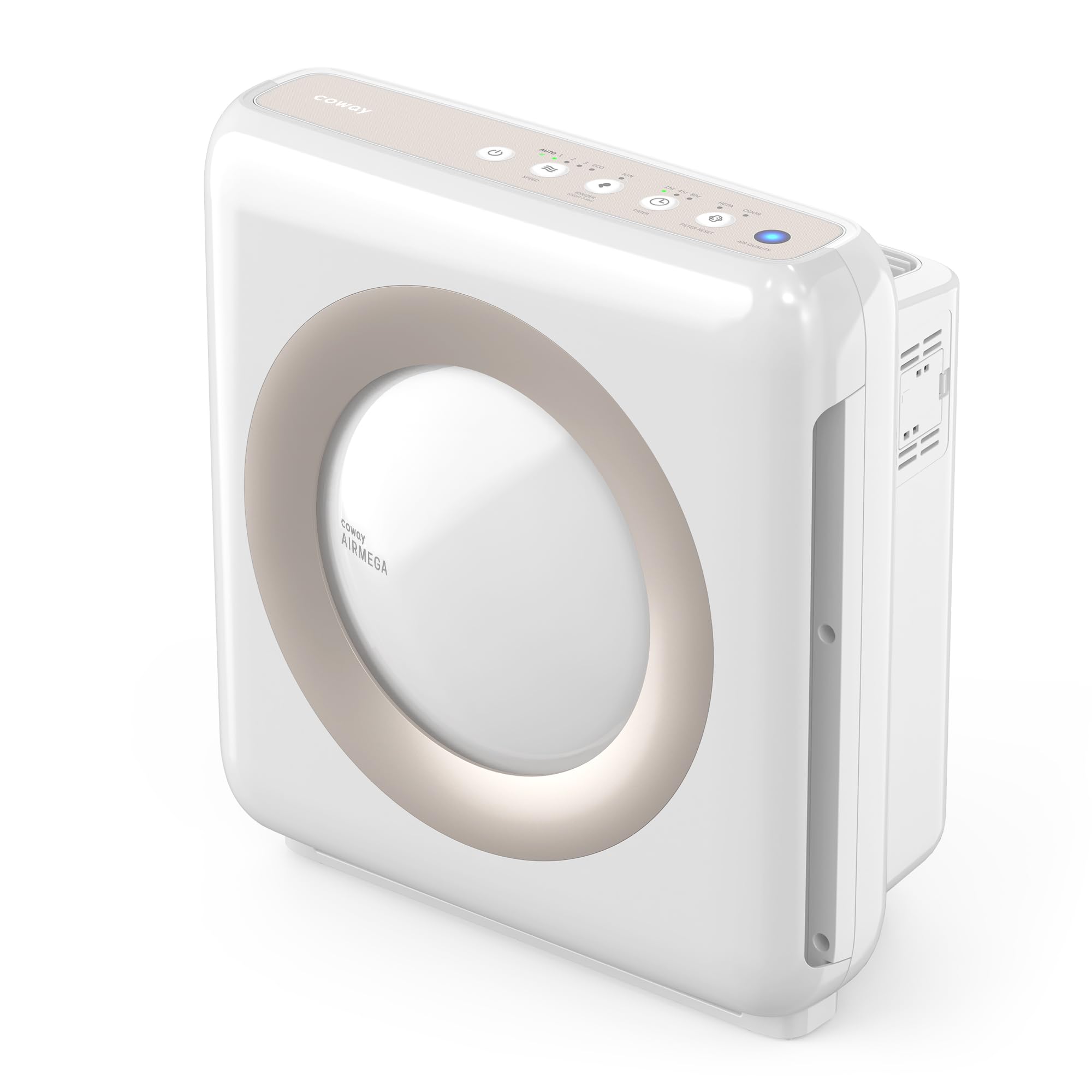
The Coway Airmega AP-1512HH has held the Wirecutter top spot for years because its CADR numbers — 233 for smoke, 240 for pollen, 246 for dust — translate directly to asthma symptom reduction in rooms up to 361 square feet. The pollution sensor communicates air quality in real time through a brightly colored LED, and the 4-stage system (washable pre-filter, deodorization carbon, True HEPA, and Vital Ion) handles the three trigger categories asthma households face most: PM2.5 particles, VOCs from cooking and cleaning products, and biological allergens.
Owner reports consistently mention that the auto mode detects cooking smoke within seconds and ramps fan speed from 24.4 dB (nearly silent) to 53.8 dB (audible but tolerable) only when needed. Eco mode stops the fan after 30 minutes of clean air, saving energy during long undisturbed nights. The 77-watt max power draw is low enough to run 24/7 without a noticeable electric bill bump. Filter replacement occurs roughly once per year, and the pre-filter slides out for vacuuming — no tools required.
The primary trade-off is that the highest fan speed is loud enough to compete with TV dialogue, so you will want to run it in auto or low mode during awake hours. The air blows upward rather than horizontally, which keeps it from disturbing desktop papers but means placement near a wall reduces its effective range slightly. For most asthma households, the combination of real-time monitoring, proven CADR, and annual filter changes makes this the most balanced option.
Why we love it
- Proven CADR of 233+ CFM across all three particle categories
- Real-time air quality LED and auto mode adjust without app
- Washable pre-filter extends HEPA life to 12 months
Good to know
- Highest fan speed is loud during awake hours
- No WiFi or smart app control
2. CleanForce Air Purifier CP-Rainbow
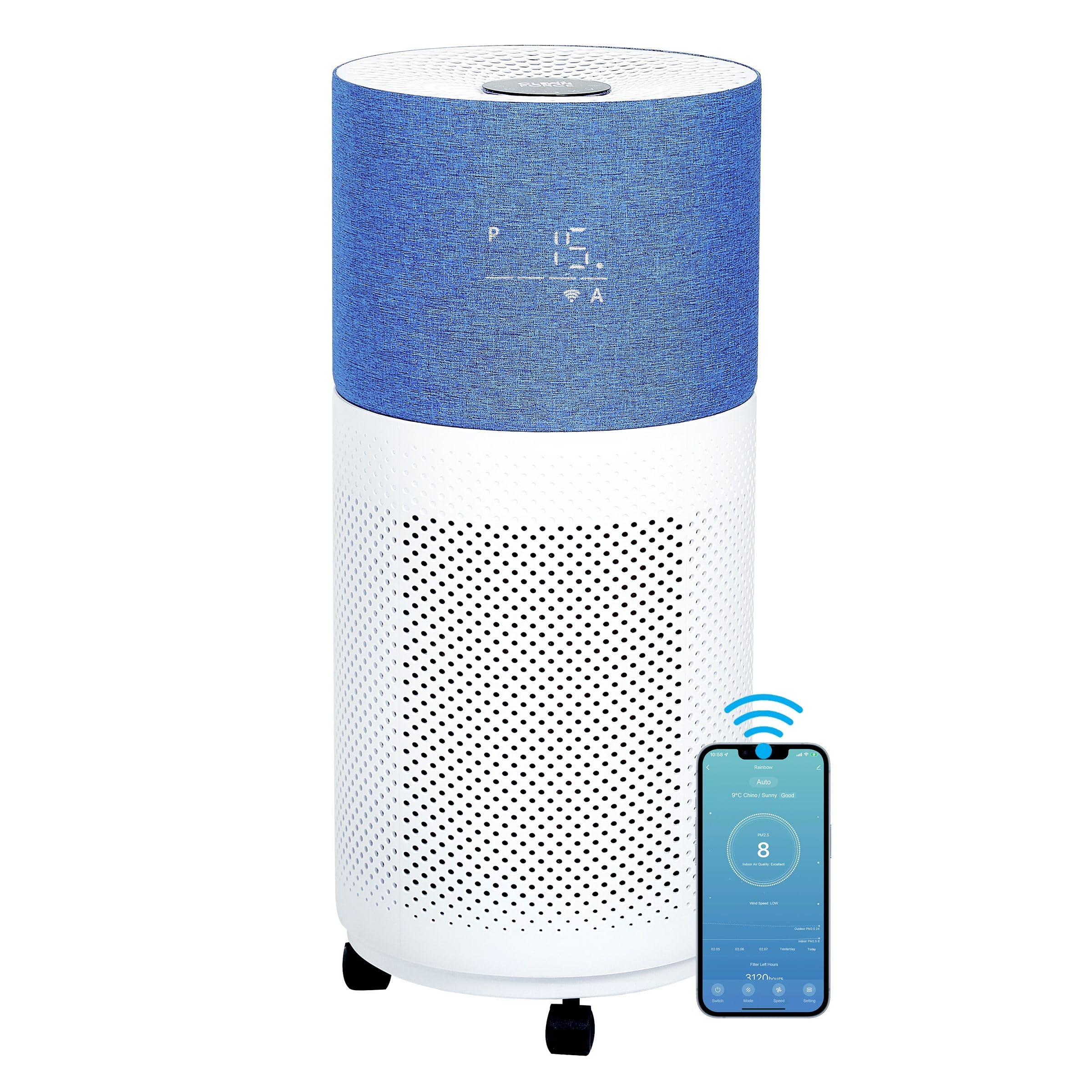
For asthma sufferers in open-concept living spaces or large basements, the CleanForce CP-Rainbow delivers a massive 550 CFM CADR using a dual H13 HEPA system and iMACT activated carbon filter. It covers up to 2,550 square feet in one hour, which means a 500-square-foot living room gets nearly five air changes per hour — well above the minimum for asthma trigger removal. The triple-filter technology includes a pre-filter for pet hair and large dust clumps, the H13 medical-grade HEPA for 99.97% capture at 0.1 microns, and the carbon stage for wildfire smoke, cooking odors, and VOCs.
Owners report that the wheels make this 15.4-pound unit easy to move between rooms, and the smart auto mode adjusts fan speed based on real-time particle detection. Sleep mode drops noise to around 35 dB, which is quieter than a window AC unit. The 12-hour timer and filter replacement reminders take the guesswork out of maintenance. Multiple owner reviews note that it is heavy enough that rolling over carpet is difficult — stick to hard flooring if you plan to move it frequently.
The HVAC industry professionals who reviewed this unit praised its tight-fitting HEPA and charcoal filter seals, which prevent unfiltered air from bypassing the media. The main drawback is that the white exterior can yellow when exposed to direct sunlight, and the highest fan speed is noticeable — though owners say it is quieter than smaller units running at equivalent CADR because of the larger fan blades. CARB and ETL certifications confirm ozone safety for asthma households.
Why we love it
- Class-leading 550 CFM CADR for very large rooms
- Built-in wheels for room-to-room mobility
- H13 medical-grade HEPA with tight bypass seals
Good to know
- Heavy and difficult to roll on carpet
- White plastic may yellow in direct sunlight
3. BLUEAIR Blue Signature 225
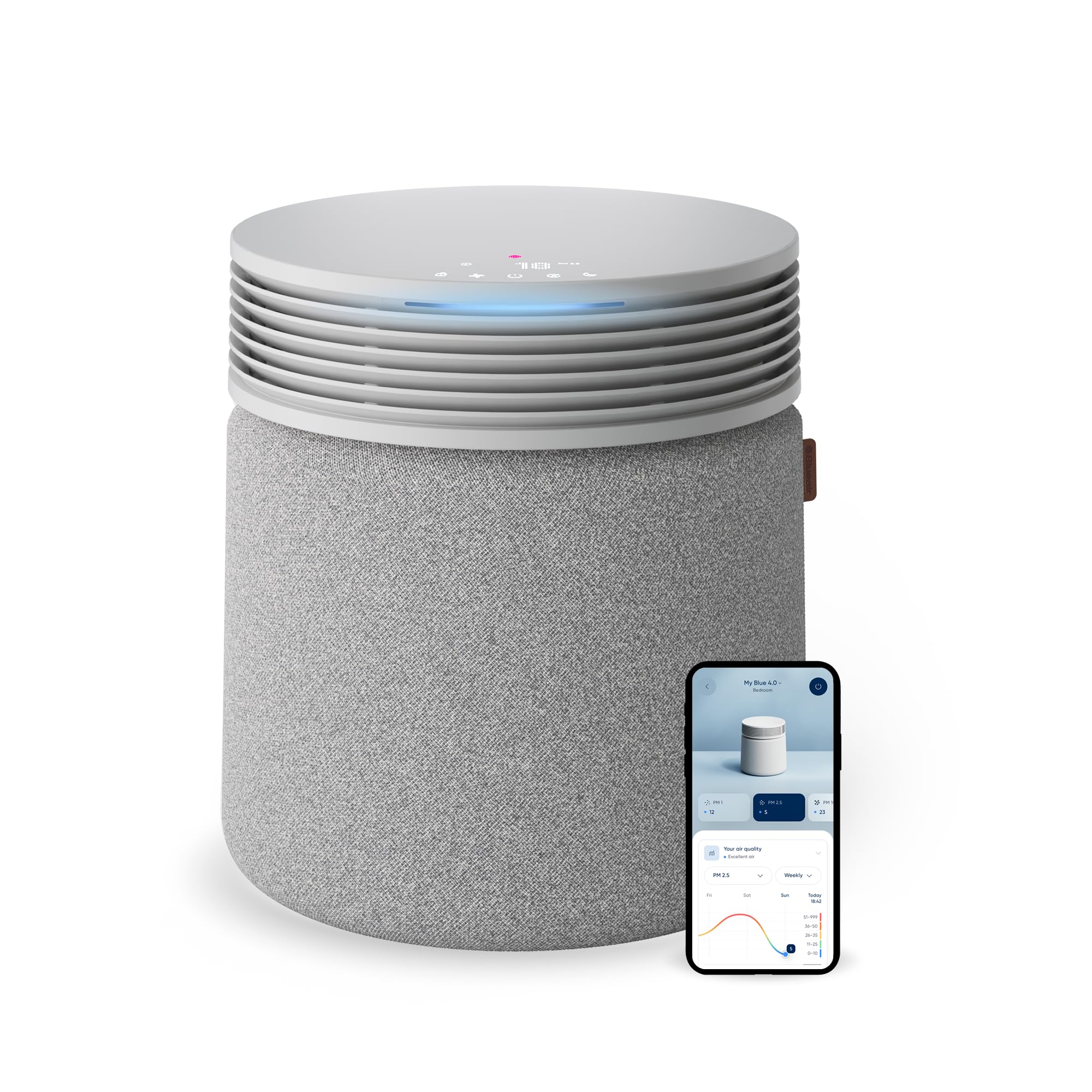
The Blueair Blue Signature 225 doubles as a stylish side table while delivering HEPASilent filtration that removes dust, pollen, wildfire smoke, pet dander, and odors. It covers up to 3,385 square feet in one hour, making it one of the highest-volume options for an open floor plan or large living room. The HEPASilent technology combines electrostatic charging with mechanical filtration, which allows it to move more air at lower noise levels than a standard HEPA-only design.
Built-in smart sensors monitor air quality and automatically adjust fan speed — no manual toggling needed when cooking smoke or pollen spikes occur. The Blueair app connects via WiFi, allowing remote control of fan speed, monitoring of filter life, and tracking of indoor air quality trends. Owner feedback consistently mentions that the air feels noticeably fresher within hours, and that odors from pets and cooking disappear faster than with previous purifiers they had used. The lowest setting is nearly silent, making it suitable for bedroom use despite its large coverage area.
Filters are expensive and need replacement every 6 months under continuous heavy use — that is the main ongoing cost consideration. The app sometimes takes a few seconds to connect, but owners generally find the convenience of auto mode outweighs that minor lag. The furniture-style design means it integrates into a living room without looking like a medical appliance, which matters for households where the purifier needs to run in shared spaces during the day.
Why we love it
- Double as a side table — no ugly appliance look
- Smart WiFi with auto mode for hands-off asthma management
- Very quiet even at medium fan speeds
Good to know
- Replacement filters are expensive
- App connection can lag occasionally
4. AirDoctor AD2000
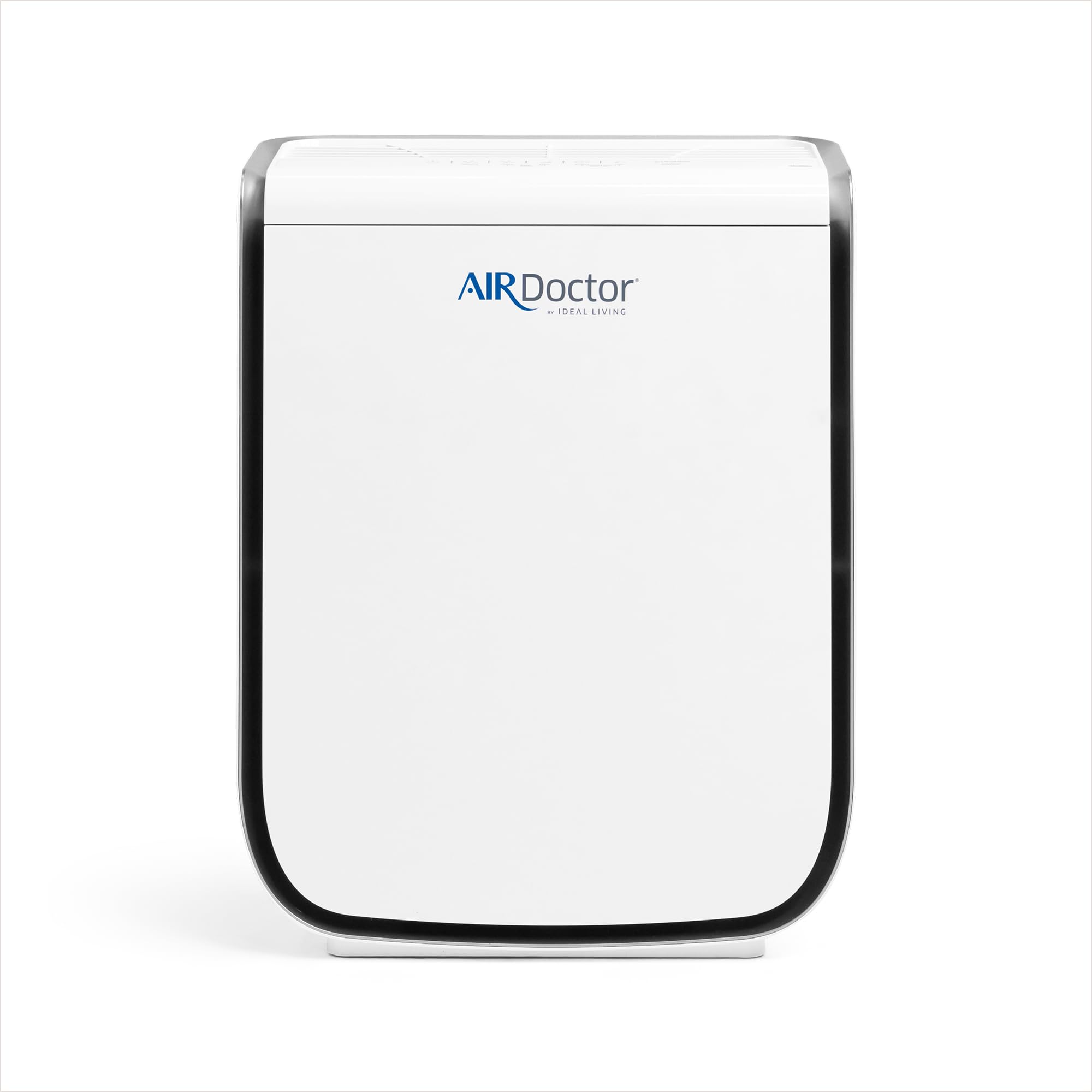
The AirDoctor AD2000 uses UltraHEPA filtration to capture 99.99% of airborne particles at 0.003 microns — 100 times smaller than the standard HEPA threshold. For asthma households, this means it traps bacteria, viruses, mold spores, and ultrafine smoke particles that conventional HEPA filters might only partially catch. It cleans a 305-square-foot room in 15 minutes and covers up to 1,220 square feet in one hour, making it suitable for medium bedrooms and home offices.
The 3-stage system includes a pre-filter, a premium activated carbon and potassium permanganate filter for gases and VOCs, and the UltraHEPA main filter. The Halo sensor displays PM2.5 levels with color-coded air quality feedback and activates Boost mode automatically when pollution spikes. Owners with severe dust allergies report visible dust reduction on surfaces within days, and those who bought it to remove VOC odors from new furniture noted smell elimination within 24 hours. The carbon filter replacement interval is 6 months; the UltraHEPA lasts 12 months.
The main concern is variability in early units — some owners received units with noisy fans or sensors that failed to detect smoke. AirDoctor customer service replaced those units promptly, and the replacement units performed as advertised. The 30 dB noise level on the lowest setting is genuinely whisper-quiet, and night mode turns off all display lights. For asthma households where VOC sensitivity is as big a trigger as particles, the dedicated carbon/potassium permanganate stage gives this an edge over purifiers that rely on thin carbon pre-filters.
Why we love it
- UltraHEPA captures 0.003-micron particles — 100x smaller than HEPA standard
- Dedicated carbon/potassium permanganate stage for VOCs and gases
- Real-time PM2.5 display with auto Boost mode
Good to know
- Early units had quality control issues (customer service resolved them)
- Carbon filter needs replacement every 6 months
5. IQAir Atem Desk

The IQAir Atem Desk is not a room purifier — it is a personal air cleaner that blankets a 150-square-foot zone around your desk or bed with HyperHEPA-filtered air down to 0.003 microns. Its bladeless design and 3.4-watt power draw make it one of the most energy-efficient asthma relief tools available, and the Swiss design fits on a nightstand or desktop without dominating the space. Winner of the Global Innovations Award, it uses IQAir’s proprietary HyperHEPA technology to remove 99% of contaminants up to 100 times smaller than traditional HEPA systems.
Owner reviews highlight its effectiveness for reducing allergy symptoms in a single bedroom or office cubicle. One parent reported that their son’s coughing stopped and dust accumulation vanished after placing it near his bed. The Bluetooth proximity feature is designed to adjust fan speed based on distance, but several owners found the signal range unreliable and turned it off. The internal filter clogs faster than floor-model filters if run on the highest setting for 8 hours nightly — covering the unit with a plastic bag when not in use doubles filter life, according to a travel-heavy owner.
The primary concern for asthma households with chemical sensitivities is the chemical scent emitted by the filter itself, which one owner described as smelling like urinal cakes — a deal-breaker for VOC-sensitive users. Additionally, the HyperHEPA replacement filter is expensive and needs changing every 3-6 months with heavy use. For single-desk or single-bed scenarios where the user wants focused clean air rather than whole-room coverage, this is the most precise tool available. For whole-room asthma management, the AD2000 or Coway provide more complete coverage at similar or lower cost.
Why we love it
- HyperHEPA captures particles 100x smaller than HEPA standard
- Extremely low 3.4W power draw — negligible operating cost
- Compact desktop design with bladeless operation
Good to know
- Filter emits chemical scent that may bother VOC-sensitive users
- Replacement filter life is short (3-6 months) with heavy use
6. Nuwave Forever Smart Air Purifier

The Nuwave Forever eliminates the single biggest long-term cost of asthma air purification: replacement filters. Its patented 7-stage system uses washable stainless-steel pre-filters, Bio-Guard filters, and ozone removal filters that never need replacement — you rinse them under water and let them dry. Intertek lab certification confirms it captures 100% of particles down to 0.1 microns, including smoke, dust, pollen, and pet hair, and it reduces ozone levels to 1 ppb, exceeding CARB compliance standards.
Coverage reaches 2,002 square feet in one hour, and the adjustable flow panel directs clean air at 30, 60, or 90 degrees — useful for aiming purified air toward a sleeping asthmatic child on the other side of the room. The six fan speeds range from whisper-quiet to noticeable, with auto mode adjusting speed based on particle and odor sensors. WiFi and app control allow remote monitoring and timer setting from anywhere. Owners with pets and allergies report noticeable improvement in breathing and a reduction in visible dust on furniture within days.
The washable filters require 24 hours to dry completely before reinstallation, so you need a spare set if you plan to wash them and keep the unit running continuously. The plastic body feels less premium than metal-and-polycarbonate competitors, and one owner noted that the auto mode is sensitive enough to ramp up fan speed after detecting toast smoke in the kitchen two rooms away. The highest fan settings (4-6) produce noise comparable to a stove vent, so most buyers run it on levels 1-3 during sleep. For asthma households tired of buying paper filters every six months, the long-term savings are substantial.
Why we love it
- Washable filters — zero ongoing replacement cost
- Adjustable airflow panel directs clean air where needed
- 100% particle capture at 0.1 microns per Intertek certification
Good to know
- Filters take 24 hours to dry after washing
- Plastic body feels less durable than premium competitors
7. GermGuardian 4-in-1 AC4825E

The GermGuardian AC4825E combines a True HEPA filter (99.97% capture at 0.1 microns) with an optional UV-C light to reduce airborne germs, bacteria, and mold spores. It covers up to 743 square feet per hour and cleans a 153-square-foot room in 12.5 minutes. The Zero Ozone certification means the UV-C light produces no detectable ozone — critical for asthma households where any ozone exposure can trigger bronchial constriction. The 3-in-1 system includes a charcoal pre-filter for odor reduction, the True HEPA main filter, and the UV-C light that runs on a separate toggle.
Owner reviews from asthmatic households are overwhelmingly positive over long use periods. One owner reported that after six months of nightly use, their asthma symptoms and stuffy nose were significantly reduced, and the unit helped prevent illness even when a visitor with pneumonia stayed in the house. The rotary dial control is simple — three speed settings and a UV button, no smartphone pairing required. Owners appreciate that the first filter is washable, and the HEPA filter needs replacement only once per year.
The tower is tall (22 inches) and narrow (10.25 inches wide), making it space-efficient but slightly top-heavy. The highest setting is noticeably loud — described as white noise that can be heard from across the room — so most asthma households run it on low or medium during sleep. The blue UV light is bright and cannot be dimmed, which some owners find distracting in a bedroom. For the price, the combination of True HEPA, UV-C, and verified zero ozone output makes it a solid choice for a child’s bedroom or a shared living area.
Why we love it
- True HEPA at 0.1 microns plus UV-C for germ reduction
- Zero Ozone certified — safe for asthma-sensitive lungs
- Simple rotary dial control, no app needed
Good to know
- High fan speed is loud — best on low/medium for sleep
- Blue UV light is bright and cannot be turned off
8. LEVOIT Core 200S-P

The LEVOIT Core 200S-P is a compact, AHAM VERIFIDE-certified air purifier designed for small spaces up to 140 square feet. Its 360-degree air intake and high-efficiency motor refresh the room air 4.8 times per hour. The 3-in-1 filter system includes a nylon pre-filter, a high-efficiency activated carbon filter for odors and fumes, and the main HEPA filter that removes 99.97% of particles 0.1 to 0.3 microns — including pollen, dust, and dander. Sleep mode drops noise to 27 dB, making it one of the quietest options in the budget tier.
Levoit also includes smart voice control compatibility with Alexa and Google Assistant, allowing asthma sufferers to adjust fan speed without getting out of bed — useful during an attack when reaching for a phone is difficult. The compact footprint (8.07 x 8.07 x 4.96 inches) fits on a nightstand without crowding, and the display off button eliminates light pollution during sleep. Owner reviews from small apartment dwellers and allergy-heavy households confirm that the unit reduces dust accumulation and neutralizes cooking odors within minutes.
The main limitation is room size — this unit struggles to keep up in anything larger than a standard nursery or dorm room. Owners who bought it for a 200-square-foot master bedroom found it insufficient and had to upgrade to a larger model. The filter replacement indicator is helpful, but genuine Levoit replacement filters add ongoing cost that some budget-conscious buyers did not anticipate. For a child’s small bedroom or a home office where space and noise are the primary constraints, this is the most compact asthma-safe option available.
Why we love it
- Smart voice control via Alexa and Google Assistant
- 27 dB sleep mode — nearly silent for sensitive sleepers
- AHAM VERIFIDE certified for independent performance validation
Good to know
- Effective only for rooms up to 140 square feet
- Genuine replacement filters add ongoing cost
9. LEVOIT Core 300-P

The LEVOIT Core 300-P uses a 56W high-torque motor to deliver a smoke CADR of 143 CFM, dust CADR of 153 CFM, and pollen CADR of 167 CFM — strong numbers for a budget-midrange unit. It refreshes a 222-square-foot room 4.8 times per hour and can cover up to 1,073 square feet once per hour, making it more flexible than the smaller 200S. The AHAM VERIFIDE seal confirms independent testing, and the 3-in-1 filter captures 99.97% of particles 0.1 to 0.3 microns.
Where the Core 300-P stands out is its multiple filter choices: a Toxin Absorber Filter for smog and VOCs, a Smoke Remover filter for wildfire smoke, and a Pet Allergy Filter for dander and odors. This means asthma households can tailor the filtration to their specific triggers without buying a new machine. The QuietKEAP technology reduces sleep mode noise to 24 dB — the quietest setting in the entire lineup. Touch controls, a timer (2/4/6/8 hours), and a check filter indicator are standard.
Owner feedback confirms significant dust reduction, fresher air within minutes of running on high, and effective odor removal from litter boxes and cooking areas. The highest setting is loud enough to be noticeable, but levels 1 and 2 are quiet enough for undisturbed sleep. The main complaint across reviews is the cost of genuine replacement filters, which some owners describe as expensive relative to the unit’s purchase price — though they acknowledge the performance difference compared to third-party filters. For asthma households on a tighter budget that need coverage for a standard bedroom, this is the most capable entry-level option.
Why we love it
- Multiple filter types for specific asthma triggers (toxins, smoke, pet)
- 24 dB sleep mode — quietest setting in the lineup
- AHAM VERIFIDE with solid CADR across all three particle types
Good to know
- Genuine replacement filters are costly
- Highest fan speed is loud
FAQ
How many air changes per hour does my asthma bedroom need?
Can I use an air purifier with asthma and a humidifier in the same room?
Is UV-C light safe for someone with asthma?
What CADR rating should I look for in a 300-square-foot living room?
How often should I change the HEPA filter for asthma use?
Final Thoughts: The Verdict
For most gardeners, the best air cleaner for asthma winner is the Coway Airmega AP-1512HH because it delivers proven CADR across all three particle categories, includes a real-time air quality sensor that auto-adjusts fan speed, and uses a washable pre-filter that keeps replacement costs manageable. If you need very high CADR for an open-concept living space, grab the CleanForce CP-Rainbow with its 550 CFM dual H13 HEPA system. And for a zero-filter-cost solution that eliminates ongoing expenses, nothing beats the Nuwave Forever with its fully washable 7-stage filtration.