
Every birdhouse you hang sends an open invitation, but the wrong dimensions or materials invite trouble—empty nests, predator raids, or weather damage within a single season. A well-chosen house balances entrance size, wood thickness, ventilation, and drainage to turn a decorative box into a secure nursery.
I’m Mo Mahin — the founder and writer behind Furric. I’ve spent years comparing specifications across dozens of wild bird nesting boxes, studying manufacturer build tolerances and the measurable factors—from cedar thickness to predator guard metals—that determine whether a house attracts tenants or collects dust.
After reviewing material density, mounting options, cleanout access, and verified owner feedback across five real-world models, this guide breaks down every detail you need to confidently choose the best bird house for your yard’s specific visitors.
How To Choose The Best Bird House
A birdhouse that looks perfect on the shelf may fail in the field. Start by identifying which species you want to attract—bluebirds, wrens, chickadees, or finches—because each requires a specific entrance diameter. Beyond the hole, the wood species, ventilation design, drainage, and how easily you can open the box for seasonal cleaning all separate a functional nesting box from a decorative ornament.
Entrance Hole Diameter
This single measurement determines who moves in. Wrens and chickadees need a 1-1/8 inch opening. Bluebirds prefer 1.5 inches. A 1.57-inch hole invites larger birds like starlings. Always check the spec before buying—guessing by eye is why many houses sit empty.
Wood Quality and Thickness
Cedar is the gold standard because it resists rot, repels insects naturally, and handles freeze-thaw cycles without warping. To maintain stable internal temperatures, the wall thickness should be at least 3/4 of an inch. Pine or composite materials degrade faster and offer less insulation.
Ventilation and Drainage
Without air circulation, chicks can suffocate inside a box heated by direct sun. Look for vent slots near the top and floor drain holes. These features prevent moisture buildup, reduce mold risk, and keep the nest dry after rain.
Cleanout Access
A hinged front door, removable roof, or side panel makes annual cleaning possible. Inaccessible houses accumulate old nests, parasites, and bacteria. Models with screw-secured doors also discourage raccoons and squirrels from opening them.
Quick Comparison
On smaller screens, swipe sideways to see the full table.
| Model | Category | Best For | Key Spec | Amazon |
|---|---|---|---|---|
| Kingsyard Wooden Bird House | Mid-Range | Wren specialists wanting a predator guard | 1-inch entrance w/ metal ring | Amazon |
| STARSWR 2-Hole Bird House | Premium | Multi-family viewing with dual cleanout | 1.57-inch dual entrances | Amazon |
| Fitraho 2 Pack Bird Houses | Premium | Volume buyers wanting two identical houses | 1.5-inch entrance, cedar | Amazon |
| Auslar Wooden Bird House | Budget | Decorative hanging with herringbone style | 1.57-inch entrance, cedar | Amazon |
| SISTERBIRD Wren Bird House | Budget | Wren/chickadee houses with predator guard | 1-1/8 inch entrance, red cedar | Amazon |
In‑Depth Reviews
1. Kingsyard Wooden Bird House with Predator Guard

The Kingsyard strikes a near-perfect balance of construction thickness, ease of cleaning, and species-specific sizing. Its 1-inch entrance hole is purpose-built for wrens and actively excludes larger birds that would dominate or bully smaller species. The solid New Zealand Pine walls measure thicker than most comparably priced models, giving the box enough thermal mass to moderate temperature swings during spring cold snaps.
What makes this house stand out in a crowded category is the combination of a hinged roof for tool-free cleaning and a metal predator guard that prevents raccoons or squirrels from gnawing the opening wider. The roof lifts off without any screws or latches—just slide the wire hanger free—which means you can clear out old nesting material in under thirty seconds. The bottom of the box also has drainage slots, a detail often missing from aesthetic-focused designs.
Owners consistently report birds moving in immediately after mounting, and multiple reviewers on their third purchase confirm the build holds up across seasons. The zinc-plated wire hanger resists rust, though mounting it against a tree trunk using the backplate offers even more stability in high wind. If you want a small-bird house that prioritizes function over decoration without looking out of place, this is the clear choice.
Why we love it
- 1-inch hole perfectly targets wrens and chickadees
- Metal predator guard can’t be chewed larger
- Tool-free removable roof makes cleaning instantaneous
- Thick New Zealand Pine walls retain heat better than thin cedar
Good to know
- Wire hanger feels lightweight for very exposed areas
- Green color may fade after prolonged direct sun
2. STARSWR Bird House, 2-Hole Wooden Outdoor House

The STARSWR bird house operates on a two-room layout, with entrances on opposite sides to minimize territorial disputes between nesting pairs. Each 1.57-inch opening accommodates finches, bluebirds, and larger chickadees, though the diameter does permit entry for starlings in areas where they are prevalent. The log-cabin aesthetic is more decorative than the Kingsyard, making it better suited for visible garden placement or gift-giving.
Each story has its own side-panel cleanout door, a thoughtful design feature that allows you to remove old nests without disturbing a neighboring active box. The top roof vent promotes airflow through both chambers, and the bottom platform provides a stable footing for birds approaching the entrance. The natural wood finish invites customization—several owners have stained, painted, or even lightly charred the surface to match their garden style.
The hanging hardware is the weakest link here. The included rope works for temporary placement, but the wren house excels when mounted flush against a fence post or tree using screws through the provided back holes. Owners report nuthatches, chickadees, and finches all showing interest within days of proper mounting. The dual-chamber design effectively doubles your yard’s carrying capacity without taking up more visual space.
Why we love it
- Two nesting chambers on opposite sides reduce fighting
- Each level has independent cleanout access
- Log-cabin styling blends into woodland settings
- Roof vent prevents overhead moisture buildup
Good to know
- 1.57-inch holes allow starlings in some regions
- Hanging rope is too thin for permanent use
3. Fitraho 2 Pack Bird Houses for Outside
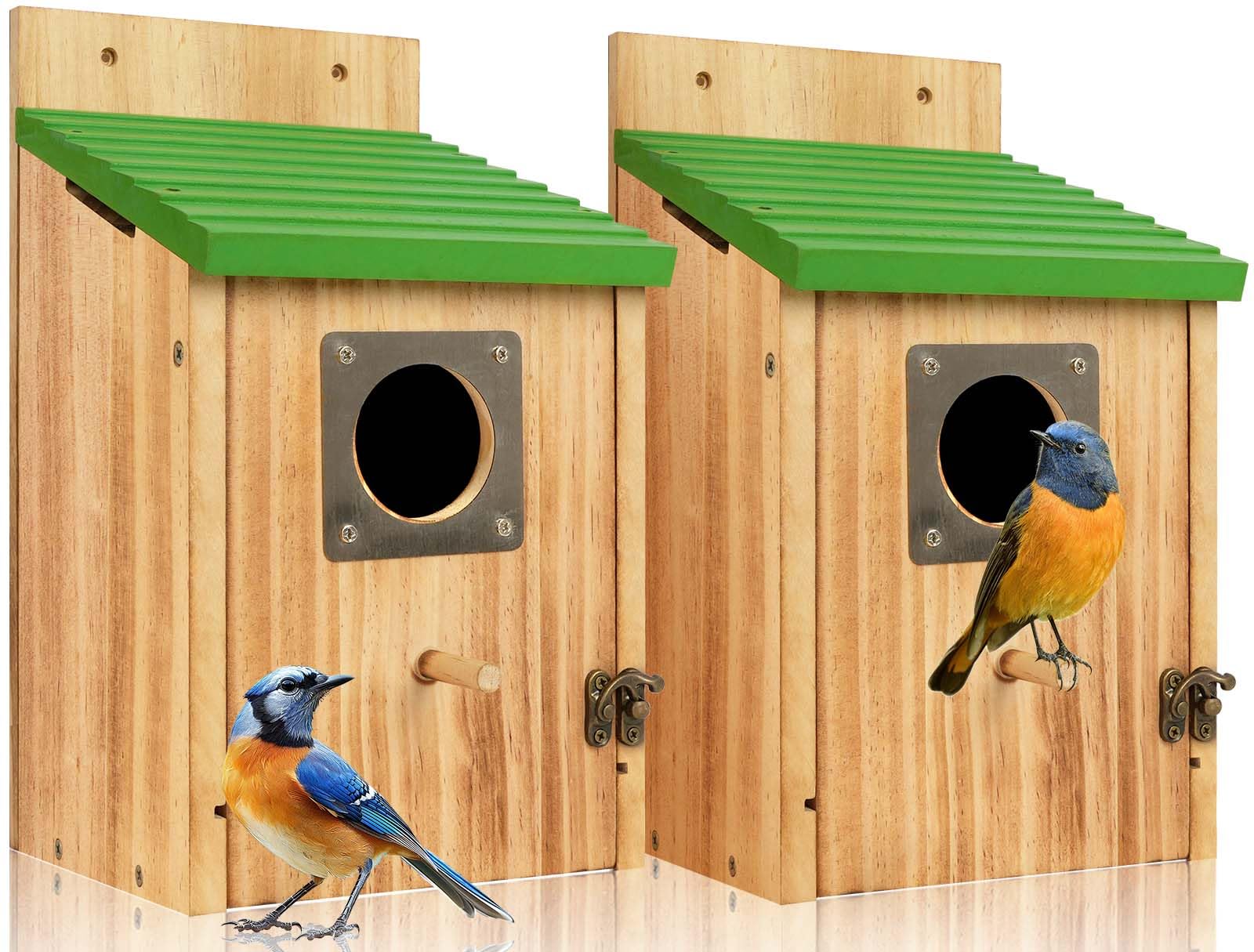
The Fitraho two-pack delivers identical bluebird-spec houses for a per-unit cost that undercuts most standalone competitors. Each box uses carbonized cedar—a process that heat-treats the wood to increase dimensional stability and rot resistance without chemical sealants—and the 1.5-inch entrance is tailored for bluebirds, tree swallows, and eastern bluebirds while excluding house sparrows in many cases. A metal predator guard rings each hole to prevent enlargement.
Assembly is required, but the process is straightforward with the included mini screwdriver and pre-drilled holes that align accurately. The front-opening door is secured by a metal latch that keeps curious raccoons out but remains simple for you to open during end-of-season cleaning. Interior grooves on the front wall act as fledging ladders, giving hatchlings a textured surface to climb toward the exit opening.
The 10.2-inch depth provides enough interior volume for bluebird nests without wasted space that could attract starlings. The bottom features drainage gaps rather than single holes, which prevents clogging from damp nesting material. Multiple owner reviews note that birds begin inspecting the boxes within hours of mounting. For anyone establishing a bluebird trail or covering multiple zones in one yard, this pack offers the best value per successful nest.
Why we love it
- Two pre-cut cedar houses for one low per-unit cost
- 1.5-inch entrance matches bluebird specifications
- Metal predator guard and fledging ladder included
- Easy assembly with included screwdriver
Good to know
- Light sanding needed if edges feel rough
- Soft cedar can strip if screws are overtightened
4. Auslar Wooden Bird House, Hanging Bluebird House
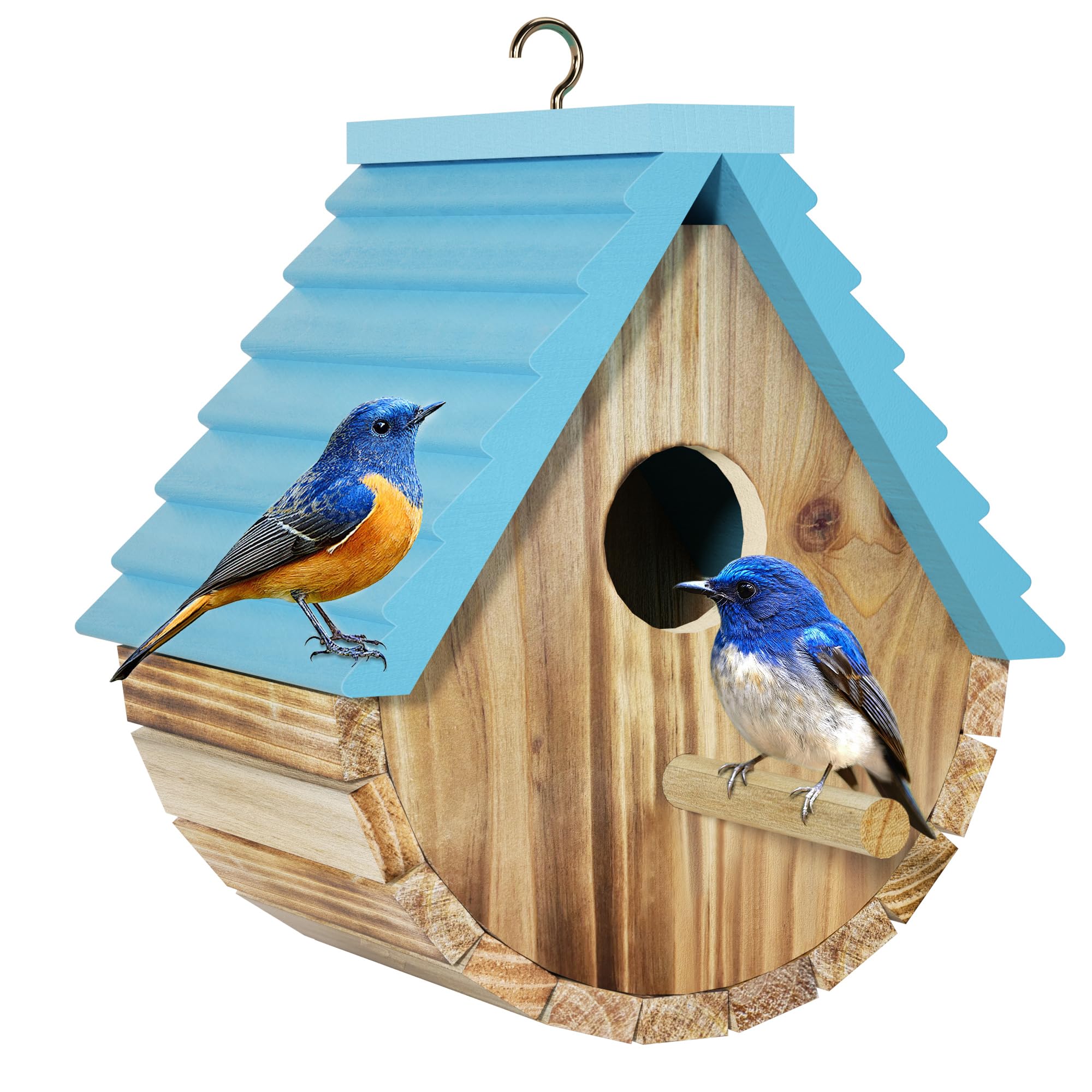
The Auslar bird house is the most visually distinct model of the group, with a herringbone roof pattern and a carbonized black finish accented by a blue top. The 1.57-inch entrance hole opens the door to bluebirds, finches, and tree swallows, though the diameter is wide enough that starlings may fit in areas where they are common. The compact 7.87-inch height and 7.01-inch depth keep the profile small for hanging on thin branches or window hooks.
Cleaning is handled through a swivel back door that pivots open without removing the box from its mounting position. This is a genuine advantage if you have multiple houses placed in hard-to-reach spots. The 80mm perch platform gives birds a resting spot, but perches can also help predators if placed directly under the entrance—something to consider for safety-focused buyers.
The cedar construction feels sturdy despite the budget-friendly position, and the pre-drilled screw holes allow wall mounting as an alternative to hanging. Owners consistently call it adorable and well-crafted, though a minority note that the included mounting hardware could be more robust. This house works best in protected garden corners where you want visual appeal and occasional visitors rather than high-density nesting.
Why we love it
- Distinctive herringbone roof stands out visually
- Swivel back door enables cleaning without unmounting
- Compact size fits tight hanging spaces
- No assembly required out of the box
Good to know
- 1.57-inch hole may admit starlings in some regions
- Perch could aid predators if placed too close to the hole
5. SISTERBIRD Wren Bird Houses for Outside Cedar Hanging

The SISTERBIRD wren house is laser-focused on one job: attracting tiny cavity nesters like Carolina wrens, house wrens, and chickadees. The 1-1/8 inch entrance is the correct diameter to exclude larger, more aggressive species while giving small birds a snug, defensible home. The red cedar construction carries natural oils that repel moisture and insects without chemical treatment, and the roof is widened and sloped to divert rain away from the hole.
The metal predator guard wraps around the entrance rim, preventing squirrels from gnawing the opening wide enough to reach inside. Inside the box, five vertical kerfs (fledging ladders) on the interior wall give young birds traction to climb up to the exit—a critical safety feature missing from many budget birdhouses. The stainless steel hanging hook resists rust and wear far better than standard galvanized wire, and the round bottom mimics the shape of a natural wren nest, encouraging occupancy.
The side door is secured by a metal latch fixed with four small screws, a design that outperforms the cheap twist-latch mechanisms found on many entry-level houses. The latch stays closed against squirrel manipulation better. Multiple ventilation slots on top and six drain holes at the bottom keep the interior dry year-round. Owners praise the ready-to-hang convenience and sturdy build, noting that nesting activity often begins within the first two weeks of installation.
Why we love it
- 1-1/8 inch hole is tuned specifically for wrens and chickadees
- Round bottom mimics natural nest shape
- Stainless steel hook outlasts wire options
- Five interior kerfs help fledglings exit safely
Good to know
- No perch included by design (intentional safety choice)
- Latch can be jostled by persistent squirrels
FAQ
What size entrance hole attracts bluebirds but rejects starlings?
Does a birdhouse need a perch below the entrance hole?
How often should I clean out a birdhouse during the season?
Is untreated cedar better than painted wood for a birdhouse?
Final Thoughts: The Verdict
For most gardeners, the best bird house winner is the Kingsyard Wooden Bird House because its 1-inch entrance, tool-free roof cleaning, and metal predator guard cover every functional requirement wren and chickadee enthusiasts need. If you want dual-chamber viewing with easy access to each level, grab the STARSWR 2-Hole Bird House. And for maximizing value across multiple mounting spots, nothing beats the Fitraho 2 Pack Bird Houses in carbonized cedar.