
A planted aquarium without stable CO2 injection is like a car running on fumes — the plants may survive, but they won’t thrive. The heart of any pressurized CO2 system is the regulator, and choosing the wrong one means wasted gas, dead plants, and a constant battle with algae that flourishes when CO2 levels fluctuate. The right regulator delivers a consistent bubble count per second, day after day, without creeping pressures or leaking seals.
I’m Mo Mahin — the founder and writer behind Furric. I’ve spent years comparing the internal valve designs, brass forging tolerances, and seat material quality across dozens of CO2 regulator models, cross-referencing them against real owner reports of pressure creep, seal failure, and thread compatibility issues specific to planted aquarium setups.
Whether you’re pushing CO2 into a 10-gallon nano tank or a 120-gallon Dutch-style scape, this guide cuts through the specs to show you the best aquarium co2 regulator for consistent delivery, leak-free connections, and precise bubble control that keeps your plants growing and your fish safe.
How To Choose The Best Aquarium CO2 Regulator
Aquarium CO2 regulators differ from beer keg regulators in one critical way: they must deliver stable output at very low PSI (typically 20–40 PSI) while maintaining a precise bubble count per second for planted tank use. A regulator built for homebrew dispensing often releases at too high a pressure or lacks the fine needle valve needed for aquarium bubble counters. Understanding the internal architecture and thread standards separates a reliable unit from a gas-wasting headache.
Dual-Stage vs. Single-Stage: The Pressure Creep Problem
A single-stage regulator drops tank pressure in one step, meaning as the CO2 tank empties, the output pressure slowly rises — a phenomenon called “creep.” In an aquarium, this creep changes your bubble count over the tank’s lifespan, leading to pH crashes or CO2 starvation. Dual-stage regulators use two consecutive pressure reductions, keeping output pressure rock-steady from a full 5-pound tank to the last puff of gas. For planted tanks, dual-stage is the clear safety and consistency choice.
Needle Valve Quality and Bubble Counter Integration
The needle valve is your bubble-count control. Cheap regulators use a generic tapered pin that makes fine-tuning nearly impossible — you twist and nothing happens, then twist again and you’re at 4 bubbles per second. Look for a regulator with a dedicated, high-precision needle valve (often labeled as a “micro-adjust” valve) that provides smooth, incremental adjustment without hysteresis. The regulator should also accept standard 12mm bubble counter threads or include an adapter.
Material, Thread Standard, and Seal Components
All CGA-320 regulators (the standard for CO2 tanks in the US) share the same tank connection, but the quality of the brass forging, surface plating, and internal seals varies enormously. Solid brass bodies resist corrosion from aquarium humidity better than zinc or pot-metal alloys. The regulator should include at least two nylon or Teflon sealing washers — one for the tank connection and one for the output fitting. Avoid models that rely on a single O-ring at any high-pressure junction.
Quick Comparison
On smaller screens, swipe sideways to see the full table.
| Model | Category | Best For | Key Spec | Amazon |
|---|---|---|---|---|
| HGKEKE High Pressure (120 PSI) | Premium | High-pressure carbonation & planted tanks | 0–120 PSI output range | Amazon |
| Hilangsan Dual Stage Kegerator | Mid-Range | Steady low-PSI aquarium injection | Dual-stage, lock-ring knob | Amazon |
| HGKEKE Dual Gauge Keg Regulator | Mid-Range | Leak-free kegerator & soda setups | 50 PSI relief, 5/16″ barb | Amazon |
| FERRODAY Dual Gauge | Budget | Budget homebrew with support backup | 50 PSI automatic relief valve | Amazon |
| VEVOR Double Gauge | Budget | Entry-level beer keg users | 65 PSI pressure relief valve | Amazon |
In‑Depth Reviews
1. HGKEKE High Pressure CO2 Regulator Dual Gauge (120 PSI)
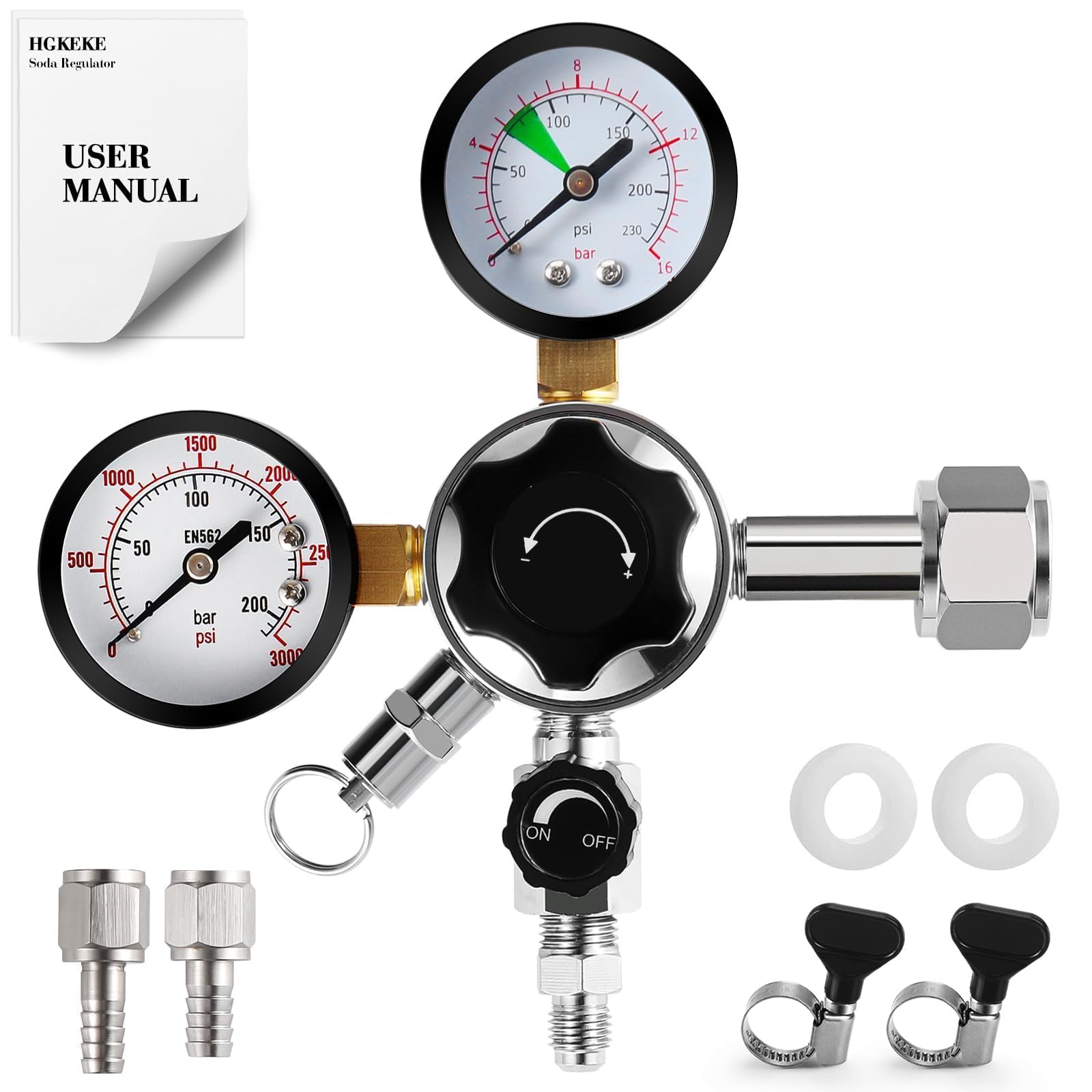
This HGKEKE model stands apart because it offers a full 0–120 PSI output range — significantly wider than the typical 0–60 PSI found on standard aquarium and kegerator regulators. For planted tank enthusiasts using inline CO2 reactors or high-pressure diffusion systems, that extended range means you can dial in exactly 80 PSI for soda-style carbonation or drop to 20 PSI for gentle mist injection without the regulator hitting its ceiling. The dual gauges (0–3000 PSI tank side, 0–120 PSI output) give clear, immediate feedback.
The threaded quick disconnect fitting (7/16-20 UNF) is welded directly to the brass body — a design choice that eliminates the leak potential of detachable barb connectors. Two included nylon washers at the tank connection and two different barb sizes (1/4″ and 5/16″) provide setup flexibility. Multiple owner reports confirm consistent pressure holding for both carbonated water and beer, with the shutoff dial minimizing air gaps during tank swaps, a common source of CO2 waste in less refined designs.
One limitation worth noting: the automatic pressure relief valve activates at 120 PSI, meaning if you need to push beyond that threshold for specialized high-pressure carbonation, this unit won’t accommodate. However, for the vast majority of aquarium, soda, and homebrew applications, the 120 PSI ceiling is more than adequate. The 24/7 customer service response from HGKEKE is frequently praised in user feedback, which adds peace of mind.
Why we love it
- Unusually wide 0–120 PSI output range suits high-pressure diffusion reactors
- Welded 7/16-22 UNF threaded fitting eliminates barb-leak failure point
- Includes two nylon washers and two barb sizes for versatile setup
Good to know
- Relief valve triggers at 120 PSI, limiting extreme high-pressure use
- Green zone on gauge is calibrated for soda, not low-PSI aquarium injection
2. Hilangsan Dual Stage CO2 Regulator
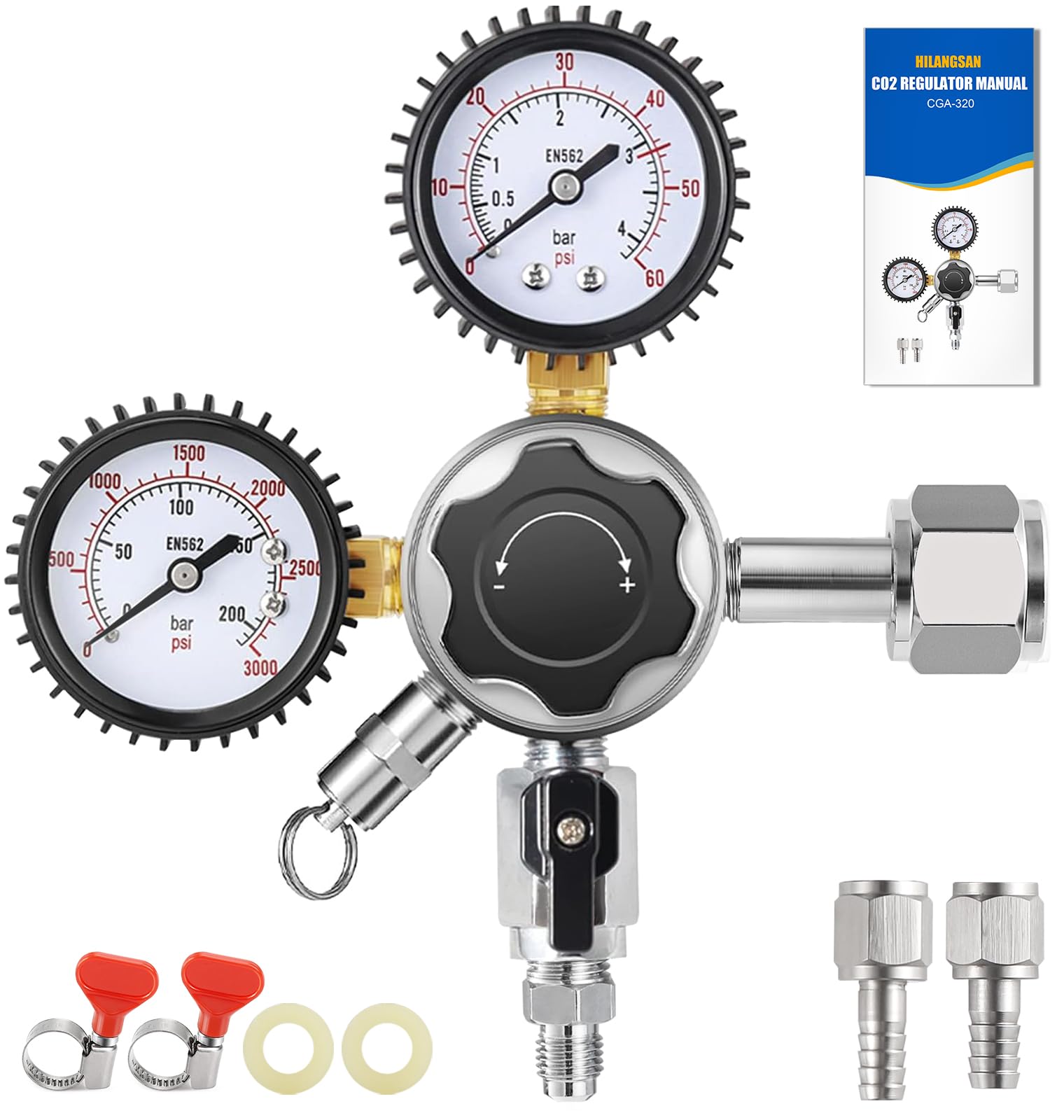
The Hilangsan Dual Stage regulator is the best fit for planted aquarium use because its two-stage internal design delivers consistent output pressure regardless of the tank level — no pressure creep as the CO2 cylinder depletes. This is the single most important feature for aquarium applications where stable bubble counts are critical to preventing pH swings that stress fish and melt sensitive plants like Hemianthus callitrichoides. The output gauge reads 0–60 PSI, which is the ideal range for needle-valve bubble counters and in-tank diffusers.
The adjustment knob features a lock nut that physically holds your PSI setting against accidental bumps — a common annoyance when reaching around a regulator in a tight stand. A 90-degree shut-off valve lets you isolate the gas flow without multiple turns, and the pressure relief valve automatically releases at 50 PSI for safety. The chrome-plated brass construction resists the corrosive humidity inside aquarium cabinets better than painted or raw steel alternatives. The included sealing washers at the CGA-320 inlet provide a reliable high-pressure seal.
Some users reported initial confusion with the fine-tuning knob’s range, but a certified welder’s review confirmed the regulator holds pressure without measurable leakage. A small subset of owners experienced gauge defects, but the 2-year warranty and lifetime technical support from Hilangsan appear to address these promptly. For the dual-stage design at this price bracket, the Hilangsan offers the best balance of safety and consistency for planted tanks.
Why we love it
- True dual-stage design eliminates output pressure creep as tank empties
- Lock ring on knob prevents accidental PSI changes in tight spaces
- 90-degree shut-off valve enables fast isolation without multiple turns
Good to know
- A few units arrived with sticky tank gauge needles requiring a rap to free them
- 50 PSI relief valve may activate prematurely for some high-flow setups
3. HGKEKE Dual Gauge Keg Regulator
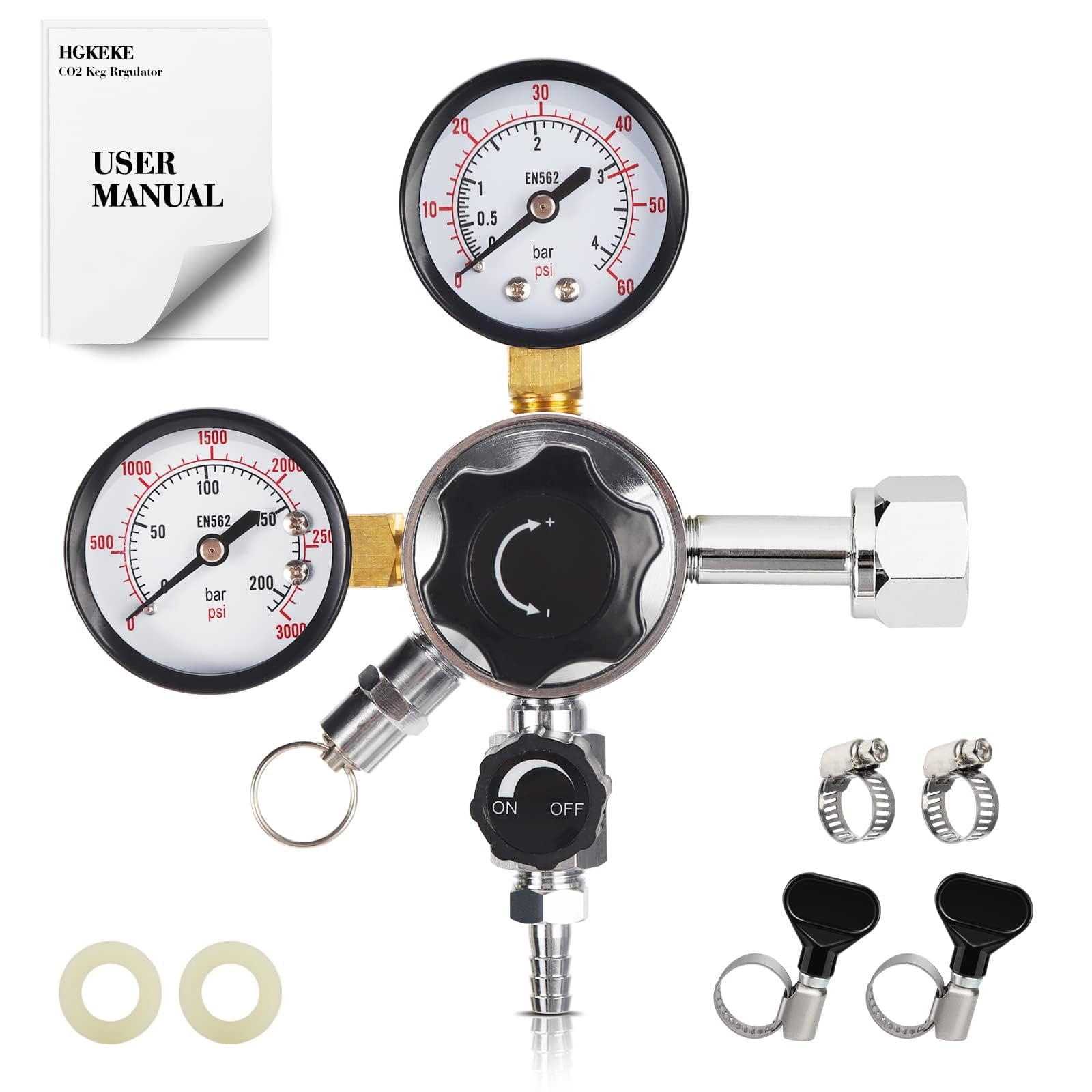
The HGKEKE Dual Gauge Keg Regulator focuses on preventing the single biggest frustration in CO2 delivery: gas leaks. It ships with two nylon washers (not just one) and two stainless steel hose clamps to secure the 5/16″ barb connection, addressing the most common failure point where gas escapes at the tubing junction. The dual-stage architecture (confirmed by the two separate gauge readings for tank and output) provides stable delivery, and the lock ring on the adjustment knob prevents the PSI from drifting after setting.
The rotary adjustment knob allows fine-tuning without tools, and the pressure relief valve automatically vents at 50 PSI. User feedback consistently highlights that this model holds pressure without the slow leak that plagued their previous budget regulators — one reviewer explicitly said “this one is perfect” after replacing a VEVOR unit that leaked continuously. The clear dual gauges with excellent readability allow you to spot the exact moment the tank pressure begins dropping, giving you days of advance notice before running out of CO2.
The main drawback is that the pressure relief valve begins venting at 50 PSI, meaning if you need a steady 60 PSI output (common for some soda carbonation setups), you’ll hit the safety ceiling regularly. However, for standard aquarium diffusion at 20–40 PSI, this is irrelevant. The unit also includes a purge valve for manual pressure release, which is useful when swapping kegs or performing maintenance on your CO2 line.
Why we love it
- Dual nylon washers and SS hose clamps minimize leak risk at connections
- Lock ring holds PSI setting reliably even under vibration or bump contact
- Clear dual gauges provide immediate tank-level and output pressure visibility
Good to know
- Pressure relief valve activates at 50 PSI, not suitable for 60 PSI output needs
- Welded 5/16″ barb limits hose size flexibility without an adapter
4. FERRODAY Dual Gauge CO2 Regulator

The FERRODAY Dual Gauge regulator is a budget-friendly option that still delivers heavy-duty forged brass construction — a meaningful upgrade from the zinc-alloy bodies found on other entry-level regulators. The two large gauges provide tank pressure and output pressure readings that are easy to read even in dimly lit kegerator or cabinet spaces. A lock ring under the main adjustment knob holds your pressure setting in place, and the separate shut-off knob lets you stop gas flow instantly without disturbing the PSI setting.
The sintered metal filter inside the stem protects the internal valve from dirt and debris, a durability feature rarely seen at this price level. The pressure relief valve automatically vents at 50 PSI and can also be manually pulled to quickly depressurize the line. Customer service from FERRODAY is frequently praised — multiple one-star reviews were later upgraded to five stars because the seller proactively sent replacement parts or entire new units when initial defects (sticking tank gauge, slow purge valve leak) were reported. That level of support is valuable for a budget regulator where quality control can vary.
The downsides are consistent with the budget tier: some units arrive with a tank gauge that sticks at zero until sharply rapped, and a few users experienced slow leaks from the purge valve after extended use. The 50 PSI relief valve also limits output to below 50 PSI, so this is not suitable for high-pressure carbonation. For standard aquarium CO2 injection at 20–40 PSI, however, the FERRODAY offers solid value if you verify the unit seals correctly on initial installation.
Why we love it
- Forged brass body delivers durability at an accessible price point
- Sintered metal filter protects internals from debris contamination
- Responsive customer service team replaces defective units without hassle
Good to know
- Some units ship with sticky tank gauge that requires manual tapping to free
- Slow purge valve leak reported by a small number of long-term users
5. VEVOR Double Gauge Regulator

The VEVOR Double Gauge Regulator is the least expensive option in this lineup, designed primarily for draft beer kegging but often repurposed for aquarium CO2 injection due to its standard CGA-320 connection and 0–60 PSI pressure range. It includes an integrated check valve to prevent liquid backflow into the regulator — a useful feature if you’re running a diffusion system with occasional pressure drops. The pressure relief valve is set to vent at 65 PSI, which is slightly higher than the 50 PSI standard on most competitors, giving you a bit more headroom.
Owner feedback is sharply polarized. Positive reviews praise the build quality as “much higher than expected” for the price, noting that after adjusting the pressure knob correctly, the unit works great and holds pressure without issue. Negative reviews, however, reveal a concerning failure mode: at least one user reported a slow leak from the gauge that emptied a full 5-pound CO2 tank over the course of a week, wasting the gas and requiring a replacement regulator. This suggests quality control inconsistencies between individual units.
For aquarium use, the gamble on seal integrity is a significant concern — a slow leak means not only wasted CO2 but also a potential pH crash if the leak accelerates unexpectedly. The included gaskets and clamps help with the initial seal, but the reported gauge leak appears to originate from the gauge connection itself rather than the tank seal. If you choose this regulator for a planted tank, perform a thorough 24-hour soapy-water leak test on all joints before trusting it with a full tank of CO2.
Why we love it
- Integrated check valve prevents liquid backflow into the regulator body
- Included gaskets and clamps simplify leak-free initial installation
- Adjustable 0–60 PSI range covers standard aquarium injection needs
Good to know
- Slow gauge leak reported by multiple users, risking full tank depletion
- Quality control varies significantly between individual units
FAQ
Can I use a kegerator CO2 regulator on my planted aquarium?
What PSI should I set my aquarium CO2 regulator to?
How often should I replace the sealing washers on my regulator?
Why does my CO2 regulator gauge show the tank is full even after weeks of use?
Final Thoughts: The Verdict
For most planted aquarium enthusiasts, the best aquarium co2 regulator winner is the Hilangsan Dual Stage because its dual-stage design eliminates output pressure creep as the tank empties, keeping your bubble count consistent and your plants healthy day after day. If you need a full 120 PSI output for high-pressure diffusion or soda carbonation alongside your aquarium, grab the HGKEKE High Pressure model with the welded 7/16-20 UNF thread. And for a budget option with responsive customer support that stands behind its product, nothing beats the FERRODAY Dual Gauge — just run a thorough leak test before trusting it with a full CO2 cylinder.