
Every reef keeper eventually faces the same bottleneck: hauling 5-gallon jugs from the local fish store, praying the TDS stays low enough to keep your SPS colonies happy. A dedicated RODI system changes that equation entirely—it turns your tap water into a zero-TDS supply on demand, eliminating the variables that cause nuisance algae and coral stress.
I’m Mo Mahin — the founder and writer behind Furric. I’ve spent months comparing membrane rejection rates, DI resin capacities, and pressure gauge accuracy across dozens of reef-specific systems to isolate which units actually deliver consistent 0 ppm water without constant tinkering.
Whether you are topping off a nano or feeding a 150-gallon display, the right rodi system for reef tank determines how much time you spend on water changes versus actually enjoying your tank.
How To Choose The Best RODI System For Reef Tank
Selecting an RODI system for a reef tank comes down to matching your daily water volume, tap water chemistry, and budget with the right stage configuration and membrane capacity. The wrong choice either wastes resin too fast or produces water too slowly for urgent water changes.
Membrane GPD — What the Rating Actually Means
A 100 GPD membrane is tested under ideal laboratory conditions (65 psi, 77°F, low TDS feed water). In a typical home with 45-55 psi, you will see 50-70% of that rated output. Do not choose a 50 GPD system if you change 20 gallons weekly—you will wait all day. The 150 GPD units from Koolermax and LiquaGen offer a meaningful buffer for moderate-to-heavy usage.
Stage Count — When More Is Actually Better
A standard 4-stage system (sediment, carbon, RO membrane, DI resin) works fine for city water under 250 TDS. Systems with 5 or 6 stages typically include an extra carbon block for chloramine-heavy municipal supplies or a second DI canister for longer resin life. Dual DI canisters let you run separate cation and anion resins, which is beneficial when your feed TDS exceeds 400 ppm.
DI Resin Volume and Color-Changing Media
The total DI resin capacity dictates how many gallons you can produce before replacement. Color-changing resin shifts from blue to brown, giving a clear visual cue. A single 10-inch cartridge typically lasts 200-400 gallons depending on your membrane’s rejection rate. Systems with a refillable cartridge, like the Aquatic Life Classic, let you buy bulk resin and save significantly over pre-packed cartridges.
Pressure Gauge and Auto Shut-Off
A pressure gauge lets you diagnose membrane fouling and low feed pressure—both of which reduce output and waste more water. An auto shut-off valve (ASOV) stops production when your storage container is full, preventing overflow and saving the membrane from constant on/off cycling. These two features separate mid-range systems from entry-level units that leave you guessing.
Quick Comparison
On smaller screens, swipe sideways to see the full table.
| Model | Category | Best For | Key Spec | Amazon |
|---|---|---|---|---|
| Aquatic Life Twist-in 4-Stage | Mid-Range | Compact setups & easy cartridge swaps | 100 GPD, twist-in cartridges | Amazon |
| Aquatic Life Classic 4-Stage | Mid-Range | Reliable 4-stage with pressure gauge | 100 GPD, built-in pressure gauge | Amazon |
| Max Water 6-Stage | Mid-Range | Budget-friendly 6-stage mineral restoration | 100 GPD, BPA-free, 6 stages | Amazon |
| LiquaGen 5-Stage | Mid-Range | Pre-assembled with garden hose adapter | 75 GPD, nuclear-grade DI media | Amazon |
| Koolermax AR-122 6-Stage | Mid-Range | High capacity with dual DI canisters | 150 GPD, color-changing dual DI | Amazon |
| AquaFX Barracuda | Premium | Heavy well-water use & USA build | 100 GPD, aluminum bracket | Amazon |
| Aquatop CF-400UV | Premium | All-in-one canister + UV for existing tanks | 370 GPH, 9W UV, 125 gal | Amazon |
| LiquaGen 6-Stage Dual Use | Premium | Dual outlet for drinking + reef water | 150 GPD, pH alkaline restore | Amazon |
| Fountainhead FH32RODI150 | Premium | Pro-grade with dual DI & booster-ready | 150 GPD, made in USA, dual DI | Amazon |
In‑Depth Reviews
1. Aquatic Life Twist-in 4-Stage RO/DI

The Aquatic Life Twist-in redefines convenience for reef keepers who value fast filter swaps. Instead of wrestling with wrench-tightened housings, you twist the triple-sealed cartridges in by hand—a genuine time-saver when you are on a bi-weekly replacement schedule. The 100 GPD membrane and color-changing DI resin deliver the zero TDS that SPS and LPS corals demand.
Real-world production runs about 50-70 GPD depending on your feed pressure, which is typical for this price band. Multiple owners verified 0 ppm output from city tap water ranging from 200-400 TDS. The compact footprint (12″ x 4″ x 13″) means it tucks under a bathroom or kitchen sink without requiring cabinet demolition.
New York City users should note the manual pre-filtration advisory due to high sediment loads. A few owners reported the hose-to-filter connection needed extra tightening, but the responsive customer support quickly resolved issues with replacement membranes and missing adapters. For the blend of portability, ease, and proven reef performance, this is the unit most hobbyists will thank themselves for buying.
Why we love it
- Tool-free twist-in cartridge design saves time on every filter change
- Consistently achieves 0 TDS from typical municipal tap water
- Lightweight and compact enough to store in a small cabinet or carry to the sink
Good to know
- Actual output is roughly half the rated 100 GPD at average household pressure
- NYC high-sediment tap requires additional pre-filtration before the unit
2. Aquatic Life Classic 4-Stage 100 GPD

The Classic 4-Stage builds on the trusted Aquatic Life platform with two upgrades serious reefers notice immediately: a liquid-filled pressure gauge and an auto shut-off solenoid. The gauge lets you see when your membrane is fouling or your feed pressure drops below 40 psi—both common causes of TDS creep that kill DI resin prematurely.
Owners running Florida chloramine-treated water reported 324 TDS in and 0 TDS out, which speaks to the Carbon Plus cartridge’s ability to handle chloramines where standard carbon blocks struggle. The flush valve extends membrane life by sweeping sediment off the thin-film composite surface, a maintenance step too many entry-level systems omit.
Setup is straightforward with color-coded tubing and push-fit connectors, though the blue rubber plugs inside the filter housings can be stubborn to remove if pushed too deep. A few units arrived with O-rings slightly out of position, causing slow drips that were fixed by reseating them. For the price, the built-in monitoring and automatic shutoff make this the most complete 4-stage package available.
Why we love it
- Integrated pressure gauge eliminates guesswork on membrane health
- Carbon Plus cartridge removes up to 98% chloramines from treated municipal water
- ASOV prevents overflow and reduces membrane cycling wear
Good to know
- Blue inlet plug can jam inside the housing; use needle-nose pliers for removal
- Some units shipped with loose O-rings that required reseating for leak-free operation
3. Max Water 6-Stage 100 GPD RO/DI

Max Water’s 6-stage system brings a surprising amount of filtration depth at an accessible price point. The extra stages include a second carbon block and an inline final carbon polisher that catches any residual tastes or odors after the DI stage. The clear housing lets you inspect sediment buildup without disconnecting, a helpful visual cue for scheduling replacements.
The 100 GPD membrane typically produces about 30 gallons in an 8-hour stretch at 50 psi, which sustains a moderate reef tank with weekly water changes. Owners using it for auto top-off systems appreciated the consistent 0 TDS output once the DI resin was fully seated. Some noted the included instructions were adequate for experienced DIYers but vague for complete newcomers.
A minor trade-off is the post-DI inline carbon stage, which can temporarily register 20-60 ppm TDS from harmless carbon fines until flushed. This is not an actual contamination, but it can confuse new owners who panic over non-zero TDS readings. If you want a true 6-stage system without breaking the monthly coral budget, this unit delivers reliable filtration.
Why we love it
- Six-stage filtration at a price that undercuts most 4-stage competitors
- Clear sediment housing allows visual inspection without tools
- BPA-free construction for anyone concerned about plastic leachates
Good to know
- Post-DI carbon stage can show temporary TDS from carbon fines during first flush
- Installation requires basic plumbing skills; instructions could be clearer
4. LiquaGen 5-Stage 75 GPD RO/DI
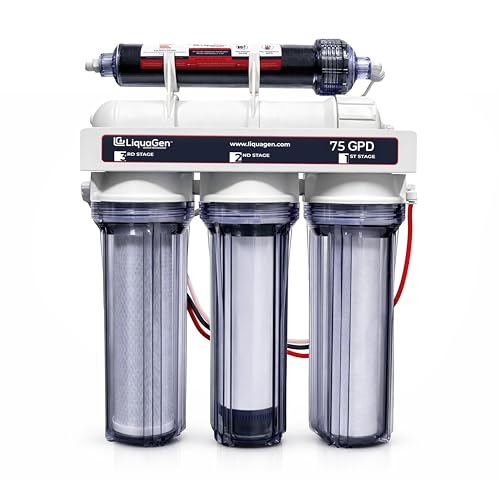
LiquaGen’s 5-stage system uses a 75 GPD GE membrane paired with nuclear-grade deionization media, a combination that produces genuinely 0 TDS water from tap water as dirty as Detroit’s 300+ ppm supply. The garden hose adapter makes it easy to run from an outdoor spigot or washing machine connection—ideal for reefers who do not want to drill into their kitchen cabinetry.
At 55 psi, owners measured roughly 20 gallons in 3 hours, which is decent for the 75 GPD rating. The DI resin life averaged about 280 gallons before exhaustion, consistent with single-cartridge systems. The pre-assembled design cuts installation time to under 30 minutes if you have a compatible threaded faucet or splitter.
Customer service responsiveness is a split bag; some received free auto shut-off valves and replacement resin when issues arose, while others had to source a adapter themselves after a broken fitting. The unit stands tall and can feel unstable on floors, so mounting it on a wall bracket or placing it inside a bucket is recommended. For the marine biologist-level purity it delivers, the minor fit-and-finish quirks are acceptable.
Why we love it
- GE-made RO membrane with high rejection rate extends DI resin life
- Garden hose adapter provides flexible installation options beyond under-sink
- Consistently produces 0 TDS from high-TDS municipal supplies
Good to know
- Faucet adapter may need replacing with a more standard threaded fitting
- DI cartridge life is moderate (~280 gallons); buy a spare when ordering
5. Koolermax AR-122 6-Stage 150 GPD
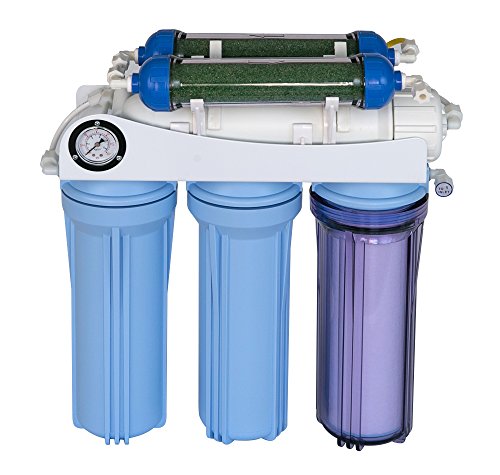
The AR-122 stands out for its dual color-changing DI canisters, which give heavy users roughly twice the resin capacity of typical single-cartridge systems before needing a refill. The 150 GPD membrane is over-specced for most home setups, but that margin means you still get reasonable production even if your feed pressure sits at 45 psi—owners reported about 120 gallons per day in practice.
Designed and assembled in Santa Ana, California, this system uses standard 10-inch filter sizes, contrary to some online rumors. Owners using it on well water with 400+ ppm TDS consistently measure 0 ppm output. The included garden hose adapter and drain saddle cover the most common connection scenarios out of the box.
The push-fit connectors require a firm push to seat fully—hoses that pop off during first startup are almost always due to incomplete insertion. A few users found the PDF manual difficult to read on screen, but the physical connectors are intuitive enough for anyone comfortable with basic DIY. For the dual DI capacity alone, this is the strongest value in the mid-range tier.
Why we love it
- Dual color-changing DI cartridges double resin life between changes
- 150 GPD membrane provides overhead for low-pressure households
- Uses standard 10-inch filter sizes for easy replacement sourcing
Good to know
- Push-fit connectors must be fully seated to prevent hose blow-offs under pressure
- Installation instructions are PDF-only and can be cumbersome to navigate
6. AquaFX Barracuda 100 GPD RO/DI

The AquaFX Barracuda is built for the reef keeper who battles extreme well water. The solid aluminum bracket provides a stable mounting platform that does not flex or crack like plastic frames, and the Chlorine Guzzler carbon block handles chloramine-heavy supplies that would exhaust standard carbon in weeks. Owners running pH above 8.5 with extreme hardness reported the unit still produced usable water, albeit with faster sediment replacement.
The high-flow, high-rejection TFC membrane is AquaFX’s own—rated at 100 GPD but delivering roughly 40-50 GPD under hard water conditions at 55 psi. That is slower than the rating suggests, but the build quality and leak-free operation earned consistent praise from owners who had previously returned cheaper units.
DI resin depletion is faster than average when feed water is very hard; expect monthly changes if your TDS is over 400 ppm. The system ships with a pressure gauge essential for diagnosing when the membrane needs cleaning or replacement. If your tap water is punishing and you want a system that survives, the Barracuda’s construction justifies the premium.
Why we love it
- Aluminum bracket provides rigid mounting that won’t degrade over time
- Chlorine Guzzler carbon block handles high chloramine levels effectively
- Made in the USA with consistently leak-free assembly reported by owners
Good to know
- Real-world output is about half the rated GPD under hard water conditions
- DI resin depletes quickly with very high TDS feed water; stock spare cartridges
7. Aquatop CF-400UV 4-Stage Canister
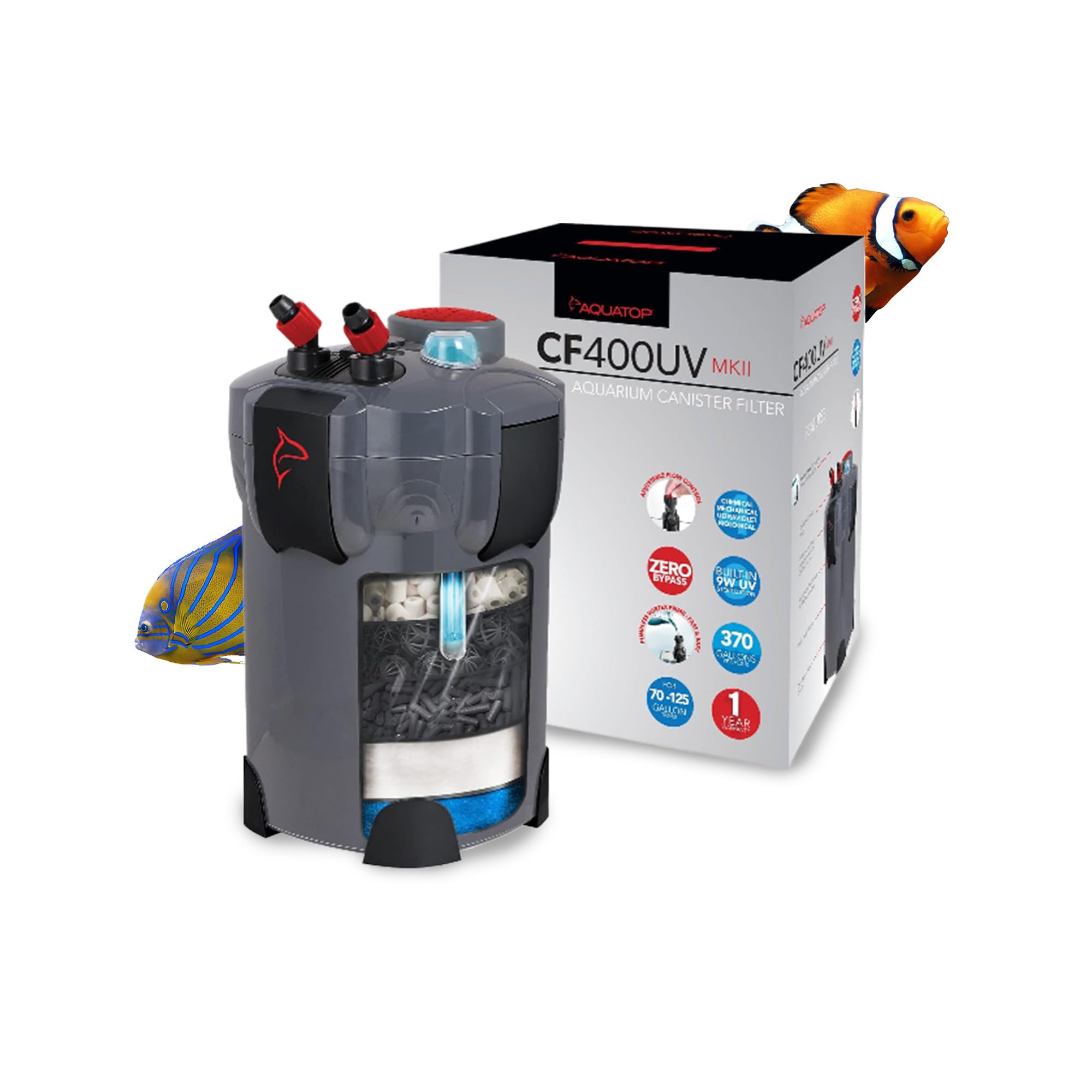
While not an RODI system in the traditional sense, the Aquatop CF-400UV belongs in this guide as a complementary filtration powerhouse for reef tanks that already have an RODI source. It combines a 4-stage mechanical/biological canister with a 9W UV sterilizer, giving you crystal-clear water and pathogen control in one unit rated for tanks up to 125 gallons.
The 370 GPH flow rate supports strong circulation even in heavily stocked systems. Owners with cichlid and planted turtle tanks reported dramatic clarity improvement within days, and the UV cleared green water blooms in under 48 hours. The media baskets are larger than comparable Eheim units, allowing generous space for ceramic rings, activated carbon, and filter floss.
Priming requires holding the button for 5 seconds before plugging in—a quirk that becomes second nature after the first use. Some users noted the seals on the canister head can degrade after 18 months, though the filtration performance during that window was excellent. For reefers wanting a polished display alongside their RODI-produced water, this canister is the finishing touch.
Why we love it
- Integrated 9W UV sterilizer clears green water and controls free-floating pathogens
- Generous media baskets accommodate custom filtration media arrangements
- Quiet operation even at 370 GPH flow rate
Good to know
- Canister head seals may fail after 18 months in continuous use
- UV dwell time may be insufficient for full sterilization at maximum flow
8. LiquaGen 6-Stage Dual Use 150 GPD

The LiquaGen 6-Stage Dual Use is the only system in this roundup with two independent outlets: one for ultra-pure 0 TDS reef water and one for mineral-restored drinking water. The alkaline restoration filter adds calcium, magnesium, and potassium back after the RO stage—meaning one unit serves both your reef tank and your kitchen without compromise.
The 150 GPD membrane produces 5 gallons of 0 TDS water in about 90 minutes at 50 psi. Owners on well water measured a drop from 837 ppm to 0 ppm after the DI stage. The manual flush valve is easy to operate and genuinely extends membrane life by sweeping accumulated sediment off the surface.
The pre-assembled design cuts installation to about 10 minutes, though some units had hand-tightened connections that needed Teflon tape reapplication to stop drips. The DI cartridge capacity is modest—roughly 40-90 gallons before needing a resin shake—so heavy users should budget for a spare cartridge. For anyone who wants one machine to handle drinking water and reef water separately, this is the only plug-and-play option.
Why we love it
- Dual outlets provide separate 0 TDS reef water and mineral-restored drinking water
- 150 GPD membrane produces water quickly even at moderate feed pressure
- Manual flush valve is simple to use and extends membrane service life
Good to know
- DI cartridge produces only 40-90 gallons before needing resin refresh
- Some pre-assembled connections may require re-sealing with Teflon tape
9. Fountainhead FH32RODI150 RO/DI System

The Fountainhead FH32RODI150 is built for the long-haul reefer who expects the system to outlast multiple tank upgrades. Made in the United States with dual DI canisters and a 150 GPD membrane, it offers the highest resin capacity in this lineup. Owners with 33 years of reef experience called it the finest RODI set they had ever used, citing consistent 0 TDS output and no guesswork.
At 40 psi, the system still produces water without a booster pump, though adding one pushes output to 80 psi and significantly increases production rate. The backward flow direction (right to left) takes a moment to get used to but does not affect performance. The unit produced roughly 200 gallons of 0 TDS water from an 800 ppm tap supply before any DI resin exhaustion was noted.
Customer service distinguishes Fountainhead from larger manufacturers; when one owner received a unit missing a non-essential part, the company resolved it quickly without hassle. The price point reflects the US manufacturing and dual DI capacity, but owners unanimously agree it pays for itself by eliminating the need for weekly LFS water runs. If you want a system that you install once and trust for years, this is the benchmark.
Why we love it
- Dual DI canisters provide exceptional resin capacity for high-TDS feed water
- Made in the USA with materials that hold up over years of continuous use
- Works at low 40 psi without a booster, but accepts one for increased output
Good to know
- Flow direction is right-to-left, opposite of most standard systems
- Premium price reflects US manufacturing; budget alternatives exist for lighter use
FAQ
Why does my RODI system show 0 TDS but my reef tank still has algae issues?
How often should I replace the DI resin in a reef tank system?
Can I run an RODI system without a storage tank for my reef aquarium?
Is 75 GPD enough for a 100-gallon reef tank?
Do I need a booster pump for my RODI system?
Final Thoughts: The Verdict
For most reef keepers, the rodi system for reef tank winner is the Aquatic Life Twist-in 4-Stage because it combines tool-free convenience, proven 0 TDS output, and a compact footprint that fits any small space. If you need a pressure gauge and auto shut-off for a more automated setup, grab the Aquatic Life Classic 4-Stage. And for heavy users who want maximum resin capacity between changes and long-term durability, the Fountainhead FH32RODI150 sets the professional standard.