
A birdhouse is only as good as the season it survives. Thin wood warps, seams split, and poorly sized entrance holes invite predators instead of protecting the clutch. Selecting a nest box that mimics natural cavities means looking beyond curb appeal and dialing into the specs that keep broods safe from the first egg to fledging day.
I’m Mo Mahin — the founder and writer behind Furric. I study market trends, parse manufacturer specifications, and cross-reference owner feedback across dozens of outdoor wild-bird product lines to find the constructions that hold up to real weather and actual nesting pressure.
Whether you’re welcoming wrens or hosting bluebirds, finding the right shelter starts with the best nest bird houses that balance ventilation, predator resistance, and ease of seasonal cleaning.
How To Choose The Best Nest Bird Houses
Selecting a nest box that birds actually use — and that fledges healthy young — comes down to four structural details that are often overlooked in favor of paint color or shape. Here is what separates a safe seasonal home from a decorative failure.
Entrance Hole Diameter: The Species Gate
A 1.57-inch (40 mm) hole suits bluebirds, tree swallows, and chickadees while blocking European starlings. A 1-inch hole targets wrens and downy woodpeckers exclusively. Anything larger invites House Sparrows and aggressive competitors that will destroy eggs and kill adults. Measure the hole before you hang anything.
Ventilation and Drainage
A nest box without upper ventilation gaps or floor drain holes turns into a solar oven or a bathtub after rain. Mortality spikes above 95°F, and damp nesting material breeds fungus and parasites. Look for side-wall gaps near the roof or a small floor gap beneath the back wall — both are signs the manufacturer accounted for air exchange.
Predator Guards and Clean-Out Access
Raccoons, snakes, and squirrels will enlarge a soft wood hole in minutes. A metal predator guard plate around the entrance stops that cold. Equally important: a hinged side wall, a removable roof, or a swivel back panel that lets you scoop out old nesting material at season’s end. Without access, the box becomes a parasite reservoir.
Quick Comparison
On smaller screens, swipe sideways to see the full table.
| Model | Category | Best For | Key Spec | Amazon |
|---|---|---|---|---|
| Kingsyard Recycled Plastic | Premium | Long-term durability & bird viewing | Recycled plastic — 12.2 in. height | Amazon |
| Kingsyard Wren House | Mid-Range | Small songbirds & predator protection | 1-inch hole + metal guard | Amazon |
| SISTERBIRD Wren House | Mid-Range | Chickadees, titmice & easy cleaning | 1.125-inch copper guard ring | Amazon |
| STARSWR 3-Hole House | Mid-Range | Multi-family setups | 3 compartments — 11.8 in. wide | Amazon |
| Auslar Wooden Bird House | Budget | Budget-friendly starter box | 1.57-inch hole — no assembly | Amazon |
In‑Depth Reviews
1. Kingsyard Recycled Plastic Bird House

The Kingsyard Recycled Plastic Bird House is the only unit in this lineup that sidesteps wood rot entirely. Its 12.2-inch tall recycled plastic body resists denting, cracking, and fading through snow, rain, and direct sun — a material advantage that wood, even cedar, cannot match across multiple seasons. The interior includes an etched climbing grid for fledglings and a bottom ventilation screen that keeps air moving even when temperatures climb.
A transparent side panel lets you observe nest progress without cracking the box open, which minimizes stress on the adult pair. The predator guard wraps around the 1.5-inch entrance hole, preventing squirrels and raccoons from chewing the opening wider. Stainless steel hardware and bullnose edges reinforce the premium feel, and the hinged side door makes end-of-season clean-out trivial.
The box ships requiring minor assembly, but the pieces fit precisely. Some owners in hot southern climates add extra ventilation holes in the back panel, though for most zones the factory ventilation is sufficient. This is the set-and-forget house for birders who want decades of use from a single purchase.
Why we love it
- Recycled plastic construction outlasts any wood box in this review
- Clear viewing panel lets you monitor nesting without disturbance
- Predator guard and bottom ventilation screen included
Good to know
- Minor assembly required out of the box
- Hot climates may need owner-added back ventilation
2. Kingsyard Wooden Wren House with Predator Guard

The Kingsyard Wren House uses a 1-inch entrance hole — the exact diameter that admits House Wrens and chickadees while excluding larger competitors. The thick New Zealand Pine walls provide natural insulation, and the metal predator guard ring around the entrance prevents any mammal from gnawing the opening bigger. This is the box you hang when your yard has active wren traffic and you want zero drama.
Ventilation gaps built into the side walls and floor openings prevent heat buildup, a critical detail for wren broods that can number six to eight chicks. The lid lifts off without tools for cleaning, which is the simplest access system in this review. At 7.4 inches tall, the interior volume matches the cavity dimensions wrens naturally seek in the wild.
The royal blue roof adds visibility for the birds without being garish, and the included wire hanger lets you mount it on a tree limb or shepherd’s hook. Some users report that the metal hanger can twist in high wind, so a pole-mount option works better for exposed locations. Overall, this is the most predator-conscious design for small songbirds in the mid-range tier.
Why we love it
- Metal guard ring stops hole widening by squirrels and larger birds
- Tool-free removable lid makes seasonal cleaning fast
- Thick pine walls provide excellent thermal regulation
Good to know
- Wire hanger may twist in strong wind — pole-mount preferred
- Entrance hole size strictly limits occupants to wrens and chickadees
3. SISTERBIRD Wren Bird House for Outside

The SISTERBIRD Wren Bird House brings a classic cabin silhouette with a copper-toned predator ring around its 1.125-inch entrance — a modest size jump from the Kingsyard wren box that also admits titmice and nuthatches while still blocking starlings. The solid wood construction uses multi-point anchor nails instead of staples, which translates to noticeably less wobble when hanging from a branch.
A side door secured by a vintage latch swings open for clean-out, and interior ridges serve as a built-in ladder for hatchlings climbing toward the entrance. The included 304 stainless steel swivel hook resists corrosion and allows the box to rotate slightly in wind, reducing torque on the hanging point. The weatherproof coating layer on the exterior adds a barrier against moisture absorption that untreated wood lacks.
Owners note that the latch can be jostled by determined squirrels, so those in high-pressure predator zones may want to add a small twist-tie or clip for extra security. The rounded interior floor helps wrens shape their nest cup naturally. This is the best choice for birders who want a decorative appearance without compromising the critical safety and access features.
Why we love it
- Copper predator ring protects the entrance without rusting
- Side door with vintage latch simplifies end-of-season clean-out
- Stainless steel swivel hook resists corrosion and reduces wind torque
Good to know
- Side latch can be flipped by squirrels — consider a secondary fastener
- Wooden perch dowel may not be included in all shipments
4. STARSWR 3 Hole Bird House

The STARSWR 3 Hole Bird House stretches 11.8 inches wide across three separate compartments, each with a 1.57-inch entrance and its own rear access door for cleaning. This design accommodates multiple bluebird or finch families without territorial conflict, as each chamber has independent ventilation and drainage. The wide bottom platform gives adults a stable landing before entering.
The wood is raw — no stain or sealant applied from the factory. Owners report that adding a coat of exterior polyurethane or paint dramatically extends the box’s lifespan, especially in humid or rainy climates. The included hemp rope supports hanging, but the weight of three chambers plus birds makes a pole-mount with a 4×4 post a more secure long-term solution.
Customer feedback notes that the wood can feel thin compared to premium single-box options, though the separate rear doors make monitoring and cleaning three nests easy without cross-contaminating chambers. This is a practical volume-play for large yards or community garden plots where you want to maximize occupancy per square foot of mounting space.
Why we love it
- Three separate compartments can host multiple families simultaneously
- Each chamber has independent rear access for cleaning
- Wide bottom platform aids landing for adult birds
Good to know
- Raw wood requires owner-applied sealant for weather protection
- Thinner wood construction than premium single-box alternatives
5. Auslar Wooden Bird House
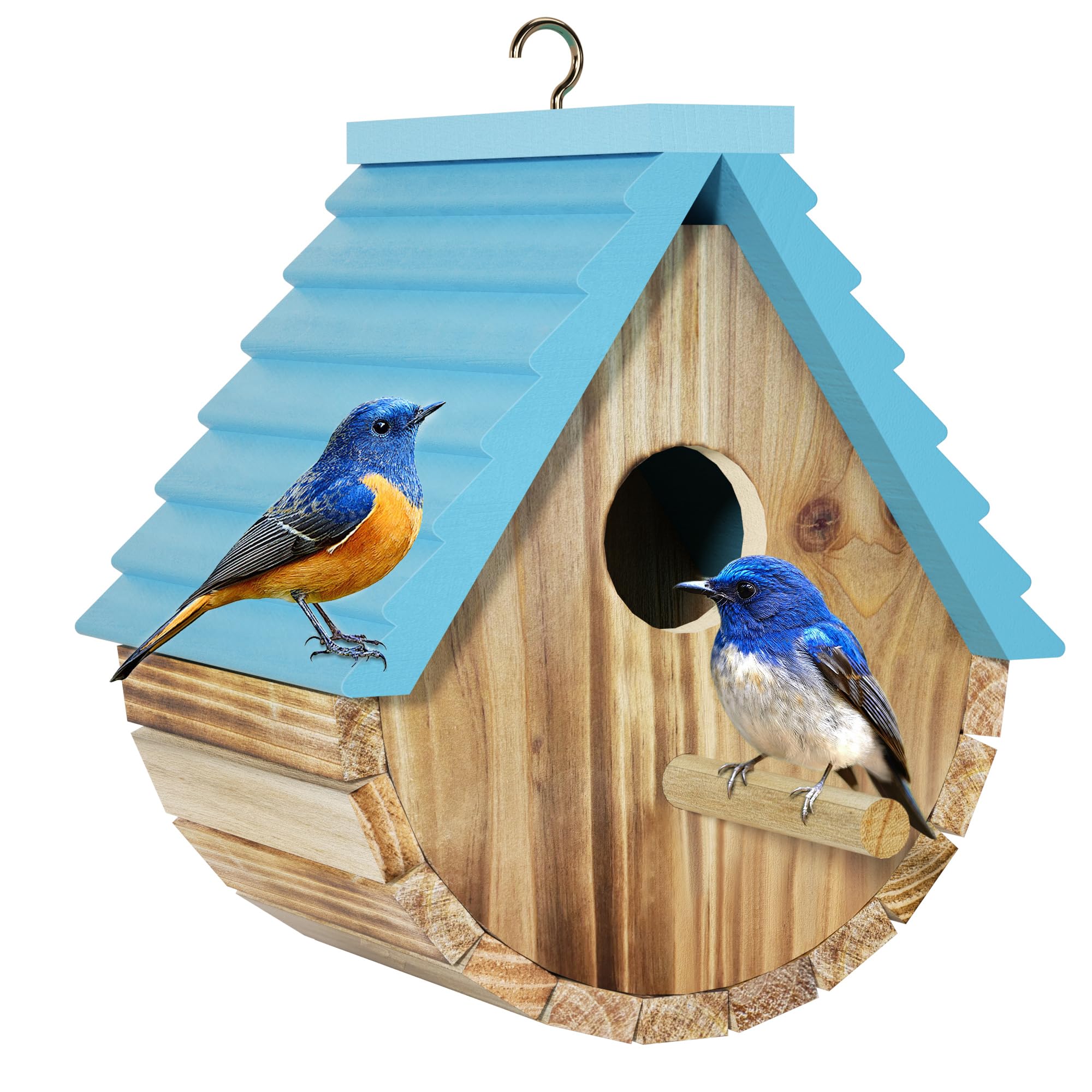
The Auslar Wooden Bird House is a zero-assembly, ready-to-hang cedar box with a 1.57-inch entrance that targets bluebirds, finches, and tree swallows. The herringbone-style roof adds visual interest, and the swivel back door opens for ventilation and cleaning. At 7.87 inches tall, the interior volume is adequate for a single brood of cavity-nesting songbirds.
Cedar is naturally rot-resistant, but this unit’s painted top and carbonized finish add a layer of moisture protection the raw STARSWR box lacks. The included screws allow wall or fence mounting, while a built-in hook supports hanging. The perch below the entrance is purely decorative — birds do not need it, and it can actually aid predators, so some owners remove it after installation.
Customer reports consistently praise the box’s sturdiness relative to its entry-level pricing, though the thin wood walls do not match the thermal mass of the Kingsyard or SISTERBIRD options. For a first-time buyer testing whether birds will occupy their yard, this is a risk-free starting point. Just plan to replace it after two or three seasons of full sun exposure.
Why we love it
- Ships fully assembled — hang it straight out of the box
- Swivel back door provides ventilation and cleaning access
- Carbonized cedar offers better moisture resistance than raw wood
Good to know
- Decorative perch can aid predators — consider removing it
- Thinner cedar walls won’t insulate as well as thick pine or plastic
FAQ
Should I add a perch to a nest bird house?
What is the correct hole size for bluebirds compared to wrens?
Final Thoughts: The Verdict
For most gardeners, the best nest bird houses winner is the Kingsyard Recycled Plastic Bird House because its durable material, clear viewing panel, and predator defenses deliver the longest service life without maintenance. If you want a predator-focused design for small songbirds, grab the Kingsyard Wren House with Predator Guard. And for a decorative cabin-style box with easy side clean-out, nothing beats the SISTERBIRD Wren Bird House.