
Raising fry without a reliable source of live baby brine shrimp is a losing battle — weak growth, low survival rates, and constant frustration. A proper hatchery separates the hobbyist who sees eggs float from the keeper who consistently delivers moving nauplii to the tank. The difference is in the design: a conical bottom for clean separation, gentle aeration to keep eggs in suspension, and a harvesting valve that lets you drain live shrimp without dumping shells into the fry tank.
I’m Mo Mahin — the founder and writer behind Furric. I’ve spent years analyzing the aquarium supply market, comparing hatch rates, egg-to-nauplii conversion data, and the real-world durability of plastic fittings and air pumps across dozens of kits to find which designs actually survive repeated use.
A strong brine shrimp hatchery kit eliminates the guesswork of DIY soda bottle rigs by giving you a purpose-built chamber, calibrated airflow, and a harvesting system that delivers live food on a consistent schedule — no trips to the hardware store, no clogged airlines, no wasted eggs.
How To Choose The Best Brine Shrimp Hatchery
Choosing the wrong hatchery design wastes eggs, introduces shell material into your tank, and makes daily feeding a chore. Focus on these four factors to get a system that works with your tank size and time budget.
Hatchery Geometry: Cone vs. Dish vs. Bottle
Cone-bottom hatcheries concentrate hatched nauplii at the lowest point, allowing clean separation from empty shells when you open the valve. Dish-style hatcheries use a shallow floating tray that relies on the shrimp’s natural phototaxis — they swim toward light, congregating in a center ring. Straight-sided soda bottle conversions are cheapest, but they create a dead zone where shells and unhatched eggs settle together, forcing you to strain through a net that often passes debris.
Aeration and Air Pump Compatibility
Suspended eggs need continuous, gentle bubbling that keeps the water column oxygenated without violent turbulence that shatters egg casings. Look for kits that include a control valve so you can dial back airflow from a standard aquarium pump. USB air pumps offer a backup option during power outages, but their flow rate must match the hatchery volume — 1 to 1.5 liters is common for starter units.
Harvesting Method and Valve Design
A ball valve or trim valve at the base of the hatchery lets you close the airline, wait 10–15 minutes for the shrimp to settle, then drain them directly into a net. Cheaper push-fit valves can leak or snap under repeated use. Dish-style hatcheries skip the valve entirely and let you pipette shrimp from the illuminated center; this works for small batches but becomes tedious when you need a dense feeding.
Ease of Cleaning and Material Quality
Acrylic chambers scratch easily and can crack if over-tightened, but they offer clear visibility of the hatching process. Polycarbonate is more impact-resistant but often costs more. No matter the material, the hatchery must disassemble fully — every airline, air stone, and valve fitting collects salt residue that clogs within a week if not rinsed under hot water.
Quick Comparison
On smaller screens, swipe sideways to see the full table.
| Model | Category | Best For | Key Spec | Amazon |
|---|---|---|---|---|
| NestBasics Artemia Incubator | Mid-Range | Small to medium tanks | 1.32 L volume, USB air pump | Amazon |
| Saricho 20-Piece Kit | Premium | Full feeding system | 20 pcs with auto feeder | Amazon |
| Brine Shrimp Direct Dish | Premium | No-power hatching | 100,000+ shrimp per batch | Amazon |
| PUPUZAO 2-Way Bottle Kit | Budget | DIY-style users | Dual bottle adapter, 3/16” tubing | Amazon |
| LEIFIDE Floating Dish | Budget | Surface-floating setups | 7.7” L floating tray | Amazon |
In‑Depth Reviews
1. NestBasics Brine Shrimp Hatchery Kit

The NestBasics kit is the strongest all-in-one value in this test because it pairs a 1.32-liter conical acrylic chamber with a USB-powered air pump that can run off a power bank during outages — a feature no other budget-to-mid kit offers. The included air stone and control valve let you fine-tune the bubble stream so eggs tumble gently without blasting sediment into the water column. The 11.8-inch clear tubing and separate black airline let you route the pump outside the tank while keeping the hatchery inside using the four suction cups or the tripod stand for external mounting.
Holding roughly 0.5 scoops of eggs per batch, this unit handles the daily feeding needs of a 75-gallon fry system without overflowing. The bottom trim valve works for harvesting, but the plastic shutoff is the weak point — owners who upgraded to a brass valve saw a significant drop in leakage. The kit ships with two pipettes, a brine shrimp net, and six storage bottles, so you have everything needed to collect, rinse, and refrigerate excess nauplii for the next feeding.
Some units arrive with a non-functional USB pump, but the spare Y-fitting trick lets you tap into your existing aquarium air system. For anyone who wants a purpose-built colony rather than a hacked soda bottle, this is the most complete starter package under competitive pricing tiers.
Why we love it
- USB pump runs on power bank — no feeding gaps during outages
- Includes storage bottles, net, and two pipettes for clean collection
- Tripod stand allows external mounting for better temperature control
Good to know
- Plastic shutoff valve is prone to leaking; a metal replacement is recommended
- USB pump is loud and may vibrate against glass without padding
- Instructions are minimal — expect to consult online setup videos
2. Saricho Brine Shrimp Hatchery Kit (20-Piece Set)

This Saricho set is the most comprehensive kit in the test, bundling 20 individual pieces that cover the entire workflow from incubation to automatic dispensing. The rectangular acrylic incubator allows vertical mounting inside or outside the tank via a four-corner bracket, and the transparent chamber provides a clear view of eggs popping into nauplii — some owners report 80% hatch rates within 36 hours at 77°F using 250–300 ml of RODI water and one teaspoon of marine salt. The included air pump pushes bubbles through an acrylic rigid tube that connects to the regulating valve, giving you precise control over aeration intensity.
What sets this kit apart is the closed-loop feeding system: after harvesting through the bottom net, you can load the collected shrimp into two automatic feeders that adhere to the tank glass and release nauplii through small bottom holes. Five storage containers hold excess harvest for the next meal, and three brine shrimp straws allow direct pipetting into fry corners. Owners who ran two units simultaneously in a 5-gallon quarantine tank report consistent daily harvests without any modifications beyond a bottle brush for tube cleaning.
The build quality has some tradeoffs — the plastic suction clamps are fragile and one user reported a broken clamp during the first assembly. The air stone in the kit does not sink well and distributes bubbles unevenly, which can leave unstirred eggs at the bottom corners of the rectangular chamber. For keepers who want a turnkey hatchery-to-feeder pipeline without piecing together separate components, the sheer completeness of this set justifies the premium.
Why we love it
- Automatic feeders release nauplii gradually — no overfeeding spikes
- Four-corner bracket enables stable external mounting
- 5 storage containers keep excess harvest fresh for days
Good to know
- Plastic suction clamps can snap during installation
- Air stone does not sink well; needs a weight or replacement
- Rectangular shape creates dead corners — shake chamber gently during hatching
3. Brine Shrimp Direct Hatchery Dish

The Brine Shrimp Direct dish is the single most elegant solution for keepers who want live food without buying an air pump, tubing, or valves. It relies entirely on the shrimp’s innate phototaxis — you place the dish on a stable surface under a desk lamp, add water and eggs, and within 24 hours the hatched nauplii swim toward the light source and concentrate in the center well. The tutorial video accessible through the product images shows the entire process in under two minutes.
Yields exceed 100,000 shrimp per batch in a 10.5-ounce dish, which is enough to feed a community of small fry for 3–4 consecutive days of harvesting. The included feeding dropper lets you suck up a dense cloud of nauplii from the center without capturing shells, which remain at the outer ring. No messy cleanup — just rinse the dish under hot water and dry it for the next cycle. Owners report successful hatches in as little as 8 hours when combined with a heat mat and a consistent temperature above 70°F.
The tradeoff is batch size: this dish is designed for small-volume hatching only. If you need to feed a breeding rack of cichlids or a large shrimp colony, you will need multiple dishes running in rotation. The white mesh netting on the included collection cup eventually clogs with salt residue and cannot be cleaned or replaced, which limits the unit’s usable lifespan to roughly a year of regular use. For the beginner or the keeper with one or two fry tanks, the simplicity and shell-free harvest quality are unmatched.
Why we love it
- No pump, tubing, or valves — just a lamp and a stable surface
- Shrimp self-concentrate via phototaxis for clean separation
- 24-hour turnaround with yields over 100,000 nauplii
Good to know
- White collection netting clogs permanently and cannot be replaced
- Small dish footprint — unsuitable for large breeding operations
- Requires consistent temperature above 70°F; best with a heat mat
4. PUPUZAO 2-Way Soda Bottle Brine Shrimp Hatchery Kit

This PUPUZAO kit is the purest expression of the soda bottle method, giving you two complete bottle adapters, two one-way control valves, and one two-way control valve so you can run two hatcheries in parallel from a single air pump. The 3/16-inch airline tubing connects directly to standard aquarium pumps, and the design is dead simple: thread the adapter into a recycled soda bottle, add water, salt, and eggs, open the air valve, and let bubbles churn for 24–36 hours. Closing the airflow valve settles the shrimp in the bottleneck for draining into a net.
The value proposition is hard to beat for keepers who already own an air pump and want a low-friction way to produce dual batches. The transparent adapter body lets you see the color change as eggs hatch, and the two-valve system gives independent control over each bottle’s airflow — useful if one bottle holds a denser egg load. Owners who set this over a bucket or catchpan avoided all floor mess from the inevitable drips that occur when disconnecting the valve for harvesting.
Build quality is the weak link here. The tubes detach from the check valve under the weight of water, causing the entire batch to drain onto the floor. Several users fixed this by gluing the tubing to the valve body with aquarium-safe epoxy. The check valve itself lacks a positive seal and can backflow if the pump is turned off, letting saltwater creep toward the pump diaphragm. This is a functional budget option, but expect to reinforce the connections before trusting it with a full batch.
Why we love it
- Runs two hatcheries simultaneously from one air pump
- Transparent adapter for clear visual monitoring of hatch progress
- Ultra-low start if you already own a pump and soda bottles
Good to know
- Tubes detach from check valve under water weight — glue recommended
- Check valve can backflow, pushing saltwater toward the pump
- Air pump and soda bottles not included; must be sourced separately
5. LEIFIDE Floating Brine Shrimp Hatchery Dish Kit
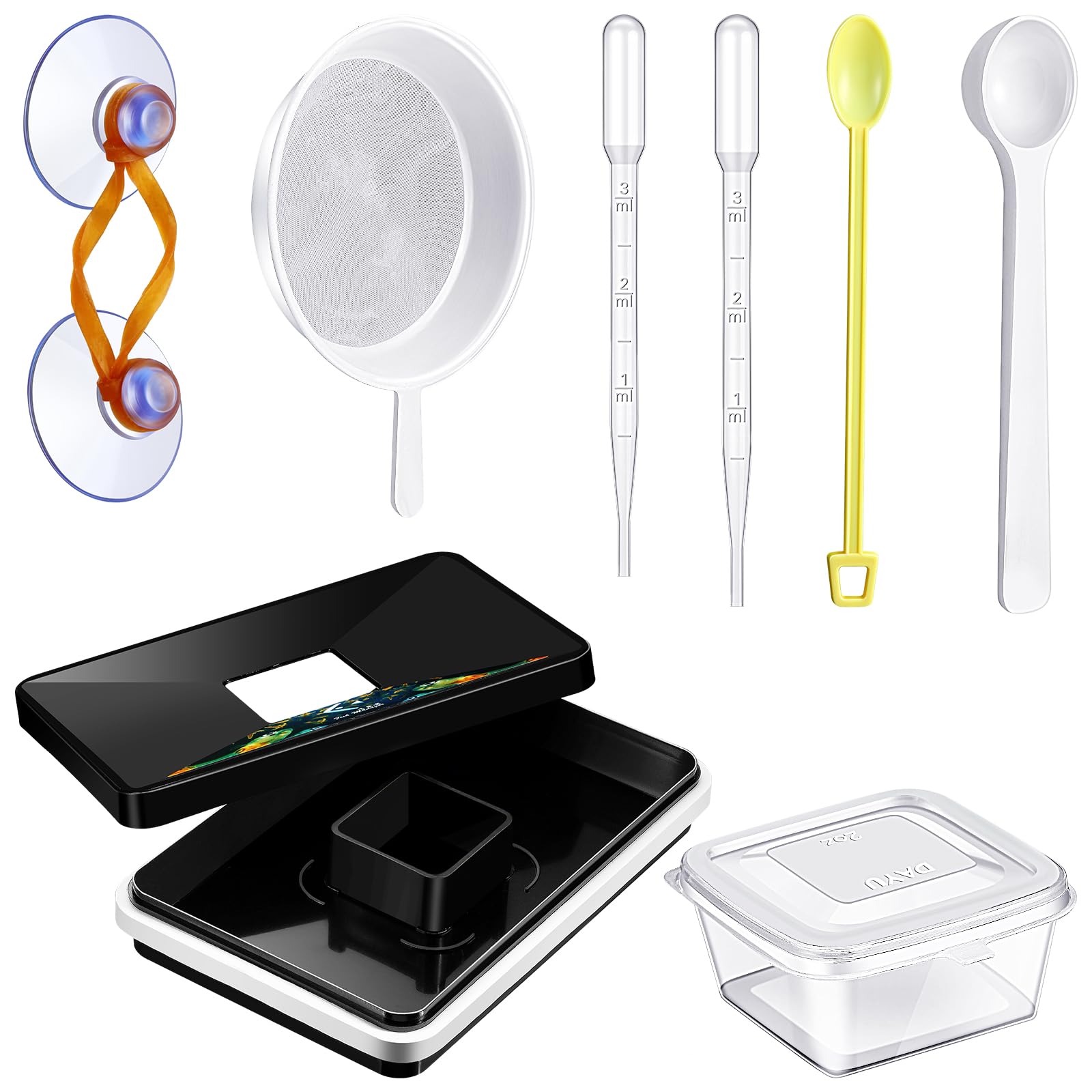
The LEIFIDE dish is an entry-level floating hatchery that uses a 7.7-inch rectangular tray to sit on the water surface of your aquarium, eliminating the need for a separate stand or mounting bracket. The package includes a hatching box lid, a floating ring, a shrimp net, a collection cup, a salt spoon, an eggs spoon, and two pipettes — enough to start hatching immediately without any additional purchases. The concept is that hatched nauplii swim toward the light and concentrate in the center ring for easy collection via the included dropper or the net.
In practice, this unit works best in larger tanks — 20 gallons or more — where the floating tray has room to rest without tipping. The lid does not sit flush; the center collection ring protrudes slightly, so you need to sand the edge or accept a loose fit. Temperature control matters here: hatch rates drop sharply below 70°F, and the dish is small enough that water cools quickly unless the aquarium is heated to 78–82°F. Owners who placed the dish on a stable external surface rather than floating it reported better hatch consistency because the tray did not rock with the water surface.
The suction cup mounting system included in the kit is unreliable — the rubber suction cups lose grip within a few days, causing the dish to drift or capsize. The fill line printed on the tray is misleading; filling to that line makes the dish unstable and prone to spilling. Keepers who needed a dense batch for fry in smaller tanks found the floating design too unwieldy and preferred a dedicated external hatchery. For a breeder with a large display tank who wants to add live food without running extra equipment, this is a low-hassle entry point.
Why we love it
- Floats directly on the aquarium surface — no external stand needed
- Complete tool set: net, cup, spoons, and pipettes included
- Phototaxis ring concentrates shrimp for clean collection
Good to know
- Too large for tanks under 5 gallons — capsizes easily
- Suction cups lose grip after a few days
- Lid doesn’t close flush; may need sanding for proper fit
FAQ
Why are my brine shrimp eggs not hatching?
Can I use a dish-style hatchery for a 10-gallon tank?
How long can I store harvested baby brine shrimp?
What is the ideal salinity for hatching brine shrimp?
Final Thoughts: The Verdict
For most keepers, the brine shrimp hatchery that delivers the best balance of hatch capacity and ease of use is the NestBasics Artemia Incubator because its 1.32-liter conical chamber, included USB air pump, and external mounting option let you produce consistent daily harvests without relying on DIY hacks. If you want a no-power system for small, single-batch feeding, the Brine Shrimp Direct Dish eliminates every piece of equipment except a lamp. And for a complete hatchery-to-feeder pipeline that handles storage and automatic dispensing, the Saricho 20-Piece Kit is the most comprehensive solution available.