
Goldfish are notoriously messy eaters, producing a bioload that can overwhelm standard aquarium filters within weeks. Choosing the wrong filtration system leads to cloudy water, toxic ammonia spikes, and stressed fish that are prone to disease. The key is finding a unit that combines high-flow mechanical filtration with ample space for beneficial bacteria colonization.
I’m Mo Mahin — the founder and writer behind Furric. I spend my time comparing filtration specifications like GPH flow rates, media volume, and sponge density, while cross-referencing hundreds of verified owner experiences to understand what actually keeps a goldfish tank stable long-term.
After analyzing dozens of models across price tiers and use cases, I’ve built a focused list of the best fish filter for goldfish tanks that balances flow power, biological capacity, and maintenance convenience for these heavy-waste producers.
How To Choose The Best Fish Filter For Goldfish
Goldfish are not like tetras or bettas. They produce significantly more waste per inch of fish, meaning the filter you choose must have a higher flow rate and more biological media surface area than a standard aquarium filter. Here’s what to prioritize.
Flow Rate and Turnover
The industry standard for tropical tanks is 4-6 times turnover per hour. For goldfish, you need 8-10 times your tank volume per hour minimum. A 50-gallon goldfish tank requires at least 400 GPH of rated flow, accounting for head pressure from media and tubing. Units with adjustable flow give you control to dial back if your fish show signs of stress from current.
Filtration Stages and Media
Goldfish filters need three stages: mechanical (sponge or pad), chemical (carbon optional for clarity), and biological (ceramic rings, bio-balls, or high-density sponge). The biological media volume is the most critical metric — more surface area equals more bacteria to process ammonia. Look for filters that let you add supplemental media beyond what ships in the box.
Filter Type and Tank Compatibility
Sponge filters work for fry or small tanks under 20 gallons. Hang-on-back (HOB) filters offer easy maintenance for medium tanks, while canister filters provide the highest media capacity for tanks 40 gallons and up. For goldfish specifically, canister filters dominate the premium tier because they keep media submerged and running even during cleaning of other stages.
Quick Comparison
On smaller screens, swipe sideways to see the full table.
| Model | Category | Best For | Key Spec | Amazon |
|---|---|---|---|---|
| Hikari Bacto-Surge Foam Filter XL | Sponge | Heavy bio-load, standalone in large tanks | 125-gal rating, high porosity | Amazon |
| Fluval AC20 Power Filter | HOB | Small goldfish tanks up to 20 gal | 5-20 gal, customizable media basket | Amazon |
| DEGGOX Sponge Filter with Pump | Sponge + Pump | Fry, shrimp, low-flow goldfish | 20-55 gal, includes ceramic media | Amazon |
| TARARIUM Internal Filter | Internal | Goldfish and turtle tanks 20-75 gal | 290 GPH, 3-stage, adjustable | Amazon |
| COOSPIDER UV Canister Filter | Canister + UV | Green water control in large tanks | 400 GPH, 254nm UV, 40-150 gal | Amazon |
| Zoo Med Turtle Clean 15 | Canister | Nano goldfish tanks up to 15 gal | 15-gal, external, 3-stage media | Amazon |
| SunSun HW-602B Canister | Canister | Small community goldfish tanks | 106 GPH, 3-stage, ≤15 gal | Amazon |
In‑Depth Reviews
1. Hikari Bacto-Surge Foam Filter XL
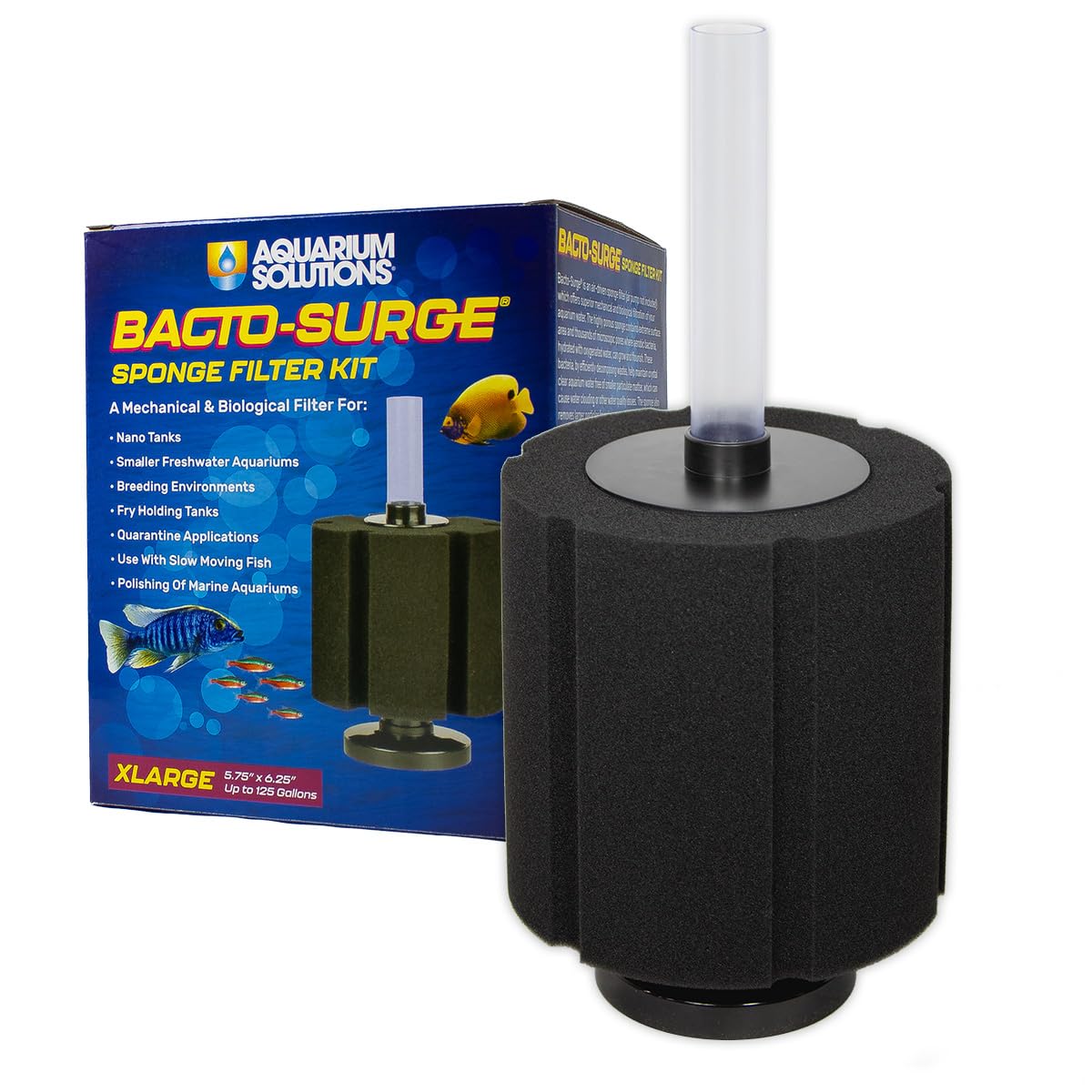
The Hikari Bacto-Surge is a massive sponge filter that earns its place as the top pick for goldfish owners running tanks between 55 and 150 gallons. Its foam retains pore density far longer than standard polyester sponges, which tend to compress and lose surface area within six months. The XL version is roughly the size of a coffee tin, providing an enormous surface area for nitrifying bacteria to colonize. This is critical for goldfish, which produce ammonia at rates that overwhelm small sponges quickly.
Users report it works equally well as a standalone filter in 75-gallon tanks or as a pre-filter on canister intake lines to protect ceramic media from large debris. The included dual air stones and tubing keep operation quieter than most sponge filters. However, you will need a sufficiently powerful air pump to push air through the dense foam; a standard whisper pump may struggle with this unit. The filter is also bulky, making it hard to hide in planted aquariums without strategic rock or driftwood placement.
Stackable design allows you to add a second unit for even more biofiltration in extra-large tanks. Owners note that it can be seeded from an established filter to instantly cycle a new tank, which is a major advantage when upgrading a goldfish setup. The foam material also cleans easily under dechlorinated water without degrading, extending its useful life well beyond cheaper alternatives.
Why we love it
- High-density foam resists compression for years
- Massive biofiltration surface area in a single unit
- Easy to clean and re-use without media replacement costs
Good to know
- Requires a strong external air pump for proper flow
- Very large; difficult to conceal in display tanks
- No mechanical pre-filter for debris capture
2. Fluval AC20 Power Filter
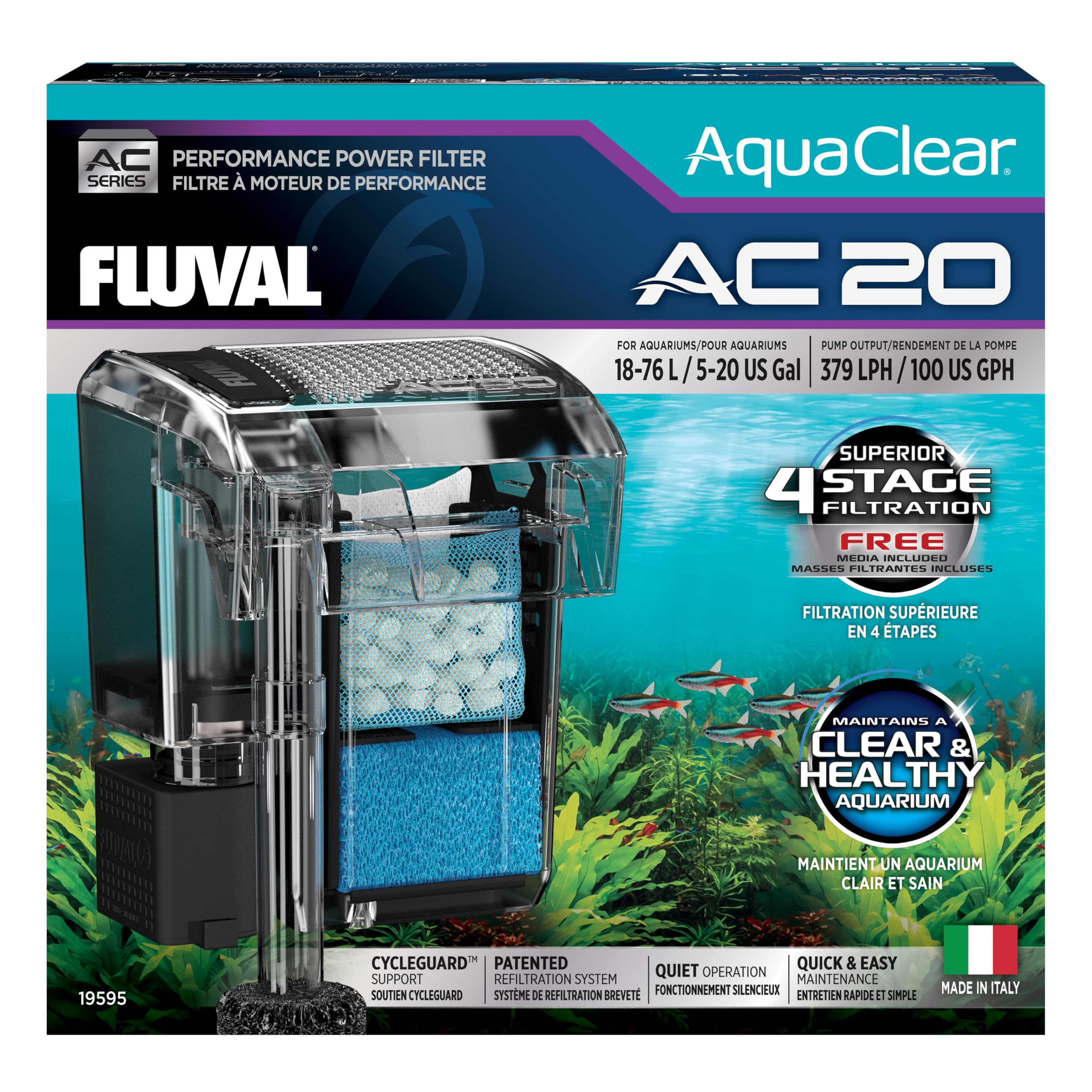
The Fluval AC20 is a hang-on-back filter built on decades of proven design, now updated with a customizable media basket that lets you stack foam, BioMax, and carbon inserts as needed. For goldfish tanks in the 10 to 20-gallon range, this unit delivers strong flow without overwhelming smaller fish. The adjustable flow control is a practical feature for fry or fancy goldfish varieties that prefer gentler current. Owners consistently report it runs near-silently when water level is maintained, making it suitable for bedrooms or offices.
Pre-packaged media is adequate for start-up, but experienced users recommend supplementing with extra fine filter floss to capture the fine particulate that goldfish produce. The basket accepts standard pad sizes, so you are not locked into proprietary cartridges. The included pre-filter sponge on the intake tube protects the impeller from large debris and reduces cleaning frequency. Some units lose flow strength over time, typically due to impeller wear or debris buildup, so routine disassembly and cleaning of the motor housing is advised.
Priming is straightforward — moving the inlet pipe in and out creates siphon action without needing to fill the chamber manually. The unit is made in Italy, and the build quality is noticeably superior to budget HOB filters in the same size class. For goldfish keepers with small tanks, this is a reliable mid-range option that avoids the noise and leaks common with cheaper alternatives.
Why we love it
- Silent operation when properly primed
- Fully customizable media basket with no proprietary pads
- Made in Italy with proven long-term reliability
Good to know
- May lose flow strength over time without impeller cleaning
- Stock carbon and foam media are mediocre
- Not designed for tanks larger than 20 gallons
3. DEGGOX Sponge Filter with Pump
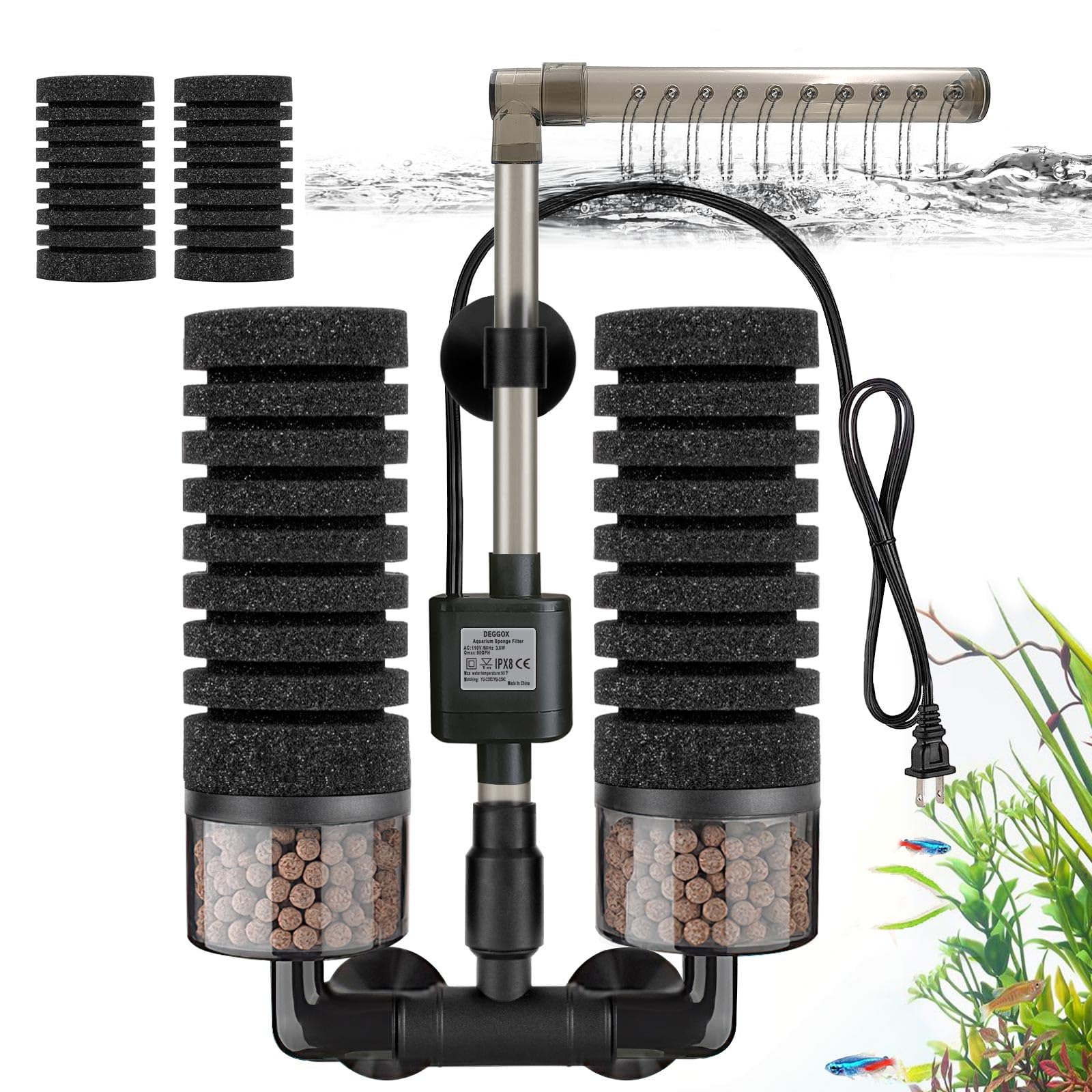
The DEGGOX sponge filter combines a submersible pump directly with a sponge and bio-ceramic media, removing the need for an external air pump. This unit is rated for 20 to 55-gallon tanks and adds a venturi nozzle and rain mode, producing gentle outflow ideal for fry, shrimp, or nervous goldfish. The dual-stage approach — physical sponge filtration plus ceramic biological media — gives you better waste processing than a plain sponge filter at a similar price point. The included ceramic balls provide additional surface area for nitrifying bacteria, which helps handle the higher ammonia output of goldfish.
Setup is plug-and-play: submerge the unit, connect the power, and it starts immediately. The pump is remarkably quiet at full flow, and the venturi feature adds oxygen while creating minimal current. However, durability reports are mixed. Several owners report the pump failing after the return period, with flow dropping to near zero. The plastic components where water exits are also noted as fragile — knock-offs can dislodge easily during cleaning. This filter works best as a supplementary unit in a larger goldfish tank rather than a primary filter, providing backup biological filtration if the main unit fails.
The detachable fine sponges are easy to rinse and re-use, reducing ongoing costs. For goldfish keepers with tanks under 40 gallons who want a quiet, self-contained sponge system, this is a budget-friendly entry point. Beware of using it in turtle tanks, as the manufacturer explicitly advises against it, though some owners report success with smaller turtles.
Why we love it
- No external air pump needed — plug-in simplicity
- Includes ceramic bio balls for added biofiltration
- Very quiet operation with venturi oxygen injection
Good to know
- Pump lifespan is inconsistent; some fail after 2 months
- Plastic exit nozzles are fragile and detach easily
- Not recommended as a primary filter for heavy goldfish bioload
4. TARARIUM Internal Filter 20-75 Gal

The TARARIUM internal filter is built around a three-stage process: a dense dual-sided mesh sponge for mechanical debris capture, a layer of ceramic bio-balls for biological filtration, and a waterfall output that oxygenates the water. For goldfish tanks between 20 and 75 gallons, the 290 GPH flow is appropriate for heavy waste loads, and the adjustable flow dial lets you reduce current for slower-swimming varieties like orandas and ranchus. The internal design means no hoses or external canisters — the entire unit hangs inside the tank, making it easy to install and maintain.
Users with 60-gallon goldfish tanks report the filter operates nearly silently, with the waterfall sound being calming rather than disruptive. The lowest water level compatibility at 2.6 inches is useful for shallow tanks or those with lower water levels. However, the filter’s intake sits low, which can suck up sand substrate unless you raise the unit on a rock or platform. For goldfish that dig or stir up substrate, this is a real consideration. The double-sided sponge needs cleaning every 3-5 days in heavily stocked goldfish tanks to maintain flow, which is more frequent than canister filters.
Media replacement is straightforward via the top lid canister, and the included ceramic bio-balls provide adequate surface area for a moderate goldfish load. The one-year after-sales warranty adds confidence, though the build quality of the plastic housing feels mid-range. For goldfish keepers who want a simple, quiet internal filter with waterfall aeration and adjustable flow, this is a solid mid-range pick.
Why we love it
- Near-silent operation with pleasant waterfall sound
- Adjustable flow rate for different goldfish types
- Easy top-access media replacement
Good to know
- Intake can suck up fine substrate without a riser
- Requires frequent sponge cleaning in heavy bioloads
- Plastic housing feels less robust than premium internal filters
5. COOSPIDER UV Canister Filter 40-150 Gal

The COOSPIDER UV canister filter is designed specifically for green water problems, combining a biochemical sponge with a 254nm UV light sterilizer. For goldfish keepers with large outdoor or indoor ponds and tanks in the 40 to 150-gallon range, this unit clears cloudy green water in 3-7 days by killing free-floating algae. The separate switches for the pump and UV light let you run the filter continuously while only activating the UV when needed, which extends bulb life and saves electricity. The 400 GPH flow rate is adequate for large goldfish tanks, though the UV chamber adds some head pressure that reduces effective flow slightly.
Owners confirm the filter works spectacularly on stubborn green water, with results visible within 3 days in 65-gallon tanks. The multi-section sponge cartridge captures debris while the UV handles the biological load. However, there are reliability concerns — some units fail within weeks or months due to pump or UV bulb issues. The UV light indicator is easy to check from outside the tank, but the switch cord is excessively long and may hang over the tank edge annoyingly. Aeration from the output is limited, so you may still need a separate air stone for goldfish.
For goldfish tanks plagued by algae blooms despite other filtration methods, this is a targeted solution. The double filtration approach — sponge for mechanical, UV for microbial — addresses the two most common causes of cloudy water in heavy-waste systems. Just be aware that the UV component requires bulb replacement every 6-12 months and the pump warranty is only 180 days, making long-term ownership a gamble for some users.
Why we love it
- Eliminates green water algae in under a week
- Separate switches for pump and UV light
- Powerful 400 GPH flow for large goldfish tanks
Good to know
- Pump and UV bulb reliability is inconsistent
- Short 180-day warranty limits long-term coverage
- Limited aeration output despite water flow
6. Zoo Med Turtle Clean 15 Canister Filter

The Zoo Med Turtle Clean 15 is a compact external canister filter sized for tanks up to 15 gallons, making it a niche but effective option for nano goldfish setups or quarantine/hospital tanks. Despite its “Turtle Clean” branding, the 3-stage media system (mechanical, chemical, biological) works perfectly for goldfish, and the external placement saves valuable tank space. The clear viewing case lets you monitor media condition without disassembly, which is helpful for catching carbon saturation early. For a 10-gallon goldfish tank with one or two fish, this filter provides gentle flow that won’t stress fancy varieties.
Owner experiences highlight that the filter is effective when properly primed — following the manual’s priming instructions is critical to avoid air locks that cause noise and reduced flow. The included carbon pellets are mediocre; many users replace them with loose activated carbon chips in a nylon bag for better absorption and water clarity. Cleaning the canister involves multiple small parts, which some find cumbersome, but the external design makes media changes less disruptive than internal filters. The intake slats are sized for small debris, meaning larger goldfish waste can bypass the mechanical stage unless you add a pre-filter sponge.
Flow rate is rated at 79 GPH, which works out to roughly 5-7 times turnover per hour for a 10 to 15-gallon tank — adequate for light goldfish loads but insufficient for heavily stocked tanks or larger goldfish. The hoses lack quick-disconnect valves, making maintenance slightly messy. For nano goldfish tanks, this is a functional canister option that provides better biofiltration than a typical HOB filter of the same size, but it demands more attentive maintenance than simpler alternatives.
Why we love it
- Compact external design saves tank space
- Clear viewing case for media status checks
- Effective biofiltration for small goldfish tanks
Good to know
- Stock carbon pellets perform poorly; recommends upgrading
- Priming requires careful steps to avoid air locks
- No quick-disconnect valves on hoses
7. SunSun HW-602B 3-Stage Canister Filter

The SunSun HW-602B is a budget-priced 3-stage canister filter with a 106 GPH flow rate and 6W energy-efficient motor, designed for nano tanks up to 15 gallons. For goldfish keepers with a 10-gallon quarantine tank or a single fancy goldfish in a small setup, this offers canister-level mechanical, chemical, and biological filtration at a fraction of the cost of premium brands. The three customizable media trays let you stack coarse foam, polishing pads, and biological media in any configuration that fits your water chemistry needs. The compact footprint makes it easy to hide behind a stand or inside a cabinet.
Owners report the filter operates very quietly once fully primed and free of air pockets. However, the flexible hoses are stiff and difficult to route neatly, and the intake screen has large slots that can’t accommodate standard pre-filter sponges without modification. The metal clips that secure the canister lid are prone to falling off during opening, which can be frustrating. Some units fail to develop suction if not positioned correctly — the canister must sit below the water level to gravity-feed properly. The 106 GPH rating is optimistic; effective flow after media loading is closer to 70-80 GPH, making this best suited for very small goldfish loads.
For the price, the SunSun delivers basic canister functionality but with noticeable compromises in build quality and fit-and-finish. The plastic feels thin, and the intake/outlet hardware has sharp internal angles that are difficult to clean. Goldfish keepers on a tight budget who need biological filtration for a small tank will find this adequate, but those with medium-to-heavy goldfish loads should look to higher-GPH or larger-canister options. It’s a budget-friendly entry into canister filtration, not a long-term primary filter for goldfish.
Why we love it
- Very quiet operation for a budget canister
- Customizable media trays for flexible filtration
- Low power consumption at only 6 watts
Good to know
- Stiff hoses and fragile lid clips frustrate assembly
- Real-world flow rate lower than advertised
- Intake screen too large for common pre-filter sponges
FAQ
How many gallons per hour do goldfish need from their filter?
Can I use a sponge filter as the primary filter for goldfish?
Why does my goldfish filter need UV sterilization?
How often should I replace filter media in a goldfish tank?
Can I have a canister filter for a 10-gallon goldfish tank?
Final Thoughts: The Verdict
For most gardeners, the best fish filter for goldfish winner is the Hikari Bacto-Surge Foam Filter XL because its high-density foam provides unmatched biological surface area for heavy goldfish bioloads in large tanks. If you want a customizable hang-on-back for smaller setups, grab the Fluval AC20 Power Filter. And for green water control in big tanks, nothing beats the COOSPIDER UV Canister Filter.