
The foundation of a thriving marine aquarium—whether a fish-only system or a dense SPS-dominated reef—is the water itself. More specifically, the synthetic salt mix you use determines the baseline levels of calcium, alkalinity, magnesium, and over 70 trace elements that every inhabitant depends on for osmoregulation, skeletal growth, and metabolic function. Choosing the wrong blend can stall coral growth, crash pH, or introduce unwanted phosphates and nitrates.
I’m Mo Mahin — the founder and writer behind Furric. I’ve spent years analyzing the chemical profiles, dissolution rates, and batch consistency of marine salt mixes, cross-referencing manufacturer data sheets with thousands of verified owner experiences to identify which formulas deliver on their promises for specific tank setups.
This guide breaks down the top-performing synthetic blends on the market, from value-oriented anhydrous options to premium high-alkalinity reef formulas, so you can confidently select the best salt for saltwater aquarium that matches your livestock and maintenance routine.
How To Choose The Best Salt For Saltwater Aquarium
Not all sea salt is created equal. A fish-only system with a few soft corals has very different chemical requirements than a high-energy SPS reef with acropora colonies. Understanding a few key parameters will ensure you pick a mix that supports, rather than stresses, your aquatic life.
Target Alkalinity and Calcium Levels
Alkalinity (measured in dKH) and calcium (ppm) are the two pillars of coral growth. Standard fish-only salts often mix to around 8–9 dKH and 350–400 ppm calcium, which is adequate for fish and live rock. Reef-specific blends, like Red Sea Coral Pro, target elevated levels (10–12 dKH and 450–500 ppm calcium) to fuel accelerated skeletal deposition in LPS and SPS corals. If you maintain a mixed reef, look for a salt that mixes to at least 9 dKH without requiring separate buffer dosing.
Dissolution Speed and Clumping Resistance
Anhydrous salts, such as Seachem Vibrant Sea, contain no water of hydration, meaning a smaller volume of powder produces the same volume of saltwater compared to standard hydrated salts. They dissolve rapidly and produce a clear solution with minimal sediment. However, all salt mixes will form hard clumps if exposed to humidity. Bucket-based products with an inner bag offer better moisture protection; bag-only products require transferring to a sealed container immediately after opening.
Trace Element Profile and Batch Consistency
Natural seawater contains a precise ratio of over 70 elements. Brands like Brightwell Aquatics emphasize replicating this ratio using USP-grade and ACS Reagent-grade ingredients. Higher manufacturing standards generally mean less batch-to-batch variation—critical for sensitive systems. If you run a high-end reef, a salt that guarantees consistent levels of iodine, strontium, and potassium can prevent unexplained coral recession or pale coloration.
Quick Comparison
On smaller screens, swipe sideways to see the full table.
| Model | Category | Best For | Key Spec | Amazon |
|---|---|---|---|---|
| Brightwell NeoMarine (150-GAL) | Premium | SPS/LPS Reef Tanks | pH ~8.30, Alk ~7.5 dKH at 1.025 SG | Amazon |
| Red Sea Coral Pro (175 Gal) | Premium | Accelerated Coral Growth | Elevated Ca/Mg/Carbonate Ratio | Amazon |
| Fritz Reef Pro Mix (4 Pack) | Mid-Range | Mixed Reef Systems | Enhanced Buffer & Ca/Mg/K | Amazon |
| Seachem Vibrant Sea (60 Gal) | Mid-Range | High-Yield Anhydrous Mix | Anhydrous, Enhanced K | Amazon |
| Bulk Reef Supply Kalkwasser (4 lb) | Specialty | pH & Alk Dosing | Ca(OH)2 Powder | Amazon |
| Kolar Labs GFO (1 lb) | Media | Phosphate Removal | Granular Ferric Oxide | Amazon |
In‑Depth Reviews
1. Brightwell Aquatics NeoMarine Marine Salt Blend (150-GAL)
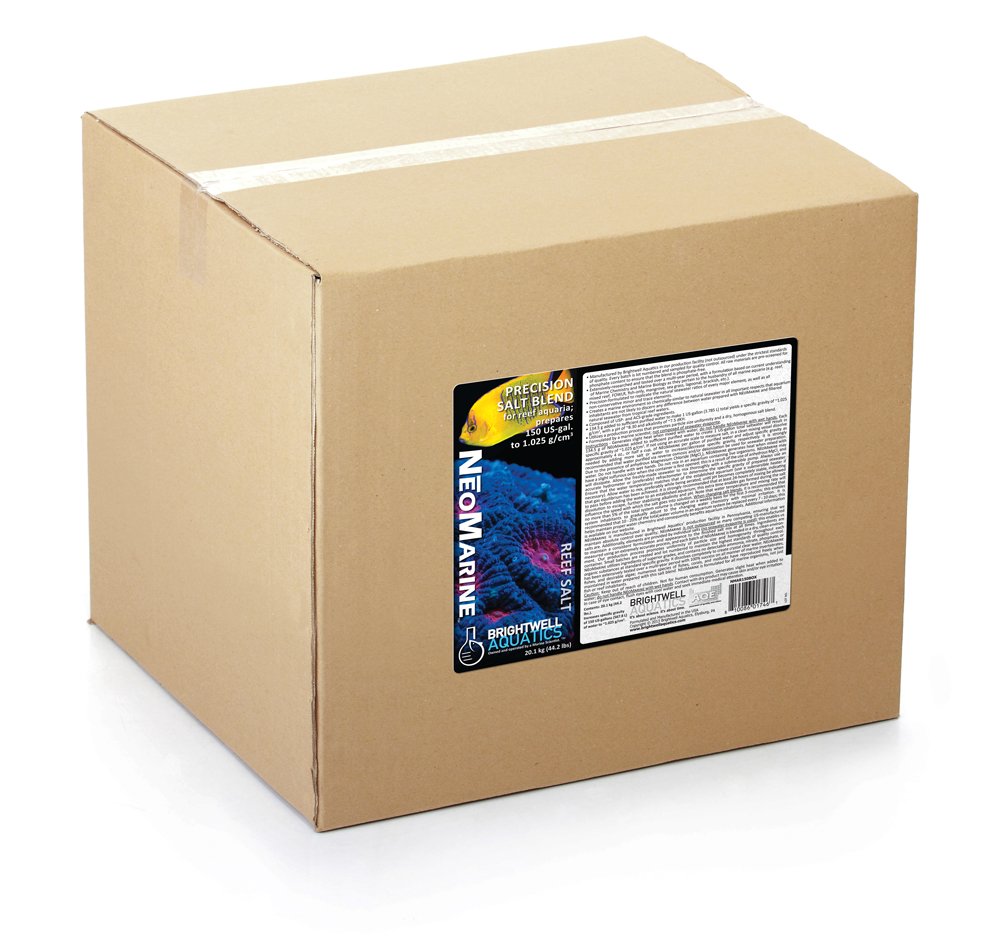
The Brightwell NeoMarine blend is engineered with USP, ACS Reagent-grade, and FCC Food grade ingredients, making it one of the purest synthetic salt mixes on the market. It targets a specific gravity of ~1.025 and a pH of ~8.30 when mixed at 134g per gallon, with an alkalinity of ~7.5 dKH—a stable baseline that experienced reef keepers appreciate for predictable water chemistry. Owners of large SPS-dominated systems consistently report improved color and polyp extension after switching from standard blends.
This salt dissolves completely with no visible residue, and the particle size uniformity ensures every bucket mixes to the same parameters. The 150-gallon box provides excellent value per gallon compared to premium European brands. A common observation is that the salt produces a mild chemical smell and heats up slightly during mixing—a normal exothermic reaction from the anhydrous ingredients.
The only practical downside is the lack of an inner bag inside the bucket; the salt arrives loose, so storing the bucket in a low-humidity area is essential to prevent clumping. For reef keepers managing 75-gallon tanks and up who prioritize consistent water chemistry, this is the long-term winner.
Why we love it
- Ultra-pure ingredient sourcing ensures batch-to-batch consistency
- Mixes crystal clear with no sediment or precipitate
- Excellent value per gallon for premium-grade salt
Good to know
- No inner bag—must be stored in a sealed container
- Heats up during mixing; allow time to cool before use
2. Red Sea Coral Pro Reef Salt Mix (175 Gal Bucket)

Red Sea Coral Pro is formulated with an elevated calcium/magnesium/carbonate ratio specifically designed to accelerate skeletal growth in all coral types—soft, LPS, and SPS. The bucket yields 175 gallons of saltwater at 1.025 SG, making it a high-volume choice for reef keepers performing frequent large water changes. The salt mix is bagged inside the bucket, which helps protect it from moisture and clumping during storage.
Aquarists using this salt in mixed-reef systems frequently note improved growth rates in montipora and acropora frags within weeks of switching. Mixing instructions recommend measuring by weight (roughly 4.75 cups per 5 gallons), but first-time users should verify specific gravity with a calibrated refractometer, as the instructions can be slightly ambiguous regarding final salinity. The salt dissolves cleanly with minimal residue.
Some customers report that the plastic bucket can arrive cracked due to shipping weight, though the internal bag usually remains intact. A small fraction of users experienced a drop in pH when transitioning from other salts, so acclimating livestock over several water changes is advised. For dedicated reefers prioritizing coral growth above all else, this formula delivers measurable results.
Why we love it
- Elevated calcium and alkalinity fuel rapid coral skeletal growth
- Bagged inside bucket prevents moisture damage
- Large 175-gallon output reduces per-change cost
Good to know
- Buckets occasionally crack in transit—inspect on arrival
- Transition period may require pH monitoring in sensitive systems
3. Fritz Aquatics Reef Pro Mix Complete Marine Salt (4 Pack, 50 Gal)

Fritz Reef Pro Mix arrives as a 4-pack of sealed bags, each making 50 gallons of saltwater. This packaging format is a practical advantage: you only open one bag at a time, keeping the remaining three bags factory-sealed and moisture-free for months. The formula includes enhanced buffer levels that reach a stable pH shortly after mixing, plus elevated calcium, magnesium, and potassium—parameters that benefit mixed-reef tanks with both LPS and soft corals.
Aquarists report that this salt mixes into a very clear solution with minimal dust or clumping. Soft corals, in particular, show strong feeding response and expansion after water changes. The powder dissolves fully within about 30 minutes with standard circulation, and no pre-heating is required as long as the mixing water is at 75–78°F. Long-term users appreciate that the batch consistency remains tight, even across different production lots.
The main trade-off is the bag format itself: if you do not transfer the opened bag into a sealed container, the salt can absorb humidity and harden over a few weeks. Additionally, the 50-gallon bag size is slightly smaller than many bucket options, so heavy users with 200+ gallon tanks will need multiple packs. For the hobbyist with a 40–75 gallon system, this four-bag pack offers an outstanding balance of quality and cost efficiency.
Why we love it
- Four separate bags preserve freshness for months
- Enhanced buffer reaches stable pH quickly
- Clear dissolution with minimal residue
Good to know
- Opened bags must be transferred to an airtight container
- Requires multiple packs for tanks over 150 gallons
4. Seachem Vibrant Sea Highly Concentrated Synthetic Sea Salt (60 Gal)

Seachem Vibrant Sea stands out for its anhydrous formula, meaning the salt contains no water molecules in its crystalline structure. This results in a higher concentration per volume—the 6.2 kg container produces 60 gallons of saltwater, which is significantly more yield per pound than standard hydrated mixes. The formula includes elevated potassium levels, an element often depleted in closed reef systems and linked to vibrant coral coloration.
The dissolution speed is notably fast; users report mixing thoroughly within 30–60 minutes using only a small powerhead, with no need for a heater or strong pump. The resulting water is clear and free of precipitate. Fish-only and soft-coral systems benefit from the balanced calcium and alkalinity levels without the intense spike that some reef-specific blends deliver. This makes it a solid choice for newer marine keepers moving beyond basic instant mixes.
Because Vibrant Sea mixes to a lower dKH compared to specialized reef salts, hard-core SPS keepers may need to supplement with a separate buffer to maintain 10+ dKH. The bag format inside the box is less robust than a bucket, so careful storage is important. For those prioritizing yield per dollar and simplicity of mixing, this is a top-tier value proposition.
Why we love it
- Anhydrous formula yields more saltwater per pound
- Quick dissolution with minimal equipment needed
- Enhanced potassium supports coral color
Good to know
- Lower dKH may require separate dosing for SPS-dominant tanks
- Bag packaging requires transfer to a sealed container
5. Bulk Reef Supply Pharma Kalkwasser Calcium Hydroxide (4 lb)
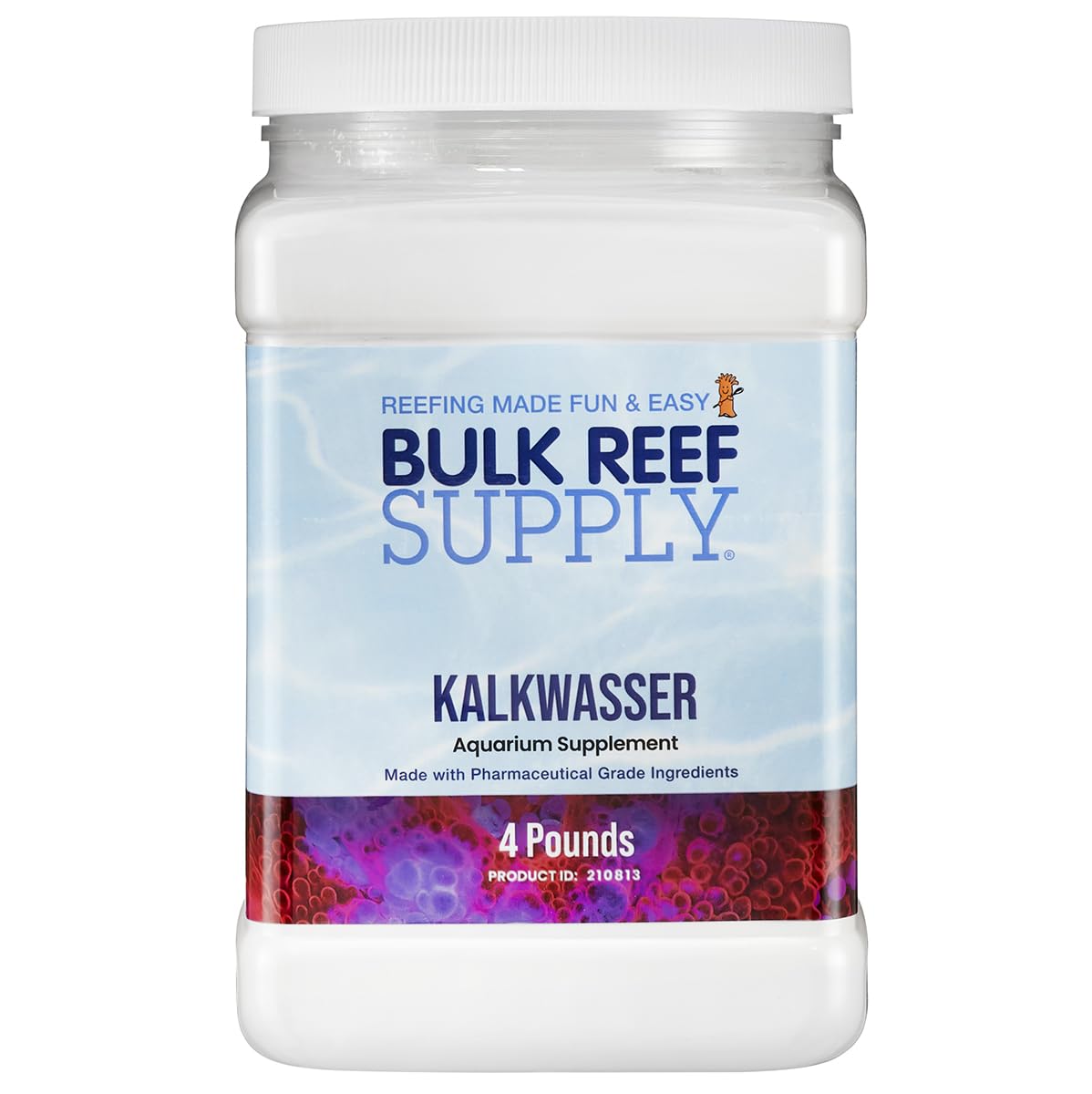
Kalkwasser (calcium hydroxide) is not a standard salt mix—it is a supplemental dosing agent used to raise calcium, alkalinity, and pH simultaneously. This 4-pound container from Bulk Reef Supply is a pure, high-grade powder designed for use in kalk reactors, auto top-off (ATO) reservoirs, or drip systems. When dissolved, saturated kalkwasser provides a balanced dose of calcium and carbonate without introducing other ions.
Experienced reef keepers use this to offset the daily consumption of calcium and alkalinity in mature SPS tanks, often eliminating the need for two-part dosing. Users report that it dissolves more completely than some competing brands, leaving minimal sediment at the bottom of the mixing container. It is also effective at controlling aptasia and other nuisance growth by raising pH locally.
This is a product for intermediate to advanced hobbyists. Newcomers who dose kalkwasser without careful pH monitoring or without accounting for evaporation rates can accidentally overshoot alkalinity. The powder is also caustic when dry—avoid inhalation and skin contact. For reefers who have already dialed in their system’s demand, this 4-pound bag provides a cost-effective long-term dosing solution.
Why we love it
- Delivers balanced calcium and alkalinity in a single dose
- Dissolves thoroughly with minimal waste
- Effective pH booster for tanks with low nighttime pH
Good to know
- Not a standalone salt mix—used for dosing only
- Requires careful pH and alkalinity monitoring
- Caustic powder—use gloves and avoid inhalation
6. Brightwell Aquatics NeoMarine Marine Salt Blend (150-GAL) – B0044TG606
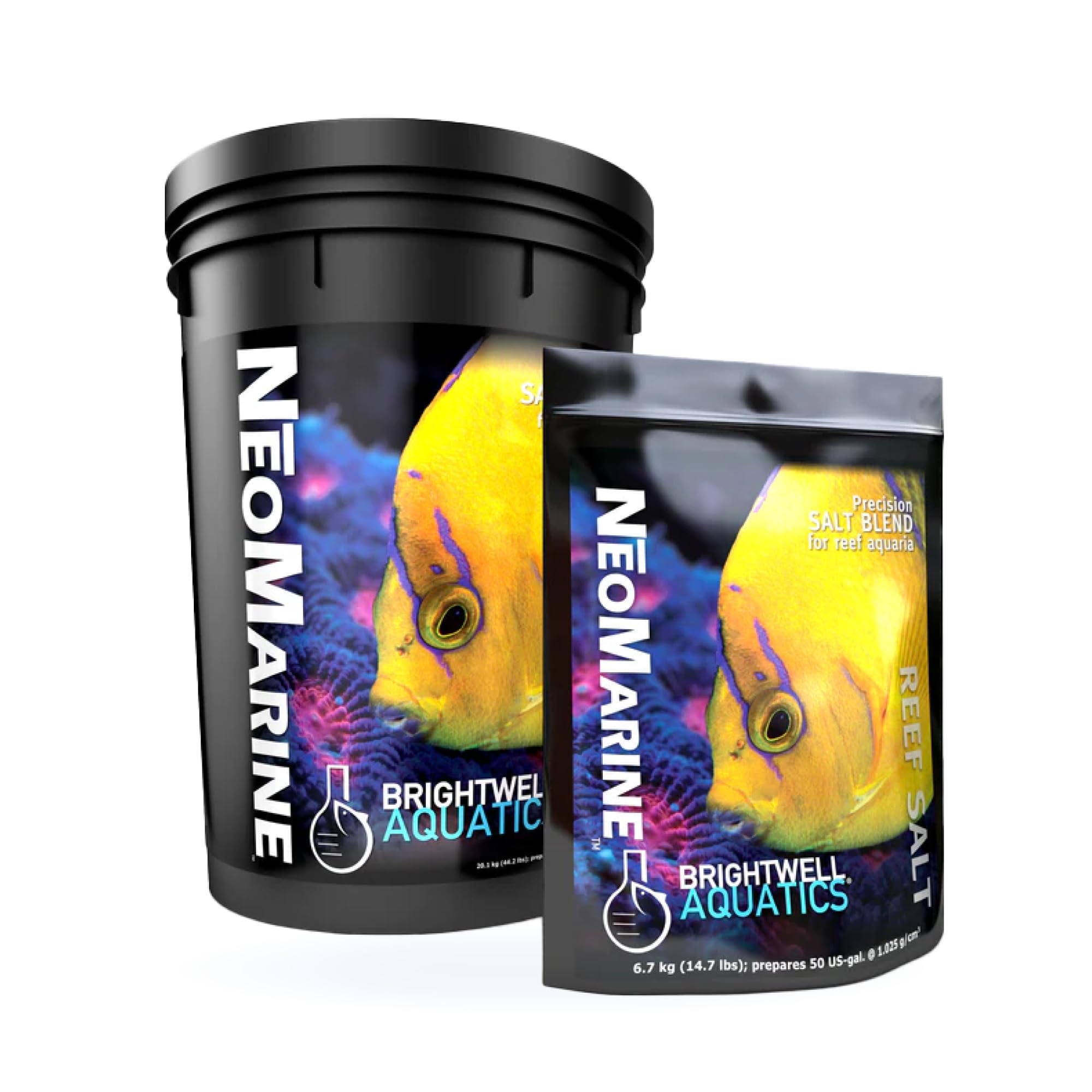
This second listing of Brightwell NeoMarine (ASIN B0044TG606) is fundamentally the same premium formula as product #1 but packaged in a 150-gallon box without an inner bag. The formulation replicates natural seawater ratios using USP, ACS Reagent-grade, and FCC Food grade ingredients, targeting a specific gravity of ~1.025 and a pH of ~8.30 at 7.5 dKH. Regular users across multiple tank setups report that this salt consistently produces stable water parameters without the parameter creep seen in some budget blends.
The manufacturing process emphasizes particle size uniformity, which translates to a dry, homogenous mix that dissolves without clumping when added slowly to vigorously circulating RODI water at 76–78°F. Many owners of 100–400 gallon systems have switched to this salt from European premium brands and noted equal or better SPS color and health at a significant cost savings.
The lack of an inner bag means the entire bucket’s contents are exposed to ambient air each time you open it. Storing the bucket in a low-humidity environment and keeping the lid sealed when not in use is critical to prevent the salt from hardening. If you manage a larger reef system and value precise, repeatable water chemistry, this version delivers identical performance to the more expensive packaging variants.
Why we love it
- Premium USP/ACS-grade ingredients ensure purity
- Consistent parameters batch after batch
- Cost-effective compared to premium European salts
Good to know
- No inner bag—requires humidity-controlled storage
- Heavy bucket over 47 pounds when full
7. Kolar Labs GFO – Phosphate Removal Media (1 lb)

Kolar Labs GFO is a granular ferric oxide media designed specifically for phosphate removal in saltwater and freshwater aquariums. It is not a salt mix—it is a consumable media used in reactors, filter socks, or canister filters to lower PO4 levels that can fuel nuisance algae and inhibit coral calcification. The 1-pound bag is made from high-purity Bayoxide E33 produced by LANXESS in Germany, a recognized standard for phosphate-binding media.
Users running reef tanks with elevated phosphate (0.10–0.25 ppm) report that this GFO drops PO4 to near-zero levels within 24–48 hours when used at a rate of 1.5 cups in a standard reactor. The media has a fine granular consistency that requires a thorough rinse before use to remove dust from shipping. Some aquarists note that it exhausts slightly faster than high-capacity GFO variants, but the lower per-pound price compensates for the replacement frequency.
Because this media is potent, it can strip phosphate too quickly in systems with heavy SPS colonies, potentially causing coral bleaching or pale tissue. It is recommended to start with a smaller amount and gradually increase the media volume while monitoring PO4 with a reliable test kit. For the budget-focused reefer managing nutrient import in a mixed reef or fish-only system, this GFO offers effective phosphate binding at a very competitive cost per pound.
Why we love it
- Produces rapid, measurable phosphate reduction
- Made from German-sourced Bayoxide E33
- Excellent value per pound compared to other GFO brands
Good to know
- Requires thorough rinsing before first use
- Can exhaust faster than high-capacity variants
- Use carefully with SPS tanks to avoid overshooting
FAQ
What is the ideal specific gravity for a mixed reef aquarium?
Can I use a reef-specific salt for a fish-only tank?
Why did my saltwater mix become cloudy after adding the salt?
Final Thoughts: The Verdict
For most reef keepers, the best salt for saltwater aquarium is the Brightwell Aquatics NeoMarine because it delivers USP-grade purity, consistent batch parameters, and a cost-per-gallon that undercuts premium European brands without sacrificing performance. If you want a formula engineered for maximum coral growth acceleration, grab the Red Sea Coral Pro. And for a budget-friendly, high-yield daily salt that mixes effortlessly in fish-only or soft-coral systems, nothing beats the Seachem Vibrant Sea.