
Goats are notoriously picky eaters, yet they’ll waste half a bale of hay if it’s dusty, stemmy, or simply not what they want. The difference between a thriving, glossy-coated herd and a barn full of picky eaters often comes down to one thing: the precise nutritional profile and form of the feed you’re offering. Choosing the wrong mix can lead to urinary calculi in bucks, poor milk production in does, or simply a lot of uneaten, spoiled grain on the barn floor.
I’m Mo Mahin — the founder and writer behind Furric. I’ve spent thousands of hours cross-referencing feed tag analysis, reviewing crude protein percentages against specific life-stage requirements, and correlating owner-reported palatability scores with ingredient sourcing data to separate the truly effective goat feeds from the filler-heavy options.
Whether you’re raising a backyard pygmy or a commercial Boer herd, this guide evaluates the top contenders by their ingredient transparency, fiber content, mineral fortification, and overall value to help you confidently select the best goat feed for your specific herd needs.
How To Choose The Best Goat Feed
Goats are ruminants with specific dietary needs that differ significantly from sheep or cattle. A feed that works for one herd can cause metabolic issues in another if the protein, calcium, and phosphorus ratios don’t align with the goat’s age, sex, and purpose (meat, milk, or fiber).
The Balancing Act of Calcium and Phosphorus
The ideal calcium-to-phosphorus ratio for goats is roughly 2:1. Alfalfa-based feeds are naturally high in calcium, making them excellent for lactating does but potentially problematic for wethers and bucks if not balanced with sufficient phosphorus and ammonium chloride. A feed lacking this balance significantly increases the risk of urinary calculi.
Protein Levels by Life Stage
A 16% crude protein feed is a solid baseline for most adult goats. Growing kids, late-gestation does, and high-producing dairy goats often require 18% protein, while dry does and wethers can maintain condition on 14%. Overfeeding protein to non-producing adults is not only wasteful but can also lead to digestive upset and higher ammonia levels in confinement.
Form Matters: Pellets vs. Whole Grains vs. Hay
Pellets minimize waste because goats can’t selectively sort out the tasty bits. Whole grains require strong teeth and can be sorted, leading to an unbalanced intake if fed as a mix. Straight alfalfa hay is a forage, not a complete grain ration — it lacks the energy density and mineral fortification that a properly formulated feed provides. The best strategy usually combines a high-quality pellet or grain ration with access to good hay.
Quick Comparison
On smaller screens, swipe sideways to see the full table.
| Model | Category | Best For | Key Spec | Amazon |
|---|---|---|---|---|
| Wholesome Harvest Goat Grain | Grain Mix | All-life-stage balanced nutrition | 16% Crude Protein | Amazon |
| Family Farm and Feed Alfalfa Pellets | Pellet | Supplemental forage & protein boost | 5 lbs bag | Amazon |
| Gold Buckle Co Alfalfa Hay | Hay | Palatable forage for picky eaters | 9 lbs box | Amazon |
| Ernst Grain & Livestock Whole Barley | Whole Grain | Weight management & supplement mix | 10 lbs bag | Amazon |
| BUYYAH Wall Mount Hay Rack | Feeder | Reducing hay waste at the barn | 16 Gallon Capacity | Amazon |
In‑Depth Reviews
1. Wholesome Harvest Non-GMO Goat Grain
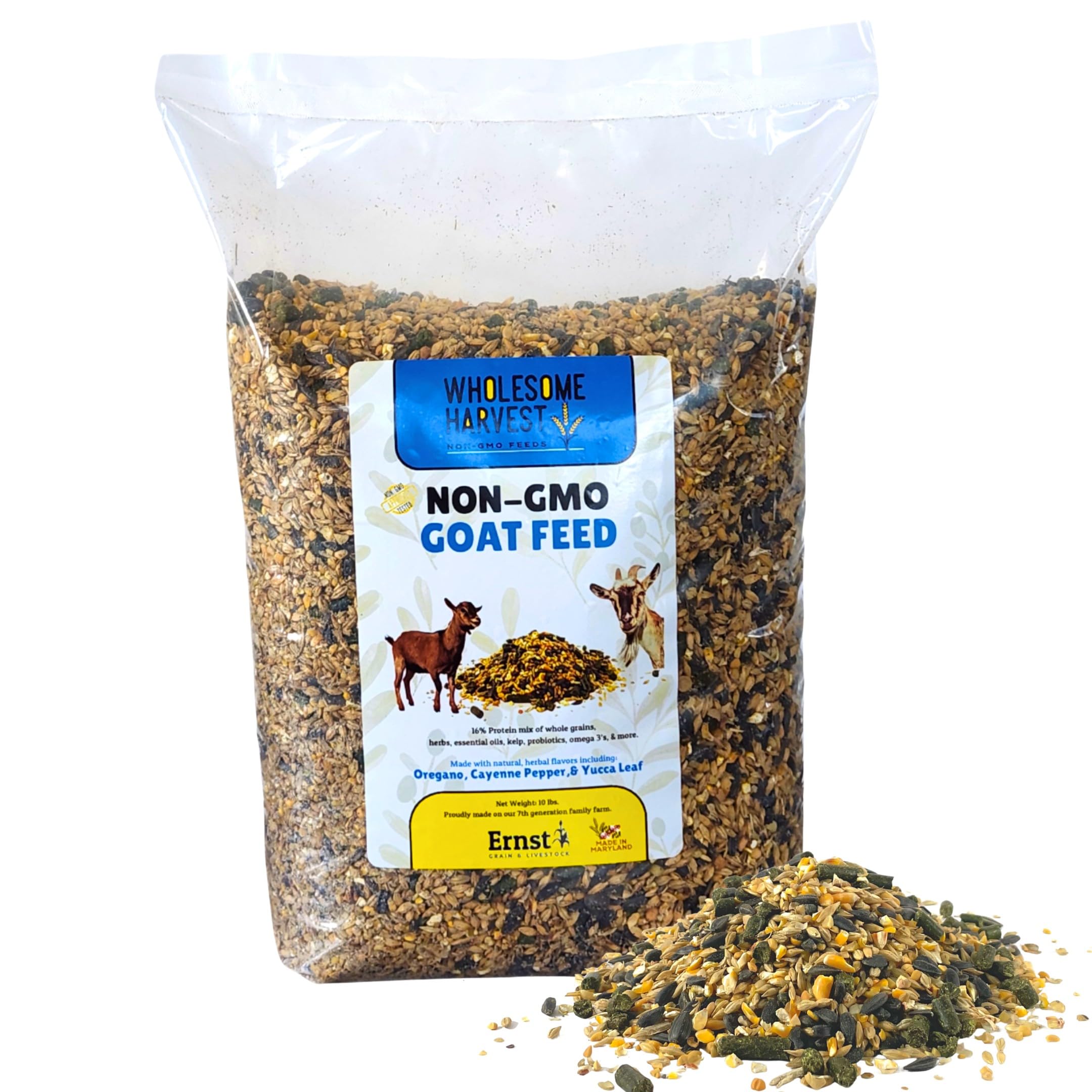
This is the most complete goat feed in the lineup, formulated as a true all-life-stage ration rather than a single-ingredient supplement. At 16% crude protein, it hits the sweet spot for most herds, and the inclusion of probiotics, kelp, and omega-3s goes beyond basic vitamin-mineral premix to actively support rumen health and coat condition. The mix includes whole grains and a pellet component, which offers texture variety but also opens the door to selective eating.
Owner reports highlight a dramatic turnaround for a goat with chronic scours — months of vet treatments resolved within a week of switching to this feed, suggesting the probiotic blend has real efficacy for digestive upset. The paper bag packaging, however, demands careful dry storage; a surprise rain event can wick moisture up from the floor and spoil the bottom layer quickly.
The critical caveat mentioned by several buyers is the apparent lack of ammonium chloride in the formulation. For owners of intact bucks or wethers, this omission raises a legitimate concern about urinary calculi risk over long-term feeding. For does, kids, or mixed herds where grain is only a portion of the diet, this is generally a safe and highly palatable daily ration.
Why we love it
- Probiotics and kelp support digestion and mineral intake
- Goats, chickens, and ducks all reported to enjoy it
- Balanced 16% protein suitable for most life stages
Good to know
- Paper bag requires bone-dry storage conditions
- Lacks ammonium chloride for urinary calculi prevention
- Selective eaters may waste the pellet portion
2. Family Farm and Feed Alfalfa Pellets

These are straight alfalfa pellets — nothing more, nothing less. The product description emphasizes their use for small pets, but the ingredient quality and analysis make them a perfectly viable supplementary feed for goats. Because they are dust-free pellets, there is zero waste from sorting or blowing away, which is a major advantage over loose hay in windy barn conditions.
Several creative owners have reported using these pellets as a nitrogen boost for tomato plants, which underscores the high protein and mineral density of the alfalfa itself. For goat keepers, these are best used as part of a balanced ration rather than a complete feed. They lack the added vitamins, minerals, and ammonium chloride found in a purpose-formulated goat grain, so they should not be the sole feed for bucks or lactating does.
The 5-pound bag size is small, making this a good trial purchase for a single goat or for mixing into a larger grain ration to boost palatability. The pellets are large enough to be easily handled by adult goats but may be a bit hard for very young kids without soaking.
Why we love it
- Dust-free pellets mean zero sorting waste
- High-quality western alfalfa source with natural protein
- Versatile as a feed, treat, or even garden amendment
Good to know
- Not a complete ration — lacks added minerals
- 5-pound bag is small for multiple goats
- No ammonium chloride for urinary health
3. Gold Buckle Co Alfalfa Hay
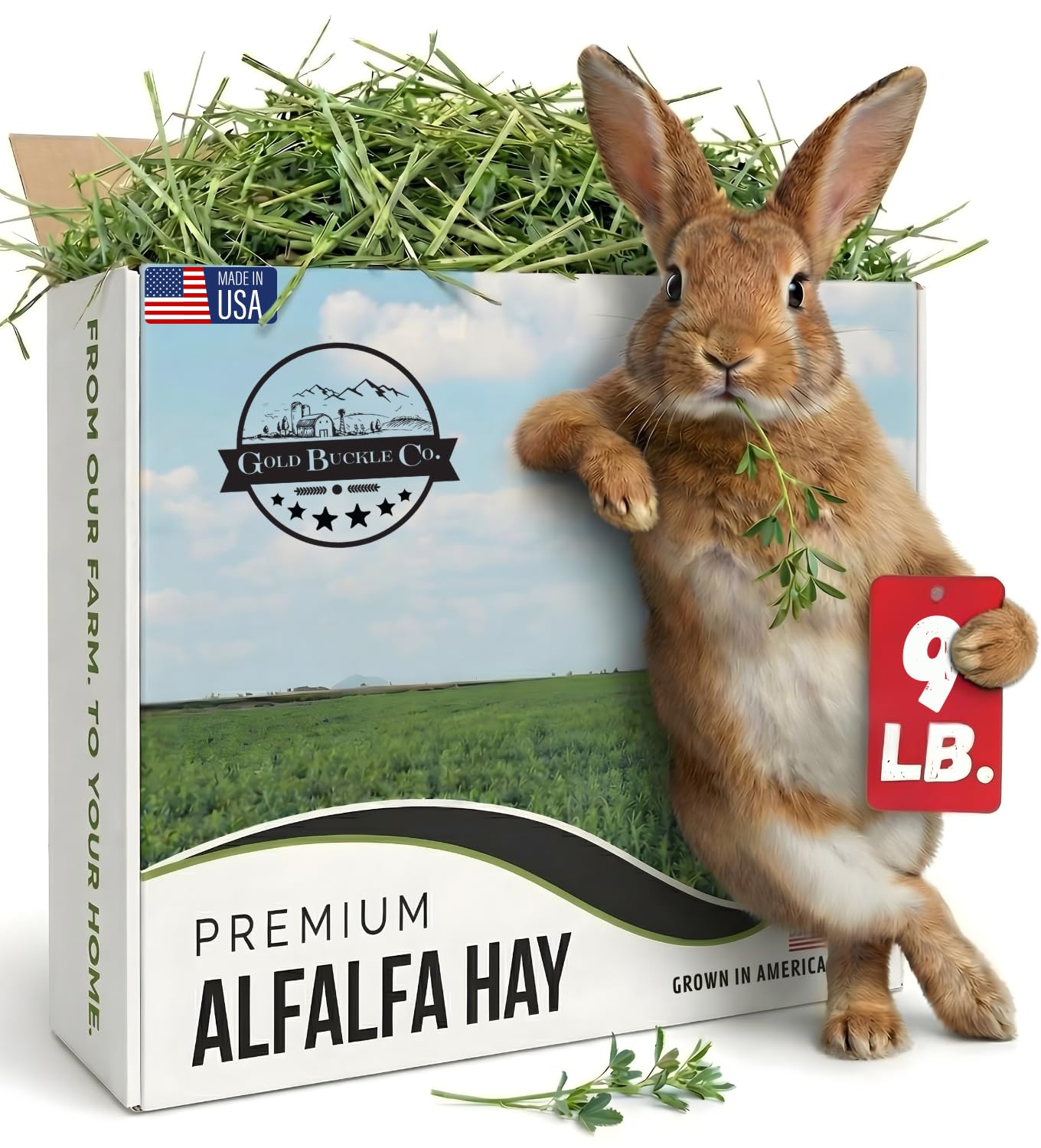
This is the standout hay option for owners whose goats turn their noses up at dusty or stem-heavy bales. Grown in Utah’s high desert, the alfalfa is hand-selected and packed in a carton that preserves moisture and aroma far better than traditional poly-wrapped bales. The freshness is immediately apparent — owners consistently describe the bright green color and strong hay scent that drives even reluctant eaters to clean their feeders.
For goats specifically, this hay provides the high calcium and protein content that supports milk production in does and rapid growth in kids. It is also an excellent source of long-stem fiber, which is essential for proper rumen function and bloat prevention. The 9-pound box is a practical size for owners with one to three goats, as larger herds would need multiple boxes per week or a traditional bale.
Because this is pure hay, it must be paired with a grain ration that provides energy and mineral balance. Owners of bucks should be particularly mindful of the high calcium content and ensure their grain source offsets it with adequate phosphorus. The packaging is convenient, but once opened, the hay should be stored in a dry, sealed container to maintain its moisture content and prevent mold.
Why we love it
- Exceptional freshness with vivid green color and aroma
- Hand-selected from a family farm with 90-year history
- High leaf content reduces woody stem waste
Good to know
- Not a complete ration — must be paired with grain or minerals
- 9-pound box is portioned for small herds only
- High calcium content requires phosphorus balancing for bucks
4. Ernst Grain & Livestock Whole Barley Seeds
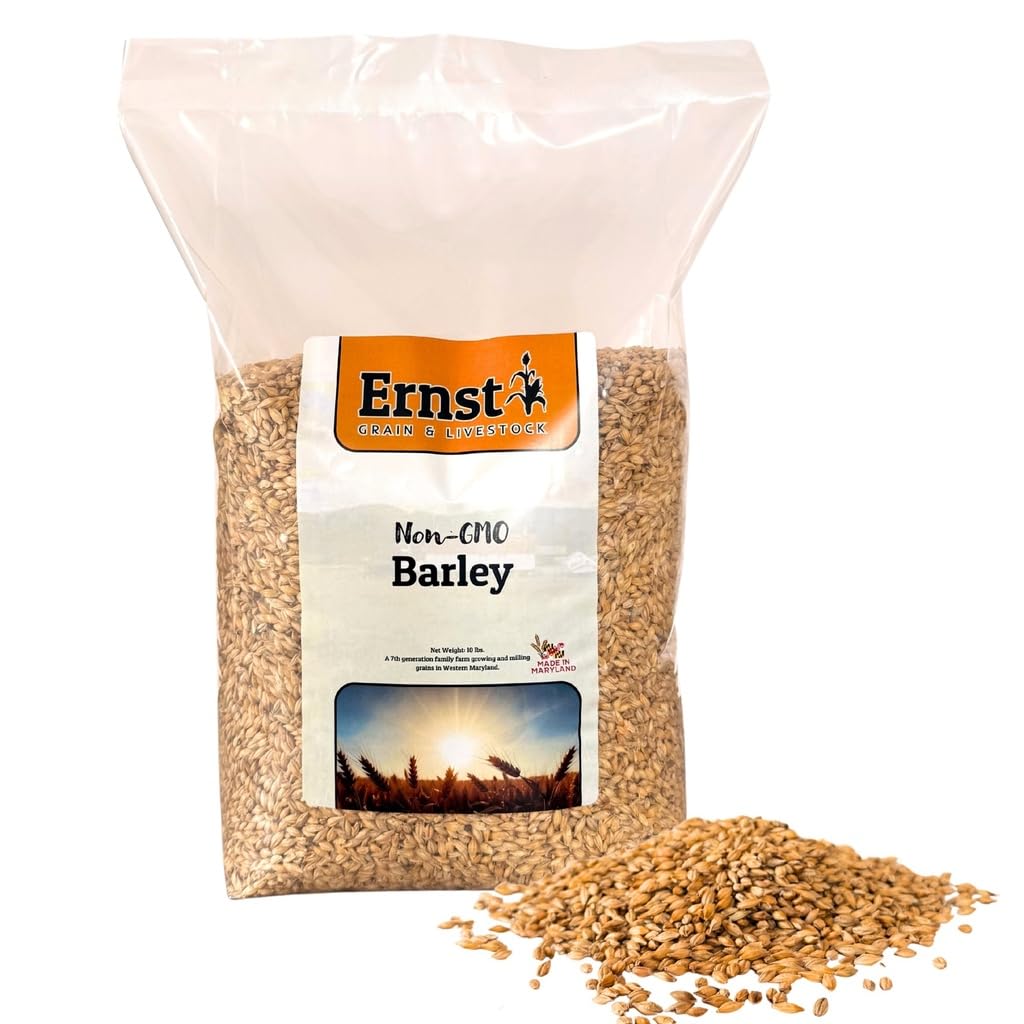
Whole barley is a classic energy grain for ruminants, and this batch from Ernst Grain & Livestock stands out for its cleanliness and consistency. Multiple buyers report a near-total absence of dust, debris, or broken kernels, which is unusual for bulk grain on Amazon. The 10-pound bag is also resealable, making storage easier than a standard woven sack.
For goats, barley is a high-energy, low-protein grain (roughly 12% crude protein), making it suitable for weight maintenance, dry does, or as a cool-weather energy boost. It is not a complete feed — it lacks the mineral fortification, ammonium chloride, and vitamin premix that goats require for long-term health. However, it works well as a mixing grain to dilute a higher-protein pellet or as a base for a custom ration.
One of the most interesting use cases reported by buyers is sprouting this barley for fresh fodder. The high germination rate (nearly 100% in several tests) means it can be soaked and grown into a living forage mat within a week, providing fresh greens during winter months when pasture is unavailable. This makes it a dual-purpose product for owners who want both grain and sprouting capability.
Why we love it
- Exceptionally clean grain with minimal dust or debris
- High germination rate ideal for sprouting fodder
- Resealable bag improves storage convenience
Good to know
- Not a complete ration — requires mineral and vitamin supplementation
- Lower protein content (approx 12%) limits use for growing kids
- Whole barley requires good teeth; older goats may struggle
5. BUYYAH Wall Mount Hay Rack

While not a feed itself, the BUYYAH hay rack is an essential piece of equipment for any goat keeper looking to reduce hay waste. The 27-inch long, 16-gallon capacity unit allows multiple goats to eat simultaneously, which is critical in herds where dominant individuals tend to bully subordinates away from a single feeder. The wall-mount design also keeps hay off the barn floor, dramatically reducing the amount that gets soiled or trampled.
The rack is constructed from carbon steel with a rust-resistant coating, and the multiple-sided openings provide generous access points. However, owner reports regarding assembly quality are mixed — some found the push-button connection pieces difficult to seat correctly, requiring repeated disassembly. The final assembled unit can feel slightly loose unless the user upgrades the included wall anchors with heavier-duty options.
Despite the assembly quirks, owners consistently praise the rack’s ability to separate eating stations and reduce waste. One owner with ten goats noted it works well for their needs even if it doesn’t accommodate all ten at once as advertised. For owners with smaller herds (2-5 goats), this rack offers a significant upgrade in feeding efficiency and hygiene compared to a simple ground pile or single-opening feeder.
Why we love it
- Multiple openings reduce bullying and allow shared access
- Wall-mount design keeps hay off wet, soiled floors
- 16-gallon capacity minimizes refill frequency
Good to know
- Assembly can be finicky with push-button connection issues
- Included wall anchors are lower quality; recommended to upgrade
- Advertised capacity of 5 goats may be optimistic for larger breeds
FAQ
Can I feed whole barley as the only grain for my goats?
Why is ammonium chloride important in goat feed?
What is the difference between alfalfa pellets and alfalfa hay?
Final Thoughts: The Verdict
For most goat owners, the goat feed winner is the Wholesome Harvest 16% Protein Grain because it provides balanced, all-life-stage nutrition with added probiotics and natural ingredients, making it the closest thing to a complete ration in this lineup. If you need a palatable forage supplement for a picky eater or does in milk, the Gold Buckle Co Alfalfa Hay delivers unmatched freshness and leaf content. And for owners wanting to cut down on wasted hay, the BUYYAH Wall Mount Hay Rack is the smartest investment for your barn.