
Every dog owner faces the same gut-wrenching aisle: hundreds of bags and cans labeled “natural,” “premium,” and “veterinarian recommended,” yet one in three dogs still struggles with dull coats, itchy skin, soft stools, or picky eating that turns mealtime into a daily battle. The difference between a food that transforms your dog’s vitality and one that merely fills the bowl often comes down to a single ingredient line and the protein-to-filler ratio.
I’m Mo Mahin — the founder and writer behind Furric. For years, I’ve been analyzing canine nutrition labels, comparing crude protein percentages against actual meat content, studying recall histories across major brands, and aggregating thousands of verified owner experiences to identify which recipes deliver measurable health improvements and which ones just market well.
This guide breaks down five distinct recipes across wet, dry, and variety-pack formats to help you match your dog’s age, size, and sensitivities with the right formula. After evaluating ingredient sourcing, nutritional completeness, and real-world owner satisfaction, these rankings define what truly separates the best from the rest when shopping for your next to worst dog food order.
How To Choose The Best To Worst Dog Food
Not all dog food labels are created equal. Some boast “real meat first” while loading the next five slots with corn, wheat, and unnamed by-products. Others use “grain-free” as a marketing halo while the actual protein content barely clears 25%. To separate a genuinely nutritious recipe from a filler-heavy bag, you need to look past the front-of-bag claims and check three specific areas.
Protein Source and Placement on the Ingredient List
The first ingredient should always name a specific animal protein — deboned salmon, chicken, beef, turkey — not a vague “meat meal” or “poultry by-product.” A named protein as ingredient one signals at least 20–30% actual meat content before processing. If the second ingredient is corn, wheat, soy, or brewer’s rice, the recipe is likely protein-light and carb-heavy, which often leads to soft stools, gas, and a dull coat.
Life Stage Formulation and Guaranteed Analysis
Adult maintenance formulas typically need 18–25% crude protein and 8–12% crude fat. Senior dogs benefit from slightly higher protein (to preserve muscle mass) with moderate fat and added glucosamine or omega-3s for joint and brain function. Puppy recipes require at least 25–30% protein and higher calcium for bone growth. Feeding an all-life-stages food to a senior dog may overshoot calories while undershooting targeted joint support.
Wet vs. Dry: Moisture Content and Palatability Trade-Offs
Wet food delivers 75–85% moisture, which supports hydration and kidney health, especially for seniors or dogs that don’t drink enough. Dry kibble is more calorie-dense per ounce and better for dental scraping, but it can be lower in palatability for picky eaters. A mid-range strategy — using wet food as a topper over quality dry kibble — combines hydration benefits with the convenience and cost-efficiency of dry.
Quick Comparison
On smaller screens, swipe sideways to see the full table.
| Model | Category | Best For | Key Spec | Amazon |
|---|---|---|---|---|
| Hill’s Science Diet Adult 7+ Senior Vitality Wet | Senior Wet | Senior dogs needing brain & joint support | 12.5 oz cans, omega-3/6, veterinarian #1 brand | Amazon |
| Merrick Grain Free Wet Variety Pack | Grain-Free Wet | Dogs bored by one flavor, grain-sensitive | 12.7 oz cans, real deboned meat #1, 3 recipes | Amazon |
| Nutrish Salmon Dry Dog Food | Dry Kibble | All life stages, skin & coat health | 26 lb bag, 21% protein, omega-3/6 fatty acids | Amazon |
| Taste of the Wild Pacific Stream Wet | Grain-Free Wet | Allergy-prone dogs, picky eaters | 13.2 oz cans, salmon #1, grain-free, probiotics | Amazon |
| Royal Canin Adult Pate in Gel Wet (Labeled as Levi’s – Royal Canin) | Veterinary Wet | Sensitive stomachs, senior appetite recovery | 13 oz cans, pate in gel, B vitamins, fish oil | Amazon |
In‑Depth Reviews
1. Hill’s Science Diet Adult 7+ Senior Vitality Wet Dog Food

The Hill’s Science Diet Senior Vitality formula is the only recipe on this list specifically engineered for dogs aged 7 and up, with a proprietary blend designed to support interaction energy, brain function, and vitality. The 12.5-ounce cans deliver a stew texture with real chicken and vegetables, providing 75–80% moisture that supports kidney health and hydration in aging dogs. Veterinarians recommend Hill’s Pet Nutrition more than any other brand, and the 12-pack format gives a full month of topper portions for a medium-sized senior dog.
Owner reports consistently highlight appetite revival in senior dogs that had become picky or lethargic. Multiple verified reviews describe dogs from 12 to 15 years old returning to eagerly eating meals, regaining interest in dry kibble when the stew is used as a topper, and showing improved coat shine thanks to the omega-3 and omega-6 fatty acid profile. The chicken and vegetable stew also scores high on palatability for small-breed seniors, with the chunks being soft enough for aging teeth.
The main trade-off is cost-per-ounce relative to dry kibble — this is a premium wet formula aimed at targeted senior nutrition rather than budget feeding. For owners of young adult dogs, the senior-specific fortification (higher B vitamins, glucosamine precursors, and brain-supporting antioxidants) is unnecessary, making a general adult formula a better value. But for dogs 7 and older, the measurable vitality improvement justifies the premium tier position.
Why we love it
- Veterinarian #1 recommended brand; trusted for senior nutrition
- Proprietary vitality blend improves energy and brain function in older dogs
- High-moisture stew texture helps hydration and is soft on aging teeth
Good to know
- Not suitable for puppies or young adult dogs needing different nutrient profiles
- Premium price-per-ounce compared to standard adult wet formulas
- Single flavor (Chicken & Vegetable Stew) may not suit dogs with poultry sensitivities
2. Merrick Grain Free Wet Dog Food Variety Pack
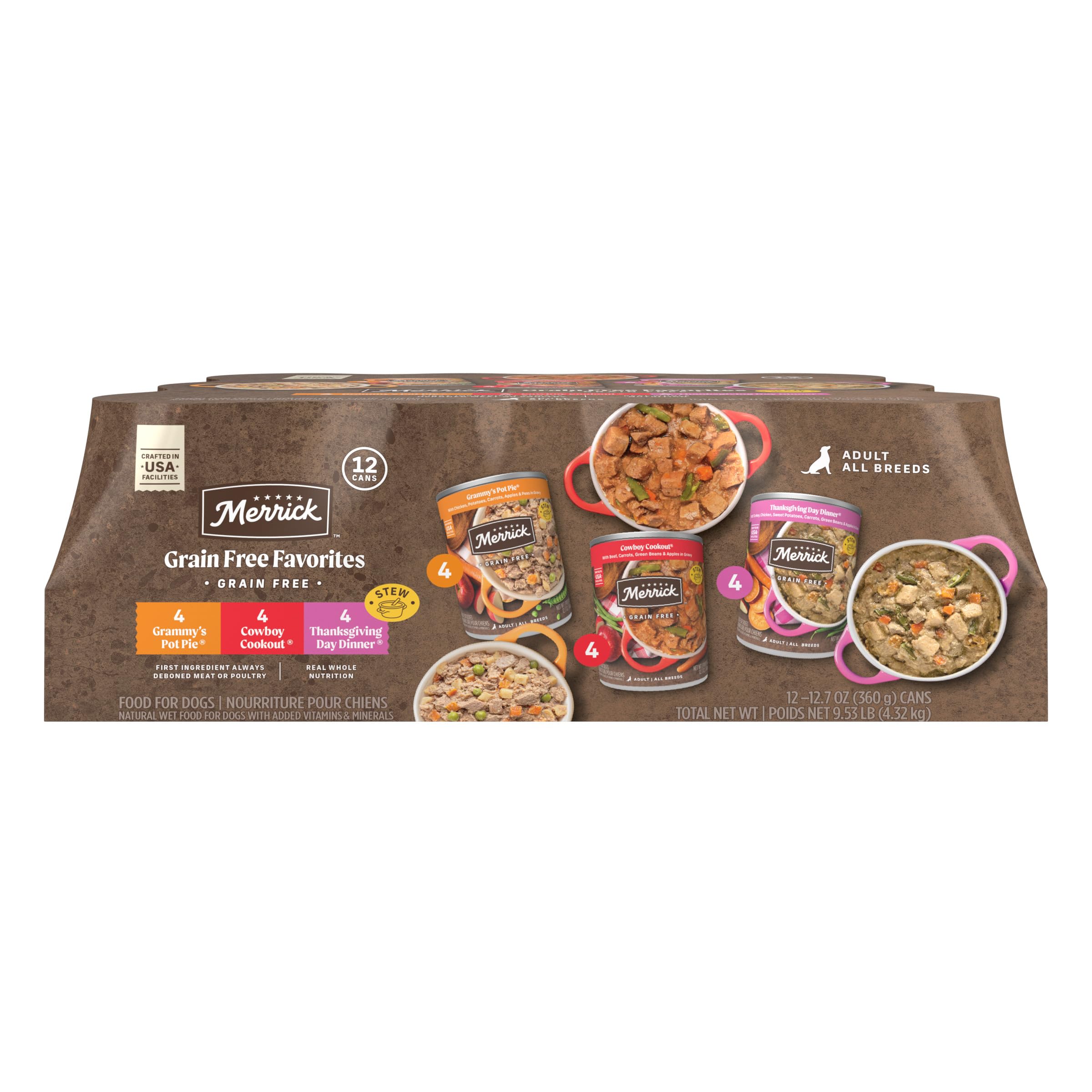
Merrick’s Grain Free Wet Variety Pack delivers a rotating menu of three recipes — Grammy’s Pot Pie (chicken), Thanksgiving Day Dinner (turkey), and Cowboy Cookout (beef) — all with real deboned meat as the first ingredient. Each 12.7-ounce can contains chunks in gravy, providing 78% moisture and a texture that works equally well as a standalone meal or a topper over dry kibble. The grain-free formulation eliminates corn, wheat, and soy, making this a strong choice for dogs with confirmed grain sensitivities.
The variety pack format helps combat flavor fatigue, a common issue with single-protein wet foods. Owners of small to medium dogs report getting 3–4 meals per can, stretching the 12-pack into a six-week supply. The ingredient panel lists named fruits and vegetables — soft carrots, green beans, apples — rather than vague “vegetable fiber.” Merrick also boasts no recall history on these core recipes, which reassures owners concerned about food safety consistency.
On the downside, some owners report packaging damage during shipping — cans arriving dented or with burst seams, which compromises the sealed freshness. The variety pack also lacks a single-protein option, so dogs with a specific poultry or beef allergy may react to one of the three recipes. For dogs that tolerate all three proteins, this is a high-quality rotation that avoids the boredom of eating the same flavor twice a day for months.
Why we love it
- Three distinct grain-free recipes prevent flavor boredom
- Real deboned meat (#1 ingredient) across all recipes
- Clean ingredient panel with named fruits and vegetables, no recalls on these recipes
Good to know
- Variety pack means no single-protein option for dogs with specific allergies
- Packaging damage during shipping reported by multiple buyers
- Chunks-in-gravy texture may be too rich for dogs with very sensitive stomachs
3. Nutrish Salmon Dry Dog Food, 26 Pound Bag
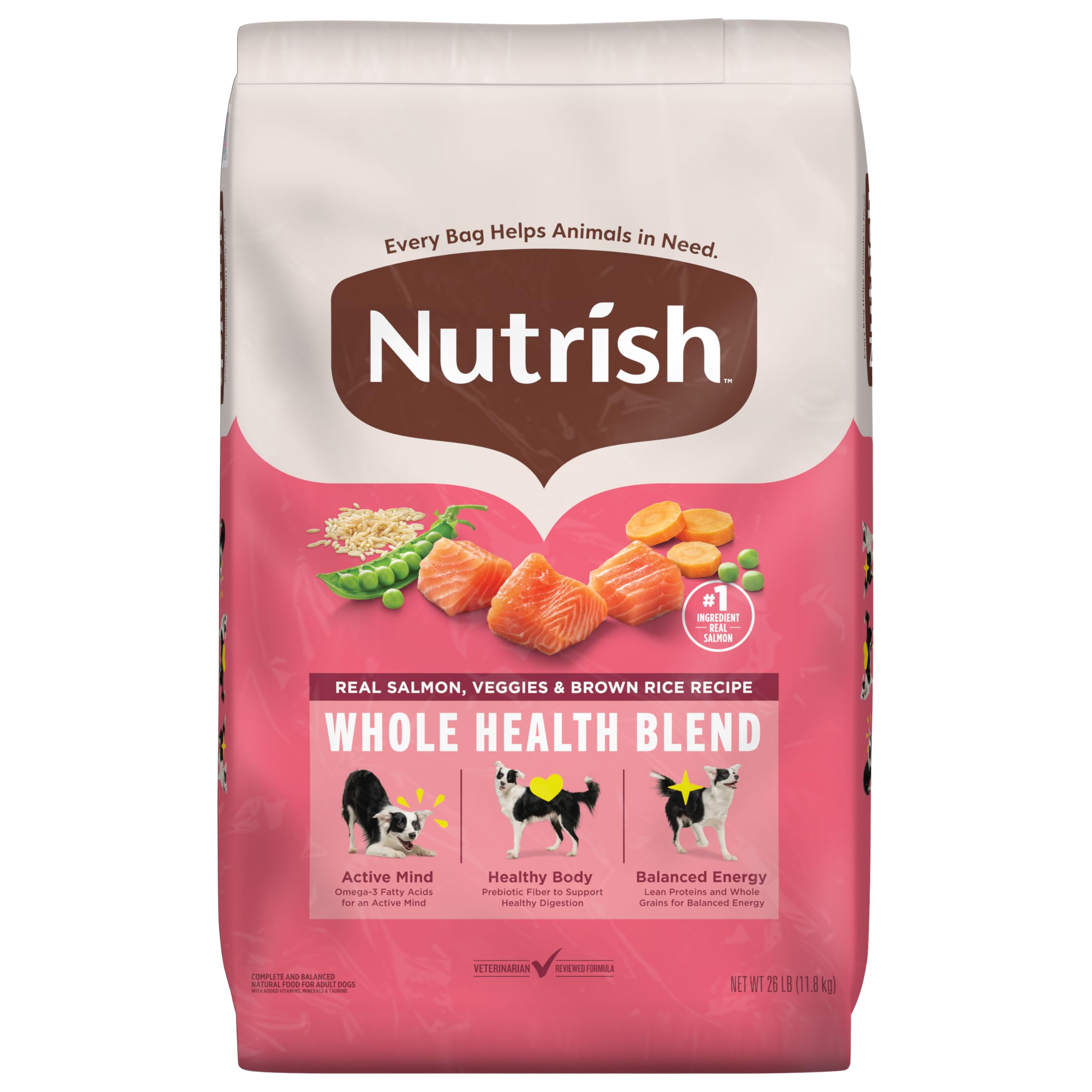
The Nutrish Salmon Dry Dog Food delivers a mid-range tier with solid nutritional fundamentals: real salmon as the first ingredient, a 26-pound bag size that feeds a medium dog for roughly six weeks, and a guaranteed analysis of 21% crude protein and 12% crude fat. The inclusion of brown rice and veggies provides digestible carbohydrates without the fillers found in budget kibbles, while omega-3 and omega-6 fatty acids support skin and coat health — a claim backed by multiple verified reviews noting shinier coats and reduced shedding within three weeks of switching.
This formula is labeled for all life stages, which adds flexibility for multi-dog households with different ages. The kibble size falls into a medium granule range that works for both small and large breeds, though very small dogs (under 10 lbs) may struggle with the piece size. The Nutrish brand supports The Rachael Ray Foundation with every purchase, which resonates with owners who prioritize charitable contribution as part of their buying decision. The food produces minimal gas and vomiting according to owner reports, suggesting good digestibility for dogs without severe sensitivities.
Where this option falls short is ingredient specificity. The formula includes “brewers rice” and “whole grain brown rice” in the top seven ingredients, which pushes the carbohydrate content higher than protein-focused diets. For owners seeking a low-carb or grain-free diet, this bag does not qualify. Additionally, the 26-pound bag, while cost-efficient per pound, requires proper airtight storage to prevent staleness before the bag is finished, especially in humid climates.
Why we love it
- Real salmon #1 ingredient supports skin and coat health with omega-3/6
- All life stages formulation works for multi-age households
- Charitable contribution component adds ethical buying value
Good to know
- Brewers rice and brown rice are top ingredients, raising carb content
- Not grain-free — unsuitable for dogs with confirmed grain allergies
- Kibble size may be too large for very small breeds under 10 pounds
4. Taste of the Wild Pacific Stream Wet Dog Food

The Taste of the Wild Pacific Stream recipe uses real salmon as its single protein source, flanked by a grain-free formula that omits chicken meal — a common allergen trigger. Each 13.2-ounce can delivers salmon in gravy with added fruits and vegetables (peas, sweet potatoes, blueberries, raspberries) that provide antioxidant support and fiber for digestive regularity. The inclusion of proprietary probiotics helps maintain healthy gut flora, which is particularly beneficial for dogs transitioning from low-quality kibble or recovering from digestive upset.
Owner reports are some of the strongest on this list: verified reviews describe resolution of seizures in a Yellow Lab and complete clearance of skin allergies in a Black Lab after switching from premium brands like Blue Buffalo and Orijen. The wet food texture — meat chunks in a rich gravy — is highly palatable even for picky eaters. The brand is family-owned, manufactured in the USA, and priced lower than many comparable grain-free wet foods, making it accessible for owners managing chronic allergies on a tighter monthly budget.
The primary limitation is cost-per-feeding volume for large breeds. A 60–70 lb German Shepherd requires roughly two cans per day as a primary food source, bringing monthly cost to ~ for wet alone. Owners of large dogs often pair this wet formula with Taste of the Wild’s dry kibble (High Prairie) to extend value while maintaining the novel protein and grain-free benefits. The recipe is also single-flavor only, so dogs that tire of salmon will need a different product entirely.
Why we love it
- Single novel protein (salmon) helps resolve common allergies and skin issues
- Includes probiotics, antioxidants from real fruits, and no chicken meal
- Family-owned USA brand with strong price-to-quality ratio in grain-free wet
Good to know
- Single-flavor only — rotation needed for dogs that get bored
- Large breed feeding cost ~/month if used as primary food
- Grain-free formula may not be necessary for dogs without confirmed grain sensitivity
5. Royal Canin Adult Pate in Gel Wet Dog Food

The Royal Canin Adult Pate in Gel formula is formulated for adult dogs of all sizes (at least 10 months old) and features a pate texture suspended in gel that provides a smooth, easy-to-digest consistency. The recipe includes a B vitamin complex (biotin, niacin, riboflavin) targeting skin and coat health, along with zinc proteinate and fish oil for additional skin barrier support. The highly palatable loaf-style meal is designed to appeal even to dogs that have lost interest in eating — a common challenge with aging or medication-affected dogs.
Customer reports on this formula are remarkable for senior appetite recovery: a verified review describes a 15-year-old arthritic dog that regained full appetite, energy, and enthusiasm for meals after switching to this pate. Another owner of a 14-year-old Shi-Poo reported resolution of chronic skin issues, reduced stiffness, and increased social behavior within three weeks. The pate-in-gel texture requires no chewing, making it suitable for dogs with dental pain or missing teeth, and it can be gently warmed to amplify aroma for picky eaters.
The trade-off is price — this is a premium veterinary-tier formula that costs substantially more per ounce than typical grocery-store wet food. The recipe also uses chicken as its primary protein, which is a common allergen, and the pate texture may not appeal to dogs accustomed to chunks in gravy. For owners whose dogs are healthy, young, and eating well on a standard adult formula, the premium cost is hard to justify. But for senior dogs facing appetite decline or skin issues, this formula has proven results that cheaper alternatives rarely match.
Why we love it
- Proven appetite revival in senior dogs (15-year-old case reports)
- Pate-in-gel texture is easy to eat for dogs with dental issues
- B vitamin complex and fish oil support skin and coat health effectively
Good to know
- Premium price-per-ounce compared to standard adult wet formulas
- Chicken protein may trigger allergies in sensitive dogs
- Pate texture less appealing to dogs used to chunks or gravy formats
FAQ
Is grain-free dog food better for all dogs or just those with allergies?
How do I calculate the true cost-per-day of wet versus dry dog food?
What does “limited ingredient diet” actually mean on a dog food label?
Can I mix wet and dry dog food from different brands in the same bowl?
Final Thoughts: The Verdict
For most owners seeking a balanced, veterinarian-trusted recipe, the to worst dog food winner is the Hill’s Science Diet Adult 7+ Senior Vitality Wet Dog Food because it delivers targeted senior nutrition backed by the #1 veterinary recommendation, measurable vitality improvements, and a safety record that minimizes dietary guesswork for aging dogs. If you want flavor rotation and grain-free ingredients without recalls, grab the Merrick Grain Free Wet Variety Pack. And for budget-conscious owners managing allergies with a single novel protein, nothing beats the Taste of the Wild Pacific Stream Wet Dog Food.