
A pile of husks under the feeder, weeds sprouting where they should not, and birds that seem to peck through the mix only to leave the filler behind — that is the reality of low-quality wild bird feed. The right blend does not just attract more species; it changes the entire experience of backyard birding by eliminating mess, reducing waste, and delivering energy-dense kernels that cardinals, finches, chickadees, and woodpeckers actually consume completely.
I’m Mo Mahin — the founder and writer behind Furric. I have spent thousands of hours cross-referencing ingredient profiles, oil content percentages, and kernel-to-shell ratios across dozens of seed blends to understand exactly what separates a feeder-filler from a genuine nutritional offering.
After evaluating oil content, waste levels, species appeal, and feeder compatibility across the top contenders, I have narrowed the field to the five blends that deliver the most value for anyone searching for the best wild bird feed on the market today.
How To Choose The Best Wild Bird Feed
Bird feed is not a commodity — the nutritional profile, kernel integrity, and presence of filler ingredients directly dictate which birds visit, how much waste accumulates under your feeder, and how often you need to refill. Understanding three core factors will prevent the frustration of a feeder that only attracts starlings and squirrels.
Oil Content and Species Appeal
Black oil sunflower seeds contain roughly 40 percent more oil per kernel than striped sunflower seeds, making them the single most effective base ingredient for attracting a wide range of songbirds. Finches, chickadees, nuthatches, and cardinals prioritize high-fat seeds because the energy density supports their metabolism, especially during colder months. Blends that rely on sunflower hearts or hulled kernels remove the shell-splitting work entirely, which appeals to smaller-beaked birds like goldfinches and pine siskins that struggle with tougher husks.
Waste Factor and Filler Content
Standard economy blends often include milo, cracked corn, and red millet — ingredients that do not naturally appeal to most backyard songbirds. These fillers sit in the feeder, rot in the tray, or get kicked to the ground where they germinate into weeds. No-mess blends, such as shelled sunflower hearts or suet-and-seed combinations, eliminate the husk debris entirely. The edible portion is 100 percent consumable, meaning ground-feeding doves and juncos will clean up what falls without leaving a sprouted mess.
Kernel Integrity and Processing Method
Whole sunflower hearts that arrive intact rather than broken into dusty fragments produce less fines at the bottom of the feeder bag. Dusty or broken hearts clog feeder ports and force birds to sift through powder to find edible pieces. Vacuum-cleaned products remove the chaff and lightweight debris that would otherwise blow across your yard. For in-shell options, a fresh, plump kernel that has not shrunk inside the shell indicates the seed was stored properly and will deliver the fat content birds seek.
Quick Comparison
On smaller screens, swipe sideways to see the full table.
| Model | Category | Best For | Key Spec | Amazon |
|---|---|---|---|---|
| Kaytee Seed & Suet No Mess | No-Mess Blend | Attracting woodpeckers & cardinals | 10 lbs, 100% edible nuggets | Amazon |
| Happy Wings Black Oil Sunflower | Single Ingredient | Clean feeding on patios | 5 lbs, no-grow formulation | Amazon |
| Valley Splendor Songbird Melody | Premium Mix | Winter energy & variety | 7 lbs, vitamin-enriched blend | Amazon |
| Valley Farms Sunflower Hearts | Shelled Hearts | Zero-waste feeding | 4 lbs, vacuum-cleaned whole hearts | Amazon |
| Old Potters Black Oil Sunflower | In-Shell Premium | Non-GMO, USA-grown | 12 lbs, small-farm sourced | Amazon |
In‑Depth Reviews
1. Kaytee Seed & Suet No Mess Blend Blueberry Flavor 10 Pounds

Kaytee has engineered this blend around a simple promise — every nugget in the bag is 100 percent edible, meaning nothing is left behind as a shell hull or inedible filler. The suet nuggets carry a blueberry flavor that seems to drive cardinals, woodpeckers, and chickadees into a feeding frenzy that reviewers describe as requiring a refill every other day. Independent feeding trials cited by the manufacturer indicate this blend attracts three times more woodpeckers than black oil sunflower alone, which makes it a targeted solution for anyone hoping to see downy, hairy, or red-bellied woodpeckers regularly.
The 10-pound bag size strikes a practical balance between refill frequency and storage constraints, and the mix works equally well in tube feeders, hopper feeders, and open platform trays. Multiple verified buyers on third-floor apartment balconies report that the no-mess claim holds up — no husks accumulating on patios, no weed sprouts from spilled seeds. The blueberry scent is noticeable out of the bag but does not attract wasps or ants in the way sugary feeders might.
One limitation to note is the bag size itself. Several reviewers noted that the bag is physically smaller than they expected visually because the suet nuggets are dense and compact compared to fluffy seed mixtures. That density, however, translates to high caloric value per scoop, so birds need less volume to feel satiated. This is the most versatile, low-mess option for anyone maintaining multiple feeder types.
Why we love it
- No shell hulls or inedible waste on the ground
- Attracts woodpeckers at triple the rate of standard sunflower
- Works across tube, hopper, and platform feeders
Good to know
- Dense nuggets mean bag looks smaller than 10 lbs suggests
- Blueberry flavor may not appeal to every species equally
2. Happy Wings Black Oil Sunflower Seeds – 5 lb
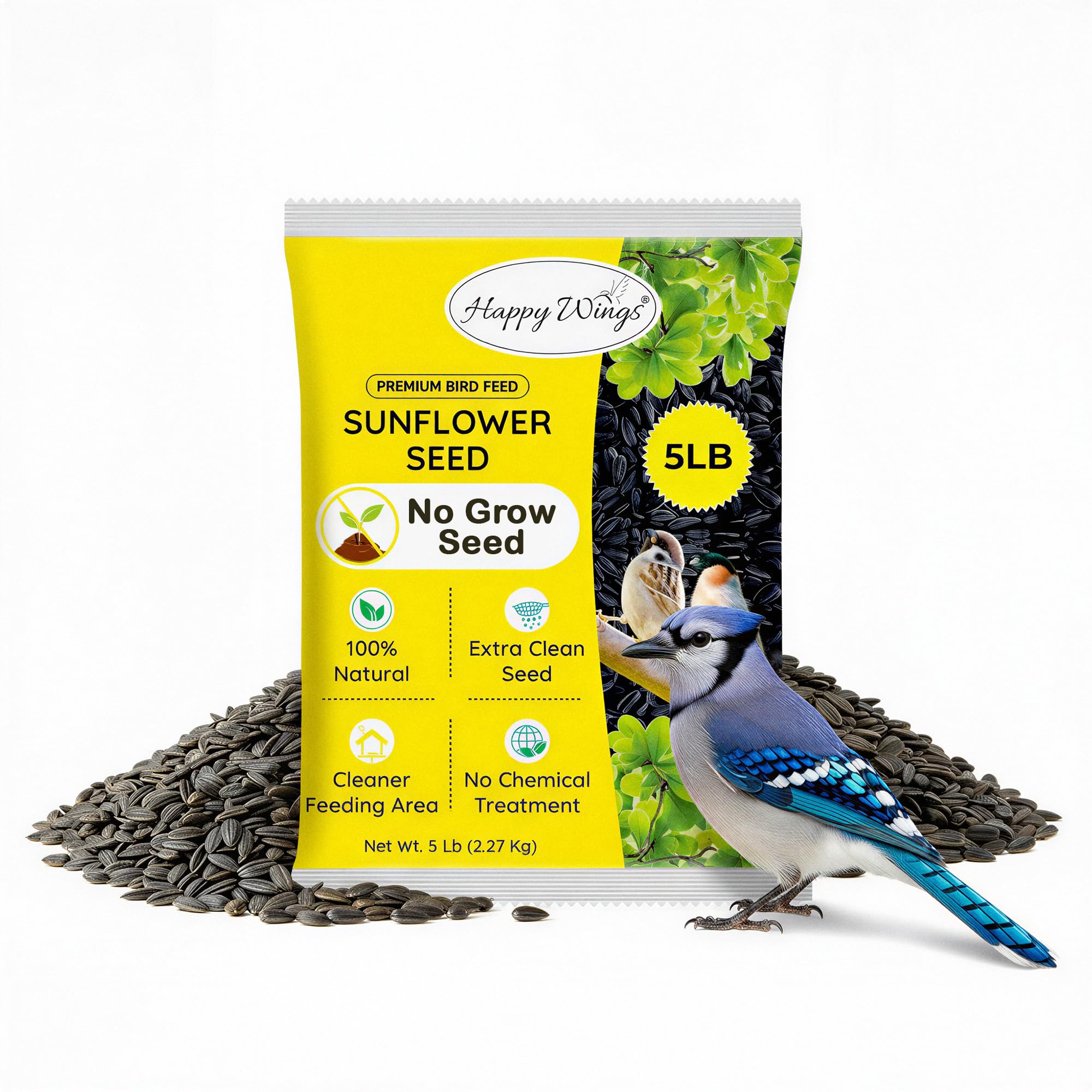
Happy Wings delivers a straightforward single-ingredient offering — black oil sunflower seeds — that sidesteps the filler problem entirely. The no-grow formulation is processed to minimize seed viability, which means the few kernels that get knocked to the ground will not sprout into sunflowers under your feeder. This is a meaningful advantage for anyone with a manicured lawn or a feeder positioned over a patio or deck that cannot tolerate volunteer plants.
The oil content in these seeds is high enough that finches, cardinals, and chickadees visit consistently, and the 5-pound bag size is ideal for first-time buyers who want to test a blend before committing to a larger volume. The seeds are produced in USDA- and BRC-GS-approved facilities, and the Wild Bird Feeding Institute standards referenced by the manufacturer suggest a level of quality control that budget-oriented economy brands typically skip. Reviewers specifically praise the cleanliness of the feeding area afterward.
One trade-off is the smaller kernel size compared to some premium black oil seeds. A few reviewers noted the seeds are slightly smaller than what they were used to, but the birds did not seem to discriminate — the feeders emptied just as fast. If your priority is a simple, high-oil seed with no filler and no lawn cleanup, this 5-pound bag is the most economical way to achieve that.
Why we love it
- No-grow treatment prevents weeds under the feeder
- Single ingredient eliminates picky bird rejection
- Produces little mess compared to economy mixes
Good to know
- Seeds are slightly smaller than premium brands
- 5-pound bag depletes quickly in busy yards
3. Valley Splendor Songbird Melody 7 Pounds
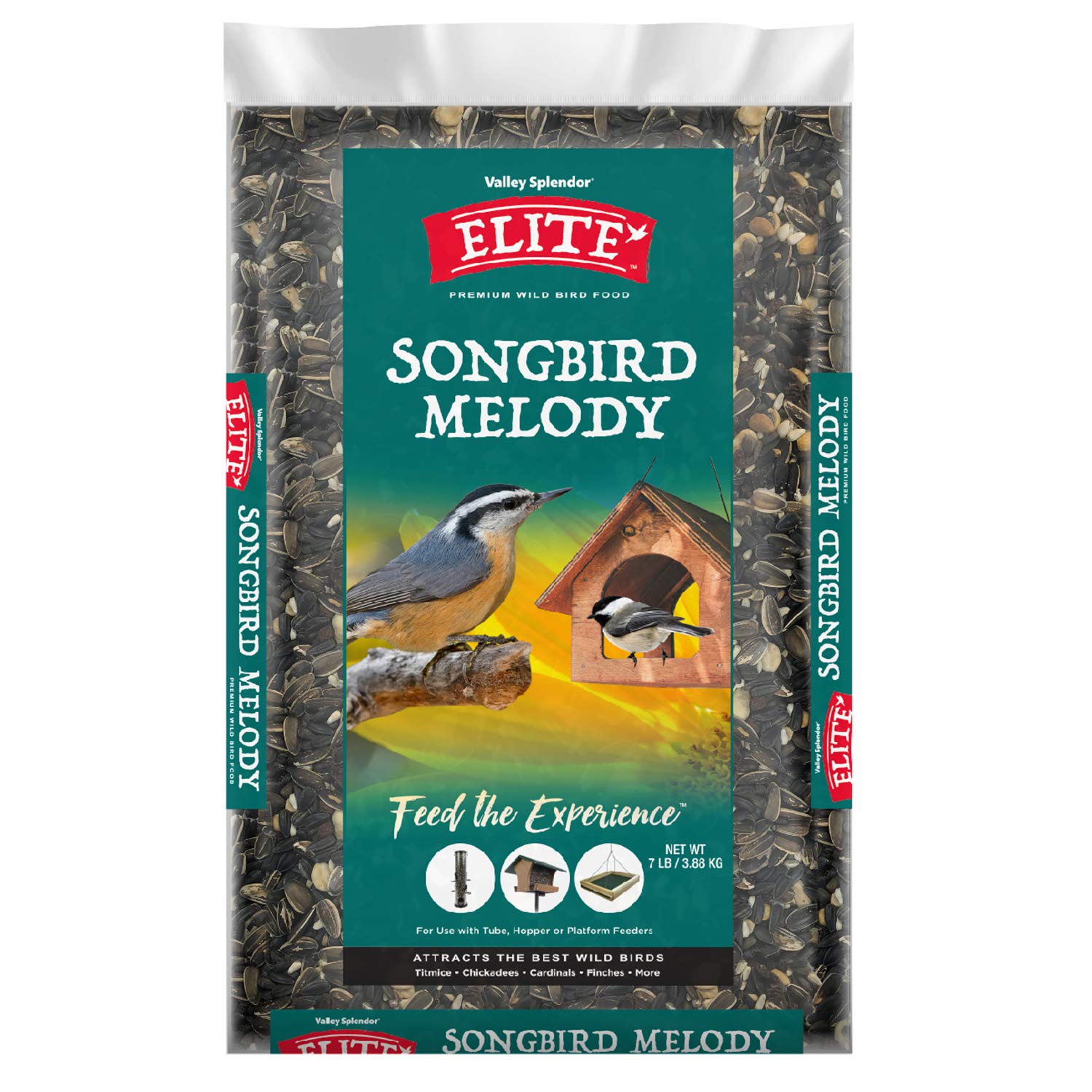
Songbird Melody is built around a five-ingredient matrix — black oil sunflower seeds, safflower seeds, peanuts, striped sunflower seeds, and raisins — that provides both high protein and high fat content. The addition of raisins introduces a sugar-carbohydrate element that few other blends offer, and birds seem to target these pieces first, according to buyer reports. The berry scent is a deliberate olfactory attractant designed to pull birds from a wider radius, and reviewers consistently note that a diverse set of species appears within days of filling the feeder.
The vitamin A and D enrichment is a distinguishing feature for this blend. Vitamin A supports feather development and immune function; vitamin D facilitates calcium absorption for strong eggshells during breeding season. For those who feed through winter and into spring nesting periods, this added supplementation bridges a nutritional gap that straight sunflower seeds cannot cover. The 7-pound bag is moderately sized and works best in hopper feeders where the larger components like peanuts and raisins do not jam the ports.
The primary drawback is the mess factor. Unlike shelled or no-mess blends, the mixture includes in-shell striped and black oil seeds, which means birds must crack open the hulls and drop them. Reviewers report that the ground under the feeder accumulates shells, though many note that ground-feeding birds and squirrels consume the dropped pieces quickly. If your feeder is on a lawn, this is manageable; if it is on a clean patio, you may prefer a no-mess alternative.
Why we love it
- Vitamin-enriched formula supports feather health and nesting
- Raisins and peanuts add dietary variety birds seek
- Berry scent acts as an additional attractant
Good to know
- Shelled seeds create hull debris under the feeder
- Larger pieces may clog narrow tube feeder ports
4. Valley Farms Whole Sunflower Hearts for Birds 4 LBS
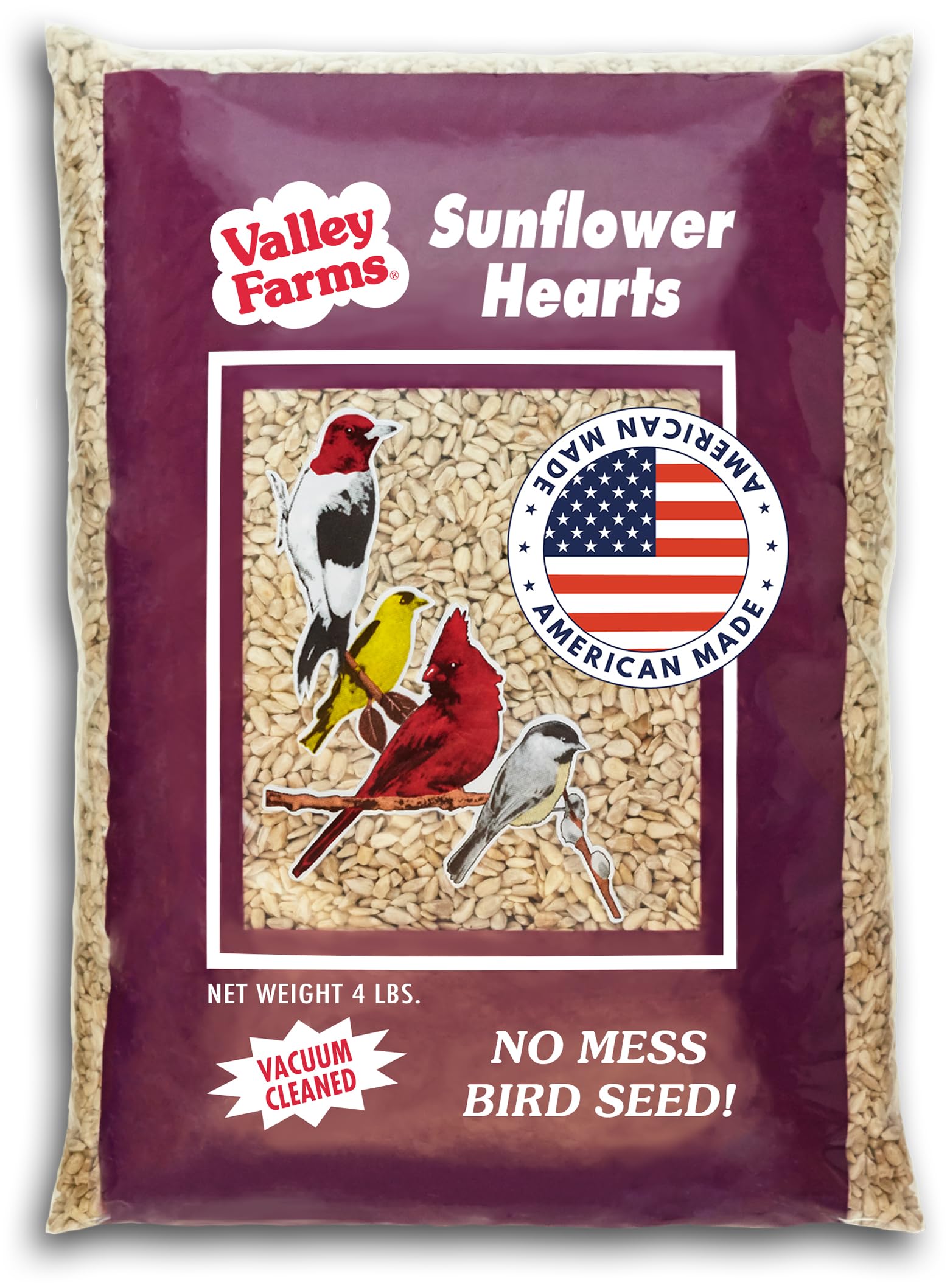
Valley Farms has positioned these sunflower hearts as the cleanest option available, and the specifications back that claim. Every kernel is vacuum-cleaned to remove dust, fines, and broken fragments, then inspected to ensure the hearts arrive whole rather than shattered into the powdery residue that clogs feeder ports. For anyone who has dealt with a tube feeder that stops dispensing because broken sunflower hearts have gummed up the mechanism, this product solves that frustration directly by delivering intact kernels that flow freely.
The 4-pound bag is smaller than the competition, but the value proposition lies in the zero-waste nature of shelled hearts. Every gram is digestible — there are no shells to discard, no fibrous hulls to break down, no inedible mass that birds must work around. Smaller-beaked species like goldfinches and pine warblers that struggle with standard black oil shells can feed without difficulty. The hearts are compatible with tube feeders, hopper feeders, windowsill feeders, and covered tray feeders, though the manufacturer warns against open trays where rain could soak the exposed kernels and cause spoilage.
The volume-to-weight ratio works against this blend for heavy feeders. A 4-pound bag of shelled hearts will be consumed faster than a 10-pound bag of in-shell seeds because there is no waste weight from hulls. Regular buyers report replenishing every three to four days if multiple bird species visit. That turnover rate is a sign of high palatability, but it also means this is better suited for supplementing a primary feeder rather than serving as the sole food source for a high-traffic yard.
Why we love it
- Zero waste — every kernel is fully edible, no shells
- Vacuum-cleaned to eliminate dust and fines
- Ideal for small-beaked birds that avoid in-shell seeds
Good to know
- 4-pound bag depletes faster than in-shell alternatives
- Must be kept dry to prevent spoilage
5. Old Potters Wildlife Black Oil Sunflower Seeds (12 lbs)

Old Potters sources its black oil sunflower seeds from small US farms and certifies them as Non-GMO, which appeals to conservation-minded birders who want to support domestic agriculture while avoiding genetically modified crops in their feeders. The seeds arrive in-shell and retain traces of field debris — small twigs and organic matter — that the manufacturer intentionally leaves as proof of minimal processing. This unprocessed nature suggests the seeds have not been heat-treated or chemically stripped, preserving the natural oil profile that birds depend on.
The 12-pound bag is the largest volume option in this lineup, and the resealable bag design is a practical addition for anyone who stores seed in a garage or shed where moisture or pests could compromise an open bag. Reviewers consistently describe these seeds as exceptionally fresh, noting that the kernel inside each shell is plump rather than shrunken — a direct indicator of proper storage and low moisture content. Plump kernels deliver higher fat content per seed, which translates to better energy density for the birds and fewer total seeds needed per feeding.
The primary consideration is the in-shell format. Birds must crack each sunflower shell open before eating, which creates a layer of hull debris directly under the feeder. Ground-feeding doves and juncos will clean up the dropped bits, but if your feeder is over a deck, balcony, or paved area, the hulls will accumulate and require sweeping. This is a premium, high-volume seed for those who prioritize non-GMO sourcing and freshness over absolute cleanliness around the feeder base.
Why we love it
- Non-GMO and grown on US small farms
- Resealable bag keeps seeds fresh between refills
- Plump kernels indicate high oil content and minimal drying
Good to know
- In-shell format creates hull debris under the feeder
- Trace field debris may be undesirable for some users
FAQ
What is the difference between black oil sunflower and striped sunflower seeds for birds?
Why do some bird feed blends have raisins and peanuts in them?
Can I mix no-mess shelled feed with in-shell seeds in the same feeder?
Final Thoughts: The Verdict
For most gardeners, the best wild bird feed winner is the Kaytee Seed & Suet No Mess Blend because it eliminates all hull waste while attracting woodpeckers and cardinals at rates that standard sunflower blends cannot match. If you want a pure, single-ingredient seed with no-grow protection for patios, grab the Happy Wings Black Oil Sunflower Seeds. And for a vitamin-enriched variety mix that supports birds through winter and nesting season, nothing beats the Valley Splendor Songbird Melody.