
Indoor air carries a hidden load of dust, pollen, pet dander, smoke particles, and volatile organic compounds that can trigger allergies, disrupt sleep, and lower respiratory comfort. The mechanical heart of any air purifier—the fan and filter assembly—must move enough cubic feet per minute to cycle your room’s volume several times each hour while trapping particulates down to 0.3 microns. Choosing the right unit means matching CADR (Clean Air Delivery Rate) to your square footage, understanding filter media depth, and deciding which smart features actually justify the cabinet space.
I’m Mo Mahin — the founder and writer behind Furric. My approach to evaluating air purifiers centers on CADR verification data from AHAM, filter efficiency certifications, noise floor measurements, and cross-referencing owner-reported long-term filter replacement costs against manufacturer claims.
After sorting through multi-layer filtration systems, HEPA ratings, coverage claims, and real-world feedback on seven distinct models, the best air purifier for your home ultimately depends on the specific particle load you face and the room volume you need to treat.
How To Choose The Best Air Purifier
Selecting an air cleaner requires more than scanning the highest square-footage claim. The real benchmark is how many times the unit exchanges your room’s volume per hour—ideally four air changes per hour (ACH) for allergy sufferers. Here are the core specs to weigh.
CADR and Room Size Matching
Clean Air Delivery Rate, certified by AHAM, tells you the cubic feet of air per minute a unit cleans of smoke (smallest particles), dust, and pollen. Multiply your room’s square footage by ceiling height, then divide by 60 minutes. That yields the minimum CFM you need for one air change per hour. For serious allergen removal, look for a CADR that delivers four ACH. Ignore inflated coverage numbers based on a single pass—they don’t reflect sustained cleaning.
Filter Media Tier: HEPA Type vs True HEPA vs H13/H14
“HEPA-type” suggests a filter that mimics HEPA performance but hasn’t passed the 99.97% standard at 0.3 microns. True HEPA carries third-party verification of that capture rate. H13 HEPA must trap 99.95% of particles at 0.2 microns—slightly stricter. For homes with asthma or severe allergies, a True HEPA or H13 rated filter is the baseline. Pair it with an activated carbon stage to handle VOCs and odors; the carbon mass—measured in pounds—determines how long it adsorbs effectively.
Auto Mode, Sensors, and Noise Floor
An infrared or laser particle sensor drives auto mode, which ramps fan speed when PM2.5 spikes. Units with granular PM2.5 numeric displays give you visible feedback, while simple three-color lights offer less detail. Sleep mode target noise thresholds vary: 15-24 dB is considered near-silent, but every unit’s “high speed” setting can hit 50-60 dB, which some owners find disruptive for overnight use. Check whether the display can be physically dimmed or turned off if you’re light-sensitive during sleep.
Filter Replacement Cost and Availability
A air purifier that requires filters every three months costs more to operate than a unit with filters that last twelve months. Look for pre-filters—washable or electrostatic—that prolong the main HEPA element’s life. Brands with proprietary filter shapes lock you into their replacement ecosystem, while some models accept off-market media. Calculate the annual cost of consumables before committing to any machine.
Quick Comparison
On smaller screens, swipe sideways to see the full table.
| Model | Category | Best For | Key Spec | Amazon |
|---|---|---|---|---|
| WINIX 5520 | Premium | Large rooms, wildfire smoke, smart control | CADR 392 sq ft AHAM verified | Amazon |
| ECOSELF HAP603 | Premium | 2400 sq ft coverage, aromatherapy | 22 dB sleep mode | Amazon |
| GermGuardian AC4825E | Mid-Range | Allergy/asthma households, UV-C | 743 sq ft coverage | Amazon |
| LEVOIT Core 300-P | Mid-Range | Versatile mid-size rooms, 4.8 ACH | 56W motor, 143 CFM CADR | Amazon |
| LEVOIT Core 200S-P | Mid-Range | Smart/Alexa control, compact spaces | 27 dB sleep mode | Amazon |
| VEWIOR ClearAir-A12 (2-Pack) | Budget | Multi-room value, 15 dB sleep mode | H13 HEPA washable filter | Amazon |
| HEAPETS P358 | Budget | Pet hair dander, odor control | 176 CFM CADR | Amazon |
In‑Depth Reviews
1. WINIX 5520 Air Purifier
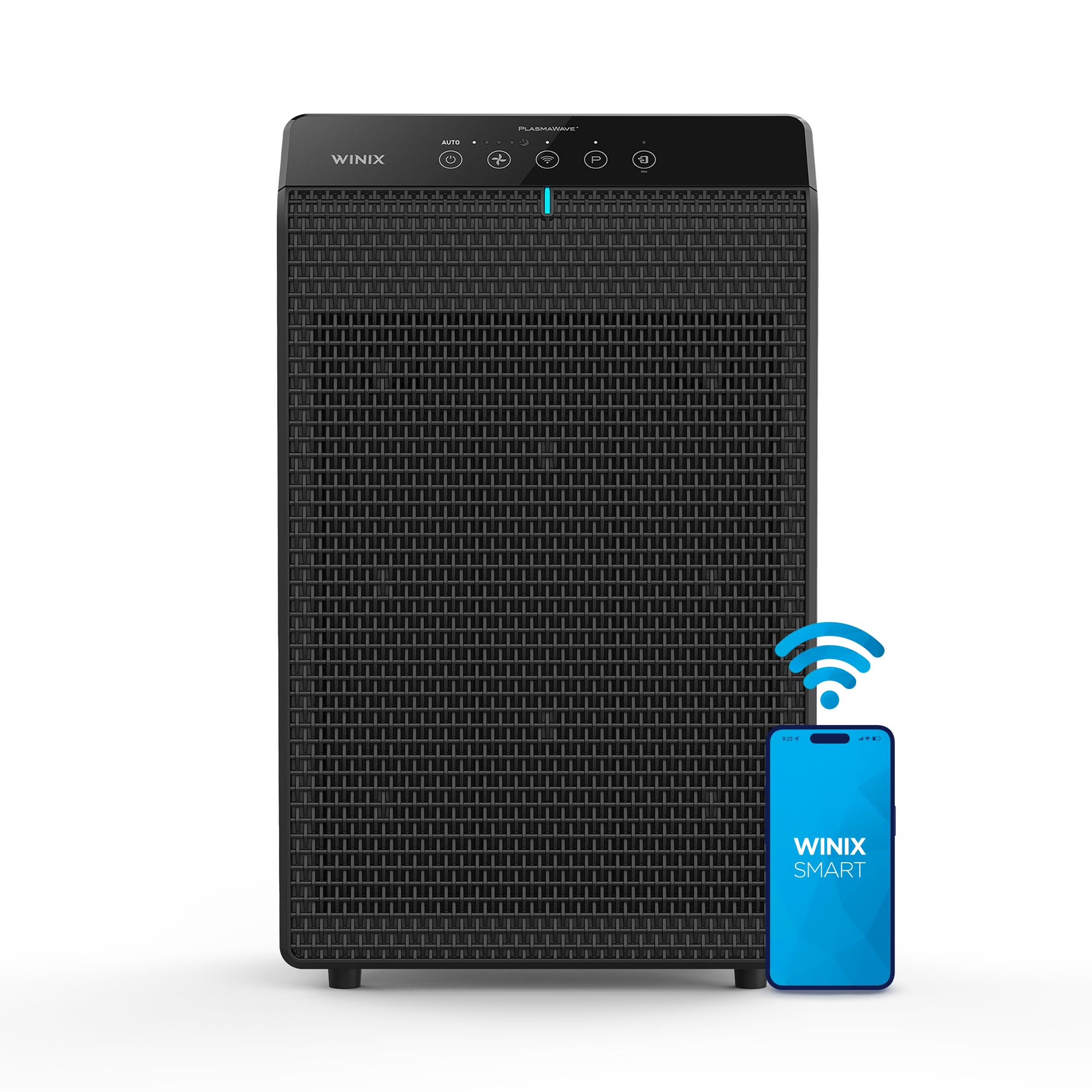
The WINIX 5520 carries an AHAM Verifide rating at 392 square feet—meaning that is the actual tested room size for four air changes per hour, not the inflated single-pass number some brands use. Its four-layer system combines a washable fine mesh pre-filter, an AOC carbon filter for odor and VOC reduction, a True HEPA filter that captures 99.99% of particles down to 0.01 microns, and a Plasmawave ionizer that can be toggled independently. Owners consistently report that the auto mode with its built-in air quality sensor detects cooking smoke and elevated dust within minutes and ramps fan speed accordingly.
The 13.3-pound cabinet houses a whisper-quiet sleep mode at 23.5 dB, and the unit automatically switches to that mode when the room darkens—no manual remote required. The magnetic front panel makes filter swaps tool-free, and replacement HEPA and carbon filters each cost roughly and last a full year. Some users note that the vertical side air intake openings could theoretically be blocked if the unit is pushed too close to a wall, so maintaining a six-inch clearance on all sides is advisable. The Winix Smart App and Alexa/Google Home integration provide remote monitoring without needing to walk to the unit.
Third-party reviewers who own Husky or Shiba Inu dogs report that the pre-filter catches visible hair accumulations within eight hours, and owners in wildfire-prone areas found the four-stage filtration dramatically reduced smoke odor indoors. The turbo mode measures approximately 60 dB—comparable to a window fan on high—so it is noticeable during conversation but tolerable for short cleaning bursts. For anyone needing verified CADR performance across a large living space with minimal ongoing maintenance friction, this configuration delivers.
Why we love it
- AHAM Verifide at 392 sq ft for real-world coverage.
- Washable pre-filter reduces main filter replacement frequency.
- Smart app and voice control add convenience.
- Ultra-quiet 23.5 dB sleep mode with light-based auto activation.
Good to know
- Side air intake requires proper clearance from walls.
- Turbo speed produces noticeable fan noise.
2. ECOSELF HAP603 Air Purifier
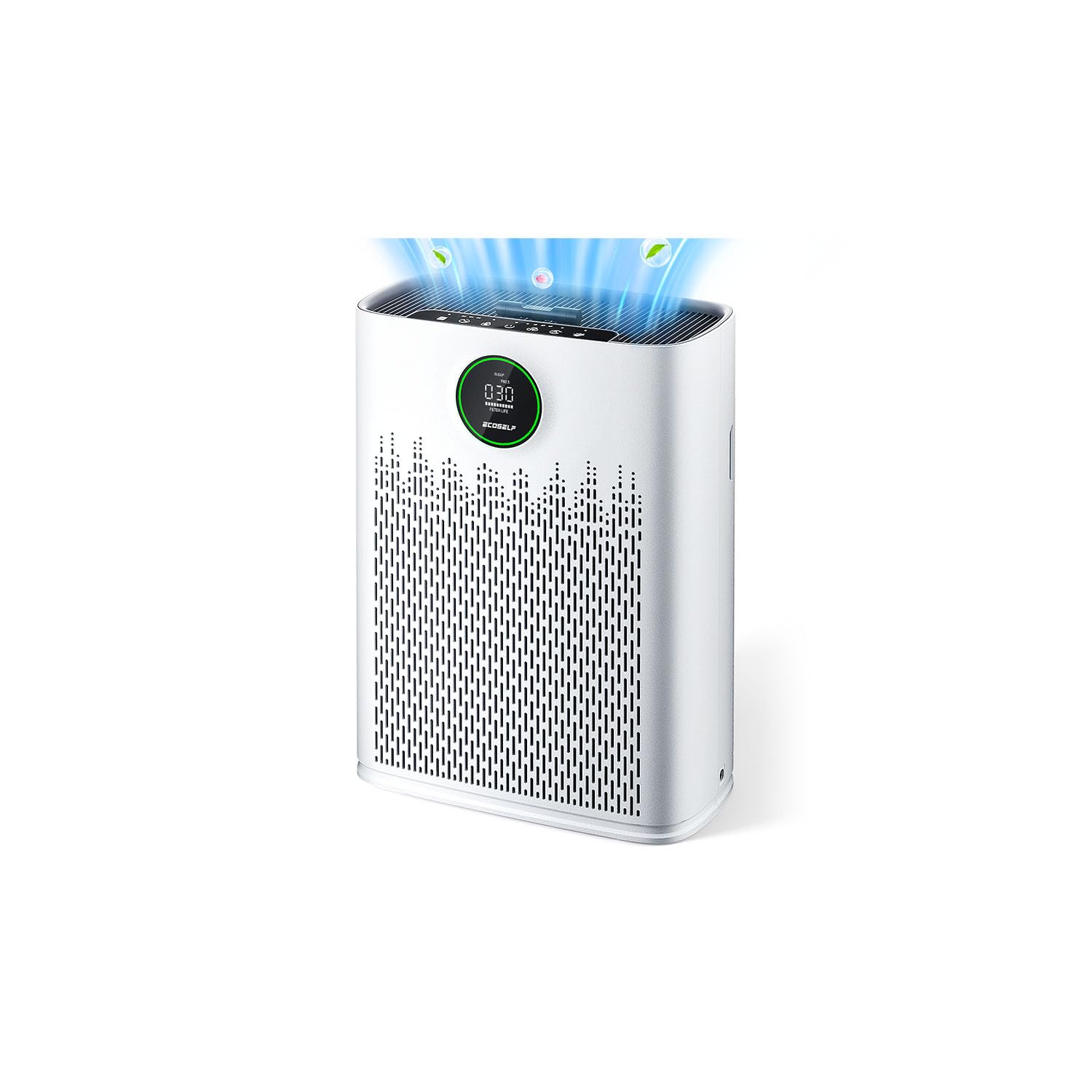
The ECOSELF HAP603 claims a coverage ceiling of 2400 square feet based on two air changes per hour, which suits open-concept floor plans or combined living-dining-kitchen areas where a single unit must cover wide spans. Its 2X-Power Filtration system uses dual-sided intake paired with a 360-degree air outlet to distribute cleaned air evenly, and the H13 True HEPA media traps 99.97% of particulates. The built-in infrared PM2.5 sensor feeds real-time readings to a numeric AQI display that changes color from green to yellow to red—giving immediate feedback as air quality shifts during cooking or when windows are opened.
Operation noise in sleep mode registers at a near-silent 22 dB, and the aromatherapy reservoir on the top panel accepts essential oils for those who want a subtle lavender or eucalyptus note during nighttime operation. Owners who ran the unit for three consecutive weeks reported noticeable reduction in sinus congestion and a general “crisper” smell in the home. The filter replacement indicator and child lock functions add practical layers, though the replacement filters from ECOSELF are proprietary, so long-term cost depends on their retail pricing. The 6.9-pound chassis is lighter than the category average, making it easy to relocate from bedroom to living area on a daily basis.
Some reviewers noted that while the 2400-square-foot single-pass coverage is accurate, achieving the full 2X filtration rate requires the unit to run on higher fan speeds that produce more noise. On auto mode the sensor tends to keep the fan at medium speed, which balances cleaning speed against comfort. The display brightness can be fully dimmed, a critical feature for bedroom placement. Given its coverage ceiling and the convenience of numeric PM2.5 feedback, this unit works best for large shared spaces where the user wants to monitor real-time particle counts.
Why we love it
- Numeric PM2.5 display offers precise air quality feedback.
- 22 dB sleep mode is genuinely silent.
- Aromatherapy function adds customizable scent.
- 360-degree outlet improves air distribution.
Good to know
- Proprietary filters lock you into the ECOSELF ecosystem.
- Full coverage requires higher fan speeds on larger spaces.
3. GermGuardian 4-in-1 AC4825E

The GermGuardian AC4825E has been on the market long enough to accumulate a dense history of owner experiences across allergy, asthma, and pet-owning households. Its True HEPA filter captures 99.97% of particles down to 0.1 microns, and the optional UV-C light adds a second disinfection stage for airborne bacteria, mold spores, and viruses. The unit covers a 153-square-foot room in 12.5 minutes and can cycle a 743-square-foot space once per hour, making it versatile for both sealed bedrooms and open living areas. The three-speed rotary dial and separate UV button are refreshingly simple—no app pairing required.
Multiple owners with asthma reported that after six months of continuous use, they experienced reduced dust accumulation on surfaces, fewer nighttime nasal congestion episodes, and elimination of cooking odors faster than with previous machines. The washable pre-filter captures larger hair and lint, prolonging the main HEPA element which lasts roughly eight to twelve months depending on usage. Replacement filters (model FLT4825) cost around and are widely available, and the UV-C bulb (model LB4000) needs replacement approximately once per year. The tower form factor occupies a 10.25 x 6.75-inch footprint, and the angled air discharge keeps the output stream from blasting directly onto nearby furniture.
The primary trade-off is noise: on high speed the AC4825E produces a noticeable whoosh that owners of smaller bedrooms described as too loud for sleep, though the low setting registers as gentle white noise. The UV-C light cannot be completely turned off by a separate switch—you must choose between UV on or UV off via the rotary control, so ambient light from the UV glow may bother some sleepers. For households that want a straight-ahead mechanical design with decades of field data and low filter maintenance costs, this tower delivers consistent results.
Why we love it
- Decades of real-world reliability across allergy households.
- UV-C light adds germicidal capability without ozone.
- Washable pre-filter extends main filter life.
- Simple rotary controls with no app required.
Good to know
- High speed noise may be disruptive for some bedrooms.
- UV light can’t be fully dimmed during sleep.
4. LEVOIT Core 300-P

The LEVOIT Core 300-P strikes a well-documented balance between room coverage and footprint, with AHAM Verifide CADR ratings of 143 CFM for smoke, 153 CFM for dust, and 167 CFM for pollen. That translates to 4.8 air changes per hour in a 222-square-foot room, and the 56-watt high-torque motor moves enough volume to refresh a 1,073-square-foot space once per hour. The 3-in-1 filtration stack includes a nylon pre-filter, a high-efficiency activated carbon layer for odor adsorption, and the main HEPA-grade media that captures 99.97% of airborne allergens down to 0.3 microns.
Owners consistently praise the QuietKEAP technology that drops noise to 24 dB in Sleep Mode, and the display-off function allows complete light blackout for sensitive sleepers. The timer offers 2/4/6/8-hour increments, and the filter replacement indicator eliminates guesswork. A notable feature is the LEVOIT replacement filter ecosystem—you can swap in the Toxin Absorber filter for enhanced VOC removal, the Smoke Remover filter for wildfire season, or the Pet Allergy filter for households with animals. That modularity lets you adjust the machine’s chemistry without buying a new unit.
Some reviewers mention that the Core 300-P is loud on its highest setting (speed 3), comparing it to a desktop fan on medium, but that low and medium speeds are genuinely quiet. A small number of users also noted that the filter life indicator is based on runtime rather than actual particle load, so it may prompt a change sooner than necessary in cleaner environments. The 7.9-pound weight and 8.7-inch diameter make it easy to relocate from bedroom to office. For anyone who wants AHAM-verified CADR with multiple filter chemistry options in a compact chassis, this is the benchmark.
Why we love it
- AHAM Verifide with specific smoke/dust/pollen CADR numbers.
- Multiple filter options for different air quality challenges.
- Near-silent 24 dB sleep mode.
- Compact footprint (8.7-inch diameter).
Good to know
- Maximum speed produces noticeable fan noise.
- Filter replacement indicator is based on runtime only.
5. LEVOIT Core 200S-P

The LEVOIT Core 200S-P is essentially a smart-enabled sibling of the Core 300-P, with the same 360-degree air intake and 3-in-1 filtration architecture but in a slightly smaller cabinet. It refreshes a 140-square-foot room 4.8 times per hour, and its AHAM Verifide certification confirms the CADR numbers are independently tested. The standout feature is built-in Wi-Fi compatibility with both Amazon Alexa and Google Assistant—you can ask your voice assistant to change fan speed, turn the unit off, or check filter life without touching the device.
The compact footprint (8.07 x 8.07 inches) fits easily on a nightstand or desk, and the weight is just 6.6 pounds. Owners report that the sleep mode drops noise to 27 dB—audible as a faint whine to some ears but generally considered near-silent. The display-off button kills all panel lights, which matters for nursery or bedroom use. The LEVOIT app provides remote scheduling and real-time air quality readings, though the Core 200S-P lacks the built-in particle sensor found on larger models; it does not measure PM2.5 directly and simply runs on the timer or schedule you set.
One owner with a dust-mite-allergic dog found that running the Core 200S-P 24/7 in a 200-square-foot camper eliminated the yeasty pet odor and noticeably reduced dust accumulation on surfaces. Another user who bought four LEVOIT units (mixing the Vital 200S-P, Core 200S-P, and Core Mini-P) for different room sizes reported that the “sunshine test”—observing airborne particles in a beam of sunlight—showed almost no visible dust after running the units for one week. The main caveat is that this model’s coverage is best for small to medium rooms under 200 square feet. For larger areas, step up to the Core 300-P or the Vital series.
Why we love it
- Alexa and Google Assistant voice control built in.
- AHAM Verifide certification for performance trust.
- Compact size fits bedside tables and small desks.
- Display-off button for zero light emission.
Good to know
- No built-in PM2.5 sensor—runs on schedule only.
- Best suited for rooms under 200 square feet.
6. HEAPETS P358 Pet Air Purifier

The HEAPETS P358 was engineered specifically for pet households, with a U-shaped air inlet and a static pre-filter designed to capture floating pet hair before it clogs the main HEPA element. The dual-sided intake system moves air from both sides simultaneously, delivering a CADR of 176 CFM (295 m³/h) and refreshing a 2,500-square-foot space once per hour. The multi-stage filtration includes a pet-formula activated carbon layer that adsorbs litter box odors, wet dog smell, and cooking fumes more aggressively than generic carbon sheets.
Owners of German Shepherds and Huskies reported that the pre-filter visibly caught large hair accumulations within the first week, and the PM2.5 numeric display confirmed single-pass cleaning of smoke in testing. The auto mode adjusts fan speed based on real-time particle readings, and pet mode applies a specific fan profile that maximizes hair capture while minimizing noise—measured at quiet levels by multiple users. The timer offers 2/4/6/8-hour options, and a pet lock prevents children or animals from changing settings. The 7.91-pound body is compact enough to fit on an end table.
Some users pointed out that the pre-filter is not washable; it must be replaced, though the main composite filter’s life extends to roughly six months thanks to the pre-filter stage. The manufacturer recommends vacuuming the pre-filter periodically to maintain airflow. A small number of reviews noted that the unit does not remove human hair that has already fallen to the floor, but that is true of all air purifiers since they capture airborne particles, not settled debris. For owners fighting pet dander, urine odors, and airborne fur, this specialized design reduces the maintenance burden compared to general-purpose purifiers.
Why we love it
- Pet-specific U-shaped inlet prevents hair clogging.
- PM2.5 numeric display for real-time feedback.
- Pet mode profile optimizes hair capture.
- Dual-sided intake for faster air turnover.
Good to know
- Pre-filter is not washable—requires periodic replacement.
- Does not capture settled floor hair, only airborne particles.
7. VEWIOR ClearAir-A12 (2-Pack)
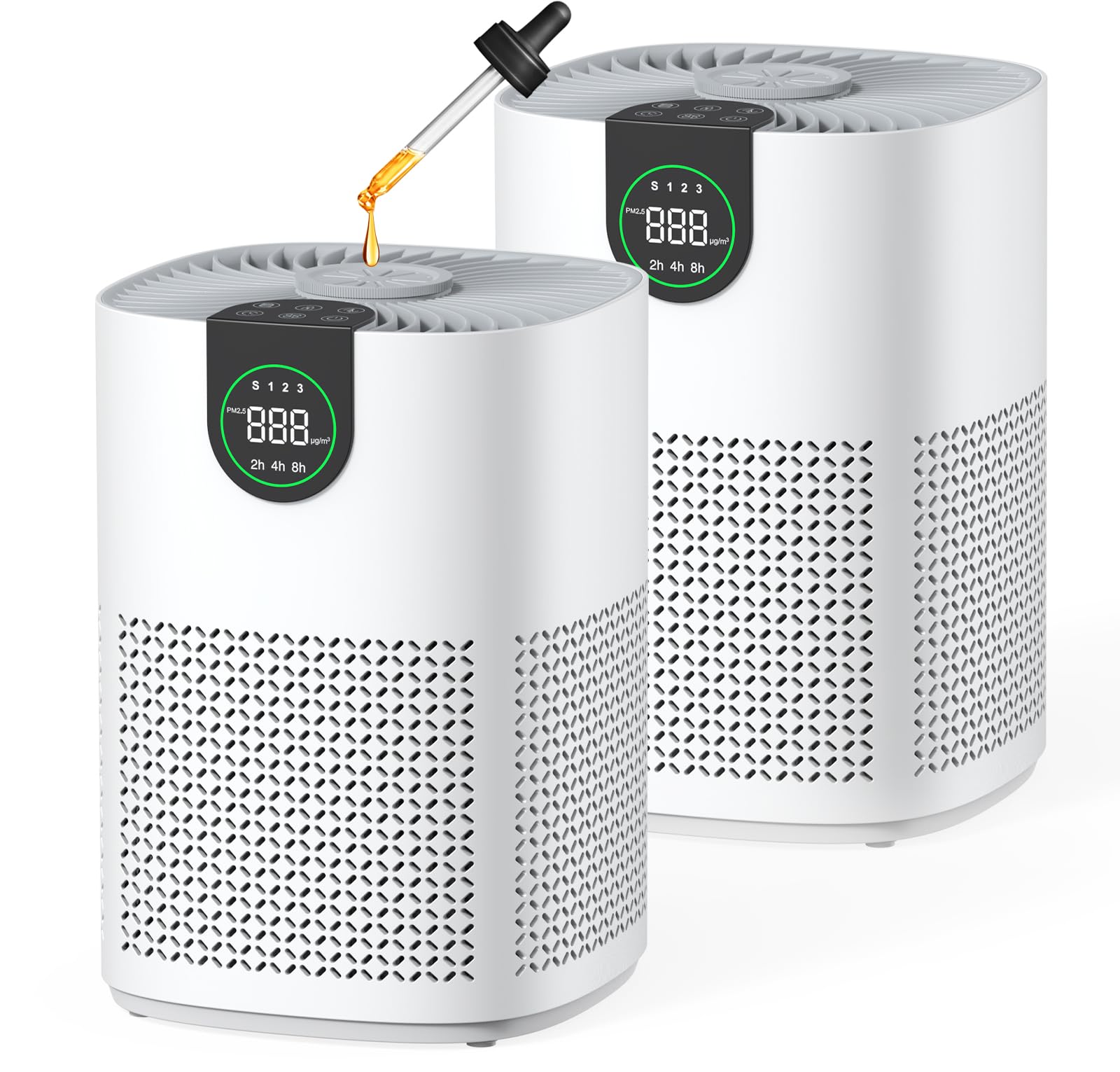
The VEWIOR ClearAir-A12 arrives as a 2-pack, making it the most economical entry for households needing coverage in two separate rooms or one large open space up to 1,200 square feet per unit. Each unit uses H13 HEPA media—stricter than standard True HEPA—and a 360-degree air intake design that cycles the room air five times per hour at the rated coverage level. The 3-stage filtration system (washable pre-filter, HEPA, activated carbon) claims to capture 99.97% of airborne contaminants including smoke, PM2.5, pet hair, and odors.
The washable filter is a real cost saver: vacuum or rinse the pre-filter and HEPA element, and you avoid the -40 replacement cost every few months that most competitors require. The unit features a built-in PM2.5 sensor with a color-coded air quality display (red/yellow/green), auto mode that adjusts fan speed based on real-time readings, and a sleep mode that drops operation to a claimed 15 dB—among the quietest in this comparison. The 4.4-pound weight per unit means they can be moved from bedroom to kitchen without effort, and the child lock prevents accidental setting changes.
Multiple owners confirmed that the 2-pack eliminated cooking odors and pet smells in a combined living-dining area of roughly 1,200 square feet, and one user reported noticeable air quality improvement within two hours on the higher speed setting. The aromatherapy pad on top allows essential oil diffusion, though the scent duration is limited. Some reviewers noted that the higher fan speeds produce noticeable noise—similar to a desktop fan—and that the build quality feels lighter than premium competitors. For buyers on a tight budget who want H13 filtration across two zones, this package delivers the lowest absolute entry cost with serviceable ongoing filter expenses.
Why we love it
- 2-pack covers multiple rooms at a low entry cost.
- Washable H13 HEPA filter reduces long-term consumable expenses.
- 15 dB sleep mode is among the quietest available.
- Built-in PM2.5 sensor with auto mode.
Good to know
- Build quality feels lighter than premium competitors.
- High speeds produce noticeable fan noise.
FAQ
How often should I replace a True HEPA filter?
What does CADR mean in real terms?
Can an air purifier handle pet hair that’s already on the floor?
Is a air purifier better than a model?
Final Thoughts: The Verdict
For most households, the best air purifier winner is the WINIX 5520 because it delivers AHAM-verified CADR at a realistic 392 square feet with four-stage filtration, a washable pre-filter, and an auto sleep mode that requires zero manual intervention. If you want smart voice control and a tiny footprint for bedside table use, grab the LEVOIT Core 200S-P. And for pet-heavy homes fighting airborne dander and litter box odors, nothing beats the specialized U-shaped inlet and pet-formula carbon of the HEAPETS P358.