
A sled dog’s paw hits packed snow at a full gallop — the boot has to absorb shock, shed ice, and stay clamped through every stride or the dog pulls up lame. The difference between a boot that spins off in the first mile and one that locks around the metacarpal for an entire run comes down to closure engineering, outsole lug pattern, and gaiter height. This guide breaks down exactly which builds survive the trail and which designs fail when the temperature drops and the miles stack up.
I’m Mo Mahin — the founder and writer behind Furric. I’ve spent months cross-referencing sole abrasion ratings, gaiter closure mechanisms, and real owner feedback from mushers and winter trail runners who push these boots through extreme cold, deep snow, and abrasive ice.
Whether you are kenneling a team that logs daily miles or protecting a single dog on a backcountry ski trip, this breakdown of the best boots for sled dogs isolates the designs that actually hold up to cold, ice, and repetitive impact without slipping off mid-stride.
How To Choose The Best Boots For Sled Dogs
Selecting sled dog boots is not about finding the softest material or the best color — it is about matching closure security, outsole grip, and gaiter height to the specific traction and debris conditions of your trail. A boot that works for a casual sidewalk walk may fail catastrophically on a snowy race course.
Gaiter Height and Closure Type
The single most common failure point on trail is a boot that rotates and slips off. For sled dogs, the boot must extend well above the carpal pad and lock around the narrow part of the leg above the paw. Look for designs with a stretch gaiter plus a secondary cinch — either a zippered closure or a dual-strap hook-and-loop system with a toggle. A boot that only uses a single elastic band or one low strap will spin free inside 100 yards of hard pulling.
Outsole Rubber and Lug Pattern for Ice
Standard rubber outsoles lose grip on packed snow and turn dangerous on exposed ice. For sled work, the outsole should use a low-temperature compound that stays flexible below freezing — look for Vibram Icetrek or a similar winter-specific rubber. The lug pattern should be multi-directional with deeper channels to shed snow and expose fresh rubber on each stride. Flat soles with shallow tread are unsafe for any dog running on hardpack or icy trail sections.
Insulation vs. Moisture Management
A sled dog running at sustained effort generates significant heat and moisture from the paw pads. Boots that are heavily insulated but lack breathability trap sweat, which then freezes between the boot liner and the paw. Choose boots with a breathable softshell or mesh upper paired with a waterproof membrane — fleece lining is fine for the rear paw that sees less impact, but the front feet benefit from less insulation and more ventilation to prevent ice ball formation between the toes.
Sold in Pairs (Not Sets of Four)
Front paws are almost always wider than rear paws on sled dogs — especially in breeds like the Siberian Husky or Alaskan Malamute. A boot that fits the front will be too loose on the rear, causing spin and loss. Select a brand that sells boots in individual pairs so you can size front and rear separately. This single adjustment dramatically reduces boot loss rates on long runs.
Quick Comparison
On smaller screens, swipe sideways to see the full table.
| Model | Category | Best For | Key Spec | Amazon |
|---|---|---|---|---|
| Ruffwear Polar Trex | Premium | Extreme cold, ice, deep snow | Vibram Icetrek outsole, zippered gaiter | Amazon |
| Spark Paws Rainboots | Premium | Wet snow, rain, mixed terrain | Velcro + toggle lock closure, fleece lining | Amazon |
| DcOaGt Mesh Boots | Mid-Range | Mud, gravel, moderate snow | 360° anti-slip opening, velcro straps | Amazon |
| BoxxBerk Winter Boots | Mid-Range | Rain, mud, snow, indoor grip | Fleece lining, waterproof fabric upper | Amazon |
| Ruffwear Summit Trex | Mid-Range | All-season trail, mixed terrain | Ripstop upper, PFAS-free water repellent | Amazon |
| SlowTon Mesh Boots | Value | Hot pavement, light snow, wound care | Three-layer mesh, space leather toe cap | Amazon |
| LUCKYPAW Boots | Value | Hot/cold pavement, short walks | Ultra-mesh upper, reflective dual straps | Amazon |
In‑Depth Reviews
1. Ruffwear Polar Trex Dog Boots

The Polar Trex is the single best option for serious cold-weather trail work. It pairs a Vibram Icetrek outsole — a compound specifically formulated to stay flexible and grip on ice below 0°F — with an insulated soft-shell upper that traps heat without trapping sweat. The winter-specific lug pattern uses deeper, multi-directional channels to shed packed snow and expose fresh rubber on every stride, making it the only boot in this roundup that can be trusted on glare ice at speed.
The defining feature for sled dog use is the pullover stretch gaiter with a zippered closure. Unlike hook-and-loop systems that can clog with ice or lose hold in freezing moisture, the zipper creates a mechanical lock around the leg that does not loosen during repetitive impact. Owners report that taking the time to fully zip the outer layer over the strap eliminates boot loss even on dogs that kick aggressively. Sold in pairs so you can independently size front and rear paws — critical for sled dog teams where front feet run wider.
A few owners note the gaiter opening is tight, and dogs with particularly thick wrists may require a sock liner to slide in smoothly. The price point sits at the premium end, and the polar-specific insulation may be excessive for dogs running in moderate winters or for rear paws that produce less heat. But for sub-zero trail conditions or packed ice tracks, no other boot on this list matches the grip or retention reliability.
Why we love it
- Vibram Icetrek outsole delivers unmatched grip on pure ice and hardpack snow.
- Zippered gaiter provides mechanical closure that ice and snow cannot defeat.
- Insulated but breathable upper prevents frozen sweat between toes.
- Sold in pairs for independent front/rear sizing.
Good to know
- Gaiter opening is narrow; sock liner may be required for thick-legged dogs.
- Insulation is best for extreme cold — may overheat dogs running in mild winter temps.
- Zipper adds time to boot removal at rest stops.
2. Spark Paws Dog Rainboots
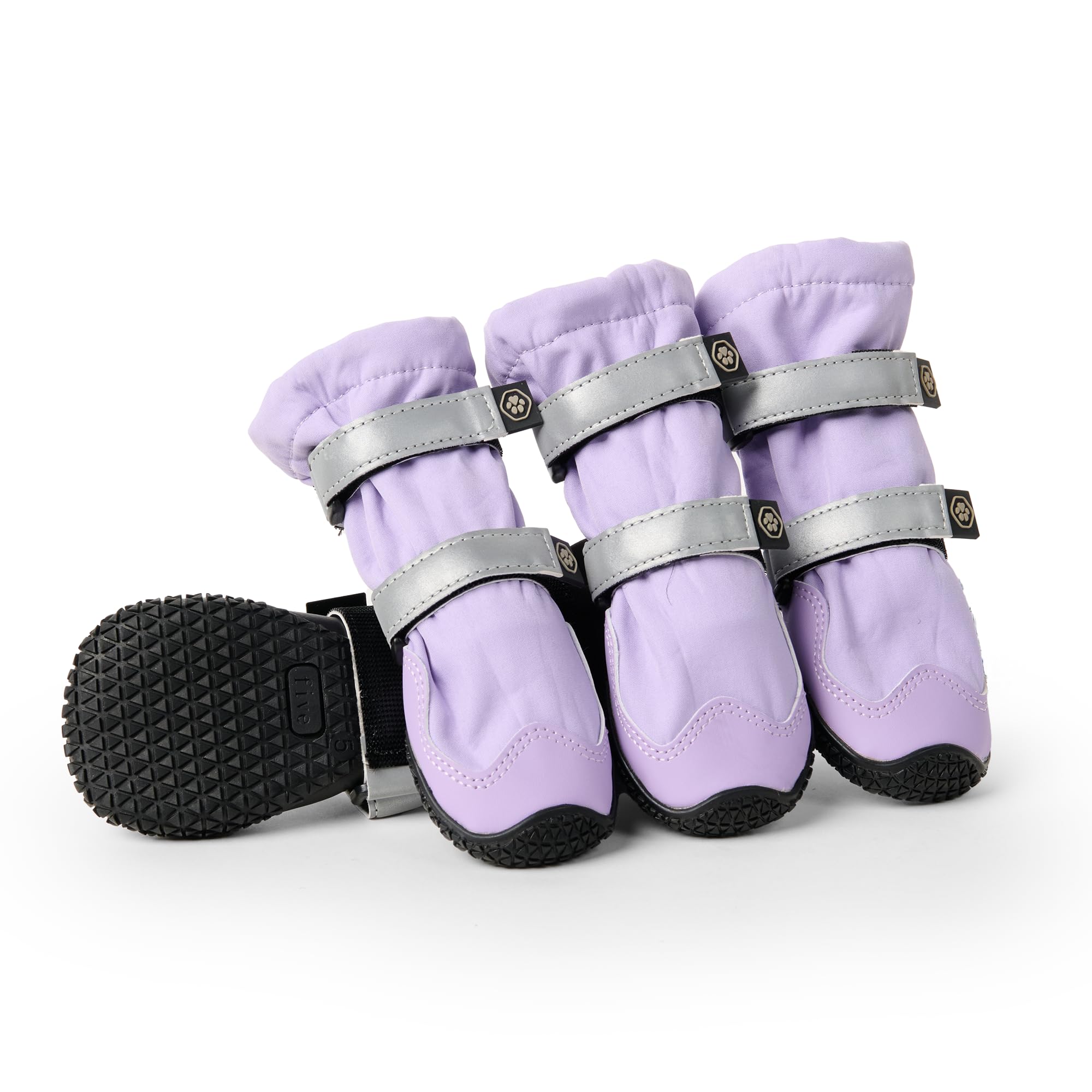
The Spark Paws boot addresses the two most common failure points in sled dog footwear — closure security and waterproof integrity — by combining dual Velcro straps with a toggle lock that cinches the gaiter tight around the narrow leg above the carpal pad. This dual-closure architecture prevents the boot from rotating or sliding off even when the dog hits full-speed zoomies on wet snow. The fleece lining adds a warm, dry layer that also helps wick moisture from the foot during active running.
The outsole uses a soft rubber compound with a moderate tread pattern that provides reliable grip on wet pavement, packed snow, and indoor hardwood floors. Owners report that the toggle lock, when properly cinched, creates a significantly more secure fit than Velcro-only boots. The reflective straps and stitching enhance visibility during early-morning or dusk runs — a practical safety feature for teams working near roads or crossing trails at low light. The boots are machine-washable, which is useful for drying between runs on multi-day expeditions.
The primary downside reported by owners of high-activity dogs is that the top elastic band is thin and can lose tension over months of use. One owner noted that the lower Velcro strap can hit the paw pad awkwardly on dogs with particularly short legs. The toggle lock adds a step to the boot-on process, which matters when booting up a full team of six or eight dogs. However, for owners who prioritize stay-put performance over quick application, the Spark Paws boot delivers reliable all-weather protection.
Why we love it
- Toggle lock plus dual Velcro straps provide exceptional closure security.
- Fleece lining keeps paws warm and aids moisture wicking during active running.
- Machine-washable for easy cleaning and drying between uses.
- Reflective straps improve team visibility in low-light trail conditions.
Good to know
- Top elastic band may lose tension after extended use on very active dogs.
- Lower Velcro strap can be awkward on dogs with short legs.
- Some owners report boots coming off if not cinched very tight.
3. DcOaGt Mesh Dog Shoes

The DcOaGt boot brings a feature rarely seen at its price point: a 360° anti-slip internal lining at the gaiter opening that actively resists the boot rotating around the leg. For sled dogs, this is a significant advantage because the twisting force generated by a pulling dog at speed is exactly what causes standard boots to migrate into an inverted position. The dual Velcro straps work with this liner to create a secure anchor point above the carpal pad, and the space leather toe cap provides a durable barrier against rock and gravel abrasion on trail edges.
The upper body uses a tightly woven air mesh that balances breathability with debris exclusion — important for dogs running through light snow, sand, or fine gravel that can infiltrate looser weaves. The outsole rubber is soft and pliable, which provides good grip on wet floors and moderate trails, though it is not designed for extreme cold where rubber stiffens. The boots are available in sizes up to paw widths of 3.2 to 3.3 inches, which accommodates the wide feet common in large sled dog breeds.
Several owners of large-breed dogs report that the top Velcro strap can be too loose for dogs with very thick legs or unusual metacarpal anatomy — a common issue with one-size-fits-all gaiter designs. The boots also tend to work best when paired with a thin sock to fill the gap between paw and fabric. The mesh upper is not fully waterproof, so extended runs through slush or wet snow will result in moisture ingress. For dry, cold trails and gravel paths, however, the anti-slip liner makes it a standout value.
Why we love it
- 360° anti-slip liner resists boot rotation at speed.
- Available in sizes up to 3.3-inch paw width for large sled dogs.
- Breathable mesh reduces moisture buildup during active running.
- Machine-washable construction simplifies trail maintenance.
Good to know
- Top Velcro strap may be too short for very thick-legged dogs.
- Mesh upper is water-resistant but not fully waterproof.
- Some dogs require sock liner to prevent boot from slipping.
4. BoxxBerk Winter Dog Boots

The BoxxBerk boot is built around a simple but effective premise: a fully waterproof fabric upper paired with a warm fleece lining that keeps the paw dry and insulated in rain, mud, and wet snow. The high-quality waterproof fabric resists the slushy conditions that cause mesh-clad boots to fail, and the fleece lining absorbs limited moisture without feeling clammy against the paw pad. The rubber outsole uses a soft, flexible compound that conforms to the paw shape and delivers strong traction on wet pavement, tile, and packed snow.
The dual Velcro straps are designed with a wide opening that makes the boots easier to slide on than gaiter-style models — a real time-saver when booting up multiple dogs. Owners of breeds with thick dewclaws report that the soft rubber material does not rub or create friction points, unlike stiffer sole constructions. The reflective strips embedded in the fabric provide solid night visibility.
The main limitation is the gaiter height. Owners of deep-chested dogs like Boxadors report that the ankle coverage could be an inch or two taller to prevent the boot from working loose on the front paws during active running. Sizing is also critical — ordering one size too large causes the boot to twist and chafe, while going too small leads to slippage. The fleece lining, while warm, can trap moisture during high-output runs in mild temperatures. These are best suited for wet, cold conditions rather than dry, abrasive trails.
Why we love it
- Fully waterproof fabric upper keeps paws dry in slush and rain.
- Fleece lining provides warmth and moderate moisture absorption.
- Soft rubber outsole resists punctures and conforms to paw shape.
- Wide opening design speeds up booting for multi-dog teams.
Good to know
- Gaiter height may be insufficient for deep-chested breeds.
- Fleece lining can trap moisture during high-output running.
- Precise sizing is critical — incorrect size leads to twisting or slipping.
5. Ruffwear Summit Trex Dog Shoes

The Summit Trex is Ruffwear’s all-season alternative to the polar-focused Polar Trex, using a 150 denier polyester ripstop upper with a PFAS-free water repellent finish that sheds light moisture and blocks debris. The outsole uses a grippy, non-marking rubber compound that performs well on pavement, rocky trails, and packed dirt — though it lacks the winter-specific cold-weather grip of the Vibram Icetrek. For sled dogs running on mixed terrain without extreme ice, this boot provides a lighter, more flexible option that does not overheat the paw.
The closure system combines a reinforced YKK hydrophobic hook-and-loop strap with reflective webbing and an improved cuff that locks around the leg with less bulk than the Polar Trex. The boot is sold in pairs, allowing front and rear independent sizing, and is available in a 2.75-inch size that fits the medium-to-large paw widths common in working sled dogs. The engineered mesh panels allow the shoe to breathe while blocking dust and grit, which reduces post-run cleanup and keeps the paw cooler during sustained effort.
The outsole is notably thinner than the Polar Trex, which reduces its performance on sharp ice or abrasive frozen crust. One owner reported the boot falling off within a minute of walking despite correct sizing — a failure mode that suggests the Velcro closure may not be sufficient for dogs with particularly narrow heels or those that kick aggressively. The water repellent finish works for dew and light moisture but does not hold up in standing water or deep snow. The Summit Trex is best deployed as a warm-weather or mixed-trail boot for dogs that do not require polar-grade insulation.
Why we love it
- Ripstop upper resists punctures and abrasion on mixed terrain.
- Breathable mesh panels reduce overheating during active running.
- YKK hydrophobic hook-and-loop closure performs well in light moisture.
- Sold in pairs for independent front/rear sizing.
Good to know
- Outsole lacks winter-specific grip for icy conditions.
- Water repellent finish is not suitable for deep snow or standing water.
- Velcro closure may fail on dogs with narrow heels or aggressive kicking.
6. SlowTon Dog Shoes

The SlowTon boot uses a three-layer mesh construction that prioritizes breathability and lightweight comfort over heavy-duty insulation. The toe cap is made from space leather — a synthetic material that provides durable waterproofing at the front of the boot where impact with snow and ice is most frequent. The outsole is a soft rubber that offers good traction on wet pavement, indoor floors, and packed trail surfaces, though the tread pattern is shallow and does not bite into hardpack snow or ice as effectively as deeper lugs.
The dual nylon straps with hook-and-loop fasteners are fully adjustable and include reflective material for night visibility. Owners of dogs with compulsive licking disorders report that these boots work effectively as wound recovery covers because the mesh breathes well enough to prevent maceration while the straps stay secure during light movement. Sizing is based on paw width, and the manufacturer offers nine size options, which improves the chance of a correct fit for unusually proportioned sled dog paws. One owner of a 67-pound Standard Poodle confirmed that size 6 fit well and stayed on during initial walks.
The primary functional limitation is that the boot is not fully waterproof — multiple owners report that paws become wet after walking on dew-covered grass or through shallow puddles. The mesh upper allows water ingress through the side walls, which makes these boots unsuitable for sustained use in wet snow or slush. The single- layer Velcro strap, while easy to adjust, provides less holding force than dual-strap or toggle-closure designs. For dry trail walks, hot pavement protection, or wound recovery, the SlowTon offers a low-cost entry point with decent build quality.
Why we love it
- Three-layer mesh provides excellent breathability for active dogs.
- Space leather toe cap adds waterproof durability at impact points.
- Nine size options improve fit accuracy for diverse paw shapes.
- Effective as wound recovery boots for dogs with licking disorders.
Good to know
- Mesh upper is not waterproof — paws get wet in dew and slush.
- Shallow tread provides limited grip on hardpack snow or ice.
- Single Velcro strap may not hold for dogs with aggressive kicking.
7. LUCKYPAW Dog Boots
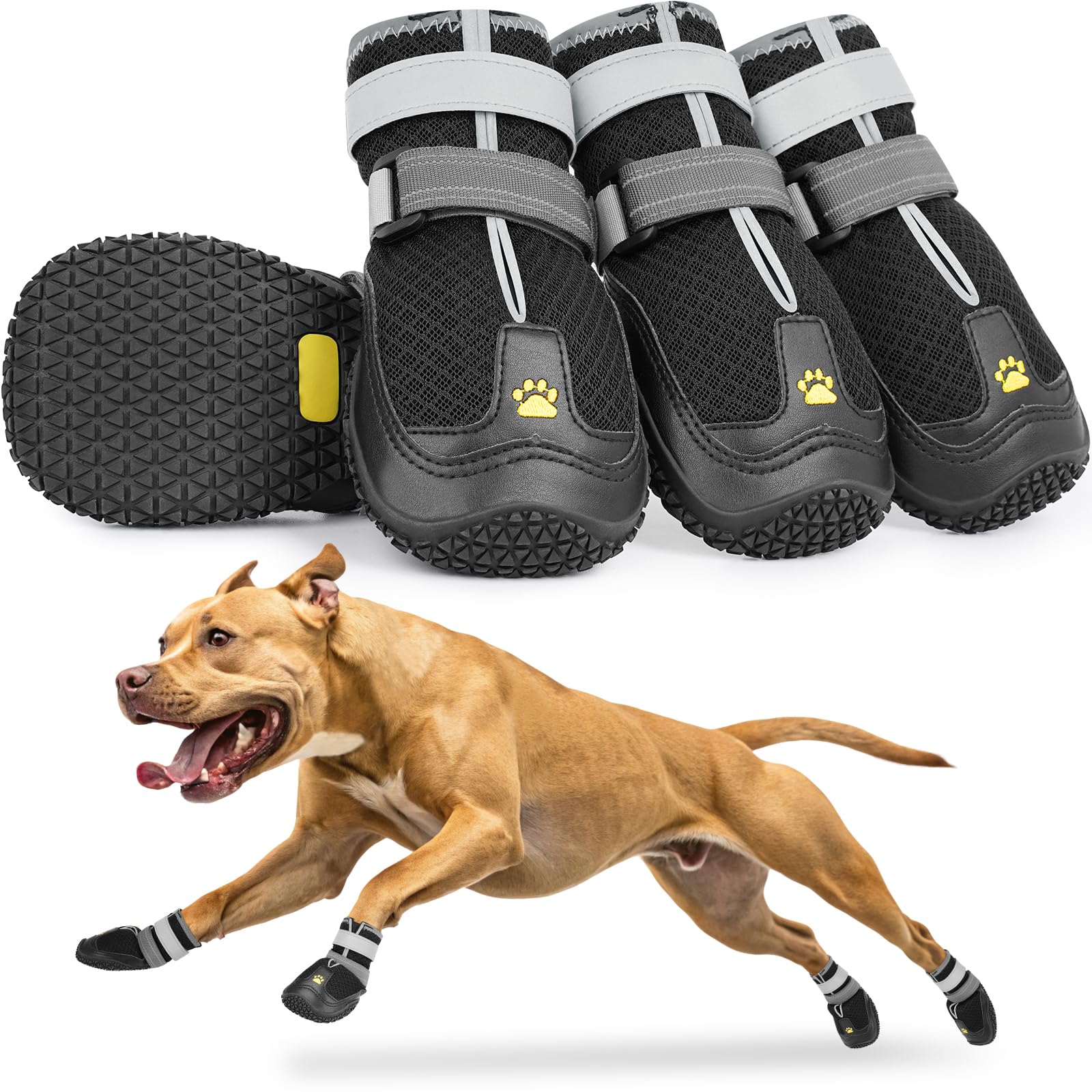
The LUCKYPAW boot uses an ultra-mesh upper designed specifically for temperature regulation — the fabric is highly breathable to prevent paw overheating on hot pavement, which makes it a good option for summer trail use rather than deep winter sledding. The dual reflective straps provide a secure fit when properly fastened, and the 360° anti-slip inner lining helps prevent rotation. The outsole uses a flexible rubber compound with moderate tread patterns that offer solid grip on hot asphalt, tile, and smooth trail surfaces.
Owners of large-breed dogs like Saint Bernards report that the boot fits wide paws well, with the two ankle wraps staying in place even in deep snow. The rubber toe guard adds a layer of protection against sharp rocks and glass, and the reflective built-in elements improve visibility during low-light walks. The boots are lightweight enough that dogs accept them quickly — one owner noted their Springer Spaniel adapted within a few attempts and that the traction helped heal a paw injury faster by keeping the paw clean and dry during recovery.
The boot is explicitly not waterproof — the manufacturer states that the breathable mesh upper may allow water to seep through in heavy blizzards, deep snow, or wet grass. The outsole also lacks deep lugs, which means grip on sheer ice is inadequate for sled dog work at speed. The top fabric can shred if a dog chews on it, and some owners report that the boots can work loose without socks to fill internal dead space. For casual walks on hot or cold pavement, this boot provides functional protection at a budget-friendly entry price.
Why we love it
- Ultra-breathable mesh prevents paw overheating on warm pavement.
- Reflective dual straps improve night visibility for trail safety.
- Wide fit accommodates large-breed paws with thick dewclaws.
- Lightweight construction helps dogs accept boots quickly.
Good to know
- Not waterproof — mesh allows moisture ingress in wet conditions.
- Shallow tread provides inadequate grip on ice for sled work.
- Top fabric can shred if dog chews on boot during downtime.
FAQ
How tight should sled dog boots be around the leg?
Can I use the same boot size for all four paws on a sled dog?
What outsole material is safest for sled dogs on ice?
How do I prevent ice balls from forming inside the boot?
How many miles should a sled dog boot last before replacement?
Final Thoughts: The Verdict
For most mushers and winter trail runners, the best boots for sled dogs winner is the Ruffwear Polar Trex because the Vibram Icetrek outsole and zippered gaiter provide unmatched ice grip and retention security in the sub-zero conditions sled dogs actually run in. If you want a boot that balances wet-weather waterproofing with toggle-lock closure security, grab the Spark Paws Rainboots. And for a mid-range option that resists rotation with a 360° anti-slip liner, the DcOaGt Mesh Boot delivers reliable performance on dry, cold trails without the premium price tag.